
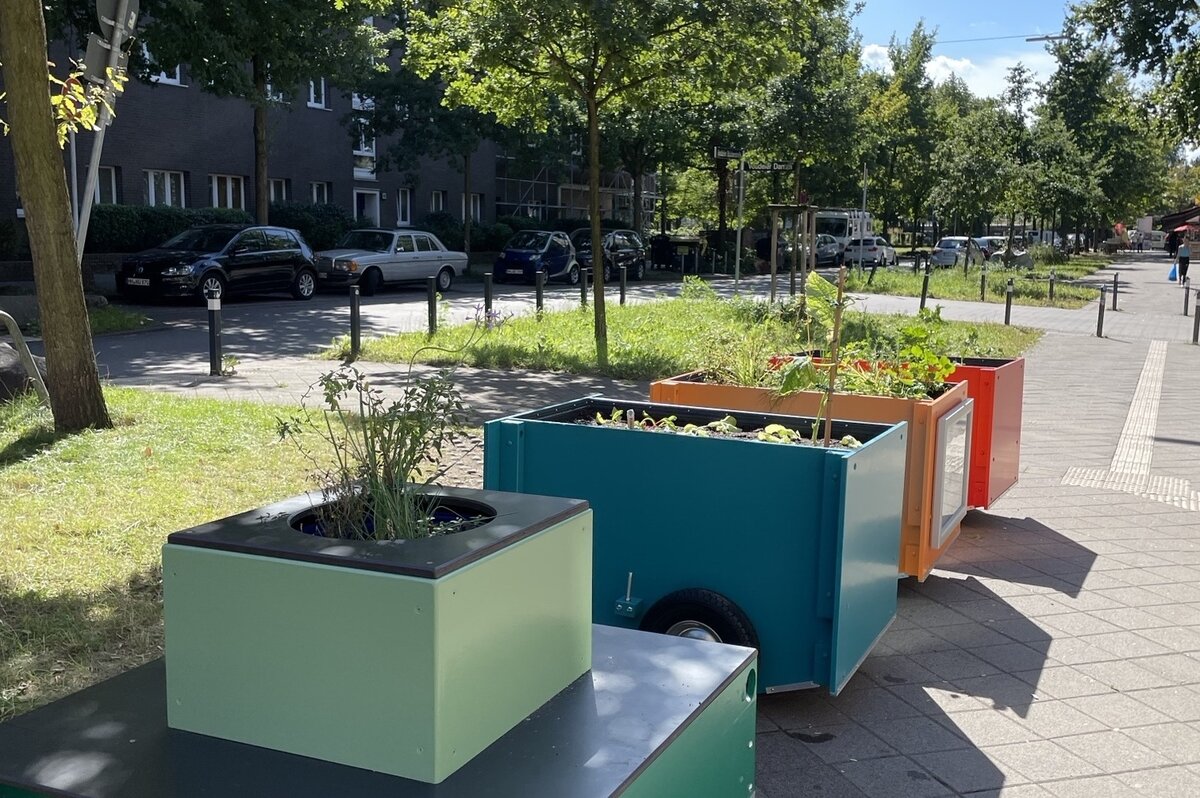
: What are Wandergärten, Mrs. Wilhelm?
Emilia Wilhelm: They are raised beds that travel through the city. The idea is inspired by the wandering tree avenues from southern Germany. There are trees in raised beds that can be moved, and thus they can wander through the city and make it greener.
: Why is it important that the garden moves?
Wilhelm: It should bring greenery into the city districts where nature is lacking. That’s why the raised beds are on wheels. They should move to as many locations as possible, but also send a signal to the districts and to politics: the neighborhood here is happy about more nature. We want to be a small nudge for further sustainability and nature projects — that’s why we also support the neighborhoods and the districts after the garden has moved on.
: Green space seems to be missing especially in the poorer city districts.
Wilhelm: I find it hard to stamp such a label on the neighborhoods from the outset. But we selectively choose districts that offer relatively little contact with nature and where there is a need for low-threshold environmental education offerings. And here we want to be bridge builders. We started on the Veddel and are now in Wilhelmsburg. There is Insel Park, but it is further south and not easily reachable from here. In other districts, children automatically experience much more nature.
In the interview: Emilia Wilhelm
29, is the project manager of the Hamburg Wandergarten, a joint project of the WAS TUN! Foundation and the Loki Schmidt Foundation.
: How does open gardening work?
Wilhelm: On the Veddel there was a strong need for gardening and for a community project. We quickly formed a group that came at a fixed time, planted flowers, watered, and maintained them. Open gardening is basically a very free offering; you can stay five minutes or an hour. Now in Wilhelmsburg we notice that people come more occasionally, to look at the beds or to sample the herbs. But with open gardening, they are not as actively involved. However the initiatives, day-care centers, and schools are at the forefront in booking environmental education workshops — that was somewhat more limited on the Veddel.
: How free are people when gardening – can you plant anything there?
Wilhelm: The nice thing is that we have both vegetables and wild perennials and herbs in the beds. That means there is something for every passion. What we specify is a standard and a focus on biodiversity and nature conservation. Therefore we do not plant geraniums in our raised beds.
: Who comes to garden?
Wilhelm: At the beds, a very diverse mix of people came together, which was really exciting: a retired couple, a goldsmith, a 3D designer, and a two-year-old child with his father. It ranges from people with master’s degrees to people without formal training, immigrants, people born in Germany. And we were welcomed with open arms.
The Project
Joint Gardening, Harvesting, and Chatting on Oct. 9, 16, 23, 30, and Nov. 6 at 4:00 PM in Veringstraße 43/45, 21107 Hamburg
: How did this concretely show itself?
Wilhelm: When we stood at the beds, people would pass by and say how beautiful they found it and how nice it is that nature is here and that it makes the neighborhood more colorful. Even people who don’t engage much with environmental and nature topics and who don’t like to garden themselves appreciated it — for example by sitting on the seating beds.
: What remains in the Veddel after the garden has moved on?
Wilhelm: That also depends on what the neighborhood wants. Our idea is not to keep the raised beds at all costs. Sometimes a green-space sponsorship may arise or a tree pit may be planted. But on the Veddel we noticed that these colorful raised beds were much loved and are now greatly missed. We were directly offered to collect signatures for it. Now we are trying to make the beds there permanent.
Comments are closed.