
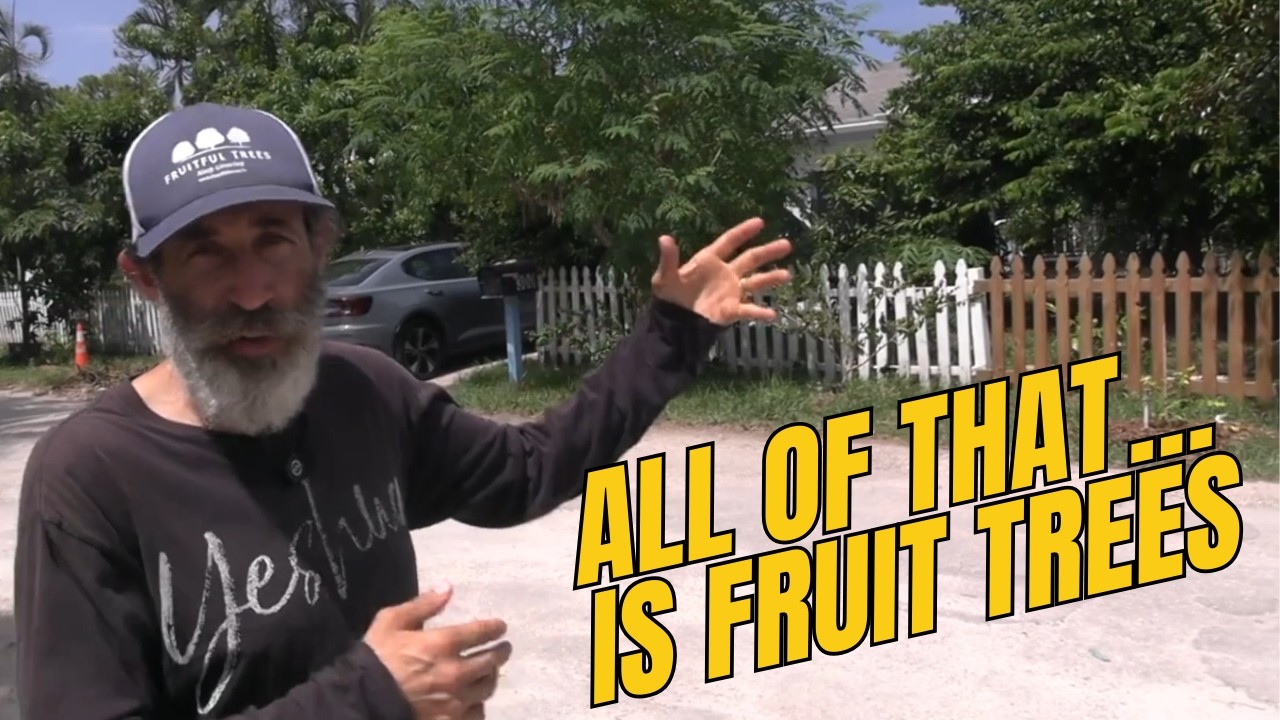
John from http://www.growingyourgreens.com/ visits Paul in South Florida, who grows over 100 fruit trees on a small 1/4 acre lot.
In this episode, you’ll learn how Paul maximizes space by planting trees close together, grafting better varieties, and even growing on his neighbor’s yard.
Discover the top tropical fruits for South Florida, how to harvest avocados for 9 months a year, and which trees are worth skipping. Plus, Paul shares his watering tips, pest solutions, and why he doesn’t grow bananas or vines.
Finally, John sits down with Paul to talk about his goals, growing philosophy, and why he doesn’t bother with bananas or vines — plus his top tips for growing fruit successfully in South Florida.
Jump to the following parts of this episode:
00:00 Let’s Get Started
00:20 Why Fruitful Trees is Different
02:10 Get Fresh Tropical Fruit Shipped
03:00 Touring Paul’s Backyard Food Forest
03:20 His Purpose Behind Growing Fruit
04:00 Easiest Fruit Trees for South Florida
05:40 Can You Plant Trees Close Together?
06:43 Growing on His Neighbor’s Property
08:25 Best Spot for Coconut Palms
09:18 Rare Black Surinam Cherry Planting
10:10 The Most Valuable Tree in the Yard
11:15 Sapodilla: Year-Round Fruit Source
12:30 Compact Mango Tree with Big Yields
13:43 The Most Underrated Tropical Tree
15:20 This Fruit Can Be Toxic in Large Amounts
17:14 Star Apple: Another Hidden Gem
18:10 Avocados That Fruit All Year
18:45 Unique Persimmon for the Tropics
20:10 How Paul Waters His Trees
20:30 Jujube: Tropical Apple Alternative
21:40 The Avocado Paul Recommends
22:11 What Is Tree Top Working?
22:45 Why He Loves Sapodilla
23:55 A Tree That Grows Fast — And Can Kill
26:30 Will Fruit Trees Work In Your Yard?
27:30 Cassava: Cook Before You Eat
28:16 Simple Tip to Protect Tree Trunks
28:45 Grafting a Better Mango Variety
30:35 Seed vs Graft: What Fruits Faster?
31:20 Why You Should Grow Miracle Fruit
32:40 Tasting Fruit After Miracle Berry
33:10 Benefits of Seedling Jackfruit
34:04 Planting a Malabar Chestnut
35:15 Don’t Grow This If You’re Low on Space
35:44 A Mango Tree That Fruits All Season
36:55 Best Mango Variety — But Risky
37:55 Planting Mangoes Too Close
38:45 Best Mango Spacing for Production
40:45 Comparing Soft and Firm Jackfruit
42:55 What Is a Champa-Jack?
43:38 Multi-Grafted White Sapote Tree
44:50 What Are Temporary Fruit Trees?
45:30 Florida-Friendly Persimmon
45:55 How to Tell a Mango is Ripe
47:34 Starting Lemon Meringue Mangoes
49:20 This Is Peak Fruit Tree Productivity
50:30 Why He Avoids Donnie Avocado
51:00 Harvesting a Perfect Jackfruit
53:20 Top Pick for Late-Season Mango
54:00 Toxic Risk with Soursop Trees
56:44 Dwarf Mamey Takes Patience
58:00 Best-Tasting White Sapote?
58:35 This Fruit Tastes Like Ice Cream
59:20 Why No Veggies in the Summer
1:02:20 Composting Human Waste Safely
1:06:05 Soursop from a Store-Bought Seed
1:06:50 Why 20-Foot Tree Spacing Works
1:07:30 Tour of Mangoland: Double Lot Setup
1:09:15 Deep Dive with Paul Nison
1:09:30 Why Grow So Many of One Type?
1:11:30 His Philosophy: Grow Meals, Not Snacks
1:13:55 The Case for Growing Snack Fruits
1:16:00 What Are Your Gardening Goals?
1:17:35 His Go-To Fertilizer Advice
1:19:32 Avoid Overdoing Nitrogen
1:20:15 How Often to Water Fruit Trees
1:22:05 Dealing with Common Pests
1:23:50 What He Sprays (and Doesn’t)
1:24:55 Top Tip for Growing in South Florida
1:28:30 Gardening with Family
1:30:30 The Best Time to Garden
1:31:22 Where to Learn More from Paul
1:32:45 Top Nurseries in South Florida
1:34:45 Using Space Efficiently
1:36:45 Growing Without Irrigation
1:37:45 What % of Food He Grows Himself
1:39:55 Growing Fruit Trees in Containers
1:40:35 Why He Doesn’t Grow Bananas or Vines
More Episodes with Paul:
He Grows over 100 Fruit Trees on his small property
Episode with Paul and his Front Yard Food Forest
How to dry Moringa filmed at Paul’s House
How to Use Your Waste to Make Fertilizer (Humanure at Paul’s Place)
Paul Grows Larger Vegetables with Humanure
Edible Patio Condo Vegetable Garden Conversion (original episode with Paul) Part 1 and Part 2
Visit to Lara Farms
Subscribe to Paul’s Fruitful Trees YouTube Channel at
https://www.youtube.com/@FruitfulTrees
Subscribe to GrowingYourGreens for more videos like this:
https://www.youtube.com/subscription_center?add_user=growingyourgreens
Follow John on Instagram at:
https://instagram.com/growingyourgreens/
Watch all 1700+ Episodes from GrowingYourGreens at
https://www.youtube.com/user/growingyourgreens/videos
Connect with Paul on Instagram
https://www.instagram.com/paulnison/
[Music] All right, this is JohnCola with
growingyour greens.com. We have another exciting episode for you. And I’m sorry for you guys that
want me to grow some greens. Today we are growing fruit. You know why? Because I am at the home of
Fruitful Trees. I would say the Fruitful Trees YouTube channel is the best channel that you could
go to for growing in South Florida as well as other tropical fruits. Paul and all the amazing
interviews and people he visit. He has the most information on the tropical fruit that I would say
online because he goes all over. He just doesn’t interview one guy. He has so many friends in
South Florida. It is absolutely insane. Actually, he goes to North Florida, too. Nonetheless, we
are actually here at his place. I’ve known Paul for like 27 years now. And this is Paul’s house.
He bought this house 11 years ago. And actually, well, before this, he was in another house that
I visited. And I think before that he was in a condo that I actually helped him out start his
first garden. Although he did have some fruit trees planted even before I got there. But we dig
up his pavers and we put in a garden. Actually, I’ll put a link down below to that video.
Um anyways, we’re here so many years later. He’s been in this property 11 years. This he has
established basically food or fruit tree forest here. Basically Paul grows 80% of what he eats in
his yard. And that’s what he wants for everybody here in South Florida to grow the majority of
the food you eat in your yard. And Paul knows exactly how to do it because he has been doing
this for not just the 11 years he’s been here, but even on his other properties before he moved
to this property. Paul is so into growing food, he actually bought the house a couple doors down.
So this this lot is I think a quarter acre. The other lot a few doors down is a third acre. Um, so
he plant has it planted out in fully ingrown fruit trees and of course for some extra income he rents
out the house but he’s like in the lease it says you know hey you have to let me come and plant my
fruit trees and stuff you know so that’s the way to do it guys get an income and grow fruit and
then even then you know he grows a lot of things and shares a lot of fruit tastings on his YouTube
channel and then people like Paul where can I get the you know lemon merang mango or where can I get
this mango cuz he tasted all kinds of mangoes with actually his buddy that lives across the street
from and uh then they actually send fruit all over. So if you never experienced these fruits,
right, I’ll tell you guys straight up and it’s hard to convey this through the video. Like if you
guys buy mango through the store, you’ll think, “Oh, that mango that Paul has tastes just like the
store.” Actually, Paul and I gave a talk actually yesterday at the mango festival comparing a
storebought mango to a homegrown mango. It’s like twice as better on the brick scale and the flavors
are incredible. So yeah, he’ll ship you guys mangoes, too. So, anyways, what we’re going to do
in this video for the first time is we’re going to get Paul. I’m going to be behind the camera. We’re
going to be walking around and Paul is going to share with you guys all these trees and some of
the specific things you need to know so you can grow fruit trees in a small space in a standard
residential house like most you guys probably live in. All right, so let’s get Paul in here and
and have him give us a private tour of his fruit forest. All right, so now we’re here with the man
Paul. And Paul, what’s going on with your house, man? How come like you got all these fruit trees
in your yard? Why do you start uh planting your own food? Well, I tell everybody when I grow
foods, what’s your goal? Or I ask them, what’s your goal? Make sure you have a goal. My goal
is I want to know where my food’s coming from, and I want to have the highest quality, best
tasting food as possible. The only way or the best way to make that happen is to grow it yourself
or at least know someone who’s doing that. So, I grow my food for that reason mainly. There are
some other goals people have of growing food, but that’s my goal is to know where it’s coming
from and get the highest quality food. And the most efficient way to do that, I want to have
trees that are going to feed me all throughout the year, not just for one season. So I don’t have
one type of tree, one variety of that tree. I have many different varieties of one particular tree
to try to expand the season. So that’s really important as well. Cool. So what are your favorite
varieties of fruit trees to grow here in Florida that are easy, Paul, for people that don’t want to
have to spray chemicals or pesticides or anything like that? That’s a good question. Uh people think
mango is the most common easily thing to grow, but they’re not. There’s a controversy if they need to
spray or not to get a good crop, but that a good crop from a commercial standpoint versus a good
crop from a from a personal place might be two different things. I don’t need a commercialized
crop, but I would still like to get it. So mangoes might not be the best thing, but uh it’s not only
fruit trees. My maringa trees uh give me food all year, but from a fruit standpoint, mangoes and
avocados are the two things that commonly grow here in South Florida that are the easiest things
to grow. Mangoes and avocados. I have star apple, which is pretty easy. Uh I have sapodia is another
fruit that’s really easy to grow, but it grows much slower. Mame sapote is a good tree to grow,
but it grows big. So that’s the other thing is you want to look at how much space the tree is going
to take versus how much fruit it’s going to give. Also to consider is how long is it going to take
to give fruit. So those are things to consider to see if it’s worth it for your situation. My
neighbor is about 15 10 to 15 years older than me. So he grows as well, but we have different goals
because he doesn’t know in 15 20 years if he’s going to be around. Uh and I think I have a better
chance of being around so I can grow trees that might take longer to fruit to reach our goals.
So, you got to consider your personal goals when you do things like this. Hopefully, it’s around
a long time. But, uh, but those are the things to consider. So, for my goals, we’ll show you the
things that I’m growing here today that I find best for this situation. Another thing is there’s
something here called high density gardening. But, if you don’t have a big space, you got to plant
much closer. And some things are better to plant closer than others. And a lot of things I focus
on my videos is how close you could plant by still getting the best the best crop possible. because
you can plant anything right next to each other to get some fruit, but you want to get the most to
make it the most efficient. And also, you don’t want to plant big trees close together. You want
to plant maybe dwarf trees closer together. So, figuring things out like that. Another challenge
in my yard is I have a lot of foot traffic that comes by. And, you know, a lot of people have
to worry about two-legged, I mean four-legged animals, their squirrels and their raccoons and
things like that. Here, we got worry about the two-legged animals because they’ll take if there’s
mangoes or something that’s wellnown, they’ll take it. So, I made sure the front of my house doesn’t
have those common fruits that are very wellnown. I have no problem sharing my fruit with people,
but I want them to ask me and I want to have that opportunity to see what I want to give them
before they just take it. So, I don’t want to make it so inviting so I have food up front that is not
the most well-known food as possible. All right, Paul. So, let’s find out what you planted up front
so that people don’t steal your fruit. And this is always changing as I learn. This part of the yard
is my neighbor’s yard, actually. And I make a deal with some of my neighbors where I’ll plant the
trees if I could. I’ll take care of your yard, but I want to plant the trees. And this guy doesn’t
even care about the fruit, but if he did, I would say, “Well, let’s just split the fruit. Let me
plant the trees.” But he doesn’t even care about the fruit, and he lets me plant here, so it’s
part of my front yard. And uh this one’s called the acharu tree. Acharu. Uh and it’s a fruit
that’s not known at all. Looks like a a a lie size. And it tastes great. It’s it grows really
well here in Florida, but it’s not well known. So that’s Acheru and that’s on my neighbor’s side of
the property here. Over here I have a star apple known as kamito or kamitos known as a star apple.
There are different varieties. It’s a beautiful tree. It’s brown and green and it doesn’t lose
its leaves. That’s another thing aesthetically. You don’t want to plant something like a pimmen
right in front because it lose its leaves in the winter or a sugar apple. So you want it to look
somewhat good and give you somewhat privacy. So, this one is a star apple. That’s a good treat to
grow. And so, people don’t know don’t know what it is, so they won’t steal it or what? Uh, it’s not
as common or popular as a banana or a mango. So, some people know what it is. As a matter of
fact, somebody stopped the other day and asked me if they could have some. Uh, another thing is
bananas you can grow up front and they go really tall. Bananas, you know, people can’t simply
get the bananas because they got to work to get it if it’s real tall as opposed to having a
dwarf banana tree, something that makes it easy to just drive by or walk by and pick it. So like
coconut trees, if you have really tall coconuts, it’s not easy to get them. But if you have a dwarf
coconut here, you won’t have any coconuts because everyone would take them when they walk by. And
isn’t that what happened to your coconuts? And is that why you pull them out? Cuz you used to have
them up here, right? No. I had a lot of coconuts inside the fence there. And they were so close
to my other trees when I would use a pole to get them down, they would fall. They would often break
my other trees. Everything was so tight. And also the the the leaves would shade out everything. Uh,
so the real way to do it is like my neighbor did it here. His he planted on the street outside
the fence, not inside the fence. So it’ll help when the coconuts drop. The other problem I had
is when Just don’t park the cars underneath the coconut trees. Yeah. The other problem I had
is when they get too high, because mine were uh about that height when I cut them. If they get
too high, they become too much work to get. So uh and he’s got a good plan. He’s going to cut
them next any day now. And he’s going to plant a new one next to them or already did. So it’ll
replace those. And then you got some new plantings here. What’s going on here? And why why are you
got new plantings? I’ve had different things here over time, but this is a cernum cherry is
very common as just a regular hedge. It’s cernum cherry and they’re red. They’re very sour. And
you can go to most houses and they actually have them as a as a just a a bush in front of their
house or a hedge. Well, there’s black cemetery which is much sweeter, much more nutritious. And I
typically don’t like to plant things like berries. I used to have a mulberry tree here and I took it
out. Uh it used to just attract a lot of people and it did give me enough food to eat for myself.
I’ve had several things here, but these cherries I really like. A lot of people don’t know what they
are and they can keep them size as a bush or a a bush or a hedge. So I planted one, two, and I just
put a new one here cuz I had something else here that wasn’t growing well. All right, cool. And
the next tree is the one I really want to stop and talk about. So tell us about your amazing moringa
tree that basically produces leafy greens you eat all year long. Yes, as I was saying, my goal is
to have the highest quality food and available to me all the time. This tree is probably to me the
most important tree in the whole yard amongst all my fruit trees. And it’s not a fruit tree. It’s
the maringa tree from a nutritional standpoint. Uh it’s like uh God’s multivitamin. It has
everything pretty much we need. Uh and it’s minus a few things, but it’s the most nutritional plant.
And I strip these uh strip the greens and I put them on dehy dehydrated trays, dry them at a low
temperature and I sprinkle the powder on my salad every single day. I love this. Sometimes I throw
these in my juice or my blended salad. Uh I just love this plant. I do have pods. Uh I know have
some Indian friends sometimes they make a soup out of the pods. Uh so they could they use that.
The seeds are edible. Uh I have several of these and I’m going to plant more. I love moringa and
I highly recommend it and it’s one of the things that keep me going by eating a diet of just fresh
fruits and vegetables. Wonderful. Paul, let’s head in your yard and check out some more stuff. All
right, now we’re inside the fence and still stuff people can reach over the fence and grab. Uh so
I wanted to again strategically plant this. And I have here a sapodilla. Sapodia is known in Florida
amongst uh a good amount of people, but they don’t all ripen at the same time. And if you don’t pick
them when they’re ripe, they don’t really ripen well off the tree. Uh, and they kind of hide in
the tree. They’re brown. This particular variety of fruits all year. It’s called the Alano variety.
It will grow super tall if you let it. I’ve been cutting it back. And that’s the Alano sapadia.
I have a bunch of sapadas and a bunch of video about the different varieties of the sapadas. And
then what’s your spacing, man? Like between the maringa and the sapadilla, like how far apart? Cuz
they’re like they’re almost touching each other at this point. Yeah, the maringa I cut down all the
time. So, this is never an issue planting things close to maringa. I mean, I’m always cutting this.
Uh, the sapodia, this one is a variety that grows super big, but it can be kept bush size if you
wanted to. So, I I didn’t even care about the spacing here, but uh the spacing here might be,
I don’t know, less than 6 or 7 ft between these two here. Uh, and then what about like your what
is this? A mango here and your sapadilla there. Yeah. So this is a considered a dwarf, not a dwarf
sapadilla, but one that can be dwarfed or can be kept small. This is a dwarf mango. This is called
a pickerin mango. So this mango can be grown in a pot actually. It’s called a condo mango and it’s
the most uh uh the variety that gives the most mangoes for keeping it small. So I never have to
prune this tree and it’s not going to grow tall. A dwarf tree doesn’t mean it doesn’t get big. It
means it takes tremendously long time to grow. I have other trees that I planted before I did
this one and they would take over the whole yard if I never cut them back. This one I didn’t have
to touch. You can come back here in 10 years and it’ll be just a little taller than this. And every
year it gives a tremendous amount. So the spacing between this doesn’t need to be much because
this doesn’t this grows real slow. This grows real slow and they both give me all the fruit that
I want. The thing here is I had over here a jaba daba tree which also grows grow small. But I don’t
like having fruits that are snack foods because I don’t have the space to just plant stuff for my
less. And I’ll show you another job tree that I have that I didn’t take out. But I took that tree
out and I made some space here for something I’m about to do. But in the meantime, I put a papaya
here as a temporary tree. So over here I planted a black sapote which uh probably is the most unne
unknown underrated uh fruit out there. There are different varieties and the most common ones don’t
taste that great. This one tastes great but most fruit like define great Paul cuz is great mean
sweet cuz all the black sodas I’ve ever had are just kind of like all right I taste some kind of
black stuff but it’s there’s no sweetness. You got to add like dates or something to make it taste.
Yeah. This one’s called the ranicki variety and it’s pretty sweet. It’s really nice. And uh so
I got several varieties that are on the sweeter side. But the great thing about the black sapoti
is all the other trees fruit in the summertime, but this fruits in the winter time and it’ll give
you fruit all throughout the winter to expand your season of eating. And there are some varieties now
that’ll even give you fruit in the summertime as well. So you can have one black sapote tree and
have fruit for maybe 9 or 10 months on it. Same thing with white sapotes. They traditionally fruit
only in the summertime, but I’m finding some now to fruit in the winter time. And I’m looking for
these varieties so I could expand my season as much as possible and make these varieties possible
so other people can do that as well. So that’s what we’re doing. So you want to look at taste.
You want to look at how well it grows. You want to look at disease resistance, but you also want to
look at how well it fruits in the season. That’s really important. Cuz if this fruit had only one
month a year, no matter how good it tastes, it wouldn’t be worth it for me to have. Yeah. Yeah,
cuz it’s taking a valuable space that you could use for something more valuable. And the reason
I plant this in front is it can grow out because it is a pretty big tree. And that’s why this is
a temporary tree and I took the other one out cuz eventually it’s going to take over this whole
spot. But this tree is going to be in the way. And this is a starf fruit tree, a carbola. And as much
as I enjoy this tree, it grows real fast and I cut it back tremendously every year. And I’m about
to either cut it back or cut it down completely because uh star fruit is toxic if you eat too much
of it. It’s kidneys cuz it has they say what ola oxalates oxalate and and don’t juice it. Yeah. So
if you eat too much it if you have kidney issues they say it can be a problem but my thing is well
how do you know you have kidney issues? Maybe you do. So don’t take them a lot of them at all. But I
would eat a lot of this variety and they’re in the store. One of them costs like $2 for one thing and
they’re not ripe and and they’re not ripe and you get a ton on here but uh and some people sell the
fruit. So, if I keep it, I would keep it to sell it. Uh, but it just produces tremendous amount of
food. It’s an excellent tree if you want to get a good qu a good quantity of fruit, but you can’t
eat too much or you shouldn’t eat too much. So, I I’ve decided it might not be the ideal if
somebody’s interested in health to have this tree and just overeating it always when that’s the
only thing in season. And this is in season three times a year. So, you get a lot of food off this
tree, but again, you have to be limited in how much of it you eat. So, here’s the thing, Paul.
Look for a low oxalate starf fruit tree would be that’d be badass. Yeah, it’s true. When they talk
about toxicity of starf fruit and other fruits, they don’t talk about the different varieties
and some are lower than others. We’re going to talk about sour because that has an issue, but
they no one’s measuring those varieties. But with starfruit, no one’s measuring it, but they always
just say starf fruit. But, you know, I if you want to look for the low variety ones, but tastewise, I
did videos on my website tasting like 10 varieties of starf fruit sitting next to each other and
tasting all of them. But I don’t know if any of them talk about uh I’m sure there’s publish
studies on the oxalate amounts. Yeah, that’s a good good thing. But that’s carbola. This one here
is uh it’s called a star apple. Well, the car the carbo that’s carbola star fruit. I think I said
uh kamito. This is kamito. This is a star apple. There are different varieties. This we spoke about
earlier. The trees are beautiful. They grow tall, but you can keep them small. Best tasting, most
underrated fruit here. And the season, uh, right now they’re in season. And the problem is if you
plant things that are in season when when mangoes are in season, which we have the most of, it’s
a little counterproductive because uh you better use use the space to grow stuff that fruits in the
winter because you have a lot of fruit here in the summer that you can get or people are growing. So,
you want to think about that when you’re planting is how much accessibility do I have to all the
other fruits that grow in the summer before you plant new things that grow in the summer. It’s
nice for variety wise, but you got to be efficient with your space, especially if you don’t have
a lot of space. So, Paul, let’s talk about more of the crops that actually don’t fruit in the
summer then. So, that that could get, you know, in people’s minds and that’s what they want to
plant. Well, avocados here fruit all year. There’s different varieties. Uh, this one’s called Maria
Black. This is actually a dwarf avocado tree. And uh this uh fruits in the summertime as well, but
most not most, but a good amount of avocados will start fruiting in Florida in about May and they’ll
stop fruiting in they’ll go all the way to March or April. So you can get avocados all year if
you have the right avocado trees. So I’ll show you some of the ones that I actually do have. This
is one that you were just talking about. This a pimmon tree and this fruit’s in the winter time.
The triumph. Yeah, this one’s a triumph. It’ll lose all its leaves in the summertime and in the
winter time. Well, actually, it’ll lose its leaves in the late summer before it starts to come back
on fruiting. But there’s some little fruits on here now if you look. So, there’s pimmens in the
tropics. Yes, there’s only two varieties that are known to grow well here because we don’t get a
lot of chill hours. One of them is a Triumph and there’s another one called the South Florida,
which used to be called Hudson. And uh those are the two that are known to grow well here. And
which between the two, which one do you like more? Have you tasted both? both taste similar, but I
think the the South Florida I’ve had more PCImmens on there. Uh, but the Triumph, I know some with
an old tree and they have a good amount. The thing about pimmons, it might take 10 or 15 years
before you start getting a good significant amount of fruit to eat off the tree. So, that’s something
you got to keep in mind. I have some empty spaces here and I had a banana here, a dwarf banana. I
also had a strawberry, Jamaican strawberry tree. But I don’t want my neighbor to sell his property
and if I don’t get it, somebody to come and plant a giant tree that’s going to shade out all my
trees. So I’m trying to plant something small that’s going to maybe deter that happening. And
so I planted here another black sermon cherry. So we’ll see how that does here. And here’s a
seedling jackf fruit. Jackf fruits are another thing people don’t really know or take uh or
that’s so accessible from the store if they do know. But that’s a seedling jackf fruit. We’ll see
how it how it goes. And I extend the water from my water system to this part of my neighbor’s
yard. So these these trees, not that one, but these trees will get irrigation as well. And
how often do you irrigate? Every day, actually, in the summertime, especially. Maybe 15 to 20 minutes
every day. Yeah. And this one is a a mango that I just put in here because I I needed a space. It’s
called Jahenar. I’ll see how it does. I have a lot of mango trees. This here is a juju bee tree. And
this variety, this is called a thornless Thai. It does have a few a few uh a few thorns, but it’s uh
the only one that really grows here. Well, they’re different than California juju bees that when they
dry up, you can use them. They call them a Chinese date. Here, that doesn’t happen. When they dry up,
they’re pretty much inedible. Uh they taste really sour. They don’t get sweeter. Uh, and these trees,
I cut this tree back every year down to like right here, and it grows back every year to give me an
abundance amount of fruit during the season. Uh, the root suckers like the ones in the uh, West
Coast. Uh, it will. Yeah. But if you don’t cut this at all, this thing would be the biggest tree
in the yard. And to me, it’s really, if you don’t get the true at the right time, it makes a big
difference. So, if you can’t reach them, it’s probably I like to keep it where I can reach them.
And I have growing within there a seedling jackf fruit that’s just growing right up there. And this
this tree you just actually got this tree. This is called a Ronnie avocado and this is a late season
avocado. My friend Julian at laurafonsmiami.com. Oh yeah. Really nice. Really nice. I like this.
So this is a Ronnie avocado and this is the second year it’s going to be a fruit and we had a great
crop last year and I planted from a onegon. I have a tree in there called an orenegro avocado,
which is a winter avocado. The best tasting, but not the best producing. So, I
might cut it back and top work it, but uh I have that there. So, explain what
top work is for people that don’t know what that means. All right. So, I have one variety
of avocado on there. And for whatever reason, I want to change it or add another variety. what
I would cut it back maybe to the middle or as low as I want and wait for it to grow new branches and
then graft on the new budwood onto those branches so that new variety of that budwood will become
part of that tree. Some people just top work the whole variety and some people add three or four
new ones or just leave it as one variety. I’ll show you in a few minutes one of the trees I just
chopped down that I’m going to start top working and one of the trees I already top worked. These
are mango trees and how they look. All right. So, and this one’s another sapodilla. This one uh rank
that in your favorite number of fruits. Like it’s one of my top favorite fruits. Paul. Uh well to
to tastewise it’s one of my top to grow-wise it’s it’s uh somebody who’s looking to eat like I am
food that’ll fill them up and not just get a snack cuz they don’t they’re uneven ripening. Well, they
don’t ripen at the same time. So you could have 100 food in this tree and at most you’ll get maybe
three or four a day. So that means you need like 10 trees and get a nice meal out of them. And if
you do that would be good. So that there’s great tasting and there’s different varieties and I did
a lot of exploring last winter about the different varieties and all the different seasons and I have
videos on that and I feel it’s important because uh if you have different varieties it stretches
the season with these and some of them taste quite significantly different. Here’s another moringa
tree. This one is planted uh before the other one. A branch from this actually supported that other
one. This is interesting here. I had an acu tree here that I took down and but it keeps trying
to grow back. I can hardly kill this tree. It literally the tree was there. But this thing keeps
growing and I try to get the roots. I tried to cut them out and everything. Uh and it was just too
big of a tree to cut out the roots. But the aki tree I had here, it just gets big fast. I like a
one at my townhouse. It just gets big too fast. And I’m in the yard every day and working every
day. Uh, Aki’s a great uh fruit to have a good tree. But describe a for people. I mean, I
know what it is, but most people watching from Jamaica idea. Yeah. It’s a k e. It’s a fruit from
Jamaica. And it’s if you eat it when it’s unripe, There’s a soft and a hard variety. Uh but
it just grows real fast. So in this spot, once it once a tree gets a certain height, people
say, “Oh, I’ll just cut it back.” It’s not as easy uh to do, especially when you have a lot of trees
to deal with. And that’s why I’m not a big fan of the high density gardening because if you do keep
everything close and keep on it and prune it, it works. Most people don’t keep up on it. stuff
happens or they they get older or it’s just too hot or so many reasons why they don’t keep up with
it and you know in that case you’re better off put planting farther apart. Also, I don’t want to
spray my trees and if you plant close and even if you are going to prune it, you’re still cutting
back on the airflow. And if you cut back in the air flow, you know, to stop disease, which is
carried through a stale air, uh it’s better off to have a lot of room around the trees. That’ll
help a little with the dise a lot I think with the disease of the trees. So, it’s better not to
plant close if you don’t have to. And in my yards, what I did is it left some areas where I planted
super wide apart and some areas where I planted real close. And I do a lot of this for my own
experimental reasons, but also to teach people in the videos so they can see what works and what
doesn’t work for me and maybe get some ideas and just what works for me. And my ideas is this area
in this climate. It could be different. People ask me about growing mangoes in California or growing
white sapote trees in other areas. I don’t know other areas. I know South Florida what’s growing
and what’s not growing. Even though, you know, I hear things about other places, but I
could tell you what’s doing well for me, but even my neighbor has a different microclimate
than I do, and we might have different experiences with the same variety of fruit. So, the best way
to know is to plant it in your own spot and see how it does. do the research, see if it meets
your goals, and then roll with it. And like me, I remove or top work a good amount of trees, uh,
because they didn’t work. The experiments didn’t turn out the way I thought they would. But I’m
never left guessing. I tried it and I’ll move on. And sometimes you got to wait a long time to do
that. But if again, if you do this strategically, you should never have to wait a long time uh to
have fruit on your trees. So that’s some of the things I consider. This here is technically my
neighbor’s yard, but I planted a bunch of mangoes back here. Mangoes do not need irrigation uh like
most other fruit trees here in South Florida. So, these trees hardly ever get any water. Uh and and
they grow well. That big tree there’s my favorite uh mango. There’s actually one on there. It’s
called a sunrise mango. There’s one that’s ripe right now. I see. All right, Paul. What’s this
plant right here? I know it. Growing it right here. Yeah. You were saying the other day that’s
a yoke. Yuka, right? Yuka. Yeah, that’s yuca. And you could harvest the tubers, but you need to
cook them or you’re not going to eat them. And the leaves are highly toxic if you eat them raw.
Maybe you could have a center leaf maybe once in a blue moon. But yeah, you got to cook those guys.
I’m glad to see those growing here though. Yeah, my neighbor grows them and likes them. And here
I have a This is a white sapote. This variety is called Vernon. And it’s not the best producer, but
it really flowers a lot. So, it helps pollinate the other white sapote trees that I have. and it
does make fruit as well. So, I’m looking forward for this to grow up nice and big. And I could
have planted a mango here, which I used to have, but it’s on my neighbor’s property. And there’s
some other people that come and they might take the mangoes. A lot of people don’t know what the
white sapote are, and it was a good spot. So, I planted one here. And then what’s up with that?
What’s over that black pipe at the bottom, man? Well, especially since it’s not my yard, even
though I’m the one that takes care of the yard, if anyone’s going to do weed whacking and the weed
whacker on these small trees or even a big tree is not a good idea. This stops in So that’s for the
weed whacker, not for like, you know, lizards or anything else. Simply the weed whacker, right?
Yeah. All right. So, this is an idea of what I do here and how I do it. I got this tree here.
I had a space and I planted it. This was called a cogs cogs hole or cog shore mango mango. And I
really didn’t like it when I planted it. And I was thinking, should I just cut it out? Because it’s
in my walking path. It would be more aesthetic. If it wasn’t here, it would be look better. Uh but
uh before I cut it out, I decided I was going to try to put another dwarf mango on here instead.
And what I did is I cut it back and I planted all the way around another mango. And this mango
is called ice cream. It’s one of my favorite uh fruits uh varieties. And it’s much smaller,
but only one branch took of the ice cream. And there’s the graph. Oh, so you grafted it. You said
you planted it. Oh, sorry. I I I planted it into another tree. It’s a graft. So, I grafted it. So,
explain to people what that is and where the graft mark is. And which one is which? Uh, like we were
saying, this was the original tree, the cogsaw, and I didn’t like that one. So, I cut it right
here. And I took budwood from the tree that I did like. You took from wood from another tree and
I put it right in here. And then it joined up. So, it’s like part of the tree now. And it took
successfully. So, it started growing leaves and then it grew into this big branch. And this year I
had three avoc mangoes on here and next year I’ll have even more. But now what I’m trying to do is
get budwood from this and do it to the other side. Oh wow. Yeah. Because originally I was just going
to keep uh I tried to do the whole tree, but it didn’t come out and those didn’t take. So I just
got some budwood from one of these the other day and I put it up here. Ah. So your your new graft.
I already grafted this side here and I which I would have did it all the way around if I had more
budwood but I didn’t. So this is a graft and if this takes now both sides of this tree will will
will be set. Now this one here is I had a seedling uh somewhere and I wanted to see what’s going to
grow into. So I took a budwood from that and I put it in here cuz it’ll fruit much faster after
a graft as if you leave it in the grounding. So, I’ll see the seedling, how long take and what
it’ll give me, if it’ll give me something good or not. So, uh that’s something. And then from
from that point, from a seedling to graft, and then how long is it going to fruit at that
point? From a seed uh from a seed in the ground to a tree, it could take 5 to 8 years, maybe even
longer. Sometimes shorter, but usually longer, maybe 10 years, sometimes 15 years. A graft in the
ground, you could have fruit in three years, maybe even two years, depending on the side of the tree.
But a seedling, the root is already established. So once a seedling takes usually two years you
could have fruit. Wow. Two years on your on your seedling plant. So you could really speed up the
production to see if you have a good seedling and you could call it name it after your daughter,
your son. Any graft. Now we didn’t look at this one here and I have all around in my yard. This is
the one I probably eat more. I love that man. You need one of those. This is called a miracle fruit.
Everybody should grow these. A miracle fruit is uh and they seed year round. They make fruit year
round, right? Yes. and it makes everything sour taste sweet for the next 15 minutes after you eat
it. And I love to fast or drink lemon water. And I eat the berry and then I drink the water and it
tastes like lemonade. So when I don’t want to eat, but I don’t want to just be on water, I like to do
this. And it’s very uncommon to see a plant this big of this variety. Uh but they a lot of people
they don’t want to plant them in the ground here in South Florida because they say the nematodes
will mess with it and it will stop them from growing. Uh, so a lot of people grow this plant in
pots and they do pretty well, but I’ve been having much success with putting these in the ground. I
have this one in the ground. There’s one behind you against the window that was actually
bigger than this that I just cut back. Uh, and that’s one. And then there’s two over there
in the front. Uh, there’s two varieties of these and the seeds are a little different shape,
but they do they they do the same thing. So, you have these propagated, Paul. That’s another
one here. Cuz I want to get these. I got one miracle bear on my property now. I don’t know what
kind it is, but I want to get more. Okay. Yeah. I sell those miracle fruit plants actually. Oh, you
do? Yeah. So, and uh Yeah. So, that’s Oh, wait. Then there’s this cool thing. This is my other job
with the coba tree. And check it out. You didn’t chop it down yet? Yeah. It’s fruing. Have you ever
tasted this, John? Of course. Oh. What variety? This is a sabra. I don’t know if I taste a I mean,
I’ve tasted Java. I don’t know if it’s This is the most common one. It’s a black one. I probably
had it then. They’re way better than grapes, man. Actually, is it GL? No, it’s Sabra. Yeah,
there’s Sabra and the Griml. I get confused, but yeah. Uh, but that and they taste good, I bet,
after the miracle fruit, right? Oh, maybe that’s why they taste good. I’m like, these are best
Japanese cows I’ve had. And this here is uh a jackf fruit. This is a china jackf fruit seedling.
Now, jackf fruit seedlings are interesting because uh if you plant a a grafted jackf fruit, you
need a lot of space. But on a seeded jackfruit, they grow straight up and they stay skinny. And
this is a seedling to a one of my favorite jack fruit fruits called a china jack fruit which is a
combination of a champa do and a jack fruit. It’s like a champa jack. So it’s not true to seed but
it’s more true to seed than any other fruit. So it might be like 90% chance you’ll get something
very similar to what the original fruit was. So we’re going to see. I have some seedlings in the
back that have fruit on them now after maybe 2 to 3 years. And I’ll show you how big they are. And
I’m about to taste them for the first time. But this is going straight up. I only had a small spot
here. They’re perfect for this for this for this area. All right, Paul, you going nuts, man? Cuz it
looks like you got a nut tree right there. That is a Malibar chestnut. They called some people call
the money tree. Uh and I haven’t had the food from it yet. I think you said you had I’ve had them
in Hawaii. They’re good. Yeah. And uh so that’s a nut tree that I put there. Uh experiment. I
haven’t had it before and I usually don’t do that, but it was on the front and I wanted something
that’s going to separate my from my neighbor’s yard cuz this is a parking space area and
you know it’s very you got to decide what your goals are. My neighbor actually took out
his parking lot to grow more trees. Uh but I have my parking lot my parking area here but I
just planted a another black sapote right here to grow out in the street and see how it does.
This tree here is a white sapote tree. This is a subell white sapote and it’s grown really well.
It has fruits and it’s a fruiting season now. So, I had a big giant sapadia tree here called a
butterscotch sapadia that I took out because it wasn’t as productive as I would like it to be.
And I replanted another sapodilla tree there that a variety that I do like. Uh, but if I want to, I
could take that tree out and open this uh driveway up and then put another fruit tree here if I
wanted to. And there things I consider. This tree here is a mame tree. This is a Key West plantain
variety. Uh, humongous tree. Uh, not something I would recommend for people that don’t have a lot
of space. Takes a really long time to fruit. Uh, but hopefully it’ll be worth it to keep it here.
I have the space for it. But if I let this tree get much bigger, I won’t have the space. So, I’m
going to have to keep knocking this tree back to make sure it doesn’t overtake the other trees.
This is a tree that I top worked previously. It was originally called a Kent variety of mango.
Uh, and I I I took the Kent off most of the tree except on one branch. And I have uh Angie and I
have Fairchild. And I have now a new variety that I put on here called Karen Michelle. So now it
has four varieties of mangoes on here and they’re all different seasons. So this starts all the way
with Fairchild at the beginning of the season and Angie at the beginning to midseason and it goes
all the way to these which are the last mangoes that I hang for the year. These are Kent mangoes
and uh Kent and Kit will be some of the latest and I’ll hang through the end of the year. Then
back there I have a big tree. It’s an avocado tree called the shukquet avocado and that one was
a winter avocado and it fruits pretty late into the spring. Uh well not maybe till like March or
April it’ll fruit. And back there I have a koutuk plant as well and koutuk is I want to get much
more of those cuz I really love it and I’d like to do more of that but I like kuk a lot. I have
a miracle fruit here in a pot and that’s a dwarf coconut I have in the pot but I I don’t have room
for these things. Now look at this tree here. It’s white. What happened to it? This tree was a lemon
zest tree. The most famous best uh mango here in South Florida tastewise. However, in my particular
area in Palm Beach, there’s something to call bacterial black spot and it it makes the mangoes
uh pretty much inedible. And so I I had this tree here and it was loaded with fruit, but the fruit
kept falling with a black spot and I just decided I’m going to top work the tree. So I cut it up. I
painted it up and now it started to come back. And hopefully in a couple of months I’ll be able to
take the variety I want and just post it on top of uh on top of the branches here. And then I’ll have
uh my own different varieties. And my goal is I’ll keep one as a lemon zest, but on the other
varieties I’ll plant different varieties. And this tree will be maybe four or five different
varieties. So that’s uh that’s that. There’s another variety of mangoes called Sweet Tart. And
definitely these varieties are too close. Uh so I have to cut. And how close are they, Paul? These
are 10 ft apart. 10 ft apart is too close cuz you see they’re kind of running into each other. And I
will cut this back a good amount at the end of the year. And this one’s called a Sugarloaf. Another
popular variety here. Sugarloaf. Most people haven’t heard of these varieties that don’t live
in Florida, but in Florida, they’re quite What are these mangoes here, Paul? There’s a tree in the
back that’s a a double tree. And I didn’t like these. These are called Duncan Mango. I’m good. I
could take them with me. Yes. You don’t want them, though. You don’t want them. They’re not. Well,
Paul, the ones you grow are better than the ones that I’ll get in the store from Mexico that are
hot water dipped. Well, we’ll see. Okay. We’ll see. This is a cac mango. My favorite. One of my
one of my favorites. It’s delicious. So that’s cac mango. So you talked about the improper spacing
of 12 ft. So what is the best spacing that you would recommend for some a homeowner like in in
this context to get the most mangoes to not have to trim them back all the time and and get good
yield, get good air flow and all this stuff? Well, what my friend Alex at Tropical Acre does, which
I think is a very good idea, he plants his mango trees 8 ft apart. And he harvests his mangoes at
8 ft for 5 to seven years on every tree. But after 5 to seven years, then you have to start worrying
about them getting too close. And then after that, he takes the middle tree out. So he’s already
got like 5 years of harveing fruit off the middle tree. Then he takes it out and it opens up
the space and then he’s left with 16 ft between trees. And he grows over 300 varieties. And that’s
what he says works best for him. But still, there are some trees that he says he wish they were 20
ft apart because the trees are just very vigorous trees. So ideally, if you have a big spot,
you don’t want to have to worry about pruning. you don’t have to worry about trees growing into
each other. Uh 20 ft would be ideal. However, if you want to get the most efficiency out of
your space, the way my friend does it, maybe 16 ft apart with one in the middle. Uh that would be
the way to get the most mangoes. And let’s talk about this, Paul. So, you got two mangoes and then
you got one papaya in the middle. So, what what’s going on with that? And is that is that a good
thing to do? Also, papaya or bananas or or some type of bush or something? Uh these are wonderful
middle trees because they’ll fruit for a couple of years. They’re easy to cut out if you want to cut
them out. Uh, so I just want to get the most food as possible. So in this space, I put a papaya.
I could have put And what what what variety? Papaya. This is a red lady. No, this isn’t a red
lady. This is a Maragold, I believe. Merit starts with an M. My friend brought it over and I I just
put it right there. And there it goes. All right. Yeah. But I have a lot of papyrus. I’ll show you.
As a matter of fact, in the corner over there, there’s like five or six growing. Oh, wow. Yeah.
This is This is a a one of my favorite jack fruits called a chin. This is the one that that’s from
It’s called It’s a It’s a Champa jack because it’s like a It’s a soft small jackf fruit and it’s
it’s you don’t have it’s an easy peel. You don’t have to cut it. You can just peel it with your
hands when it’s ready. So, talk about that. So soft jack fruit versus, you know, the firm jack
fruit. A lot of people like the firm jack fruit, but they have a lot of latex. So when you cut
them open, uh especially if it’s uh taken off the tree uh unripe, when you cut it open, it gets
a lot of latex. It destroys the knife. It destroys everything. Everything gets sticky. It’s not an
easy process to get uh the crunchy varieties are usually the ones with more latex, but also when
you get it, if it’s ripe or not completely ripe, uh but they they’ll fall off the tree often when
they’re ripe. but they start to get a smell to them when I know they’re ready. So, I know this
is ready when it smells. I take it off. And this variety has very low latex. It’s called easy peel.
And the flesh just happens to be on a softer side. There’s some hard ones that might be easier to
peel if it wasn’t uh picked at the wrong time, but most people are picking it uh too soon and
it’s really a pain in the butt to to clean and to eat and it makes the experience almost like
you don’t want it. Yeah. Yeah. The other thing is like the soft jack fruit, you could kind of
rip the fruit open and it comes apart. Like if they’re ripe without a knife because it’s only
it’s only attached on like one side, but then the firm jack fruit, the crunchy kind is attached on
both sides. So you have to use a lot more cutting. It takes a lot more work. You know, I don’t like
the I mean, you like the soft one. I don’t like the soft one cuz the soft one like it seems like
it’s going to choke me cuz you can’t really chew it. It’s maybe for smoothies or something would
be good. Well, some of them are a little soft, some are much softer. There’s a difference in this
the the different types of soft ones is there is a difference. I had one that was so soft I couldn’t
even pick it up. But this one you can open up and you can pick it up and break it. And uh there’s a
fruit a fruit called the chompa dac which doesn’t grow here in South Florida but it grows where you
are. It’ll grow in Puerto Rico and it’ll grow in Hawaii. It’s called Champa Jack. I mean Champa
Dak. And it’s all soft peel. Easy. Opens easy. Tastes amazing. Tastes amazing. So this one’s
actually called a bokeh chompadac. Even though it’s called a champa, it’s actually a jackf fruit.
And I took seeds from this and I planted it. And I have actually have a seedling on this one.
Oh, right next door. Yeah, that’s So that’s the mother. Yeah, that’s the mother right from this
tree. And this this one’s so much taller because it’s a seedling and it grows straight up and stay
skinny. I actually haven’t tasted that yet, so I’m not sure how. So that’s your first fruit off it.
Yeah. And I have another tree that I can’t plant at the same time that has a seedling as well. And
how long So from the time you planted the seed, how long did it take to get the fruit? How many
years of this? About three or four years. That’s pretty quick. Yeah. Yeah. And I’ll show you the
other two. I have I planted three seedlings of this cuz I like the fruit. And one other one
has fruit and the one that doesn’t I had to cut the top several times cuz it was getting into the
wires on top. So back here I have a white sapote plant, a white sapote tree. And this tree has
several different varieties on it. And with white sapote the leaves feel different depending on
what variety they are. So this original variety is called uh homestead variety and you can feel this
leaf and it feels just like a normal leaf here. But there are some leaves that feel like fuzzy
and I have a variety called fruit hunters variety and which is offseason. So feel this one. I did a
graft on this tree right here. The graft feel that leaf. Oh wow. That’s like velvety. That’s cool. So
you know it’s a different variety by doing that. So it’s really cool. So hopefully And how does a
Fruit Hunter uh you know variety taste? It tastes great and it fruits off season. That’s the one we
found that fruits offseason. So, it had fruit in December, which is unheard of. Wow. For for I need
to get that and bring it down on my property. Yes. So, my neighbors and I uh we we like to either
I plant on my neighbor’s property or my neighbor plants trees and we both plant against the fence.
So, I get some of his, he gets some of mine. So, that’s an Angie mango tree there and he has a
bunch of mango trees there. This is another mame tree that goes straight up this variety. So that’s
a Lorita variety. So that’s my May. As I told you, I have various papayas around the property
that will be cut down. That one’s going to be cut down soon. It’s been there usually about a
year. You’ll get good papayas, maybe two at most, but eventually they don’t fruit as well. And you
might as well cut them down and plant a new one or open up the space. Here I have a custard
apple. There’s a red custard apple called a uh Fernandez. This one’s a Fernandez. And there’s
little flowers on here right now, actually. So, that’s a good thing. So, if you leave that,
hopefully they’ll fruit. This hasn’t fruited yet. Here’s a flower that wasn’t pollinated and it just
fell off. And here I have another pimantry. This is the South Florida pimantry. Oh, wow. It’s a
lot more productive. Compare the time the triumph was planted to this one. About the same time. Oh,
really? And this one’s doing much better. This one might have been sooner. I see. Yeah. But just by a
year. So, and then here’s a a mango called Orange Sherbet. Wow. You have tons those that’s a good
one, man. We tasted it the other day. Yeah. That’s that’s actually ready. Oh, and that one just fell.
I mean, that that’s when you know your fruit’s right, Paul. So, why don’t you talk about ripe
fruit versus not ripe fruit you would buy from the store? Well, uh I mean this uh mangoes you can
pick if you pick them at the right time, they’ll be hard. They appear to be unripe, but if you some
varieties if you let brighten on the tree, uh they do better and they taste better. Some varieties
do better if you take them off the tree before they’re soft. So this is ripe, not soft. And you
could tell two ways. One way is and when you go to pick it, if the stem is black and you turn it like
this, it’ll automatically come off. And if you do that, you’ll find the mango won’t squirt either
clear liquid or white milk. You know it’s ready to come off. Meaning if you left it there, it was
about to fall off anyway. Then some varieties that the the whole fruit will turn yellow. Uh and then
at that point, you know it’s ready to take. But that’s ripe on the tree where you have to eat it
like that day. This still needs to sit on your counter for three or four days before it’s ready
to eat. And then what’s the indicators that it’s ready to eat? It’ll get soft. It’ll get it’ll get
softer and in some varieties it changes to yellow. Some varieties don’t. And very important, guys,
if you’re used to just the storebought mangoes, those need to be extra soft before you eat
them. And these ones like that are picked fresh, a little bit soft is good. Too soft is actually
they’re starting to ferment actually. Yeah. So, and and that’s how you learn if you’re growing
your own tree. I might have a hundred of these. So I can eat one at one stage and one another and you
get to start to know what stage is the best stage to eat it. So this tree is a seedling of this tree
or this is a grafted tree but this is originally called the lemon meringue tree and tell tell
everybody Paul why you planted the lemon mering. Lemon meringue is a a mango. I was eating kits and
Kents and John came to visit me many years ago and stayed at my house and he came from a local farm
truly tropical and he found a bunch of uh lemon mering mangoes and he said this is the best mango
I ever had and we just ate so many of them. This uh nursery was selling this particular variety.
It’s an excellent variety. It’s from Marramar and it was called Pop Poo Clay there and it grows
here in Florida named Lemon Marine. Marmar. Yeah. Myanmar. Marinar. Myanmar. Yeah. All right. That’s
it. And uh so somebody took a seedling of this and and and they ended up, you know, they’re
not they they’re supposed to be true to seed, but they’re not really true to seed because it’s
not never 100%. So they took a seedling of this and they ended up uh one of the seedlings came out
that tasted pretty good and they called it orange sherbet. There was another seedling that came from
this tree and they called it lemon zest. So those are all from this tree. Uh so yeah, it’s a pretty
popular tree. It’s wellnown and it fruits great. So we have orange sherbet, lemon meringue,
and if you would have came here a week ago, the tree would have been out to here. Wow. We
cut it back after it fruited. It started stop fruit’s almost done. So I cut it back to make
more room for my other trees. And I have two lemon mering trees right here. And I’m starting
to cut. You ever cut those down? Huh? We ever cut the lemon merangs down? Never say never.
I mean, I got two right here. two big ones. I know. I would keep them. So, it depends. I mean,
they’re good fruit. Sometime fruit does well and then sometimes it doesn’t. So, back there I have
another mame back there. We won’t go back there, but I want you. We have tons of jack fruit, man.
Look at that. This is how crazy fruit can be, guys. Look at this. He has fruit. Like, basically,
it’s some of them are touching the ground. So, you got to put some wood down so it don’t get
rotted. This one’s ready right now. That one’s ready cuz it’s splitting and it’s soft. Yeah.
And then if you you go we go up like 1 foot. Okay. Look, guys. Here we go up here. Another
level. There’s ones there. We go up a little bit more. They’re here. We go up a little bit
more over here. They’re here. We go up a little bit more. They’re there. We go over here. There’s
one there. There’s one there. There’s one. They go pretty tall, guys. There’s like so many fruit.
So, Paul, this is the first year it’s fruiting, actually. No way. How many? So, this is the first
time it’s fruited. And how many years did it take? I’d say three or four years from a one gallon. Is
this a Oh, this Okay, so this is a What cultivar is it? This is a black gold. It’s a soft cultivar.
Black gold. I love it. I had it the other day and I particularly I had another tree that I bought
to be a black gold and it started fruit and it didn’t it was a seedling and it didn’t it was
too soft and it didn’t taste to my liking. So, I wanted to get another black gold. So, I I
planted this here and I’m glad I did. I’m going to harvest that right now on camera. All right. This
tree here right next to my jackf fruit tree is a avocado and it’s my worst the worst flavor avocado
you can get in South Florida in my opinion. What is it? It’s called a Donnie avocado. Donnie.
Donnie. Don’t buy the Donnie. The reason I got it is one of my favorite early season avocados called
a Simmons. And I bought a Simmons tree and the nursery had it labeled wrong and it turned out to
be a Donnie. And uh so I was going to top work it, but So did you get retribution from the nursery?
Yes, they made themselves right. All right. Good. All right. So I’m 100% sure that this is ready.
It smells. And there you go. I mean, I can stick my hand right in it and eat it. But I’m not going
to eat that right now. But I will cut this right now. You need loppers. No, actually you don’t. But
well, for this one to do, it’s so big. All right. Tell us what you’re going to do with the sap as it
comes out. Man, I’m going to pour. Just a couple things to do. But I’m going to pour it on the
floor so it doesn’t get all over the place. But you let it drip and it drips out. And you might
be asking, if it’s ready, why is it dripping? uh it would be squirting out tremendously if it
wasn’t if it was uh if it was picked like a week ago. Uh but jack fruit, that’s what it does. But
if I open this fruit right now, compared to a hard variety, this fruit, there’s some of the latex.
But if I open this up, I could rip this open right now and there’ll be some latex, but it’ be nothing
like the experiences if you had a hard jack fruit like a Bangkok lemon or something else. Like what
do you think percentwise less latex? 50% less, 75%. A very noticeable difference. I can’t say
for sure, but very noticeable. Like this one would take me to open this up and take out the fruit.
And I like to wear gloves anyway. I still wouldn’t put a knife in there cuz it might get messed
up. But if I take out the fruit and do that, the whole process might take me 15 minutes or a
half hour both. That’s cuz I eat all these hard jack fruit or firm kind. I did that with a hard
one. I mean, I could eat a little section in a half hour, but then that’s part of the process.
You know, it slows you down from eating it. Yeah. No, I’m saying no, I’m saying to harvest to
harvest the fruit. But if I cut open a big one, it would take me maybe 2 hours to get the fruit.
So, I’m not talking about eating it. I’m talking about actually taking out harvesting it. So, so
let’s uh pick this up and we’ll maybe we’ll weigh it later. What do you think, John? How much
you think it weighs? Oh, man. I’m not a good judge. Let’s see. Uh, I would say 25 30. Yeah. So,
we’ll let Jack sit there. All right. For a little while. Right next to the orange sherbet. That’s
the lemon mering. There’s the difference in the size. Orange sherbet. Lemon mering. All right. So,
this is a late season mango called M4. It’s a late season. And the reason why it’s called M4 is Gary
Zil, who’s really known here in South Florida for his mangoes, he planted like 10,000 mango seeds to
see what would come up. And he named his seeds by row and letter. And the ones that were good were
the ones he kept. So let’s say out of 10,000, let’s say 100 were amazing. So that’s where he got
the name varieties. And he would somehow give them a name after either a person or the way it tasted.
But some don’t have a name yet. So this one’s M4. It was in row M spot four. So they’re called M4.
Excellent late season variety. This is a sour sap tree. We haven’t seen this yet. I have a couple
of sour chop trees here. And sour sap is known for its fruit being delicious. Its leaves are
supposed to help people with cancer. And a lot of people make a tea out of the leaves. And I found
out a couple years ago that the salaf fruit or anything from the anona family can be very toxic.
It could have a neurotoxin that can really cause uh something similar to Parkinson’s disease.
So, some people are are scared to eat them, but other people don’t know about that or even if
they know, they don’t care. We were talking about this earlier with the starf fruit. The thing is,
the reason why the leaves are so helpful to cancer is because the toxin in the leaves actually helps
fight the cancer cells and kill the cancer cells. Well, if you don’t have cancer and you’re doing
the leaves, you’re killing cells, too. And they could be good cells. Uh, but the problem is some
people say, “Well, just eat in a small amount, the tea, and also the fruit if you’re going to
have the fruit because it’s supposed to be the seeds and the skin and also the leaves that have
the toxins.” But it’s unquestionable of how much toxin that gets into the flesh. Not much. People
say not much. But here, I’ve seen the studies. Well, here’s the thing. Here’s the thing that I
found out. There’s no way to tell on a particular cultivar a variety. I agree with that. Which how
much is in one variety or not. Yes. But whatever variety the study was done with, it might not be
that one. Exactly. But with sour, there’s not many name varieties. They just say sour seedlings. Now
this one’s particularly this one is a Miami sour, but it is a well-known variety. But still, that’s
the problem. And with all the Anona family fruits, that’s the problem. any fruit, you know,
the nutrients and, you know, anti-nutrients are different levels. Yeah. But if they’re
toxins, then you don’t know. So like like fine, something has better vitamin C than something
else. But if something has a higher poison toxin, if I don’t want it, the dose is in the poison.
So you don’t want to ever do too much and you don’t want to do too little. Yeah. So you got to
you got to be careful with that. And it’s in all the anona family. So the custard apples, the sugar
apples, the relinas and the sour, these are things that you should be be questionable about. I know
somebody in California growing uh cheramoya and he found this out and he took all the chairoya trees
out because he wants to er on the side of caution. Wow. I think that’s excessive myself, but you
know, it’s easy. You think you think it is, but uh the guy has very valid points. He says error on
the side of caution because it has a known toxin, but you could get you could send the fruit off and
get it tested. I mean, it’s going to cost a lot of money and then you’ll know. That’s the way to
do it, really. You could do that as well. Uh, if they have tests for that particular, I’m sure they
do. So, this one’s a mame here. This is a this is a dwarf mame tree. It’s called a pumpkin mame. And
it hasn’t been been well known to. And how big are the fruit? Well, uh, I don’t know. It’s I had two
trees and one died. So, I haven’t had the fruits to this one yet. And how long have they been
in the ground? This has been in the ground for maybe five or six years. Wow. So, no fruit yet.
In general, they take a long time. This here is my tree that’s half sunrise and the other half was
Duncan. And there’s my Duncan. I dunked it right to the floor. You hate them. But sunrise is like
your favorite. Some my best from worst to first. I was a Duncan tree and I put sunrise on it. But
half of the tree didn’t get take on the graph. So, I took these off and now I’ll I’ll let that tree
grow and get more. And those are garbage to you, huh? Yeah. You You had one the other day. What
did I say about it? They were garbage. That’s pretty bad if I say they’re garbage. This here is
uh another avocado tree. An early season avocado. And here is my white sapote tree. Oh, no. This is
the other seedling. This is my third seedling of that jack fruit tree up front. And I had to cut
the top several times. So, this one doesn’t have a fruit on it, but the other one I’ll show you the
third one does. So, this is my white sapote fruit. This is my oldest tree. This is called Relinia.
That tree is called relinia. One just fell on the floor. Oh, relinia. What am I saying? This was
a Redlands white sapote. Redland white sapote. And they’re usually much bigger than this. But it
all depends on how well they get pollinated. But they’re usually the size of a tennis ball. Uh
but try that. That I know you like that. Yeah, I know. I had this before. It was good.
That’s called redlinin. Look at that, guys. It’s like super deep yellow. So delicious.
And they’re all they’ll be all over the floor. And the great thing about white sapote is that a lot
of people don’t know is you could freeze them and they freeze wonderful. So explain your freezing
process, Paul. You just put them in a freezer just like this. Just whole and then you take them out,
they throw out, you eat them. They’re absolutely amazing. Tastes like ice cream when they come out.
I had a linear tree right here and it just died. It was grown wonderful. It was too close to the
white sapote anyway, but it just literally died very quickly. So, I planted a seedling of a
jack fruit and also a juju bee tree. And I’ll just see what comes up and how they do. There’s
some papayas right there right near you. Those are red lady papayas. They’re very wellknown. Is
that your favorite type of papaya? No, I mean, but it’s a good variety. I don’t know if I have a
favorite one, but it’s good. All right, Paul. So, I’m seeing your vegetable beds, but I don’t see
no vegetables growing. What’s up with that? Well, in the winter here, I use these beds to grow
vegetables. And I only usually grow uh kale and spinach. So, so I usually grow kale and collards.
I love collards. And besides collards, I grow bok choy, not bok choy. I grow bok choy. The
thing I grow the most of is the uh the cabbage, the the nappa cabbage. Oh, napa cabbage. So, I
use that a lot. So, this is all nappa cabbage, collards, and uh and buck choy in the summertime,
in the winter time. But in the summertime, uh I have all these other fruits to eat, and I’m
doing stuff in the house. Now, I finally got uh irrigation on the in the beds. I used to just hand
water. Oh, yeah. I remember you asked me how you should do it. Yeah. So, I finally got irrigation
in the beds. And what I’ve decided is one of my favorite fruits in general is watermelon. And
I used to hand watermelon. It would be okay. But this year I actually first year I have the
irrigation where I don’t have to come out and hand water it. The watermelon these are all different
varieties. So in the summer time here I’m growing watermelon patches of different varieties of
watermelon. And you can see one right here. There’s one somewhere over here. Watermelon hides.
It’s a very interesting. Look how long these these grass grow. Do you grow watermelon? No. I see
it right there. Oh yeah. There’s one there and there’s one over there. Yeah. So, we’ll see how
these do. But in the last two years, I’ve been doing really well with So, with the irrigation
system in, how’s it been doing? Look at it. Much better. Much better than you hand watering, right?
Uh, well, I don’t have to hand water. I know. But when you hand watered, did it do better with
irrigation? They did. They did good. Last year, they did good. I had about maybe 10 to 12
watermelons last year. So, we’ll see how these do. And, uh, so yeah, that’s what I’m doing with the
beds in the summer. And there’s a lot of areas to grow parental vegetables like the kuk in the front
and the moringa. This here is actually my drain field. Ah, so you can’t plant things that go deep.
You shouldn’t. So that’s why I planted my garden here. Yeah. Perfect place for a garden. And you
know, I mean, I have planted different things over the years, uh, tomatoes and other things, but I
like mostly just the greens that I eat, you know, nappa cabbage. But here now, I’m going to get the
most of the yard. Like I know you always tell me you get planting things that grow well here in
the summer like Egyptian spinach and and other perennial vegetables, but longevity spinach. I’m
going to get the most I want to plant the most of what I’m going to use. This I don’t I don’t like
longevity spinach particularly and I don’t need those other greens because I have greens. I could
plant longevity spinach under any tree and have the water from the the water from the from the
irrigation under the trees. So the watermelon, you can’t really do that. You could, but the
problem is Well, it’ll grow. It’ll vine out, then you’ll be stepping on it. Yeah. You’ll be
stepping on it. So, you want to use your space as efficiently as possible. And here is another thing
that you know about. Yeah. I mean, yeah. I think this is the first year I’ve seen you doing some
kind of composting on a bigger scale. Yeah. So, uh, and there’s a little dude in there helping you
make compost. I got a lot of frogs in there. Yeah. They’re eating and pooping. Yep. They got the best
food in freaking in this area. Yeah. So, uh that is my uh my compost. And this one’s empty. And
what do you use for your browns? Uh well, we’ll say uh paper bags. Paper bags. All right. Cool. I
use cardboard myself, you know. Uh well, cardboard you got to be careful because of the I use brown
I use brown cardboard only. Yeah. Because a lot of people use cardboards for gardening. But other
than the tape that companies are using to tape them, there’s still glue inside the cardboard that
can get into. Well, yeah. Depends on the quality where the cardboard’s from. Yeah. And when most
people garden, they just get cardboard. They don’t care or think about where it’s coming from or what
it’s made with. Uh but I use that for browns and uh experimented in the past. Uh uh for the sake
of the film, I’ll say I have experimented in the past. I won’t say I’ll put a link down below,
man, cuz I made videos about what you you know, the other compost used in the past. Uh uh so uh
maybe for in case any public officials see this I might not be doing this anymore but uh it’s called
you manure where you basically take your own uh manure and you put it in there in and well it gets
composted in a different system first then you add it once it’s you know well this is the system.
Oh this is your new system now. Yeah. And it’ll I haven’t measured this yet with the heat, but when
before I go to cover it, I will and see what the heat is. And as long as it gets up to a certain
heat, you have nothing to worry about with any pathogens. So, you’re also then using some kind of
like pine shavings in is is the is your browns. Uh I mean, I I don’t put pine shavings in here,
but you can. Oh, wow. Yeah. So, and then this one’s empty, so eventually they’ll go in here.
I mean, when I start this one, I’ll cover that one for a year, and then I’ll switch over here.
So, And uh and a lot of people don’t do that, but they it’s you’re still not doing that, are
you? No, man. I haven’t caught up to you yet. No, it’s a really important thing. In Puerto Rico,
though, when I’m out on the land, I just dig a hole. It’s important thing. I think more people
would get better crops and and much better if they were if they were doing it and and they know
they know the sources of the poop they’re using. Well, technically, uh there’s a lot of
toxins and a lot of things, but I mean, if there’s a I I don’t like to kill any animals.
I love animals, but I know some people that do kill animals, but if my neighbor killed an
animal and wanted to throw it in that pile, I would have no problem with that. You could put
anything in there. It’s all going to break down. So, it doesn’t matter if the stranger comes to
my house and use the bathroom, even if they’re eating a terrible diet, you know, or whatever.
If you put it in there, it will break down. And uh you know it you might feel safer knowing
where it’s coming from, but I feel confident that everything’s going to be broken down and the heat
of the pile is going to kill everything. You know, I don’t know if you agree, but that’s how
I feel about that. I mean, yeah. Over time, you got a proper pile, it should kill everything.
Yes. Yeah. So, this here is uh another champ. Uh I had an avocado tree here. Uh but I wanted to get
another jack fruit, a champ jackf fruit. I really like them. And you could freeze jackf fruit. So,
I put this one here. Chamba jackf fruit now in my space and we and there’s my uh my sunrise mango
that I planted on the other side purposely close to the fence so I’ll be able to get some of the
fruit on this side even though that on that side is technically mine because he lets me get what I
want. Here is a top worked avocado tree that I did many years ago. This is the second year it’s
getting fruit but I didn’t like the original variety that was on there so I cut it and I don’t
even know where but it’s growing back now fruit. This is my uh look there’s one on the floor
here. This is my sour sap sapodilla. This is a I mean my sour sap. This is called Home Depot
variety. Home Depot. So that you must have bought that when you’re doing a garden. You got excited
when you seen the tree. Uh most uh most sour sap you get today will be from seeds. I see. Not a
lot of people buy grafted, but some people will, but not a lot will. But this does great. And so
I have this tree here. And now I get into spacing a little bit more. This is a Catalina avocado.
And I had trees here placed 10 feet apart, but I actually changed them to 20 feet apart because as
this grows, I want more space. This is a another white sapote with three different varieties on
here. So that’s a jackf fruit there that I top work to another variety. Then I have this variety
and then I have this. These are 20 ft apart here. So that’s the perfect space. It looks like a lot
of space now, but when these things grow, it puts the perfect space here. And here’s another thing
I recommend people do in general is uh the gray water that you’re using in your house do great
in the gardens and planting. Yep. Absolutely. So, uh got to make sure you use the right soap though.
You could have gray water going into your yard and just plant certain things. So, it really works.
So, that’s uh this side of the yard. And we have one more place called Mangoland, which uh maybe
for the sake of time, we’ll just run through that real fast and show you. Let’s do that. All right,
guys. So, we’re here at Paul’s other house on the same block. And Paul, what’s going on here? Well,
this is called Mango Land. There’s some other things other than just mangoes, but this house was
a double lot. Most people would have bought this house so they could build another house on the
second lot, but I specifically bought it because I wanted to grow fruit trees on that extra space.
So it’s like my house with a whole extra lot. So I have more trees here. Uh but basically I
have mostly mangoes, different varieties and uh most of them are planted uh at different 10
ft originally but my goal 20 ft for all of them besides most of the mangoes that I have here. I
have a white sapote up front, a jackf fruit here, and a mame there. And I’m starting to plant uh
black sapotes and white sapotes uh here as well. More in the front here. I got a black sapote, a
different variety from the one I have over there. I have mame Americana over there next to the
acerola cherry. That’s way too close. It’s going to take 10 years before that that a mame Americana
grows fruit. So until then, I’ll get cherries off the tree. And I have more black sermon cherries
here. And of course another star apple kamito right here. So along this I pretty much have
black sapotes along the whole front end. Sermon cherries. same reasoning foot traffic and so on
and some black sapotes and white sapotes in the front but the back I would say is uh 95% mangoes
all the Florida different Florida variety of mangoes and uh still even then moving taking down
top working just experimenting with the different ones to see what works best for my environment
and my goals awesome Paul yeah so let’s sit down and do a quick interview man okay all right it’s
now the pleasure of interviewing ing Paul Nissan, uh, who you just got a private tour from
today of all his different fruit trees on his main home property and then we talked about his
secondary property just down the street. So, Paul, you know, it really was apparent to me that as we
walked around, you repeated about the same five different types of fruit trees. You repeated like
mango, avocado, mame sapote, chico sapote, uh, the white sapote, and oh, the star apple I think
was another one of your favorites. Maybe we got a few miracle berries as well. Well, he also has
like jackf fruit, chompadac, and maybe like a few others that I’m missing out. But it seemed like
you had a lot of those kinds, but like different varieties. You got like I don’t even know like you
got 60 kinds of mangoes. You got five different kinds of white sapotes, few different kinds of
chico sapotes and all these things. So, you know, we’re here in South Florida. You could grow like
so many different kinds like hundreds of different kinds of tropical fruits. Why do you focus on like
maybe less than 10 but having multiple kinds of each? As I was saying, my goal is for me is to
get the most food in the most efficient way for the longest time throughout the year. So if I get
a sample, one tree that’s only going to cover one part of the year. If I get five sapodia trees,
I can cover most of the year maybe or at least 10 months out of the year. Space-wise, if I had
all the space I could need, I wouldn’t do it this way. I’d plant one of every tree or five of every
tree depending on how much space I have. But I got to do it strategically because of the space
I have. So gum chamba I had one tree with the little berries but there are different varieties
of that. But what are those little berries going to do in terms of giving me production more than
one two weeks throughout the year. It’s not worth it for two weeks of something. Even though I kept
one of those just because the spot it’s in is not I’m not going to plant anything else there right
now. But if you told me, uh, there’s a new variety of a tree that I already have that’ll fruit when
those don’t, and I’m looking for space, that might be the one to go that’s there now that’s only
giving me fruit two times a year. So, I did a lot of research on this and looking at how well
the fruit grows, how much does it produce, and the different varieties to extend the seasons. I don’t
know any tree that I don’t have that’ll fruit uh to achieve those goals that’s worth having for
my goals. I see. So it seems to me that you know I just want to understand you’re basically growing
to have like higher calorie food on your property, right? So like a lot of the fruits are higher
quality that you actually make a meal out of like a mono meal. And you want to explain what that is
cuz a lot of people may not know. Sure. Well, when I eat food, my goal isn’t to eat snacks. My goal
is to eat a meal. So for example, if I eat a mame, uh, it’s going to fill me up. I could eat not even
one whole mame. It’ll fill me up. It satisfied me. I have a sapadilla tree which isn’t my f it’s
my favorite one of my favorite tasting but it’s not my favorite treat because and this is why I
already took some out and I’d consider not having them all because if I need five sabadia trees to
get one meal space and how many how many sabadas a meal for you? Well, you can’t even get there
because uh let’s see once they’re different sizes, so it’s hard to tell. But so the normal one my a
lot sapadilla tree might have a hundred on there right now. Maybe in the last week five or six had
fell off that were ripe and ready. So if the tree was double the size, so would I have 10? I mean,
I could snack and eat two or three of those a day and not get full or anything. It’s just like a
little candy snack. But how many would it take me to get full off of it if they just that? You
know, I do like them. If I make a fruit salad, I could have that in there. And my the main
reason I still have the sapadillas is my son absolutely loves sapadilla. But if it wasn’t
for him, I’d probably replace that with with another variety of something I have that fruits
that’s going to fill me up already. I see. So, so to me, if I if I’m getting you right, you want
something that will like ripen enough of quantity so that you can eat all of that same style fruit
in one meal without making a fruit salad. Yes. Some people’s goal might be to uh just say they
grew a particular fruit or to get the flavor of a particular fruit every now and then. Again, if
I had 10 acres, that’s would be my goal, too. But with what I got, I want to make sure when I go to
a tree, the tree is there for a reason. And other than looking good and giving me a a a flavor,
I wanted to have a meal. So a meal in terms of caloric density so you can feel full that’s
going to satisfy satisfy my meal. Yeah. Yeah. So I respect highly respect Paul’s goal and producing
more food so that he doesn’t have to buy food from the grocery store and not growing all these little
what he calls snack fruits. Me on the other hand, I love snack fruits, right? Even if I have
small space, like in my property in California, I have these like little sweet gummy fruits
that are this. Paul would just he would have ripped the tree out after like one one harvest.
He’s like, “You can’t eat these. They’re kind of bitter. Can’t make a meal out of them.” But I just
love working in my garden. And that fruit produces fruit like about three for 3 months. So for 3
months out of the year, I could go up that tree, maybe pick them a little bit unripe, pick them
more ripe, and then even more ripe after that, and then they start dropping on the ground.
And um you can also freeze them. And then I just like snacking in the garden eating like 20
or 30 of them. Then I’m like, “Oh, I had enough of them.” And then I’ll work some more. And then
I’ll go to like my mulberry tree, which you know, actually those kind of ripen up all at once. And I
could definitely make a meal out of mberries. Um, have you heard of Jamaican cherry? Yeah, of
course. Yeah, they taste like And I I can make a meal. Well, Jamaican cherry is a little bit hard
because you need more than one tree cuz you could get a lot, but I don’t think unless the tree was
huge, you couldn’t and then they’d be so high up there. If you shook the tree and all the ripe ones
fell, you could eat a lot of them. Captain Crunch Tree. That’s one of my favorite section. Actually,
Paul rip ripped his out and I’m like, it was tall and they grow easy and they make lots of fruit.
And for me, that’s like I want that stuff. But, you know, once again, what are your goals? What
is your context? You know, do you want to eat more off your property, have calories from your
property? Then, yes, doing what Paul is doing is absolutely correct. And that’s actually the best
way to do it. Don’t do what I would do cuz I’m growing more for taste, flavor. I want, you know,
fruit salads and eating a little bit of this, going back to gardening. and then going to that
and snacking and stuff and yeah, you know, and if I use some space up, that’s what the space is.
Of course, my main use of space is for the greens, of course, that I could have year round that I
do literally make a salad of or a meal of cuz I pick a little bit of this green, a little bit of
that green, a little bit of this green. I mean, this time of year, I could walk around my garden,
pick 30 different kinds of greens, and make like a huge salad, right? And eat it. So, I got a meal
that way, but then I got to also have some nuts and seeds and and blend up my dressing with some
tomatoes or peppers or some kind of, you know, oranges or something with some nuts. So, then I
got a nice meal. So, we’re just doing a little bit different. So, what what are your goals? I mean,
you know, and what can somebody goals be? They could be eat for a meal, eat for a fruit salad,
eat to say they just grew it, you know, eat eat for like a rare crop that like nobody else grows.
Yeah, I know a lot of people that they just want to say they grow uh some something that’s Ian, for
example, something that’s hard to grow. Yeah. So, I know you went to another friend of mine and he
just wants to grow things that are challenging. Uh there are a lot of people that collect like
Java dabbas. They want to grow all the different varieties of java dabas to say they’re growing
that. When it comes to mangoes, some people just want to say they grew it and they’ll grow them
right next to each other. They don’t care. As long as they get one, they’re satisfied. There are
other people that their goal is to make money. So they’ll grow just a fruit that they might even
not even like just to make money because that’s the best uh selling fruit or something like that.
So uh so there are these different goals and some people can have a combination of these goals.
But another thing is the reason why I have the trees I have is a lot of the fruit I have you can
freeze. So even though storage you want to grow fruits that are storing good eating. Yeah. So like
bananas, mangoes, uh sour saps, uh white sapotes, mame, all of these could be frozen, right? And you
freeze them whole. You freeze them whole. You can freeze them and then you could eat them throughout
the year. And uh you can’t do that with some other fruits. So, you know, we can’t grow an apple here,
but I wouldn’t if I could because you can’t freeze them and it doesn’t make Yeah. So, yeah. You’d
have to drive or do something else cuz they don’t freeze well. They’ll turn all brown and all this
stuff. Yeah. So, those are the different things to consider. All right. Cool. All right, Paul. So,
we talked about your trees and all your amazing trees. They look so healthy. So, actually, what
kind of nutrients or fertilizer, organic matter, or you know, what are your growing practices so
that you could have healthy trees? Cuz literally, this is like sand. Yeah. Well, certain trees also
that’s what to consider what’s going to grow best here. So, certain foods uh or certain trees will
grow better here in South Florida in sand. If you go down to Miami or go down there, they have uh
coral there. It’s no sand and they got literally had to drill a hole to plant a tree. It’s crazy
down there. Uh so the trees tend to do better up here. Uh and but your sand still has to have
good nutrients in them. This whole yard’s been uh mulched up many times. The soil’s pretty
good, but I don’t use any fertilizer once the trees reach a certain height. And uh yeah, no
compost tea, no rock dust, no ocean minerals. Only when they’re starting out, I might use
stuff, but but everything’s already past that stage. Uh once it gets out of the pot and in the
ground, you’re more like a natural gardener. What about all the compost you make? Unless the tree is
having trouble, I pretty much don’t use anything. Wow. The compost that I’m using, I was using on
bananas, but I stopped doing bananas for the most part. I was using them on bananas. Uh but now
I I’ll use the compost to fill the garden beds uh mix them up into my own mixture when when I
do plant in the garden beds. Wow. So and do you use kind of any beneficial microbes like to enrich
the soil or you’re just like whatever happens man with with the regular soil? Yeah. Well, when you
plant, do you use any kind of microisa? Any kind of beneficial? When I plant a tree, nothing. When
I plant a tree, nothing. Wow. So he doesn’t even You don’t need to down here. You don’t need to do
anything. Not down here with the trees, not in my area. I mean, mangoes grow like weeds down here.
Really? They they hardly even need water. So, you don’t want to give your mangoes too actually
actually any any nitrogen actually. Yeah. Well, the nitrogen thing is maybe when they’re younger,
they’ll grow faster if you give them nitrogen, but as they’re getting older, uh nitrogen’s
nitrogen is a tricky one because a lot of people don’t know this. They hear that they should have
nitrogen in their fertilizer and everything else, but it makes the tree grow great, but I don’t
want to grow a tree. I want to grow fruit. And uh so I try not to I don’t like I said I don’t
use anything. I would if a tree was struggling and I would call my friends up that know about
this stuff. They would tell me what to use and I would would use it. I haven’t had that issue. Wow.
So you don’t you don’t even fertilize anything. You just get them in the ground and then they’re
they’re going to do what they’re going to do. They need water. They need water and then they’re
going to have to find their own nutrients and figure it out. The water table’s pretty low
here and they find out it’s Florida. Wow. It’s tropical environment. Wow. That’s one way to
grow, man. It’s easy way. Easy way. Not going to deny that. So, the other question is, how often
do you water? In this yard, I have irrigation. I don’t water my mango trees once uh they get to
a certain height. I pretty much don’t water them uh right before they’re about to uh they reach a
certain stage. I’ll water them for about maybe 6 month 6 weeks to a month. Uh it’s just so uh
they don’t fall off the tree. When you water them right at the right time, it keeps them from
falling off the tree. So once they start fruiting uh once they get a certain size once certain size
fruit so they don’t get a certain size stress out. Yeah. Other than that I don’t water the mangoes
at all unless they’re in first in the ground if they are water day. Uh the other things I pretty
much the irrigation comes on every day for the other trees. For all the other trees they come
about 15 minutes a day for the white sapotees jack fruits and avocados. Wow. Now remember 6
months out of the year is rainy season. So you turn it off. I don’t even turn it off then but I
could. I definitely see stress when uh they get no water unless uh so I Yeah. So next door I have um
I don’t have irrigation on some of the trees. So I have to go and hand water them three times a day.
Three times a day. If they’re not mang three time sorry three times a week. So I mean we covered
the basics, right? He bas Oh, what do you add to a planting hole when you plant a a fruit tree from
a pot? We just spoke about that. Nothing. Nothing. Yeah. Wow. Just the the sand. You dig a hole then
put it put the sand back in. Put the plant back in. Yeah. Yeah. I mean, I try to use as much soil,
if not all of it, that’s in the pot. That’s it. And also, when you take the sand out of the hole,
try to put the same sand back in. That helps. Wow. But there’s not much you need to do here. I mean,
I don’t know how it is in Puerto Rico, but I mean, I’ve been Yeah, I don’t I don’t do much. I I do a
few things. Yeah. Water. Water. Sunlight and good air exposure. The sunlight and water. It’s really
the main two ingredients you need. Kind of like our bodies. And what what pests have you dealt
with the most and how do you deal with them? So, when I originally planted the trees, there were
these little white bugs. They they like to go on the black sapote trees and stuff and you can
just take them off and pinch them. Uh the white sapotes get a caterpillar that eats the leaves.
They they come quite often so you got to take them off and that’s all we really get here. The
the m the mangoes are another story. mangoes. Uh most people spray their mangoes uh even if they’re
doing it so-called naturally organic, they spray sulfur and they spray copper. And I sprayed
last year I sprayed copper, not sulfur, but it did okay. This year I sprayed sulfur, not copper,
doing okay. And besides that, I never sprayed and I always did fine. So my goal is not to spray. But
if I don’t spray for years and I see the trees not doing well, I either got to replace the tree or
spray. So it seems like to me of a more natural approach to gardening. Just let nature figure
it out and it’ll be all right. That and also I do want to do what’s most efficient overall and
healthiest. But it’s it’s easy not to spray. Yeah, it’s easy not to spray. If I cannot spray it
and get enough food, wonderful. But again, if I find I’m getting one mango off a tree because
I didn’t spray. If I want to keep that mango tree, I might have to start spraying and then I’ll look
for the most natural things to spray. But if I get a hundred off something and I because I sprayed,
you got to weigh out the difference. Is it worth it or not? And again, if my goal was only to sell
fruit, definitely be worth it if I was commercial gardening. If it’s for me to eat fruit to sustain
myself, one fruit’s not going to sustain me. So, at that point, I either got to uh use something
more natural or or or or and spray or get rid of the tree and put something else there. Yeah. And
actually on this point, I would actually agree with Paul, you know, also on my vegetables.
I barely I don’t I I spray water. You know, when I got bugs on, I spray high pressure water,
blast the bugs off. I mean, I’m very resistant against spraying anything on my babies because
I’m going to end up actually eating them. I mean, he’s eating the fruit. They still got the the peel
on them, but I’m eating like the greens and stuff. So, like I don’t even like to spray organic things
on my crops. Let’s see when’s the I can’t remember the I mean the last time I sprayed was like I mean
if it’s so bad I just like rip the plant out and plant a new one. I mean it’s very it’s it’s a lot
easier to do with a vegetable plant that’s like 2 months old than a fruit tree that’s like 10 years
old and you’re like man it’s got a lot of bugs. What do I do? You know so yeah just I mean just
replace if it’s so bad and then maybe ask yourself why why is it bad? Do you have like poor soil
conditions? Is the plant unhealthy? it’s being stressed out because you’re not watering enough.
Is it too sunny of a spot? Does it need a little bit more shade because they’re too young? Yeah,
there’s a lot of factors you could fix. Um, you know, and that’s maybe why the plant stressed out
and then stressed out plants that are not healthy attract the bugs and the disease and stuff. So,
you know, my goal is always to have the healthiest plants possible. So, Paul, if you had to share
like one tip for people that are watching here in South Florida after all these years you’ve been
growing fruit trees, what would you tell them? Well, some people find this hard to believe and
it’s something people probably don’t talk about in your channel is uh as much as I love gardening
and as much as I love and as much as time as I spend in my garden and I I don’t want to create
a problem where I I missed a week and something messed up. Spending more time with your family
is more important than gardening. And you know, I have to forgo sometimes some things and use the
time with them instead. And it’s not as perfect as I would want it because my time is very
precious. And my time with them is precious. So like you see my trees under the trees, uh,
they’re not mulched and they don’t have this. There are weeds growing there. Some of the barks.
Y, you know, I can make this yard 24/7 every day of the year. Perfect. But I’m sacrificing the time
to do that. And of course, some people say, “Well, why don’t you hire somebody to do that, which some
people do, but then I’m sacrificing time working to pay somebody to do that.” So, I want to use my
time as efficiently as possible. Uh, and there are little things like that that make a difference.
So, I love gardening. It’s a big passion. Uh, family’s more important, you know, and but food’s
important. Sometimes I think if I didn’t own a house and I lived with a place or even if I didn’t
I lived with a place that didn’t have a yard, it would save us a lot of time. But you know,
but then where would your food come from, man? You’d have to buy all the food. You have
to work harder, make the money to get buy the food. So there are trade-offs. And the food be
very poor quality. Yeah, there are trade-offs. And and I think about all of the all of it
because here in Florida, believe it or not, uh from a cost standpoint anywhere, it’s it’s it’s
starting to change, but owning your own house is usually uh this the way to go cost standpoint.
But from a stretch stress standpoint, if I own a house and there’s a hurricane, I’m stressing.
If I’m renting, I’m packing a suitcase and say, “See you later. I’ll be back next week.” So, you
got to weigh all those factors in when you talk about overall health and things because you got to
stress about money and living paycheck to paycheck if you’re renting a house for like $3,000 a month.
Whereas, if you own it, it’s going to be cheaper. But the other stress that I just spoke about or
something breaking, you got to think about. So, you got to weigh all that out. And when I consider
all that, I consider where I’m buying my food. I don’t know what they’re spraying on my food in
the store. I don’t know where it’s coming, where I’m putting my body. So that’s why I’m choosing
to take the extra time to grow to grow my food, which uh is is a trade-off, but I don’t want to
do that so much where I I neglect my family and my time with them. So, you know, you all got to
prioritize and uh I I know you’d like to have a family one day, children, but right now you
don’t. So, you have a lot of time to dedicate when the time comes. And by the way, everybody,
ladies, she’s okay. But when the time does come, you’re gonna probably spend less time in the
garden and happily. Now you’re happy, you know, happily. So it’s you you might cut your garden
in half and say, “Well, I’d rather make this spot to play ball with my kids,” which seems like
crazy now, but when your kids’s like 8 years old, you might say, “I want to have a catch with him
in the yard,” or something. So that’s something to consider, the whole picture, you know. Thank you,
Paul. I think the other thing is that, you know, you have the whole team. You have a family team.
You know, you can get your wife out with your kid. I mean, your kid came out and you want to
actually join in the video a couple times during the filming right now. You could bring them out
and they could all pull the weeds underneath the trees and you could do that as a family and make
it out of some game or something like that. So, you know, that’s another way you could still spend
time with your family and get the gardening done. So, let’s let’s think about it more creatively,
right? How can we spend time with the family and do gardening and incorporate them and get them
back to nature? You know, your kid was running around without shoes on. He’s grounding. I mean,
it’s definitely good to expose little children to the the nature and stuff so that they could
have a stronger immune system, all these things, you know. So, yeah, I look forward to the day that
I have a partner and we have kids and we are all gardening together outside is the goal. So, I have
to find a partner that loves gardening and being outside for you knowing what you know and just
growing your food and everything else. How has somebody not watching the internet, some woman
out there who always says they love doing this stuff and they would love to do, how have they not
just like followed you around and said, “I want to get this guy because he’s a good guy, you know,
growing foods and just like the lifestyle I want to live. Some things are like bewildering like
how that and it’s hard to get a hold of me. Like I don’t I don’t have a cell phone number. Really?
You can’t get a hold of me? No, my mom can’t get a hold of me on this trip. Like I don’t I have
no cell service actually on my cell phone.” So, there was a uh uh there’s a guy I watched called
Peter Santinelo online and he interviewed this guy Titus who lived off land, off-rid, no shoes. Very
unique guy. And Peter has a very popular channel. And he was single and he said, “I would like to
find a wife.” And through the video he did. Wow. I need to be on that guy’s channel. Well, I actually
uh my wife found me through my videos. Wow. And uh you know, your wife’s watching right now. Maybe.
Maybe. Yes. And so, uh, uh, so all of these are things to consider. You know, one thing is like
I used to, uh, I used to spend all morning I the morning time here in South Florida, that’s when
you want to do. You’re going to learn this. No, no, I do. I get up really early and then I work in
the morning until it gets then I get too hot. Then I take a siesta break and then like the midday and
like eat and then get and then in the middle of the day it’s the hottest and then the afternoon I
go out again. Evening and morning. You don’t want to be outside gardening in the middle of the day.
So for me, morning’s valuable, but in my schedule, I love to go to the gym and exercise, and I love
to go and do things, but the only time I can do that fit in my schedule is during that precious
morning time when I should be gardening. So I used to be in the garden a lot between like 6:00
and 8:00. Now I I I I’m not here as much. And when my kids are sleeping, I might be exercising at
the gym or something like that or or you know or doing something like that. So, tradeoffs.
All trade-offs. All trade-offs. So, Paul, if somebody wants to learn more from you, but also
all the amazing farms and gardens and nurseries and people that you visit cuz you are very well
connected here in South Florida. You like to know everybody. How can they learn more and watch your
amazing content? I have a uh well, it’s a website, but a YouTube channel called Fruitful Trees.
fruitful trees and you go to fruitfultrees.tv TV and it taken to my YouTube channel with
all my videos. And under my videos are links, contact links, and also links uh for everyone.
And uh if anyone wants to contact me, my email is paul rawlife.com. You can contact me there. I
have a health channel called rawlifehealth show. pretty much I’m all over social media, Instagram,
Facebook, Tik Tok, LinkedIn, and I’m just trying to get the message out as much as possible to the
things that we both both learned over the years, cuz we certainly learned a lot. Wow. Maybe that’s
why your wife was able to contact you cuz you just give out your email address and I’m like, I’m
never going to give out my email address on So, the woman knows about him. She just doesn’t know
how to get in touch with him. I can’t even get in touch with him. Yeah. Yeah. I don’t even answer
his message. DM me on Instagram and hopefully I if if Instagram doesn’t filter it, I’ll see it. Yeah,
he does check his Facebook messages. I do. Yeah, if you do Yeah. message me on Facebook, I will
check it eventually. Yeah, but he probably doesn’t want a woman who’s on Facebook. So, that’s another
thing to think about. All right, enough about me, Paul. So, last question for you actually is I
bought some fruit trees actually this trip to bring back to, you know, Vegas and Puerto
Rico. Actually, vegetables of Puerto Rico, fruit trees, actually vegetables of Las Vegas,
fruit trees in Puerto Rico. What nurseries do you recommend? Because you’re like, I’m like, I told
you where I bought some of my trees. You’re like, h, so what nurseries are the best in the town for
the best prices and the best quality because you know them all. I make videos at all and uh
but uh I don’t want to exclude one for you. They’re all excellent, but uh if you’re down
in the homestead area, uh Laura Palmsmiami.com, I got free of varieties of each foods. That’s
why I mean I really that was my number one stop actually. They look not just a food like
I was saying earlier somebody might hear sour sap but this guy has different varieties
of sour saps and black. So Laurafonsmiami.com uh if you’re looking for uh great deals and
great information YouTube content and learning uh sleepy lizard uh sleepy lizard sleepy lizard
avocado farm. They’re pretty cool and uh there’s just a ton of places out there if you want to
uh buy fruit in the mail. There’s different places up here in the West Palm area. Uh again, if
you’re looking for varieties, different varieties, Zay’s World has a tremendous amount of varieties.
If you’re looking for a great selection on mature trees, there’s a place called uh Jack and the
Beantoalk Nursery. They have a great selection of uh of a whole bunch of different fruit trees and
things like this. And so many nurseries here and I do videos. I go around pretty much most of
them to do videos. Really good stuff. And I know later I’m going to say I should have said
that one because they have great stuff there. But if you want to get like mangoes, there’s a West
Palm, Fort Lauderdale, and and Homestead. There’s different places nearby. And more and more people
are starting to ship trees in the mail and also ship fruit in the mail. So that’s really exciting
because, you know, unless you were down here in Florida, you couldn’t get a lot of this fruit.
Yeah. You’re not eat I mean or you got to fly it here during the season actually like I did.
Yeah. But now and they they’ll ship it right to your door. It’s cheaper to fly here. I have, you
know, that’s another thing to consider. Years ago, I was planting uh I in my garden because I used
to I’m I’m really into growing greens. I’m really into sprouting and there’s only so much you can
eat and you can’t freeze greens. Yeah, we didn’t show your sprouts inside. So, but basically, uh
I planted carrots here one year and my neighbor who knows a lot about garden and him and I both
plant a garden every year and enough sufficient for us to eat. That’s the other thing. We can
grow a lot, but my goal is if it fills me up, fine. I don’t need to make it too complicated.
But I planted carrots. And my neighbor said, “Why are you planting carrots?” I said, “Because I
I use them.” And he says, “Uh, he doesn’t use his space to plant carrots because you can get organic
carrots so cheaply from the store.” And we know it’s great to buy I mean to to plant your own. But
when you’re talking about efficiency, when you’re looking at what’s the best things to grow and so
on, like why would you? And it’s different. Like bananas are cheap in the store, but they taste so
different. But carrots taste garbage. But carrots, you know, are pretty close tasting. Yeah. So, uh
so we gota uh consider things like that and think about what we’re growing and so on. Yeah. Just uh
making things according to what’s going to be most beneficial and and efficient for for for you and
your goals and your goal. And you’re going to find when you go to Puerto Rico uh and plant more there
that things are going to be different than where you are in Vegas. And you know, and and we learn
and it’s like, “Wow, I didn’t know that.” or that, you know. Yep. It’s it’s a fun journey I’m taking
in Puerto Rico. A lot of things are planted out. I’m planting new things every single trip and
I see what makes it and what doesn’t on with no irrigation. That’s the fun thing. No irrigation.
You use less out there because it there’s a rainy season and a dry season. I have zero irrigation.
There’s no plumbing on my property. So, if it don’t get rained on, it ain’t getting watered.
Yeah. Well, there you go. At present time until we get it in then. In that case, by the way, if you
don’t have irrigation and you are living there, mulching is very helpful, of course. So, my banana
trees, I used to use my compost on my banana trees and mulching is just really helpful. If you’re not
going to use irrigation, especially like when I’m planting a mango tree without water, I’ll put
a good amount of irrigation. I mean, I’m sorry, mulch on it. So, that really keeps the water,
keeps the moisture in. Good point. Thanks for giving me that point, Paul. start moving some of
the mulch underneath my forested area and start scooping that out and then bring it out to my
newly planted out areas, which I hadn’t thought of that before because there’s so many other things
to do. Then I can stop string trimming, which is mostly what I do. Yeah, it’s uh it’s exciting to
see what’s going to happen out there. And u I’ll have to have you out one of these days hopefully.
Yeah, I’m uh obsessed with tropical fruit trees and just everything growing tropical fruit. It’s
really my first durian, Paul. When I get my first durian, I’ll call you up. Yeah, you could grow
durian out there. That’s absolutely amazing, you know. But it’s really cool if you plan
enough stuff like at home be successful. It’s like a percentage of food at home in Vegas, even
though you’re not hardly at home. What percent of the food is from your like you’re you’re eating
versus what you have to buy? So, I mean, most of my calories I still buy because I’m growing
greens. Greens are very low in calories, you know. If you say, “What percentage greens do you
buy?” I’ll say I mean I I grow 90% of the greens I eat. I I need to buy like 10% cuz it’s like
mostly romaine lettuce. 90% of the food you’re growing at home of the greens, the leafy greens.
I’m talking about overall how much percentage of your diet are you growing? It’s tiny, man. Okay.
25%. Okay. 25%. Because I’m not growing then we’re talking calorie wise. What about growing fruit
trees in Vegas? Yeah. So, I have a lot of fig trees and I could have meals of figs cuz I got
20 figs along the wall in 15 gallon pots and when they’re ripe and I get two figs off that, one fig
off that, zero figs on that, and then I have like, you know, 15 20 figs. It’s one meal. It’s good.
And that’s like I could I could I think I went one day as a challenge. Like, I’m only eating
what I grow on my property today. That’s all I’m eating. Nothing that I bought. And I could
do that. I can’t do that every day, but I could do it like one day. Do figs grow well in Vegas?
Absolutely. And in the ground? Absolutely. Okay. Why are yours in pots still? Because they’re like
they’re they’re this far apart. This the trunks and they’re in pots because I’m not planting them
that close in the ground cuz that’d be crazy. And it’s right next to the fence and I don’t want the
roots going under the fence and messing up stuff. Okay. And Yeah. So, and I got them for a penny
at at Walmart on clearance. And I’m like, how often do you water them in the pots? Every day.
Every day. Because they’re in black pots. It’s Vegas. It’s 100° every day. It evaporates every
day. And yeah, how big are the trees? Oh man, the trees are like the trees are like, let’s
see here. Give an example. They’re like like see the top growth maybe like right right there.
All right, about seven or eight ft. Yeah, I mean some of them are pretty tall. I mean, some are a
little bit shorter. Some are about 6 ft. But yeah, here’s a tip for in Florida that I’ve learned is
if you’re growing in pots and you don’t plan on moving the tree, but you just want it to grow in
a pot. So, probably cloth pots are better. Oh, cloth. Yeah, cloth pots. They dry out way faster.
They dry out faster. You have to water them more, but they’re less chance of getting rootbound
as well. Oh, yeah. And uh they just that they breathe better. It’s just better. Now, they’re not
good if you want to move it. It’s easier to grow in the black pots, but most people I know that
growing big fruit trees here successfully use the cloth pots. So, it’s a Yeah, I mean there I mean
mine are mine are growing through the bottom of the hole of the pot and then they root in the
ground and they go into my raised beds which is I saw that happening and they’re probably like
rootbound and like I don’t have room for them. So, I got to start I’m going to start selling the
ones and start replacing like intermingling with like vegetable plants like you know in between
each. I’ll tell you something interesting here in Florida that that I I do that a lot of people
don’t think about is I don’t grow I mean vines. I don’t grow vines. I don’t grow passion fruit and
I don’t grow the vines sweet potato vines. I don’t grow vines and on purpose and I don’t uh and I’m
getting away from bananas as well. Uh, but vines and bananas are are a a good amount of work. And
the vines, especially if you’re planting tight and close to the fence, vines, they once they catch
onto the tree, it creates a problem because you got it’s a lot of work to keep them off the
tree. They take over. I had musketine grapes. I had passion fruit here. And it was a lot more
work. So, it’s a lot less work without those. I found that in Puerto Rico. Like all the wild vines
that just grow up all my all my bananas, man. I’m just trimming them and you got to like do it each
one at a time. Yeah. Takes a long time. I mean, I do have uh vines growing here, watermelon vines,
but that’s that’s different. But aggressive vines and bananas are just without even the vines, just
bananas in general, they’re more laborous. They’re very laborous because each time you harvest a
rock, you got to cut down and then it falls over. Then you got all the brown leaves to deal with.
It’s it’s a it’s a it’s a good amount of work and you get a lot of a lot of food calorie wise.
I don’t know a food a tree that’ll give you more food than bananas. Think about that. Calorie wise,
bananas will give you three or four rocks a year, you know, and that’s on one, you know, maybe even
more. So, you know, they’re not they’re a good food calorie wise, but goals-wise of not spending
my time in the yard all day to take care of them. That’s one of your goals is to spend more time
with your family. See, I I like to spend time outside. So, I’m like trellising my sweet potato
vine up the side of my house with on a string trellis and that’s like I got to train and it
takes like maybe 15 minutes to walk down the whole row to like train each one. Then I got to go
down my water spinach and then train that up to grow vertically. I mean, that’s just part of what
I’m doing. I know you’re thinking cuz I’m saying when you when when your wife that’s watching
now finds you, you’re not going to have time to do that. Hopefully, we can do it together. We
can do it together and we can chat. I know you’re thinking that she’ll be doing it or you’ll do
it together, but uh she might not be. So, right, she might we might not be. I agree. So, she don’t
want to be out there in the heat. Then I’ll hire somebody to do it. There you go. All right, Paul.
So, I think our time is coming to the end. Um, we shared your YouTube channel. We shared some tips
that you guys should be considering. I mean, I I always have fun with Paul. Oh, and the other thing
I want to share with you guys is that the first day I got into town, I did a tasting with Paul
with his crazy mangoes. These are some of the best mangoes I’ve ever had in my life. And you want
to I’ll definitely put a link down below. Well, hopefully he puts it out by then our tasting video
where you see me and Ky Lash who I brought in from Puerto Rico so he can taste some of the amazing
fruits from uh Florida here and also bring back trees in his luggage tomorrow such as actually the
Miracle Berry fruit tree I got from Paul today. So Paul sells miracle berry fruit trees. I’d
highly definitely recommend them. Definitely one of favorite crops. Freeze-dried miracle berries
sell for a lot of money and they could literally taste like make lemon water. Tastes like lemonade
without any sugar. You got to get a blackberry. The black Oh. Oh, I got to try that. Yeah, I could
grow those down. And so I’ll do the miracle berry when they’re ripe and then the black cernum cherry
be like, “Oh, yeah. So good.” You don’t even need a miracle. They’re sweet. This right Yeah. Yeah.
Yeah. I’ve had those. I’ve had those in uh San Diego for sure. Yeah. All right, guys. So, yeah,
link down below to that video with a tasting which is completely amazing. So, if you guys enjoyed
this content, want more videos like this, please be sure to give this video a big thumbs up.
Also, be sure to share this with other people that want to learn about growing fruit trees in South
Florida, as well as the amazing fruit tree orchard and food forest that Paul has planted here on its
property. Also, be sure to click that subscribe button right down below so you miss my new and
upcoming episodes coming up 5 to 7 days. You never know where I’ll show up. what you’ll be learning
on my YouTube channel. Make sure you click the little bell so you get notified as many videos
come out. And finally, be sure to check my past episodes. Past episodes are from knowledge. Over
17 episodes at this time on this channel dedicated to teach you guys all about how to grow your own
food at home. So with that, my name is John Kohler with growingyour greens.com. We’ll see you next
time and until then remember, keep on growing. [Music]
30 Comments
Jump to the following parts of this episode:
00:20 Why Fruitful Trees is Different
02:10 Get Fresh Tropical Fruit Shipped
03:00 Touring Paul’s Backyard Food Forest
03:20 His Purpose Behind Growing Fruit
04:00 Easiest Fruit Trees for South Florida
05:40 Can You Plant Trees Close Together?
06:43 Growing on His Neighbor’s Property
08:25 Best Spot for Coconut Palms
09:18 Rare Black Surinam Cherry Planting
10:10 The Most Valuable Tree in the Yard
11:15 Sapodilla: Year-Round Fruit Source
12:30 Compact Mango Tree with Big Yields
13:43 The Most Underrated Tropical Tree
15:20 This Fruit Can Be Toxic in Large Amounts
17:14 Star Apple: Another Hidden Gem
18:10 Avocados That Fruit All Year
18:45 Unique Persimmon for the Tropics
20:10 How Paul Waters His Trees
20:30 Jujube: Tropical Apple Alternative
21:40 The Avocado Paul Recommends
22:11 What Is Tree Top Working?
22:45 Why He Loves Sapodilla
23:55 A Tree That Grows Fast — And Can Kill
26:30 Will Fruit Trees Work In Your Yard?
27:30 Cassava: Cook Before You Eat
28:16 Simple Tip to Protect Tree Trunks
28:45 Grafting a Better Mango Variety
30:35 Seed vs Graft: What Fruits Faster?
31:20 Why You Should Grow Miracle Fruit
32:40 Tasting Fruit After Miracle Berry
33:10 Benefits of Seedling Jackfruit
34:04 Planting a Malabar Chestnut
35:15 Don’t Grow This If You’re Low on Space
35:44 A Mango Tree That Fruits All Season
36:55 Best Mango Variety — But Risky
37:55 Planting Mangoes Too Close
38:45 Best Mango Spacing for Production
40:45 Comparing Soft and Firm Jackfruit
42:55 What Is a Champa-Jack?
43:38 Multi-Grafted White Sapote Tree
44:50 What Are Temporary Fruit Trees?
45:30 Florida-Friendly Persimmon
45:55 How to Tell a Mango is Ripe
47:34 Starting Lemon Meringue Mangoes
49:20 This Is Peak Fruit Tree Productivity
50:30 Why He Avoids Donnie Avocado
51:00 Harvesting a Perfect Jackfruit
53:20 Top Pick for Late-Season Mango
54:00 Toxic Risk with Soursop Trees
56:44 Dwarf Mamey Takes Patience
58:00 Best-Tasting White Sapote?
58:35 This Fruit Tastes Like Ice Cream
59:20 Why No Veggies in the Summer
1:02:20 Composting Human Waste Safely
1:06:05 Soursop from a Store-Bought Seed
1:06:50 Why 20-Foot Tree Spacing Works
1:07:30 Tour of Mangoland: Double Lot Setup
1:09:15 Deep Dive with Paul Nison
1:09:30 Why Grow So Many of One Type?
1:11:30 His Philosophy: Grow Meals, Not Snacks
1:13:55 The Case for Growing Snack Fruits
1:16:00 What Are Your Gardening Goals?
1:17:35 His Go-To Fertilizer Advice
1:19:32 Avoid Overdoing Nitrogen
1:20:15 How Often to Water Fruit Trees
1:22:05 Dealing with Common Pests
1:23:50 What He Sprays (and Doesn’t)
1:24:55 Top Tip for Growing in South Florida
1:28:30 Gardening with Family
1:30:30 The Best Time to Garden
1:31:22 Where to Learn More from Paul
1:32:45 Top Nurseries in South Florida
1:34:45 Using Space Efficiently
1:36:45 Growing Without Irrigation
1:37:45 What % of Food He Grows Himself
1:39:55 Growing Fruit Trees in Containers
1:40:35 Why He Doesn’t Grow Bananas or Vines
Help me get to 1M subscribers (I'm so close!) https://www.youtube.com/subscription_center?add_user=growingyourgreens
Youtube Demonizited me, but I am not stopping. Show your support: https://www.patreon.com/growingyourgreens
More Episodes with Paul:
Taste Testing 17 varieties of Mangoes with Paul https://www.youtube.com/watch?v=-vh7WLDGPIU
He Grows over 100 Fruit Trees on his small property https://youtu.be/eK34glzH7Rw
Episode with Paul and his Front Yard Food Forest https://youtu.be/rvMUY6TNrR4
How to dry Moringa filmed at Paul's House https://youtu.be/08M4r6_A_u0
How to Use Your Waste to Make Fertilizer (Humanure at Paul's Place) https://youtu.be/PSwnXnKxyR0
Paul Grows Larger Vegetables with Humanure https://youtu.be/SQIY3NUDQ64
Edible Patio Condo Vegetable Garden Conversion (original episode with Paul) Part 1https://youtu.be/8p_R63sfdEQ
Edible Patio Condo Vegetable Garden Conversion (original episode with Paul) Part 2https://youtu.be/fKeLFnTwVxU
Visit to Lara Farms https://youtu.be/RDc3AIXhkQg
Connect with Paul:
Subscribe to Paul's Fruitful Trees YouTube Channel at https://www.youtube.com/@FruitfulTrees
Connect with Paul on Instagram https://www.instagram.com/paulnison/
Connect with Paul on Facebook https://www.facebook.com/paulnison/#
Awesome, thank you, love your amazing help and we love Paul! ❤️
I live so close to you! You are the reason why I started planting fruit trees
Florida was the location of the garden of Eden, or so I heard
Gotta love the Moringa tree. I have one because of JK. Thanks for this important and informative video.
Dave from OC, California
awesome, what zone is this…what are the averages temperatures, how much rain you guys get there…man if other people will do the same, grocery stores will get mad…lol/. great tour. Thank you.
Shalom Aleichem, Paul. It's good to see you're still around and kicking! 😃
John, it's good to see you & Paul together talking fruit trees and Moringa.
John, plant a poison fruit tree in front so people who pick them get what they deserver? Wow, really? I grew up in a place that most had fruit trees of all kinds and never cared who helped themselves. Most were proud to share.
Thanks John. I've been a big fan of your work for many years!👍
🙌
Speaking of fruits it looks like Ari
Great tour, it was great to meet both of you guys at Mango great 2025 in West Palm beach! I watch every one of Paul’s videos on fruitful trees!
Peter videos are awesome Titus is the shit love to see it helping good people!
Man o live bunch of fruit rip offs in your neighborhood, wth?
At the end around the 1hr 40 min mark you mentioned growing fruit trees in pots. I have a question about that. I am in zone 8 in Upstate of South Carolina and have a Meyer Lemon tree that I have to bring indoors in the Autumn to over Winter since we get into the teens in temperature. I can move the tree no matter the size so if it reaches 6 feet that is alright so would I be better of using a cloth bag pot (grow bag) for this purpose as well? I really want this tree to thrive and wonder if the pot I have it in is not ideal. Should I switch to a cloth bag?
is the future mrs. kohler in the comments? ❤❤
Turning a simple backyard into a fruit forest like this is truly inspiring 🌳 It makes me curious which small steps made the biggest difference along the way.
Turning a simple backyard into a fruit forest like this is truly inspiring 🌳 It makes me curious which small steps made the biggest difference along the way.
I have a volunteer jackfruit that just dropped 2 fruits. they were so high I couldn't get them down. I was able to salvage most of the fruit and it was so easy to get the fruit out since it was the perfect ripeness. Way easier than others I've bought at markets. If I had my own place i would plant all my trees but for now most are in pots.
Can you graft champadac to a jackfruit seedling?
Hard to believe there is no lemon,lime,grapefruit or oranges!
Vines should grow up your nitrogen fixer trees,not your fruit trees.
"In Miramar they call it Po Poo Klay" 🤣 Just tell him to say Burma.
Neighbor did this. Planted like 80 fruit trees on about 5000 s.f. It's a mess. Rats. Gophers. Bugs. A complete unhealthy nuisance for everyone around her. Just saying, there's a right way and an wrong way.
😅 Paul how you grow in or out is a good logic ❤
Spinach has higher oxalates than starfruit. It's all about normal consumption but there is no need to fear starfruit anymore than spinach. Water is also toxic if over consumed. For the vast majority of people, they will know they have kidney issues and already seeing a nephrologist. Great video. Thanks for the tour.
🙏
I will not eat fruit in the Annonaceae family due to Parkinson risk. Also will not eat star fruit, monstera deliciosa, and taro because of oxalate. So many other fruits you can eat, no need to eating thing that might risk your health.
Hahaha Thumbs up for John's wingman. I would love to grow fruit trees but I hear so much mixed information about what trees stay small and if they stay small do they taste good or not. Like the columnar fruit tends to get mixed reviews saying it doesn't taste great. I haven't found a place where I can sample the fruits before I spend $80 for a single tree.
Dude is not healthy just eating fruit and vegetable. Also that jew voice is just so grating