
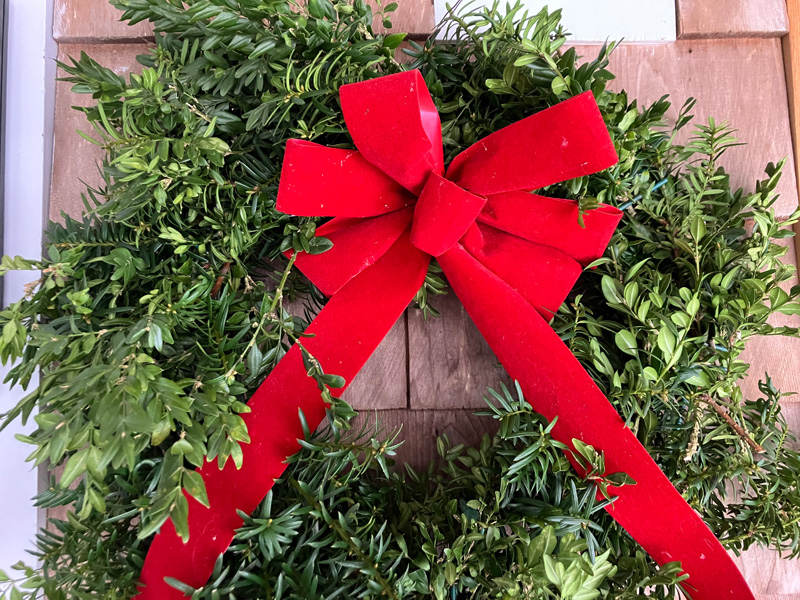
Days are short, and nights are long. Winter solstice, Dec. 21, happens when our planet reaches farthest away from the sun on its annual solar orbit. The effect is a product of the earth’s axis tilting at an angle 23.4° out of perpendicular.
As the earth circles the sun, different parts of the globe receive more, or less, sunlight and solar energy: winter, here now in the Northern Hemisphere; summer, there in the Southern Hemisphere. If the earth stood perpendicularly, straight up and down, as it rotated on its axis, all days and nights would be equal, and there would be no seasons.
After the winter solstice, daylight begins to lengthen. That is what made finding the times of solstices and equinoxes so critical to early-history humans.
Oddly enough though, here, longer days in January are not necessarily warmer days. Some of our most wintry weather occurs in January and February, when days have visibly lengthened.
Dahlias have been dug and stored. Cutdowns continue as frosted plants collapse. Rust-colored sedum and silvery lavenders contrast nicely in the brisk mornings. The cold is here.
Bailey Nurseries
Bailey Nurseries have kindly shared many free sample shrubs to me over the years from their series ‘Endless Summer,’ ‘First Editions,’ and ‘Easy Elegance.’ This is such a nice gesture on their part, and good marketing.
They have gifted roses, hydrangeas, ninebark, ilex, privet, spirea, vitex, and even gardenia. Bailey’s is known and recognized especially for hydrangea introductions, such as ‘Endless Summer’ series that bloom on new wood despite pruning. Time to say “Thank you,” and to encourage gardeners to look for Bailey’s introductions at our garden centers.
Oh, no! New insect pest
My contribution to the family Thanksgiving dinner was planned to be braised leeks from our leek patch. A favorite recipe turned out to be more concerning than anticipated. A minor drama perhaps in the greater scheme of things, but one that is actually quite serious for Island growers, and elsewhere.
The dozen-plus leeks I had harvested Saturday were, by Thursday morning when removed from the fridge –– oh, no! –– blemished and covered with black specks. Upon closer inspection, the specks were insects: insect pupae, to be exact.
The internet was quick to identify the insect and the problem: Allium leafminer. Phytomyza gymnostoma is a true fly that is a pest on the allium family members we grow as important food crops: garlic, leeks, onions, and others.
From Cornell’s College of Agriculture and Life Sciences, https://cals.cornell.edu/integrated-pest-management/outreach-education/fact-sheets/allium-leafminer: “Allium leafminer (ALM), Phytomyza gymnostoma (Loew), is a specialist pest that infests wild and cultivated plants in the Allium genus. ALM is native to Europe and was first detected in North America in 2015 near Lancaster, Pennsylvania (USA). “Since then, it has spread to Connecticut, Delaware, Maryland, Massachusetts, New Jersey, New York, Virginia, and Washington DC. Generally, ALM attacks allium crops such as chives (A. schoenopanasum), garlic (A. sativum), leek (A. porrum), onion (A. cepa), ramps (A. tricoccum), and scallion (A. fistulosum). In some instances, ALM damage can cause total crop loss.”
Further information from Cornell regarding host range and plant reference: “ALM will infest many different Allium species, but their risk for attack varies during the season. For example, chives, garlic, ramps, scallions and ornamental alliums are more likely to be infested in the spring compared with onions that are transplanted.
“Onions that are established by seeding are typically not at risk. The primary reason for these differing levels of risk is the availability of leaf tissue for egg-laying females. Very few onions that are established by seeding will emerge in time to produce foliage large enough for females to lay their eggs.”
The Cornell site has more recommended reading, as does UMass here: https://www.umass.edu/agriculture-food-environment/vegetable/fact-sheets/allium-leafminer. “Fall leeks are often the most damaged crop, because they are the only allium crop remaining in fields during the fall flight.”
Exclusion with netting is effective for avoiding pesticide use on food crops, if attention is paid to timing. Crop residue sanitation is another tool.
Allium Leafminer: What to do
Go to the Cornell or UMass links above to learn about the importance of timing the various allium crops in relation to the early and late flights of ALM, which can be helpful in damage control.
Penn State has info about garlic and ALM: https://extension.psu.edu/plant-garlic-late-to-avoid-allium-leafminer: “If you enjoy growing garlic, you should take steps to avoid having Allium leafminer destroy your crop. One simple step is to plant garlic late in the season to avoid ALM’s fall flight as it seeks to deposit eggs. Extension Horticultural Educator Tim Elkner advises planting garlic as late in the fall as possible so that garlic will only grow a few inches before winter. That way, there will not be enough growth in which ALM can lay eggs. In southeastern Pennsylvania, this planting date would be around November 1. [Here on the Vineyard, that would be later.] If you live in colder parts of Pennsylvania, consider planting garlic about two weeks later than usual. For example, if you usually plant garlic around October 1, delay until October 15.”
Braised Leeks
Thanksgiving’s dish of Braised Leeks ultimately came to the table, unbowed despite ALM damage. Soaking the leeks in heavily salted water and brushing seemed to float out the tiny, dark chrysalises.
Parboil leeks, green parts and roots removed, in a heavy saucepan in 8 cups water, about 10–12 minutes, or until white part is just fork-tender. Remove from water with tongs and set aside. (Strain out any ALM pupae!) Continue to cook down liquid until reduced to 2 cups; set aside in measuring cup or bowl.
Heat oven at 350°F. In the same pot, melt 3 tablespoons butter; when foaming, stir in 3 tablespoons all-purpose flour with a whisk, and whisk in the 2 cups of warm reduced liquid gradually. Season sauce with salt and pepper to taste. Grate ½ cup Parmesan or Gruyère cheese finely while oven is heating. Arrange parboiled leeks in lightly oiled baking dish, and pour sauce evenly over leeks. Sprinkle with the grated cheese, and bake for 30 minutes.
Happy Holidays to all!
Comments are closed.