
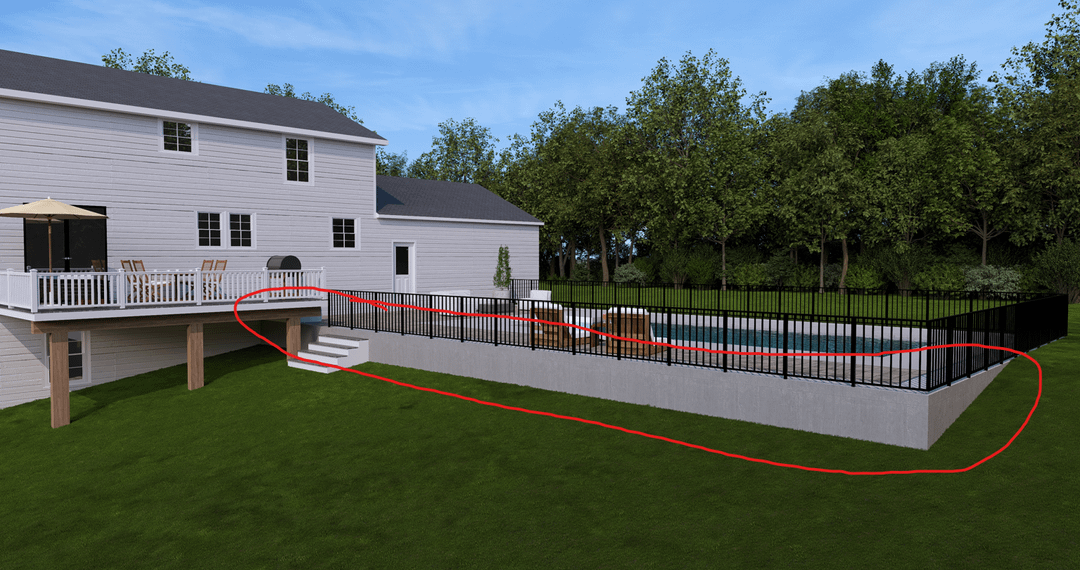
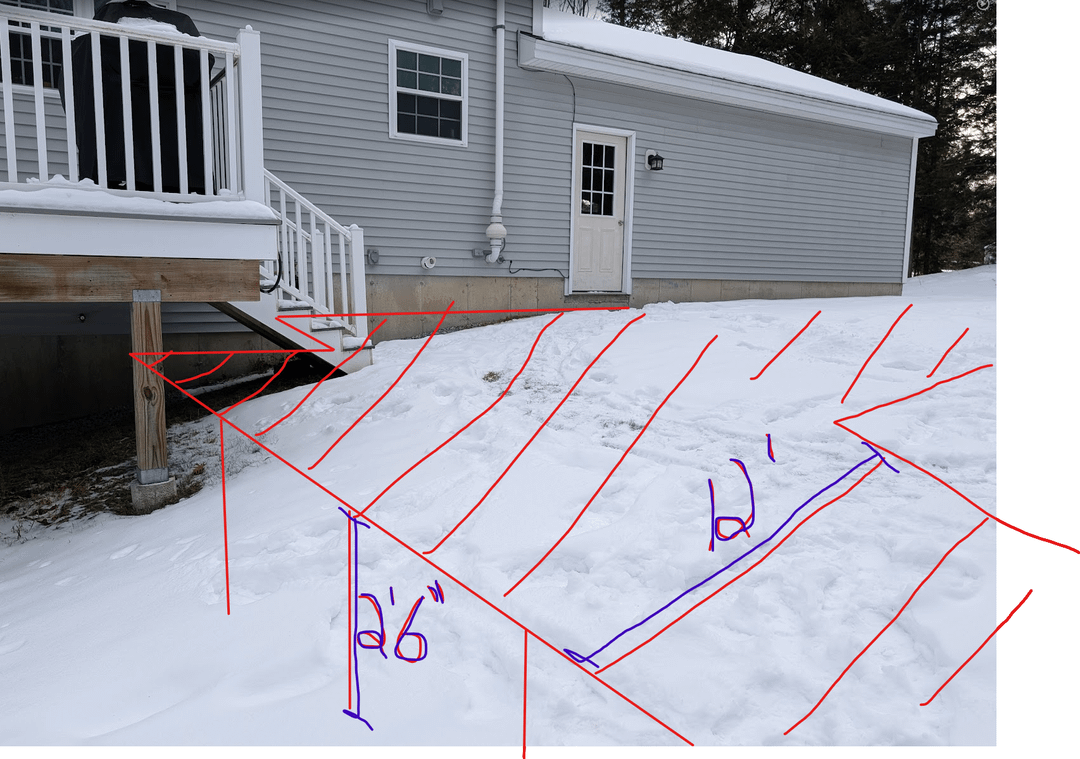
1st pic is mockup, 2nd pic is real. Pool companies are telling me no retaining wall needed, they can just use the fill to create a birm on the slope so that the area is leveled off. Landscapers are telling me I'll have too much movement if I don't make a retaining wall. They're all trying to sell me something so I have no idea who to believe or how to figure this out.
The corner with the stairs gets a little funky, and I'm fine to pay for a retaining wall there since it's only 12 feet long or so. But from the deck all along the slope is like 50 feet of retaining wall, which is probably 15-20k. Would certainly like to avoid building that if just dirt there does the same job. But also note that this is our forever home and I want things to last and be done right, so if it would actually make a difference to have it, maybe we just bite the bullet.
by Jimbo733
15 Comments
I forgot to add. This is in Maine. And the patio is undecided if we would do concrete or pavers but leaning towards pavers because of freeze/thaw. And the mockup shows a concrete wall which is NOT what the retaining wall would be, we would use blocks (boulders also an option)
Can’t answer your question but a thought; How much use are you getting out of a pool in Maine? I can’t imagine it’s warm enough to swim before June or past September. Maybe there’s a better way to upgrade your forever home, something that will be more useful for longer? This is going to be a low 6 figure job
If it’s your forever home then I’d ask yourself what do you want?
There are plenty of reasons you’re getting different advice. Because there are definitely different ways to do this.
Sure you could do a pool and pile up dirt and hope for the best. You could use river rock for a mid grade option. Because you also have to think about drainage. The concrete looks nice but where is the excess rain going to drain?
You’d definitely want it to drain away from the house.
Personally I’d try a terraced option. It looks better than a flat concrete wall and you can use that as a garden. You can also add a French drain inside to divert the excess water.
better build your pool on the lowest point of the garden…
Yes
If it was me I’d reach out to several pool companies and ask what they think / get advice / quotes.
Why not cut *into* the hill, rather than building off of it?
I don’t have any structural expertise to advise on the retaining wall, but I don’t care for the design of the pool and how it flows from your property. I think you should be more intentional about building a covered outdoor living space that incorporates a pool for a forever home to utilize the space more frequently. Also, consider entertaining.
The pool guys are looking at this from a “get the pool in the ground” perspective while the landscapers are looking at it from a “keep the patio from cracking” perspective. Trust the landscapers here. If you use fill dirt to build up a 2.5 foot rise for a patio, that dirt needs to be compacted in 6 inch lifts with heavy machinery or it is going to settle. When dirt settles, pavers separate and concrete cracks. Most pool contractors just push the excavated dirt over, track it in with a skid steer, and call it good. That is a recipe for a sinking patio within three years.
You also need to think about the math of a dirt slope. To make that berm mowable without slipping and falling, you need a 3 to 1 slope ratio. That means for every 1 foot of height, you need 3 feet of horizontal distance. So for a 2.5 foot drop, you are losing 7.5 feet of your usable backyard just to a hill. A retaining wall gives you that space back and provides a rigid, structural edge that prevents the base material under your patio from washing out during heavy storms.
Since this is your forever home I would absolutely bite the bullet on the wall. It looks cleaner, maximizes your flat lawn, and protects your investment. If the masonry quote is too high, ask about using large landscape boulders or natural slab steps instead of a formal block wall as that can sometimes shave off labor costs while still holding the grade. I design these grade transitions all the time and fixing a failed slope is always more expensive than building the wall right the first time.
Pool in Maine smdh
There’s a lot of way of dealing with this. It depends on budget as well. That slope makes for awkwardness but is workable and can have some really awesome opportunities. But the reality is the slope of the yard is going to require walls of some sort at some point. It just depends on the ultimate layout.
I would be inclined to sink the pool on the exposed side, build out landings and steps from the door and modify the existing deck with new steps. Steps on the far side because wall will be required there now for soil retention.
This is ball park brainstorming.
Source/ pool and backyard designer.
I would sink the pool deck more splitting the slope, they can also drag dirt off the backside to the front to flatten your lawn along with the actual dirt where the pool will be dug. Dropping the pool deck will cause you to lengthen the steps on the deck and build steps off the garage.
If you are putting a pool in, listen to the pool guy. My pool guy used all the fill from the hole to level my entire back yard. He was a wizard in a machine. I have since done pavers on about 1500sq feet. At no time now or before pavers (that are set on a 6 inch concrete slab) did I have any earth movement. I am in the northeast, and have winters with no trouble. I also have steel forms, but that is preferred in my region.
Yes, I would argue 2’ below grade
Wouldn’t a fence be sufficien no backfill, trenching, wall construction.. ?