
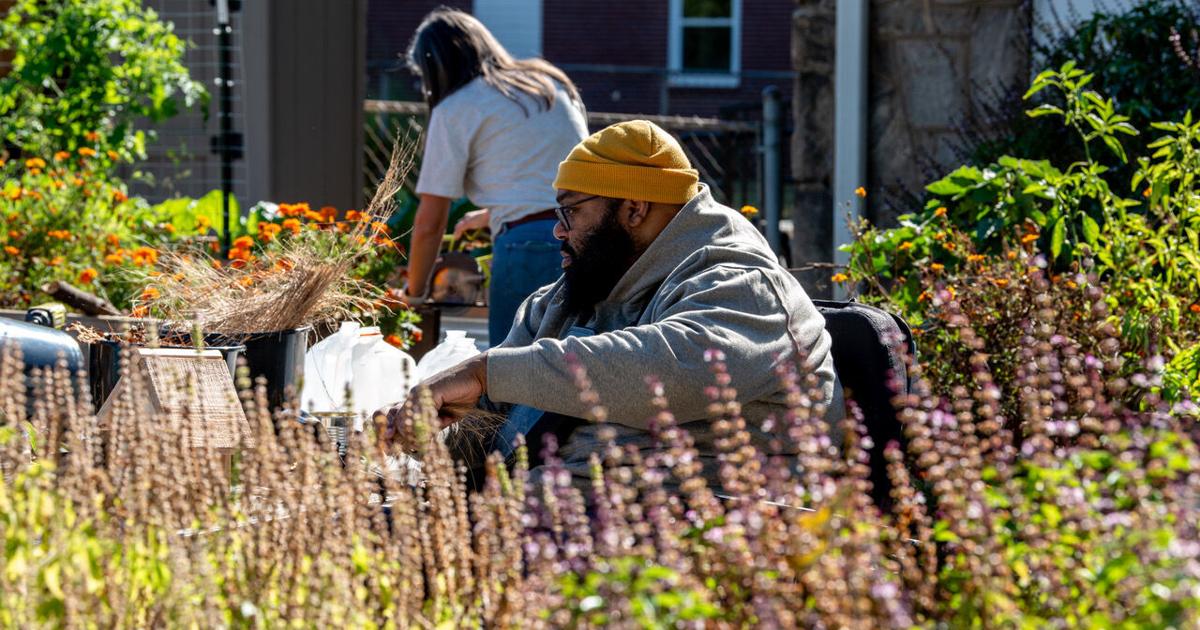
DECATUR, Ga. — Jasmine Hill sat at a folding table in the middle of Trellis’ Ability Garden at Legacy Park, assembling a bug hotel with help from her nurse.
The materials were simple: a wooden frame, pine cones, stems, and straw. Light filtered through the trees as she worked.
“This is so much better, being outside and doing stuff, than just sitting at home watching TV,” she said, smiling.
Hill was participating in Trellis’s Gather & Grow class, one of the twice-monthly sessions for people living with spinal cord injuries or other neuromuscular conditions.
Trellis, founded in 2017, is a nonprofit that runs barrier-free horticultural programs for adults with spinal cord injuries, strokes, brain injuries, or other neuromuscular conditions. Its programs take place at Decatur’s Legacy Park.
Horticultural specialist Christy Righter moved between the two students, Hill and Leroy Thompson, with supplies and brief instructions on building bug hotels, occasionally using a circular saw to cut wood.

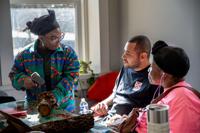
Moe Hemmings, left, an Atlanta Botanical Garden volunteer, shows Alex, center, and Loretta, right, how to plant mushroom spores in logs that will grow over the winter.
JAMIE GODIN/APPEN MEDIA
Bug hotels – bundles of sticks, bark, and pinecones – give beneficial insects a place to nest. They are also hands-on projects that show participants how plants, insects, and habitats interact in the garden. The well-maintained green space within Legacy Park creates a place in nature for people who do not always have easy access.
Wendy Battaglia, co-founder and executive director of Trellis, felt there was a need for a place for people to go after leaving rehabilitation and reentering daily life. Battaglia was inspired to create Trellis, in part, by seeing the barriers people with brain injuries face.
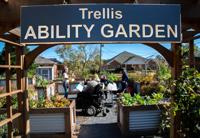
The Trellis sign frames the Ability Garden, where a teacher leads a Gather & Grow class for people living with spinal cord injuries.
JAMIE GODIN/APPEN MEDIA
“They do so well in the rehab hospital and then they go home and then all this massive isolation happens,” she said. “They’re disconnected from gardening. They’re disconnected from nature. They’re disconnected from their friends.”
Thompson, who lives with a spinal cord injury, said when patients first leave rehab, they are around more people dealing with similar issues.
“So there’s that sense of community… and when you come home, you lose that,” Thompson said. “There’s nobody else like you unless you’re keeping up with those individuals. There’s nobody in your immediate surroundings who is in a wheelchair or has a brain injury, so it’s hard for others to understand what you go through.”
Trellis co-founder Rachel Cochran said the nonprofit works to create a space where people like Thompson feel accepted and connected.
“These people are pretty isolated,” Cochran said. “They like to share what they’re going through.”
An unlikely duo
Cochran and Battaglia met during horticultural therapy training but their connection was not instant.
“Initially, we didn’t connect because I was with the rowdy table,” Battaglia said. “I was with all the landscape people who were not used to sitting still.”
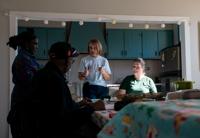
From left, Moe Hemmings of the Atlanta Botanical Garden, participant Marcellus, Wendy Battaglia leading the Gather & Grow class, and Taylor Mead of the Atlanta Botanical Garden.
JAMIE GODIN/APPEN MEDIA
Cochran was quiet and studious. They eventually became friends while attending a program in North Carolina.
“We both had landscape design experience,” Cochran said. “We learned about the Americans With Disabilities Act, pathways and turning radius and access points, and we said, let’s build a garden that’s wheelchair accessible.”
At first, Trellis ran out of their homes, but the founders wanted a home base of their own.
“We started at Callanwolde, which was amazing, but we were very hidden there,” Wendy said.
That desire for a more visible space led to the move to Legacy Park in September 2024, where Trellis now has room to grow its programs and its presence in the community.
Deeply rooted
Every task at Trellis is adapted for people with mobility or fine-motor challenges.
“Even just seed sowing, lettuce seeds are microscopic,” Cochran said. “We’ll get something like a spice jar with a shaker. You can mix seeds with sand and shake the seeds into the bed.”
Raised beds, wide paths and stabilized tools allow participants to work more independently.
Trellis now offers more public-facing programming to introduce more community members to its work.
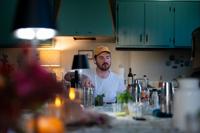
Brendan Town prepares for his cocktail-making class to raise funds for Trellis. While on his honeymoon in Hawaii, Town suffered a rare spinal cord injury known as surfer’s myelopathy that left him paralyzed from the waist down. He volunteers with Trellis because he wants to give back to programs that supported him during his recovery.
JAMIE GODIN/APPEN MEDIA
Cochran recently led a floral arrangement workshop with Agnes Scott students, and the team hosted a cocktail night for Decatur residents, a chance for people to learn a new skill while seeing firsthand what the organization is all about. Atlanta bartender Brendan Town led the cocktail night. Town, who also has a spinal cord injury, has worked everywhere from dive bars to fine-dining programs and sometimes volunteers at Trellis.
“The other piece of the dream was to make community connections,” Battaglia said. “Not just for our Garden Ability programs, but how to be more deeply rooted in the Decatur community.”
Thompson said he wants people with similar disabilities to know that groups like Trellis exist.
“I don’t want to sound cliché, but you’re not alone,” Thompson said. “The intrusive thoughts will come, but places like Trellis can help you get through it. Even if you don’t want to garden or learn new skills, it’s good to get out of the house and be around people who understand you.”
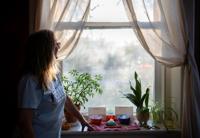
Trellis co-founder Rachel Cochran looks out a window in the Grief House, part of the Nickerson Cottage she shares with Trellis. She has raised a child who survived a brain injury from an accident and supported that child through a gender transition. “I think I have a little touch of PTSD just from my child’s accident. You lose your ability to really focus because you’re always trying to manage someone else. That you’re constantly being pulled away,” she said.
JAMIE GODIN/APPEN MEDIA
Want Decaturish delivered to your inbox every day?
Sign up for our free newsletter by clicking
here.
Support Decaturish by giving to our fall fundraiser today.
Visit here to learn more.
Comments are closed.