
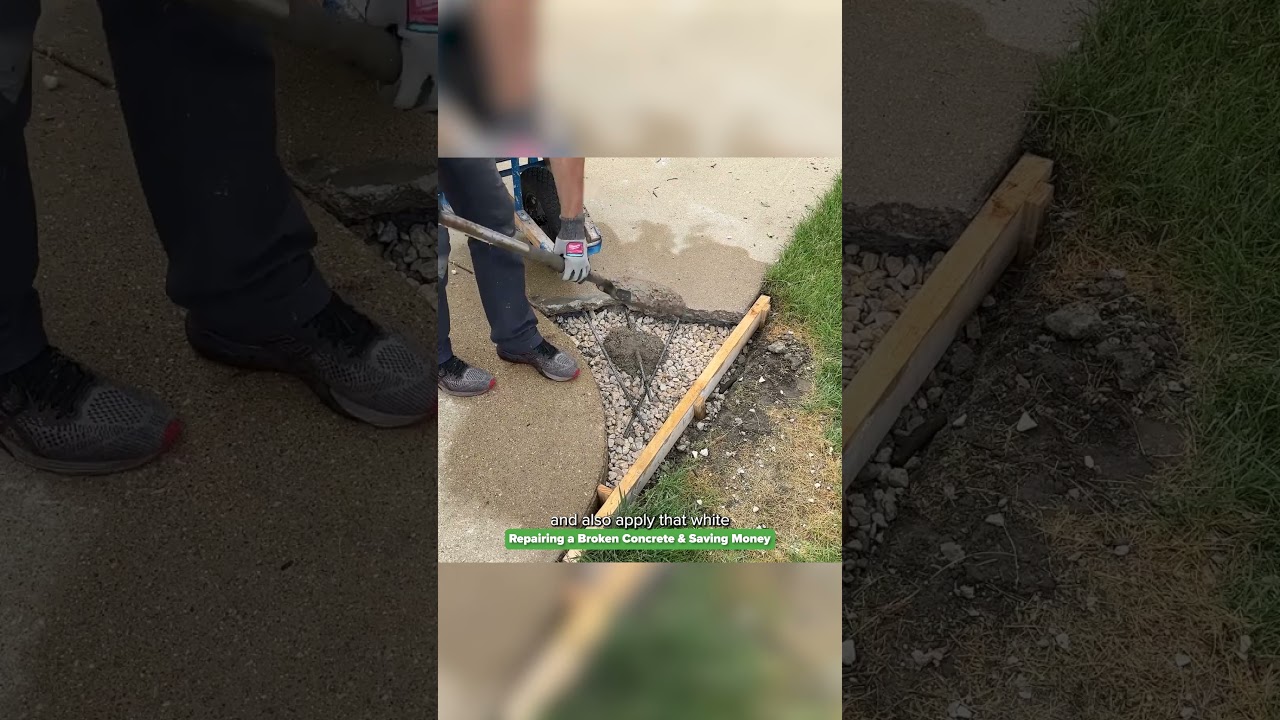
I needed to replace a large chunk of concrete that had broken off my driveway. This is a common issue for most homeowners on driveways and sidewalks, but it doesn’t have to cost you hundreds of dollars to repair. In this video, I’ll walk you through the complete DIY repair process, which you can apply to your own situation, ensuring great results. Let’s save money and fix that concrete!
take a large Spike and work up one end and flip it out of the way to make it more manageable just hit it a couple times with a sledgehammer and then now break it up into pieces that are easy to move around and you won't be hurting yourself trying to lift the one big chunk up now with a/ in masonry drill bed and my rotary hammer drill drill three holes now the angle I'm drilling these holes is I want them to crisscross so I can easily tie the three pieces of the rod together get them sunk into the existing concrete pad and again now you'll see how they're crisscrossing and that's where those angles came into play so three pieces we'll use two small wire ties tie those together and then I probably should have put the aggregate in first and then it would have made it much easier to compact this down the Rock's a little large it is nice to have a mix of 3/4 inch rock down to find and that just makes it easier to compact I did wet down the area first and also apply that white adhesive to the jagged concrete slab with the rod coming out of it that is the side that we want this new concrete to bond to and then we're going to have a expansion joint at that curv side to give it a little bit of flexibility in the future so it can move independently then I'll take the Magnesium float and start working it around to strike things off referencing the surface of the existing concrete and then also that outside form which was set exactly level to the adjacent concrete you'll start to see the cream or the moisture coming off the top because I did want to work this Edge near the form but also I wanted to set that edge on the curve there that radius curve because I do not want this new patch to necessarily be attached to that existing side I want there to be some movement there now for the fish all I did was just use that big sponge and just suck up some of the boisture off the top that gives it a rough finish and I was just trying to match the rough finish on the surrounding slab I'm going to wait about 3 days before I'd be driving on this concrete remember the curing process is critical and the full curing process actually takes 28 days it takes 28 days for this to reach the 5,000 PSI if it cures properly now depending on the temperature and how dry it is outside you are going to need to spray a light
45 Comments
You can fix the rebar to the old slab by using anchor bolts and weld them together
You should also put 2holes/bars with at least 4" deep with epoxy on the existing curved concrete,and pour it at least 4" thick of concrete,just my opinion😊,peace…😂
If you have a grinder to cut the rebar, why wouldnt you cut a straight egde on the broken, jagged side? Finish looks terrible as well. Your house broom would have gave that a better finish. Also edging the rounded part doesnt seperate the 2 slabs, its for looks…. smh
Should have put a rebar from one side of broken concrete, to the other that is not to make a bridge from slab to slab
Little does he realize the first piece broke becuase there is no reinforcing going into the other side, did not epoxy the dowels and poor base prep.
Dont do this.
White adhesive….ah you mean bonding agent. Lol
a dingo is 150 a day
Many thanks to you, this shows me that I can do this too. Several comments added useful knowledge, some must have years in the profession that we can learn more from because of you posting your video.
Great you are lucky. You didn’t broke the other thing when you use the sledgehammer to break the little piece smart…..😅
So many mistakes here that it's diabolical ! The level of his confidence is typical American ( sound like you know what you are talking about yet proves otherwise ) . No issues with the removal . Once removed you have access to the root cause of the problem which was completely ignored . there was no plastic sheet used below the slab initially . This allows wet soil to enter the voids of the stone you used creating the void which allowed the crack to form in the 1st place . You need to tamp that as much as possible to expose the cavity below the adjacent slabs . You want to wet that cavity with a hose to settle and densify that area and make a sloped surface with soil and cement mix in a 10 to 1 ratio in the broken area so that a slurry mix of sand and cement can be poured onto that slope and drive that mix into the cavity . Once filled , tamp the sand/cement mix flat . This compresses and ''forges'' the filled slurry onto the underside of the existing slabs . Now you have a compressive /positive pressure on that slab , an ''uplift'' force of sorts . place plastic over that so that wet soil will not rise into concrete / stone cavities when it rains , reducing the ''uplift'' pressure over time . Drill holes closer to the top of the slab on a downhill angle so that you can fill them with cement slurry or epoxy . gravity keeps that in the hole and you can drive reinforcing into that so that its an actually bond not just a hole with a rod . Now bend those rods until they are flat . Now you have pretensioned rods which can withstand pressure from the get go , instead of having the potential to create spring tension from scratch . Now you must chop the neighboring slab at an angle close to 45 degrees so that when it cracks in future ( It will , it's inevitable with two different mixes ) the natural slopes you created will provide support for the infilled slab regardless of reinforcement or not . Now use a wet slurry cement only ''paint'' on that sloped surface as a primer and fine fill for proper adhesion . Lay ''chicken wire'' mesh on the floor as that helps with tensional stresses which occur at the bottom of the slab ( reinforcement bars were too high ) .Now you can pour the concrete as you did but without aggregate ( that's a myth for what you're trying to do . ) Finish as you did , it's the least important part of the job anyway . I have been a contractor in South Africa ( we built proper houses here ) and I laughed for so long thinking this was a skit at first . It did however remind me of the biggest problem the world faces . Americans speak like they KNOW what they speak about yet don't in 99% of the cases ) Even the comments are like this . The blind leading the blind with hubris and arrogance . Dunning-Kruger comes to mind… Twanging , airs and graces and fake accents are false signs to non Americans , especially South Africans . We pretend to be stupid so that you guys can expose yourselves . This is a microcosm of whats wrong with the world . The youngest country wants to teach the oldest .
Y didn't you saw cut the crooked side to a straight line
😂
Or put some new under reputation same color piece of concrete back. Then add some to crack add water wahla
Why break it on the good area? Shows you don't know about concrete work. 👎👎👎👎
Not worth the trouble
That’s a ugly repair. You should’ve made a straight cut in the jagged edge.
Why was there no steel in the first place
No epoxy for the rebar in the existing concrete?
Breaking the bad slab on the good slab is actually a smart decision. Guarantee you’ll have more work in the future.
#1 you never break concrete on top of concrete you are repairing!
Good work, but one suggestion. Dont break up concrete on your good concrete. You may damage. Otherwise you did great. I love the rebar tie in.
If you're going to break it up you might as well hit it in situ
Apparently all the comments are from professional concrete workers
The edge of the curve was high about 3/16th of an inch….
Good video; observations: This triangular area broke off most likely because of poor soil compaction (non-reinforced/plain concrete can’t handle bending moments which is the reason why it cracked in flexure on the top). You were right in realizing that you should’ve properly compacted the soil and aggregates before placing the rebars. As for the rebars, I don’t think they will help much as shown because drilling a rebar a few inches into the existing slab doesn’t “develop” its capacity. That diameter rebar needs around 8” embedment or epoxy. Proper compaction and use of wire mesh would’ve been better. Keep up the good work.
careful edging against pre existing concrete if you live where the temp gets down below freezing. water can get in there, freeze, then expand causing damage.
Using stones isnt a good idea. Eventually the concrete goes into the stones and it no longer become even
Smashing the piece on the undamaged Part is a Great idea
Civil engineer here. I respect anyone doing a bit of DIY. Personally, I would have made a few different decisions.
Just a thought, but the best option for cosmetic reasons may have been to leave the cracked piece in place. If its not continuously load bearing then what's the harm of leaving it other than further deterioration of the cracked piece? You will never manage to repair that concrete and make it look indiscrete. Unless you mix the concrete exactly like the original pour, the discoloured repair is going to stand out much more than that crack did.
Potentially you could have tried to bond the cracked piece back to the main slab.
No after curing shot?
That’s gonna look even worse when it dries even compared to what it originally looked like. the color is going to be way different, and you will literally see where it was cracked originally, should’ve at least sawcut at the broken part in a straight line then took it out, cause now you have a color mismatched block of concrete, against the jagged edge of the original piece.
Great job.
What happens if you forget to wet the area before the pour… asking for a friend.
Should of cut the same curve on the other side to make it the same
Coming from a 25 year concrete veteran that looks horrendous brother. But u get an A+ for trying.
Clear communication and nice video. Everything else……
I'm sorry, the original broken piece looked better, it almost looked like it was intentional, I would have just cleaned around it, perhaps smooth and lift it a bit with dirt underneath, this now looks like a huge eye sore to me.
You didn't epoxy the rebar into the existing slab
nice job! 👍 lol these people in comments are funny
You smashed the broken concrete on the good slab?! Id throw you out the window for that!
Is it gonna change back to the color?
Cut the broken slab to match the curveatur of the other side !!!!
At the least, make it look nice !!
Awesome. Heights are wrong, no saw cut will crack, overall looks like shit.
I mean… concrete that is only like 4cm thick will never be really strong. And if you didn't want it to attach to the round edge, you should have put foam edge in. It will be attached at the bottom
Nah this is trash 😂😂😂
Fkn proof YouTube is full of fkn idiots