
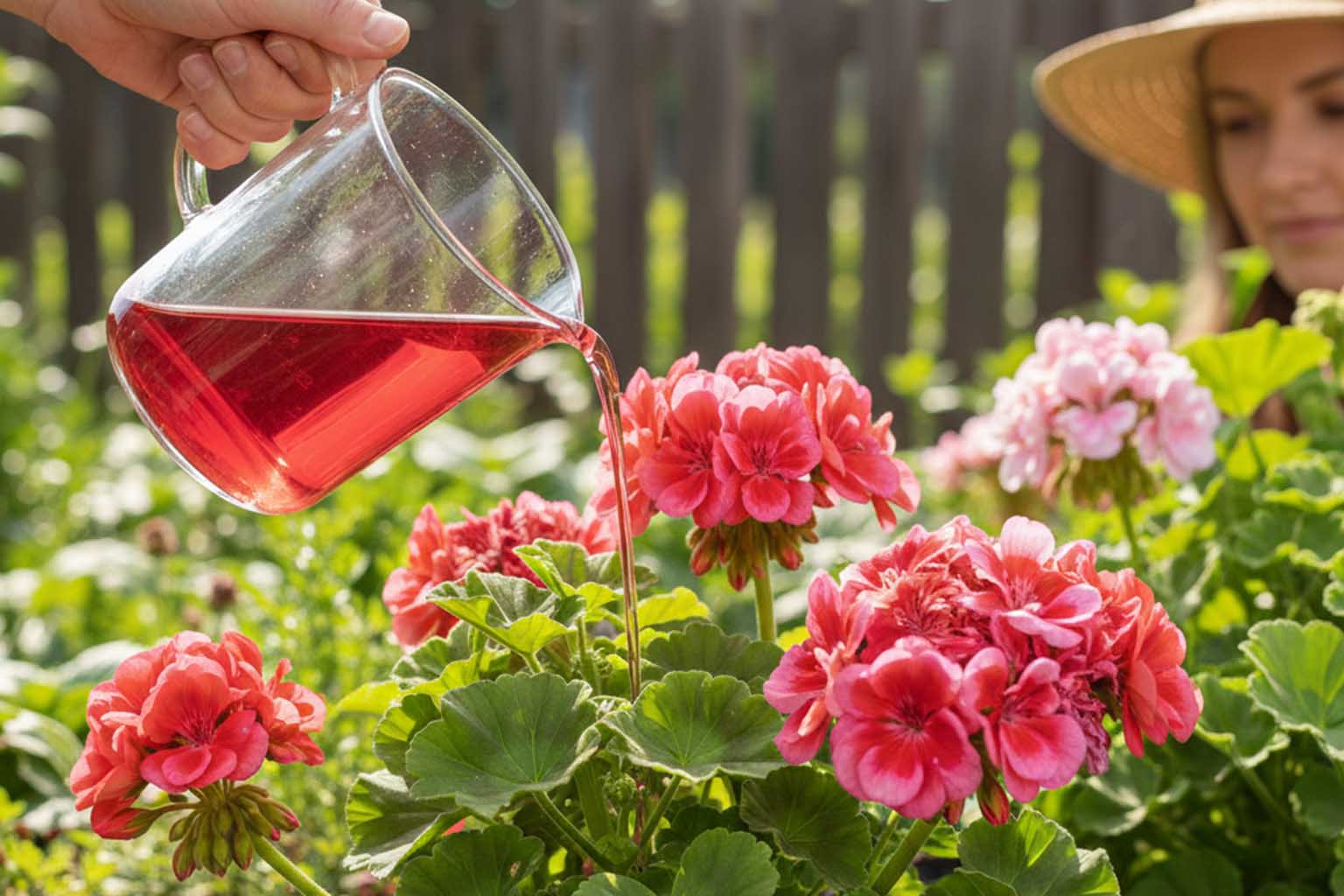
Your morning coffee might be doing more than waking you up. It could also be quietly transforming the flowers on your balcony. And for millions of gardeners, that small habit is changing the way geraniums bloom.
According to Italy’s National Institute for Plant Protection, more than 42% of Italian households grow at least one geranium on a balcony or in a garden. Among countless home remedies promising lush blooms, one stands out for its simplicity, affordability, and surprisingly solid science : used coffee grounds.
The secret hiding in your morning cup
The idea sounds almost too easy. Instead of tossing coffee grounds into the trash, many gardeners now see them as a form of natural fertilizer. Rich in nitrogen, potassium, and phosphorus, coffee grounds provide a well-rounded nutrient boost for flowering plants.
Research from Italy’s agricultural research council shows that a single handful of grounds can contain up to 2% organic nitrogen, along with trace elements like magnesium and copper. These nutrients support leaf growth, root strength, and overall plant vitality.
In practice, results don’t appear overnight. After about two weeks, many gardeners notice deeper green leaves and more even growth. When applied every 10 to 15 days, coffee grounds offer a steady nutrient release without relying on store-bought chemicals.
Natural fertilizer VS commercial products
Commercial liquid fertilizers are popular for a reason: they work fast. But speed often comes with trade-offs. Synthetic products can weaken soil structure over time and increase salt buildup, which stresses plant roots.
Coffee grounds behave differently. As an organic amendment, they improve soil moisture retention and release nutrients slowly, sometimes over an entire month. A recent survey by the Italian Association of Horticulturists found that 58% of gardeners now prefer organic fertilizers over synthetic ones.
The financial difference is just as striking. Households relying mainly on kitchen waste reduce fertilizer costs by up to 80% annually. For balcony gardeners, that can mean healthier plants at virtually no cost.
Where things can go wrong
More doesn’t mean better. The main risk with coffee grounds is overuse, which can make soil too acidic. Plant experts recommend no more than two level tablespoons per 8-inch pot.
It’s also important to mix the grounds into the soil rather than leaving them on the surface. This prevents mold growth and unpleasant odors. Consistency matters more than quantity, a lesson many beginners learn the hard way.
Not all geraniums react the same. Zonal and ivy geraniums tend to respond with vigorous blooms, while imperial varieties can be more sensitive to acidity. Knowing your plant type makes all the difference.
A circular habit taking root on balconies
Using coffee grounds fits into a broader movement toward waste reduction. Italy alone produces an estimated 360,000 tons of household coffee grounds every year. Most of it ends up discarded.
Some cities are experimenting with separate collection systems to turn coffee waste into certified urban compost. But at home, the impact is immediate. One small daily gesture reduces organic waste, lowers emissions tied to fertilizer transport, and delivers visible results on balconies and patios.
I started using coffee grounds on my own geraniums almost by accident. One spring, I ran out of liquid fertilizer and sprinkled a small amount into the soil instead. By early summer, the plants were fuller, with fewer yellow leaves and blooms that lasted weeks longer than usual. It wasn’t dramatic. It was steady—and that’s what convinced me.
Other kitchen alternatives and their limits
Coffee grounds aren’t the only option, but they remain one of the most accessible. Banana peels offer potassium and calcium when used as a diluted infusion. Used black tea provides iron and tannins, but only when mixed properly with soil.
Wood ash, while rich in minerals, can make soil too alkaline and is generally not recommended for geraniums. Every homemade solution has limits, and none should replace basic plant care like sunlight, drainage, and watering.
Agronomists remain divided. Some see coffee grounds as a valid biological soil amendment, while others argue their impact is modest compared to professional fertilizers. The debate often centers on soil nitrogen levels. Below a certain threshold, coffee grounds make a noticeable difference. Beyond it, their effect becomes minimal.
Still, the real proof may be on balconies rather than in labs. Across Italy—and increasingly elsewhere—millions of gardeners repeat the same quiet experiment each morning. A cup is emptied. Grounds are saved. Flowers keep blooming well into fall.
Have you tried using coffee grounds on your plants ? Share your experience, pass this tip along to a fellow gardener, and join the conversation about how small habits can grow into something beautiful.
Comments are closed.