
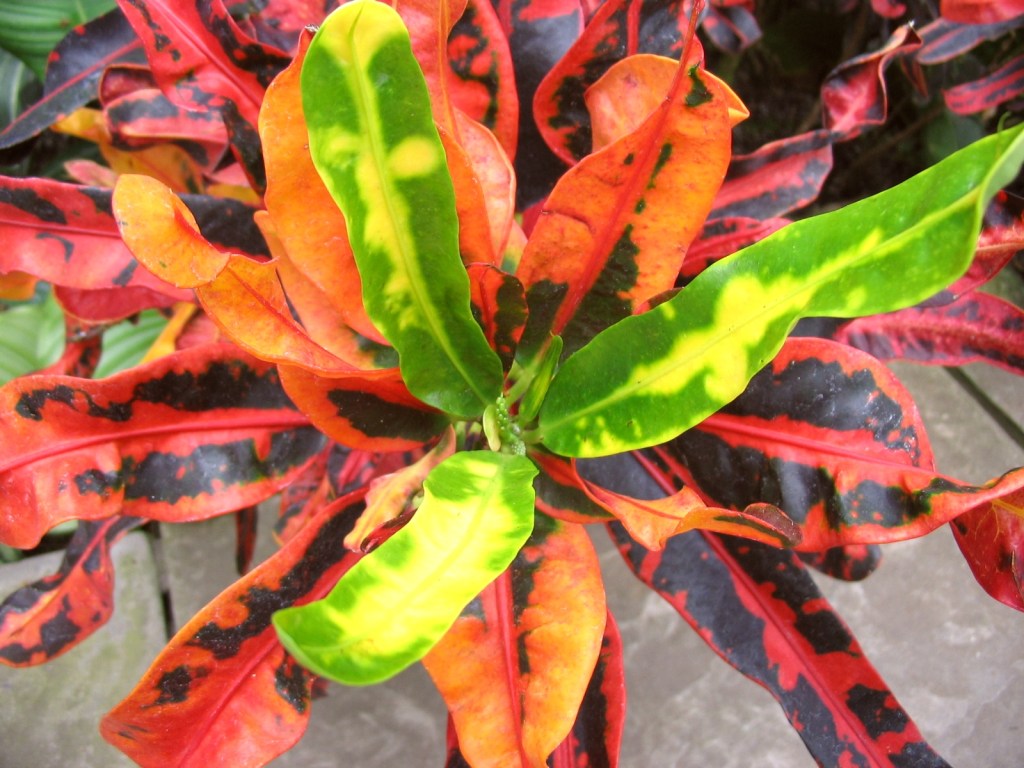
Q: I adopted this orange-leaved tropical plant (croton?) from a friend. It spent the summer outside, but while it’s inside for the winter, how do I take care of it?
Croton (botanical name Codiaeum variegatum) is a fairly common houseplant grown for its colorful foliage. It was beneficial to have it outside during the growing season, where it received good light, humidity and airflow. Once it moved inside for winter, some adjustments by the plant were needed for it to tolerate the lower light and drier air. While indoors, the plants need bright light (placed in front of a sunny window with the blinds open, or under grow lights) and moderate humidity levels. A room humidifier can boost humidity much better than misting a plant’s foliage, which could encourage leaf infections.
Avoid locations near drafty windows or heat sources, such as air vents, radiators, and fireplaces, as the plants prefer stable temperatures. Let the soil in the pot become mostly dry to the touch down to a depth of about an inch or two before watering thoroughly. If the plant sits on a saucer to catch drips, empty the saucer promptly after watering so it doesn’t sit in the puddle and absorb too much water. If the plant’s pot doesn’t have drain holes, try to transplant it into a pot that does.
More information about growing Croton indoors can be found on the University of Wisconsin’s page: Croton, Codiaeum variegatum. Be aware that croton has a reputation for being fickle – they can be quick to drop leaves when growing conditions change – but once acclimated to new conditions, they can do well indoors.
Q: Initially, my fig plant produced lots of fruit. In recent years, though, the harvest has gotten smaller, even though growth looks normal. Since it’s grown so tall, I’d like to cut it back. How can I encourage a better harvest?
It’s common for aging wood in many fruit trees and shrubs to become less productive over time, which is why the regular pruning of these plants contributes to their high-maintenance status compared to other garden plants. Poor fruiting can be caused by insufficient sunlight, but I’ll assume for now that the sun exposure hasn’t changed over the years.
In this case, a lack of fig fruits is probably due to winter kill of above-ground wood, which is not uncommon for figs grown in Maryland, especially in our western and northern counties. Fig plants typically cannot produce and ripen figs borne on new shoots that emerged in spring from the plant’s base or roots – the wood is too young, and any late-forming fruits won’t have time to ripen before a damaging freeze.
To reduce the risk of winter damage, insulate the lower 3 to 4 feet of the fig trunk(s) with bags of leaves to moderate the temperature. If you don’t have bags of autumn leaves, then bagged mulch, bales of straw, or other materials that insulate and block wind will help. When you prune to remove excess or crowded growth, don’t cut main stems lower than 3 to 5 feet off the ground, as this is where new shoots will emerge to produce a crop the following year.
Another cause of poor fruiting coinciding with lush growth is over-fertilizing or very high organic matter content. Root pruning can help force fruit production.
Imagine a ring around the fig that lies 4 feet away from the center stems. (It may help to use a garden hose laid on the ground to draw the line.) Push a spade or shovel into the soil at one point along that line. You’re slicing into the roots by doing this, but not digging up the soil. Pull the shovel out and move it about a foot away along that ring and repeat the process until you’ve made a dotted line around the plant. (If other plants, a fence, or a wall is in the way and you can’t access the entire zone in that ring around the plant, just do what you can.) The stress from that level of root disruption can spur a plant to fruit more heavily in the following year.
Suckers may grow next year as a response to the root damage. Suckers are new shoots, often faster-growing than old wood, that arise from the roots or base of the main stem. They should be removed unless needed to develop into main stems.
University of Maryland Extension’s Home and Garden Information Center offers free gardening and pest information at extension.umd.edu/hgic. Click “Ask Extension” to send questions and photos.
Comments are closed.