
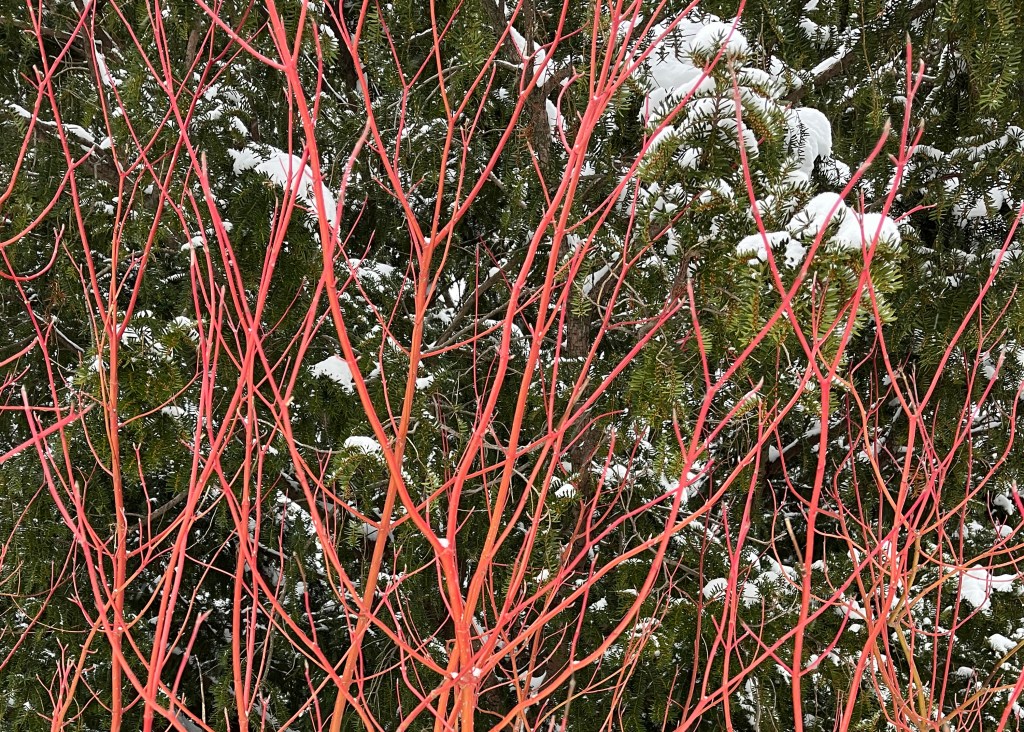
Many holiday floral arrangements include branches with red bark. Colorful bark is a characteristic of certain kinds of shrubs that can brighten winter when they grow in your own yard.
“For the best color, they’ll need regular pruning,” said Spencer Campbell, Plant Clinic manager at The Morton Arboretum in Lisle.
Among the shrubs with bright red, orange or yellow bark are red-osier dogwood (Cornus sericea subsp. sericea), Siberian dogwood (Cornus alba), blood-twigged dogwood (Cornus sanguinea) and coral-bark willow (Salix alba var. vitellina ‘Britzensis’).
The best color is on new growth — branches that are just a year or two old. Older branches will turn grayish or brown. “To keep the shrubs colorful, prune every year to remove the oldest, dullest stems and encourage the plant to send up new ones with brighter bark,” Campbell said. Pruning can also control the size of these fast-growing shrubs.
If you prune them in winter, when the plants are dormant and the leaves are gone, you can easily see the branch structure and compare the size and color of the stems. Locate the oldest stems, which will be the thickest and often have dull bark. Using clean, sharp pruners, cut them off within an inch or two of the ground. By the next winter, bright new stems will have sprouted.
“If you make a habit of pruning out the oldest stems every winter, you’ll always have good bark color the next winter,” Campbell said.
Don’t take out more than one-third of the plant’s stems in any one year, to make sure it will still be able to put out enough leaves in spring to support itself. If you harvest some of the newer, brighter branches for holiday decorations, leave a few older stems to compensate.
Not every kind of plant should be pruned yearly. In some species of trees and shrubs, branches only develop their winter interest with age. For example, the characteristic peeling bark of paperbark maples (Acer griseum), river birch trees (Betula nigra) and oakleaved hydrangea shrubs (Hydrangea quercifolia) only appears on the oldest branches and the trunk. Young branches have smooth bark.
“If you need to prune these plants, be sure to leave some branches to mature into the peeling bark stage,” Campbell said.
These differences between species are one reason it’s important to identify your shrubs and trees before you prune them. “When you know what kind of plant you have, you can find out when to prune it,” Campbell said.
The Plant Clinic can help identify plants from photos submitted by email (see mortonarb.org/plant-clinic). Once you know the species of your plants, you can use the Arboretum’s online resources to learn what kind of pruning they need. For example, find out about the needs of the most common garden shrubs at mortonarb.org/pruning-deciduous-shrubs.
“Learning about your plants will help you care for them to make the most of their most attractive features, whether it’s spring flowers or interesting bark,” Campbell said.
For tree and plant advice, see the online resources of The Morton Arboretum at mortonarb.org/plant-care, or submit your questions online at mortonarb.org/plant-clinic or by email to plantclinic@mortonarb.org. Beth Botts is a staff writer at the Arboretum.
Comments are closed.