
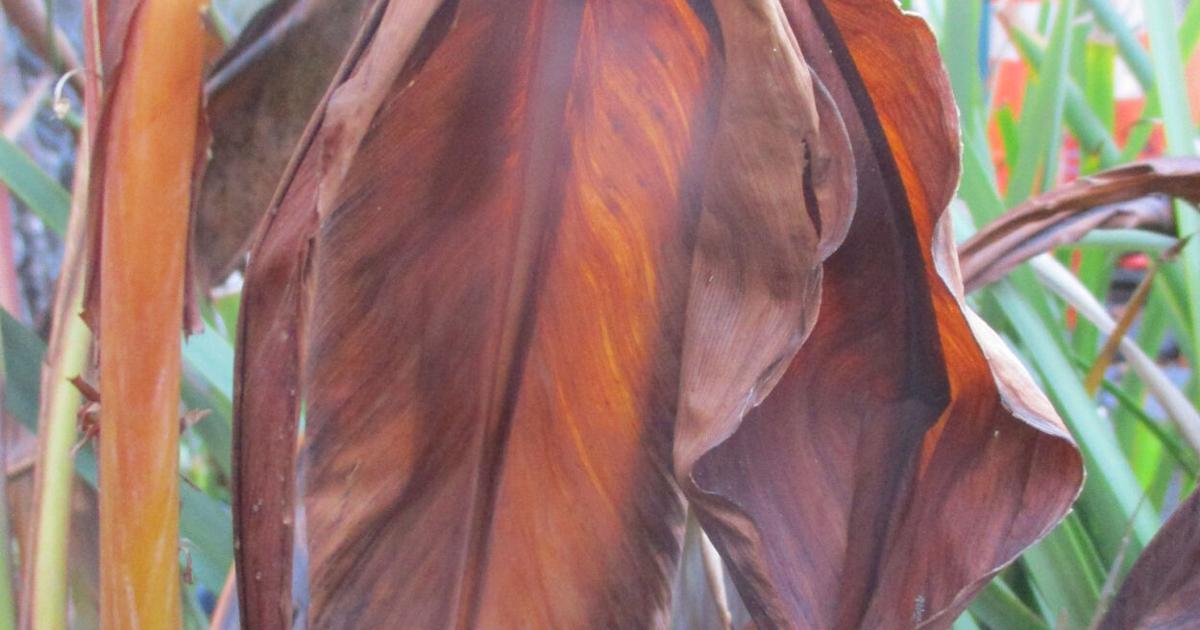
Rain was one clue. Cooler weather is another. It is now so late into autumn that it will be winter soon.
Every regional climate experiences some degree of chill. Some, particularly to the north, experience frost.
This limits gardening in two ways. Several species prefer a bit less cool weather. Several prefer a bit more. Every species prefers a particular range.
Apple trees, for example, require vernalization, which is a specific duration of chill.
Some cultivars require more than others. Without it, they can not distinguish seasons, so do not know when to bloom for spring. Consequently, few cultivars of apple perform adequately within Los Angeles.
However, many perform very well in the cooler climates of San Jose.
Banana trees, conversely, need no chill, and are instead set back by frost. Some tolerate a bit more chill than others; but ultimately, they are all tropical species.
They produce fruit only within the months between frosts. Consequently, not many banana trees are notably productive within San Jose. However, they perform better in the climates of Los Angeles.
Banana trees stop growing when the weather is cooler than 50 degrees or so. That is a bit too much chill for them. However, frost does not occur until the weather is cooler than 32 degrees.
Banana foliage can therefore be safely dormant during chilly weather. That is a range of 22 degrees. Different tropical species survive different ranges.
The simplest form of frost protection is to not cultivate species that are vulnerable to frost. This is, of course, a bit too restrictive for many who enjoy gardening.
Instead, some grow vulnerable species in pots to move to shelter prior to frost. Some simply grow vulnerable species below the shelter of eaves or big trees. Tenting may also be effective protection.
Alternatively, some species can endure frost damage to recover during warmer weather. If possible, outer foliage that succumbs to frost should remain through winter.
It insulates inner growth from subsequent damage. Besides, premature grooming can stimulate new growth that is more vulnerable. Many perennials prefer cutting back after winter anyway.
Atlas Mountain palm
Mediterranean fan palm is a shrubby palm, with a few small trunks. Atlas Mountain palm, Chamaerops humilis var. argentea, is an even shrubbier variety.
Mediterranean fan palm can grow slowly to about 20 feet tall. Atlas Mountain palm grows even slower to only about eight feet tall. Its several trunks become strikingly sculptural only after many years.
The primary allure of Atlas Mountain palm, though, is its distinctly silvery gray foliar color. Individual fan shaped leaves may be nearly two feet broad, with deep and narrow clefts.
Petioles are so nastily thorny that grooming and pruning can be painfully difficult.
Mature trunks can be six inches wide with dense coats of petiole bases. Bloom is not prominent.
Atlas Mountain palm is notably undemanding. Once established, it does not crave much water or fertilizer. Nor is it finicky in regard to soil quality. It is resilient to both extremes of heat and cold.
After several years, it might benefit from thinning of superfluous trunks and pups. Like many palms, Atlas Mountain palm should perform well within big pots or tubs.
Comments are closed.