
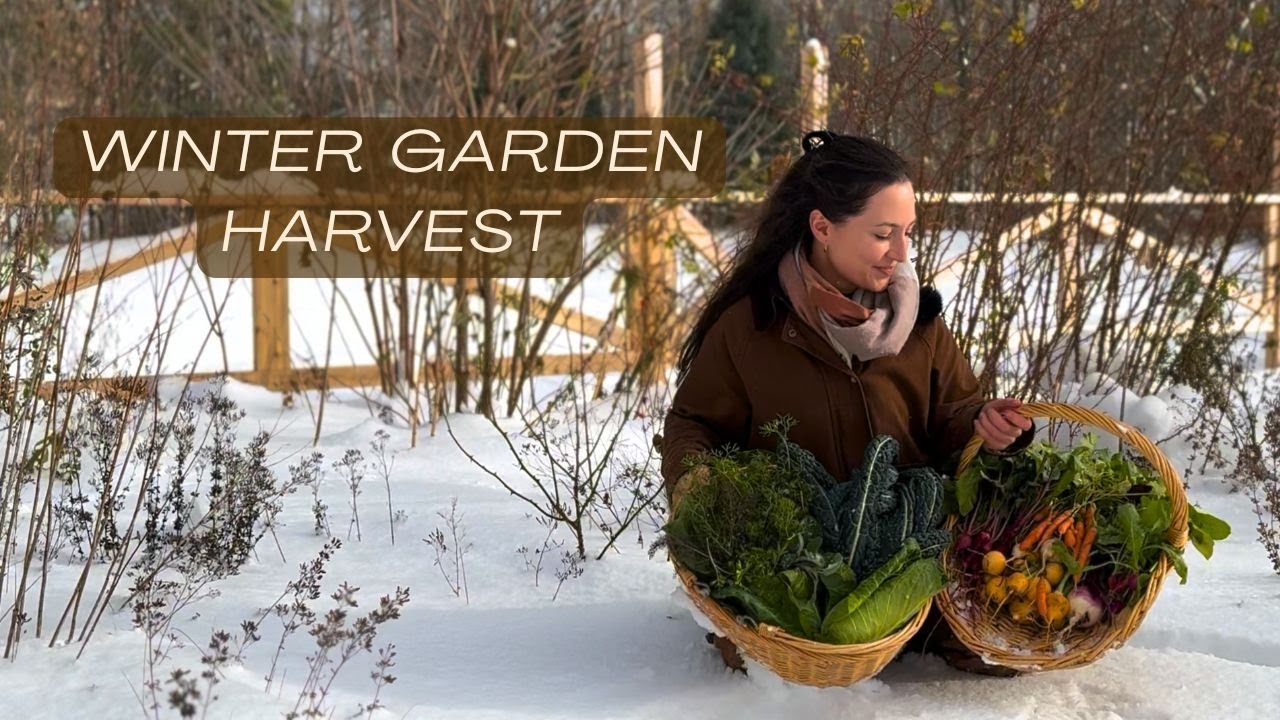
This calm winter garden harvest shows you how cold-weather veggies like kale, carrots, and cabbage actually get sweeter after a frost and why.
I’ll walk you through what we’re picking, how we protect our plants in the cold, and the simple beauty of growing food even in the winter months.
Perfect for beginners looking to grow their own food, slow down with the seasons, and support their health and wellness naturally.
0:00 Snowy Intro
0:41 Letting go/ leaving plants in the ground
1:31 Harvesting root vegetables
1:55 How vegetables get sweeter after frost
2:14 Carrots
2:52 Cabbages
3:39 Kale
4:09 Cilantro
4:56 Parsley
5:39 Fennel
6:11 Row covers and cold frames
6:24 Sage
6:47 End harvest
The best way to support Growing Her Garden is to like, comment and subscribe, or tell your friends!
If you’d like to support me further you do that can here:
https://buymeacoffee.com/growinghergarden
Thank you all for being here so we can learn and grow our garden together.
Come along for more edible gardening tips for health and wellness.
Luminous Rain by Kevin MacLeod is licensed under a Creative Commons Attribution 4.0 license. https://creativecommons.org/licenses/by/4.0/
Source: http://incompetech.com/music/royalty-free/index.html?isrc=USUAN1100169
Artist: http://incompetech.com/
[Music] Hey, It probably wouldn’t surprise you that winter isn’t my favorite season. I have trouble letting go of the plants in my garden, and I miss being able to walk outside and pick fresh produce for dinner. So, I tend to leave some plants in the ground a little longer, even as the cold sets in, which sometimes turns out to be the best thing, depending on the plant. I was surprised to see how many of them were still thriving even at multiple days of -5 to -10°. And it got me thinking, maybe there are parts of us or parts of our lives that are stronger and more resilient than we realize. And maybe with a little challenge, those parts don’t break at all. They adapt. They survive. Sometimes they even get a little better for it. Have you ever noticed that something you thought couldn’t make it actually did and maybe it’s even better than before? So this season, instead of rushing to clear everything away in the garden or in life, take a moment. See what’s still thriving. Some vegetables actually get sweeter after a frost. When it gets cold, they start converting their starches into sugars as a survival mechanism. And because sugar freezes slower than starch, they can handle the cold better, and this makes them taste sweeter once they finally are harvested. Carrots are a great example of a plant that thrives in the cold. They can survive down to about -12° or around 10°. Some varieties can handle even lower temperatures, but their tops will die back long before the root dies. The easiest way to harvest carrots is by loosening the soil gently first with a pitchfork and then only after that going in and pulling them out of the ground. These carrots are small because we grow them mostly for their carrot tops. So, we don’t thin them very heavily in the summertime. Other plants that get sweeter after a frost are the brasacas. So that would be things like kale, Brussels sprouts, and cabbages. Cabbages can survive down to about -10° or around 15° F. And some varieties are even hardier. These cabbages here weren’t planted quite early enough this year. So, a few of them have formed nice heads, while others won’t be able to. Kale is amazing. Kale you can really just pick all winter long. And these look kind of sad and droopy right now, but they’re not frozen. And if the sun were to come out, then they would actually start standing up again. Some varieties can survive in temperatures as low as -20° C, which is about -4° F. Okay. So, it doesn’t look like much, but there is cilantro right under here. Oh my gosh. Yes. Yes. Here it is. Wow. That’s amazing. So, this is actually called frill cilantro because it has these really pretty frilly little leaves. It’s actually perfectly fine. So, you can also harvest cilantro in the winter time. Cilantro can survive around -5° C or 23° F. Wow. Somewhere in this bed there is parsley. Let’s see if we can find any. No, it’s actually should be right about here. Yes. Amazing. So, this was picked recently, so there’s not a lot of new growth. That’s why you’re seeing these baby plants. But if this was a fulls size parsley, this would still look beautiful and abundant. Okay, there is another really fun treasure underneath of here. So, this is actually bronze fennel. And yes, it looks a little bit limp and sad, but it’s actually not frozen. And you can still harvest it and use it. And it’s supposed to be this color. It’s this really pretty kind of bronze color. That’s how it gets its name. Bronze fennel. Look at that. It’s beautiful. It’s perfectly fine. [Music] Besides using row covers to extend our harvest, we’ve also built a temporary cold frame to protect our sage. This is extremely heavy actually with all the snow on it. You want to help me? Okay. Ready? Oh, two and a half degrees in here. Oh my gosh, we’re picking sage. [Music] [Music] So, as you can see, there are lots of vegetables that you can still harvest even when there is a foot of snow outside. Sage, parsley, frill cilantro that we have, bronze fennel, carrots. Oh my gosh, it’s so crunchy. M. We also have our little cone cabbages as well as kale. They won’t really keep growing very quickly because the light levels are too low. But if your plant is already established, then it is likely to last longer and you’ll be able to harvest it. I need to not eat this. But I also have some really beautiful yellow turnips. That’s what these are. We have some little baby beets. I didn’t quite get these in the ground soon enough and I also didn’t thin them enough. That’s why they stayed kind of small. I also have these purple top turnips. Those are really cute. I have these other little beets. These are bull’s blood beets. And radishes. Radishes love cold weather. They are a cold weather crop. Mainly in the spring or the fall is when you would sew them. Yeah, they can handle cold temperatures. And because they’re a root vegetable, the soil kind of insulates them and keeps them a little bit warmer. So that’s why I was still able to pick some radishes. And then things like your herbs, too. They don’t necessarily get sweeter, but they can also handle a frost. Hi. How’d you get in here? Okay. Bye. Do I remember what I’m talking about? No, I don’t.
5 Comments
Love this info! Thanks for sharing
I can’t believe how healthy those veggies look!
Very beautiful 😍
Hi.how are you …I was looking forward to watching your channel, I love your inspiring videos.I liked the vegetable garden, the vegetables must have been damaged due to the snowfall.I like your talent. I was impressed after seeing the snowfall. It doesn't snow in India. I will now call you the queen of vegetables. Don't get me wrong.
I really enjoyed this video, honestly ❤ fantastic job, keep the videos going