
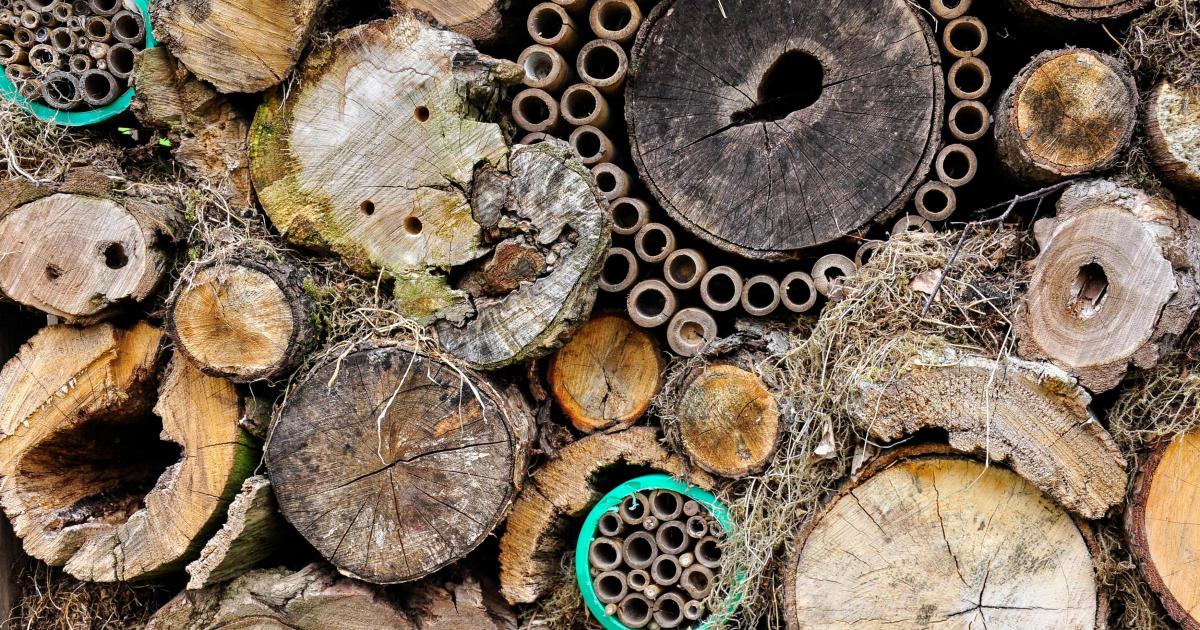
Wood contains lignin that provides structural rigidity to wood and tannins, acidic chemicals protecting against decay and pest attack. Only specialist, saprophytic fungi can break wood down. The fungal species engaged in decomposition specialise in different tree species, with each tree finding one fungus initiating decomposition over the first 2-3 years, and another two species successionally working on the wood. The final outcome is fine, soil-like woody particles.
Since I want my compost more quickly than this, I consign all sorts of smaller woody material to my dead hedge, a large pile of assorted woods in a corner of the garden. It steadily rots down over several years and in the process it offers many organisms a home, shelter and food source.
Read more:
Larger stems and branches decay more slowly and can provide a longer-term wildlife habitat. The wood of different tree species rots at different rates. Basically, the faster a tree grew the faster it will decay. So Ash, Birch or Poplar will have collapsed to compost long before you will notice much difference in an Oak branch.
A decade or so ago, a large branch broke off an old oak during a ferocious storm. Two stems sank into the grass and acted like arms supporting the main branch. This made a large decorative feature for several years before decay shortened the ‘arms’. Many plants and fungi are still busy there.
After the branch fell, I cut off a section which fell nearby. For a little while it worked as a seat in a shady spot beneath the towering oak. But before long we had to sit elsewhere as several different mosses and truly beautiful lichens moved in. But perhaps most interestingly, a native Scottish fern, common Polypody, Polypodium vulgare, has taken up residence.
A pile of logs provides another useful habitat for biodiversity. As fungi break down lignin and tannin, they make it easier for other creatures to move in to accelerate the wood’s disintegration. Many beetles, such as the wasp beetle, feed on the rotting wood, extracting nutrients from fungal hyphae-fruiting bodies. They lay eggs and the larvae also start feeding on the wood.
Overwintering butterflies and ladybirds will start using little nooks and crannies that appear as wood rots down. And solitary bees will also find this useful.
If you’re very ambitious or are preparing a garden for the Chelsea Flower Show, you could copy the Victorians and set up a stumpery. This horizontal trunk with half the root plate towering above looks most decorative, especially with ferns and other woodland planting emerging from carefully placed little pockets of soil. A hop, rose or even ivy might impressively scale the structure.
Following October’s Storm Amy I found a collapsed Oak, with half its root plate exposed. But this ‘real’ stumpery was tucked away in a secluded part of the garden and the tree was still alive, so a stumpery was assuredly out of the question.
Plant of the week
Salix alba ‘Britzensis’ is a long-leaved willow (Image: PA)
Salix alba ‘Britzensis’ is a long-leaved willow with bright, orange scarlet stems that give good winter colour in the garden. Does best in damp soil and a sunny spot to intensify the colour of the stems.
Cut back hard in early March as only fresh stems provide the attractive colour.
Comments are closed.