
Chris McKeown
| Special to The Enquirer
As long as there has been the legend of Santa Claus, there has been curiosity about what he does in the off season. We all see pictures of Santa at the beach. I would like to think and hope that Santa is a gardener. After all, the gardening season does fall opposite to his busy season of Christmas.
Here in southwest Ohio, we certainly have gardening challenges related to weather. Our challenges are nothing like Santa’s. In the North Pole, the average temperature in the winter is 30 degrees below zero. The winter is nine months long, with three months of summer. Spring and fall only last a few weeks. The summer temperatures can average in a range of 37-54 degrees. This is warmer than I thought.
There are more than 1,700 plant species growing in the Arctic. Now, this number may seem very high but included in this number are lichens and mosses which are considered plants. They grow mostly on the underside of rocks.
Also growing up there are shrubs, grasses and forbs. Amongst these, there are only 60 species of flowering plants growing in the North Pole. Arctic plants grow very low so they can be protected by the snow during the long winter months. This is why there are no trees. All of the plants have small leaves to keep them from losing moisture in the winter months. These plants all require minimal light to grow.
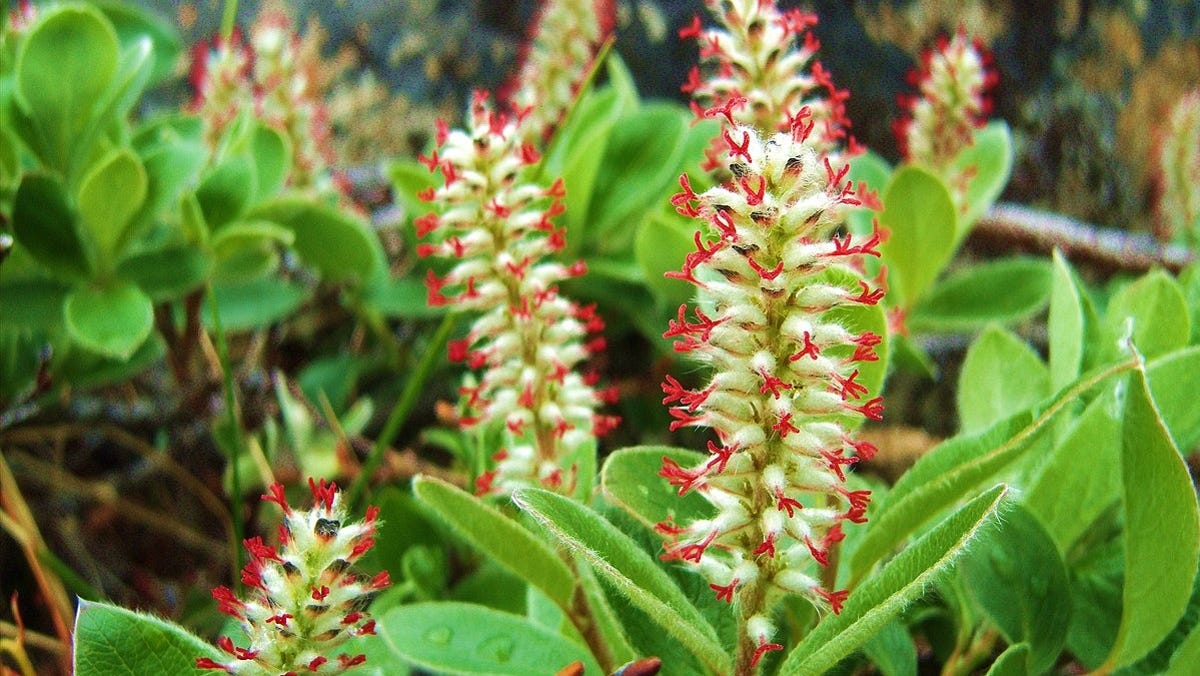
The only plant variety we can relate to growing up there is the Salix arctica – Arctic willow. This plant is in the same family as the willow trees and shrubs growing in our landscapes. The Arctic willow only grows 1-5 inches tall. It is a food source for Arctic animals like caribou, musk oxen and hares.
These animals would also be the source of meat needed to feed the elves and their families. They need a balanced diet so what about the vegetables. Vegetables are grown in the North pole and other Arctic regions in greenhouses.
Growing vegetables in greenhouses in these regions is interesting because in the winter they go months without sun. Without sun, they cannot grow anything in the greenhouses. Conversely, in the summer there are months when the sun never sets.
In these months, the extra light is an extreme benefit as it allows the vegetables to grow to much larger sizes. Many of these vegetables reach record sizes. In the greenhouses, they grow varieties of greens, squash, tomatoes and potatoes. They will even grow flowers in the greenhouses for Santa to give to Mrs. Claus.
What I have learned is that Santa does garden. It seems like during the dark winter months the elves fulfill their duties making all of the toys for the good boys and girls throughout the world. Then when the sun shines nonstop during the summer months there is a crew of elves led by Santa who transition to the greenhouse to grow the vegetables to feed everyone in Santa’s Village.
In case you are wondering what Santa likes to do most in the garden, he likes to hoe, hoe, hoe.
Comments are closed.