
The one pictured was a particularly stunning event with the sky almost on fire, creating a magical image.
We recently had a visit to Leonardslee gardens, on what turned out to be an extremely cold day. I don’t think the temperatures rose much above freezing point that morning and even poor Chester, our terrier, was feeling the cold on his paws and made clear he had had enough after wandering through the gardens for almost an hour. That said, the gardens were still very picturesque as you can see from the image of the lake with the sculpture.
Despite the cold, it was a beautiful sunny morning with amazing blue skies as a backdrop.
There have been a few frosts hit the garden over the last 3 or 4 weeks and the euphorbia mellifera looks quite interesting with its frozen leaves curled and frosted. Euphorbia mellifera, the Canary spurge or honey spurge, is a species of flowering plant in the spurge family Euphorbiaceae, native to Madeira and the Canary Islands. It is an evergreen shrub.
It has become a popular garden plant for its honey-scented summer flowers, which are popular with bees, attractive domed growth habit, and waxy leaves. It can be grown in full sun or partial shade, and will vary in habit depending on the sunlight it receives. In full sun, it will develop a denser, more compact shape, and in shadier spots, a looser and taller habit. It looks brilliant growing in exotic borders or gravel gardens.
Mine pictured is in a large bed behind the old railway sleepers at the rear of the house.
The plant can be pruned back hard in spring if it starts to get too leggy, but remember to wear gloves when pruning, as the milky white sap can irritate the skin and eyes. Lush and slender, cheerfully rich vibrant evergreen leaves crowd the upper parts of this rounded shrub’s upright stems. Each leaf has a striking cream-coloured mid-rib and emerges yellow/green before darkening to deep dusky dark green, making a stunning evergreen backdrop to the large richly honey-scented clusters of flowers, loved by all pollinators. They emerge red/burgundy and fade to orange-yellow, lasting for many weeks, followed by exploding seed heads that pop open to disperse their seeds.
A plant I really love in the gravel garden is the hardy aloe striatula. It is a sturdy succulent plant that naturally occurs on the summits of mountains along the south of the Karoo region of South Africa. Tough and hardy, with bright yellow flowers, it is also cultivated as a garden ornamental. Its natural habitat is hot and dry summers and very cold winters. It’s therefore an incredibly hardy aloe, which can be grown outside all year round in most parts of the UK. It has a sprawling, scrambling habit and may even climb if given support. Its fleshy leaves are striped in different shades of green.
In summer, it bears tall, dramatic flower spikes, not dissimilar to those of kniphofia, and it eventually forms a branching, woody trunk. It’s perfect for growing in a dry, gravel garden, where you don’t have to worry about getting it through winter. Grow Aloe striatula in free-draining soil in full sun. Deadhead blooms and tidy up foliage when necessary. In very cold winters, the foliage may shrivel but it quickly puts on new growth in spring.
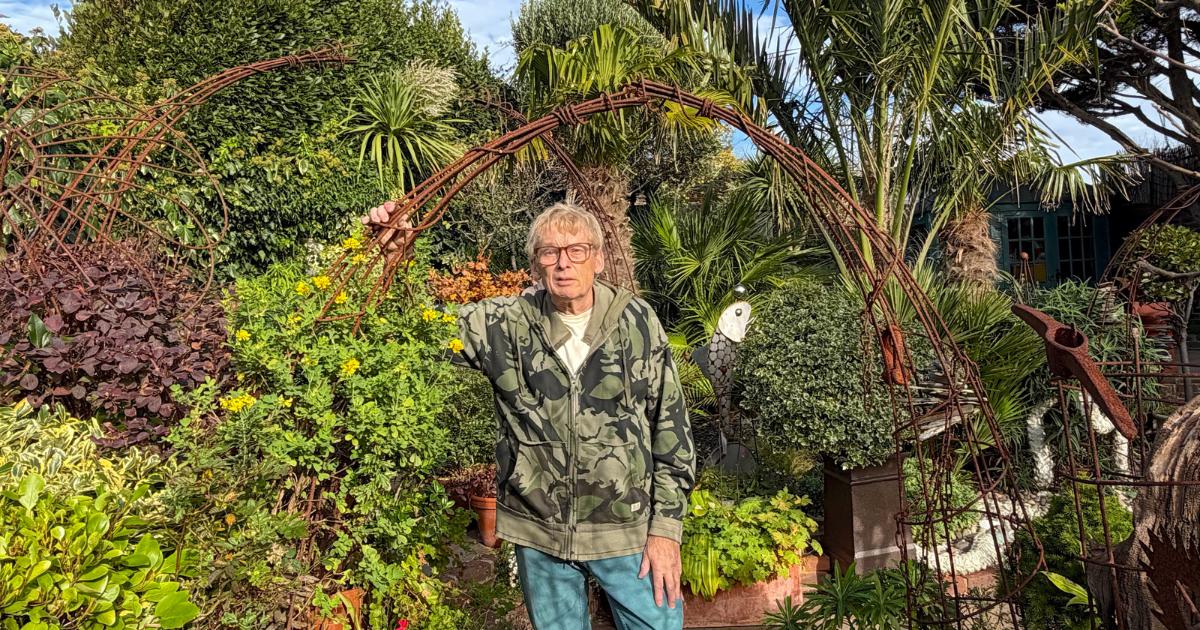
The back garden at Driftwood is still looking quite good for mid-December, as you can see from the image with me by the rusty metal arch. There is still lots of foliage colour around the plot and a few geraniums still managing to survive. You can see the pretty flowers of coronilla glauca by my hand, which never fail to impress through the cold winter months too. The dramatic central palm, a butia capita or jelly palm, looks impressive as well.
It is native to the states of Minas Gerais and Goiás in Brazil and is one of the hardiest of the feather palms with pinnate, frond-like blue green leaves. These leaves can grow between 1.4m to 3m in length and are strongly downwardly recurved, sweeping the ground in younger plants, giving this palm a very distinctive and tropical look. Its trunk grows thick and stout. Each leaf has 25-60 pairs of slender leaflets which ascend the spiny leaf stalks to form a V shape. The heavy trunk is patterned with the stubs of old leaves.
In summer, small, creamy-yellow, fruity-scented flowers appear along long spikes, up to 3 feet long. The palm is very drought tolerant and will withstand temperatures down to -10 degrees.
Read more of Geoff’s garden at www.driftwoodbysea.co.uk or follow both him and the garden on social media.
Comments are closed.