
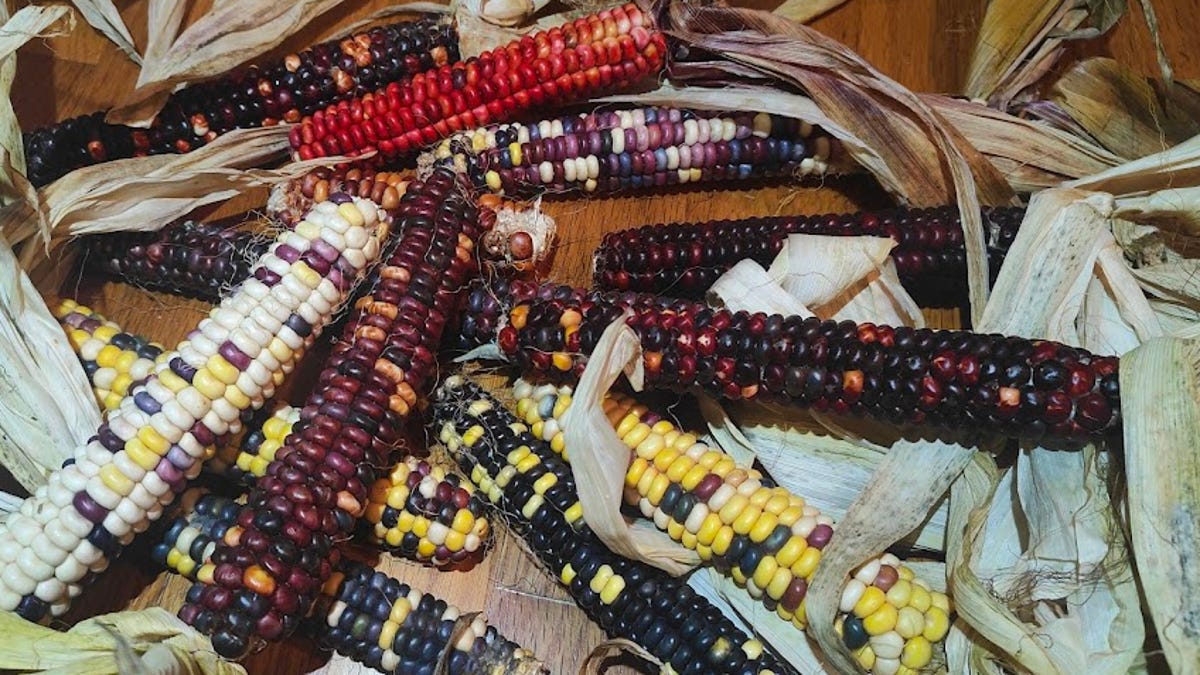
Thanksgiving is over and all of our autumn decorations have been taken down and put away. One of the decorations we used this year was Painted Mountain corn. It is an open-pollinated variety that was originally bred as a corn to grind into flour but has a secondary use as an ornamental corn with a wide range of colored kernels.
The variety was developed over a number of years by one single farmer in Montana during the 1970s using conventional plant breeding without genetic modification. He crossed around 80 traditional Native American varieties, choosing several traits including plant hardiness, taste, adaptation to mountain growing conditions, and maturing in a short growing season. Some of the varieties he used are now extinct but much of their genetic material remains as part of the Painted Mountain genome. The seeds can now be purchased online from numerous seed companies.
Every color that corn can produce is represented in these colorful cobs of corn. Red, yellow, blue, orange, purple and green are all present. Some cobs are all of one color, while others have a mix. Occasionally you can find a cob where each one of its kernels will have all of the colors in beautiful swirls on its surface. The cobs have only 12 rows of corn around the circumference of the cob compared to 16 rows found on most corn varieties, making them appear noticeably narrower.
Because of their thin seedcoat, the kernels can be ground into a finely-textured, soft flour that is used for corn bread, muffins and tortillas. Additionally, the grain contains 13 percent protein, which is significantly higher than the 8 to 10 percent found in other corn varieties.
The plant itself grows to only four feet tall or so, which is short compared to field corn, which is typically around eight feet tall.
As a short-season variety, Painted Mountain corn matures quickly to a dry grain in 70 to 90 days, depending on the elevation, seasonal temperatures and other growing conditions. This makes it ideal for short growing season areas like northern Michigan. Painted Mountain can also produce a crop in partial shade. It tolerates cold soil and air temperatures as well as drought and hot weather.
Painted Mountain can be eaten as sweet corn when harvested at the milk stage when the kernels are still soft and white and yellow in color. The bright colors form later on as the kernels mature and harden. While being sweet, it is not sugary like modern varieties but instead more of the corn flavor comes through. The corn can be cut from the cob and canned or frozen like typical sweet corn. A gardening friend of mine, Ben, tells me that when cut at just the right time, even the stalks are sweet with a soft texture. I cut a few stalks to try this out but missed the short window for sweetness and they were a little dry and bland. I’ll try again next year.
Comments are closed.