
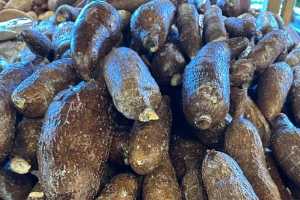
Cassava in an interesting food that literally has roots in the diets of millions across the world. Cassava is one of the important food crops grown in the world.
Cassava is an interesting food that literally has roots in the diets of millions across the world. In fact, cassava is one of the important food crops grown in the world and is known by many other names in different regions, including manioc, yucca and tute. Cassava is a woody shrub from the Euphorbiaceae family, native to South America. The origins are traced back to Brazil, Paraguay and parts of the Andes.
Why cassava? It is not a typical vegetable we see on menus or even on our dinner tables. But I had the opportunity to spend a month with a young woman from Zambia, Mwamba Mukupa. Mwamba was visiting Michigan State University as a professional fellow in Michigan State University’s Advancing Young Women Agribusiness Entrepreneurs and Innovators Program this fall. While here, alongside South Africa fellow Eunice Mashao, we explored countless farmers’ markets, farms, orchards, vineyards and even a cranberry harvest. While we were exploring Michigan crops, Mwamba taught me about the importance of cassava in Zambia and other African countries.
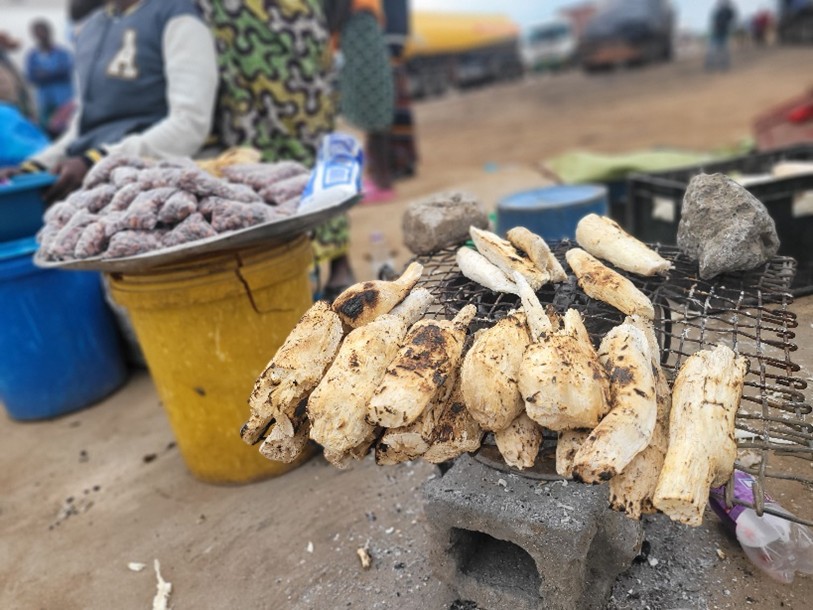
Roasting cassava. Photo by Mwamba Mukapa
Cassava is a tuberous root vegetable with a high carbohydrate content and grows in poor soil with little rainfall. Because it grows in relatively adverse conditions, it has been has become a staple in diets where water and good soil is in limited supply. Cassava is native to South America and was introduced to Africa by Portuguese traders from Brazil in the 16th century. In 2021, Africa accounted for nearly 204 million tons of cassava, making it the largest producing continent of this vital crop.
One major problem is cassava in its raw form has toxic levels of cyanogenic glycosides. There are two major types of cassava, bitter and sweet. According to the U.S. Department of Agriculture, both varieties have the cyanogenic glycoside but the bitter variety of cassava is actually poisonous when raw because it contains significant amounts of cyanide, a deadly chemical. The bitter cassava grows in Africa and isn’t sold in U.S. supermarkets, however the U.S. imports the sweet variety from Central America and the Caribbean. Sweet cassava contains smaller amounts of cyanide, meaning it’s still inedible raw. But peeled and cooked cassava is totally safe to eat. Removing the cyanide involves removing the reddish-brown bark containing the toxin and hours of soaking and cooking. The water it is cooked in should be discarded, as it also contains cyanide.
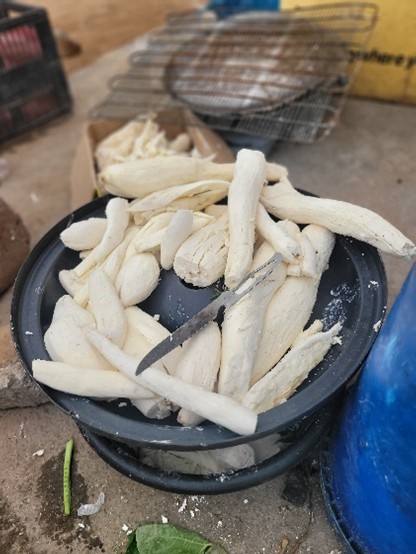
Preparing cassava to cook. Photo by Mwamba Mukapa
Researchers at Michigan State University have published many studies about cassava, because it plays such a crucial role in feeding the world. Because of this research and the worldwide importance of cassava, there are pictures of cassava processing on the walls of the Justin S. Morrill Hall of Agriculture at MSU. Locally, I’ve seen cassava roots at specialty markets and cassava flour at my grocery store. While researching for this article, I learned that tapioca is made from cassava starch, which means you’ve most likely eaten cassava too – as tapioca pudding!
Here are a few more fun facts about cassava:
It’s Latin name is Manihot esculenta.
Cassava can be baked, boiled, fried or grilled.
Cassava flour can be used as a gluten-free alternative in baking.
Tapioca is made from casava starch. For tapioca pearls, the wet starch pulp is formed into a dough, shaped into small balls, and then cooked to achieve its characteristic chewy texture.
Like Irish potatoes and yams, cassava is a tuber crop.
Cassava roots have a similar shape to sweet potatoes.
Today, more than 80 countries throughout the tropics grow cassava. It is a primary food for more than 800 million people around the world.
The leaves of the cassava plant can also be eaten after boiling.
Due to its high starch content, cassava is an excellent source of energy.
Cassava also contains small amounts of potassium, vitamin C, magnesium and B vitamins.
In Zambia, roasted cassava is typically accompanied by roasted ground nuts (peanuts) and a hot beverage on a rainy day and commonly referred to as “Tute ne’ mbalala.”
Fufu is another African dish made from cassava and green plantains.
Foods that people can make using cassava include:
Bread, which can contain gluten-free cassava flour
French fries
Mashed cassava
Cassava chips
Cassava cake
Tapioca pudding
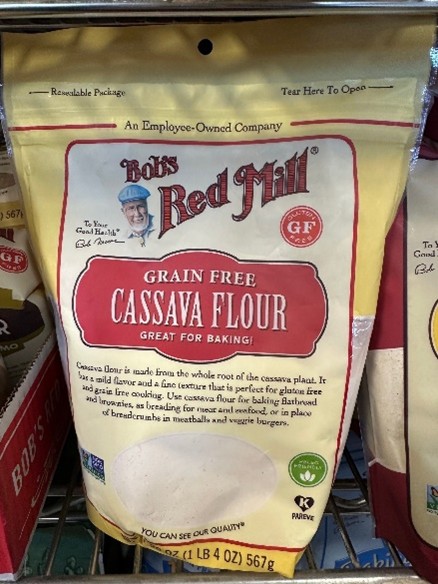
Cassava flour. Photo by Dixie Sandborn.
In addition to food, cassava can be used for:
Medications
Animal feed
Manufacturing fabrics, paper and building materials such as plywood
Bio-ethanol fuel
After learning about cassava, you might want to learn more about foods around the world. Michigan State University Extension offers a few ideas for diving deeper into new foods:
When shopping for produce in your grocery store or market, try to find new and interesting foods.
Research a little about the food you discovered and how to prepare it.
Try some new recipes from other cultures.
Host an international night and your guests could bring their favorite foods from other cultures.
Enjoy learning about different cultures through food!
Did you find this article useful?
Please tell us why?
Submit
Comments are closed.