

IF I SAY: quick, name a holiday flower, you might first answer poinsettia. But the poinsettia wasn’t always synonymous with this time of year, today’s guest tells me – like once upon a time more than a century ago the chrysanthemum took center floral stage from Thanksgiving to New Year’s, surprising as that might sound.
Whether historic or cutting-edge modern, horticulturist Matt Mattus reminds us there are many choices of festive blooms, including various ones we can grow ourselves indoors, and he has tricks for perfecting even the most familiar of those – your amaryllis, for instance.
Matt Mattus is a lifelong plant person – and that’s putting it mildly – and I can always count on him to be showcasing some drool-worthy flower on his Instagram feed, even in winter. That’s one of his exhibition mums, above.
You may recall a popular conversation I had about Christmas cactus with Matt, who is Senior Director of Horticulture for the American Horticultural Society. Matt gardens in Massachusetts, and is the author of various garden books, including “Mastering the Art of Vegetable Gardening” and “Mastering the Art of Flower Gardening.” He also provides consultation services both virtually and in person to help others with garden-design and plant-care issues.
Read along as you listen to the Dec. 8, 2025 edition of my public-radio show and podcast using the player below. You can subscribe to all future editions on Apple Podcasts (iTunes) or Spotify (and browse my archive of podcasts here).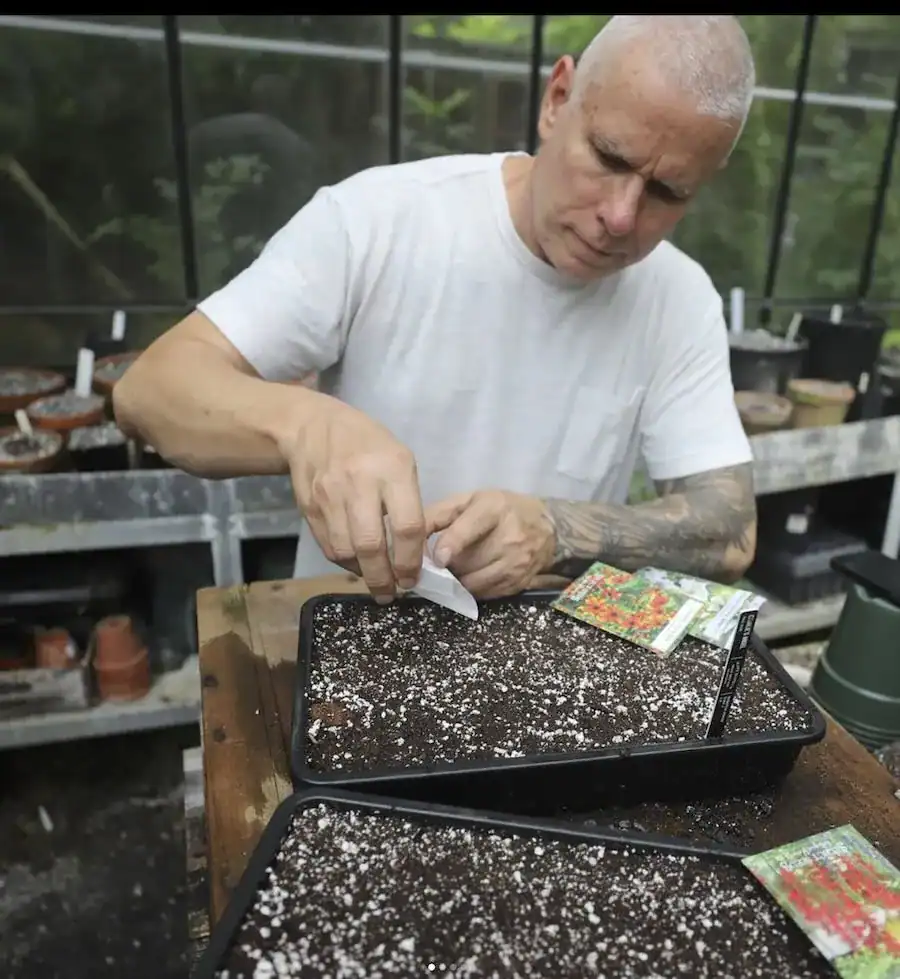
the history and how-to of holiday flowers, with matt mattus
Download file | Play in new window | Duration: 00:27:53
Subscribe: Apple Podcasts | Spotify
Margaret Roach: So ho, ho, ho, Matt or something [laughter]. How are you?
Matt Mattus: I’m great. I know those of us in the Northeast are suffering through our first snowstorm.
Margaret: I know. Unlike last year when I don’t think we had it right away, did we?
Matt: I know. But hey, it’s starting to feel like the holiday season at least.
Margaret: Yeah. I’m not looking forward to the single-digit nights though that are coming up in the next few days. That’s not my favorite thing. Keep those pipes unfrozen, baby [laughter].
Matt: That reminds me, I have to turn the heater on in the greenhouse for that.
 Margaret: Hello: This is your reminder, Matt; this is your reminder: Batten down the hatches.
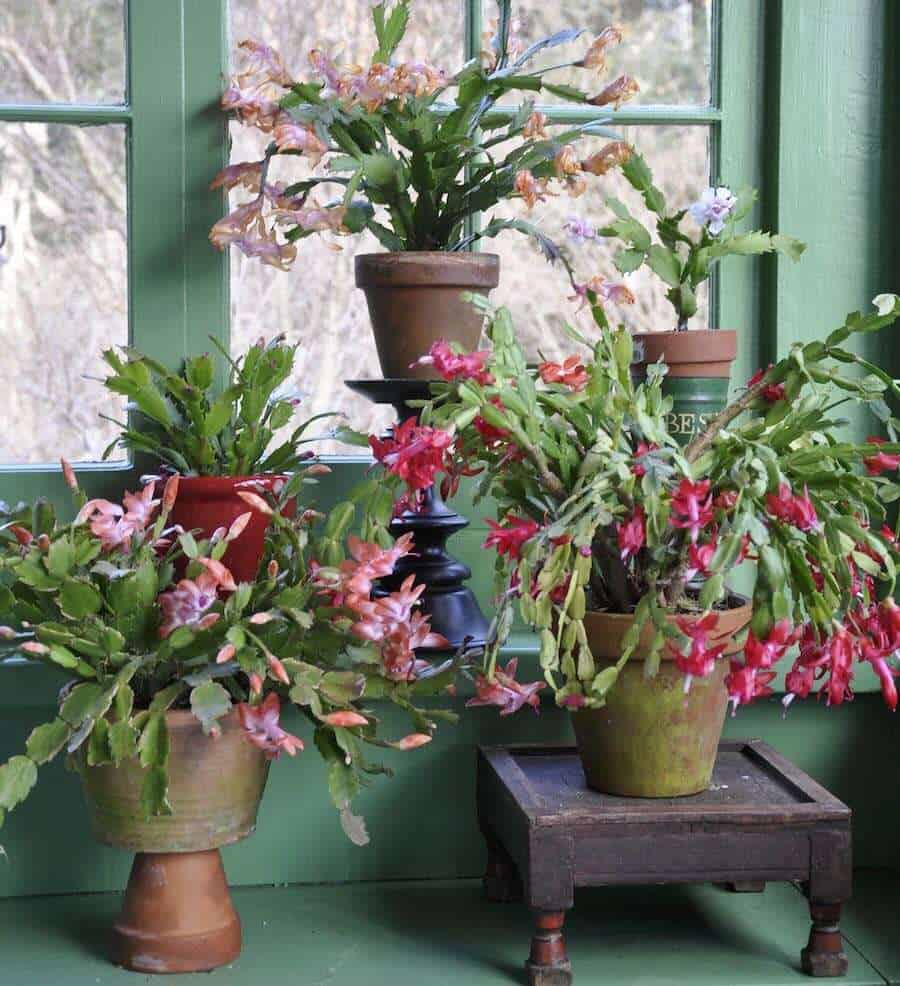
So yeah, so we did Christmas cactus not so many years ago, and it is not exactly a holiday flower, so to speak. I mean, it’s a flowering plant. But anyway, I’ve been watching your Instagram, as I said in the introduction, and you’ve been showing these incredible chrysanthemums and so forth. [Above, some of Matt’s Christmas cactus.]
And it got me nostalgic in a funny way, because one of the first pictures, baby pictures I have of myself is standing in front of a row of standard, single-stem, one-flower-at-the-top disbudded chrysanthemums that my grandmother grew each year for the fall flower show. She was into that, and she covered them with black cloth for X number of hours a night so that they got the right amount of darkness or whatever the triggers were. And so there I am with these show mums.
Matt: Oh my God, how did I not know this?
Margaret: Weird, right? [Laughter.]
Matt: Yeah, no, that’s really amazing. But first of all, it’s timely, I think. Let’s say the exhibition chrysanthemum, those you’re talking about, the sort of one giant flower in a single stem were just out of vogue for the past 70 years, I mean, unless you’re a member of the Chrysanthemum Society. And all of a sudden in the past five years, or even the past two years, it’s everywhere on Instagram. It’s like the “it” flower all of a sudden.
Margaret: Yes, yes.
Matt: The new dahlia, but it’s great. But they were the holiday flower a century ago. Chrysanthemums were easy to grow, and they grew all summer—they grow from cuttings in the spring and then they grow all summer. So local florists could grow these in their greenhouses, even if they kept them cold in the winter. But talk about local flowers, that was the flower available between October and New Year’s.
Margaret: So you see vintage pictures of these at the holidays and stuff? Cool.
Matt: Yeah, I mean, if you just go into Etsy or whatever and, say, look for vintage engraved holiday cards, you start seeing all these flowers that aren’t typically what we think of as holiday flowers. I mean even goldenrod you’ll see on a card from the mid-19th century, but often chrysanthemums for holiday card with a piece of holly.
Margaret: [Laughter.] Chrysanthemums and holly; that’s a funny combo. And again, as I said also in the introduction, we think poinsettia and that we think, oh, well, that must have been forever because it’s so ubiquitous, but it’s not. It’s much more modern, right, relatively speaking?
Matt: Totally modern. Yeah. In fact, it’s so modern as a potted plant, it really wasn’t until the 1950s where you started seeing… You think of these short ones you see now in the markets with gold foil on them, and they’re only a foot high, and that’s relatively new. That’s mid-20th century. The Ecke breeding in California and all these beautiful colors and ugly colors, however you feel about-
Margaret: Paul Ecke?
Matt: Yeah, he transformed the poinsettia. But if you look at any old holiday movie, they were a cut flower. They were primarily… if you look at “Christmas in Connecticut,” that’s a vase of cut flower poinsettias on the piano. They were grown in California. There was a big deal in Hollywood. I mean, it was grown as a crop, a field crop, in Hollywood where they’d have a poinsettia trolley that would take you out to look at the fields and you would cut stems. And almost every old movie from the forties, you won’t see a potted one, you’ll see them as a bouquet or in a vase.
Margaret: And then we invented the growth regulators that could be sprayed on them to keep them dwarf, and we put them in pots and mastered all that stuff.
Matt: Which brings us back to hardy mums, right? The mounded mums—that’s what’s given the chrysanthemum, I think, a bad name, other than supermarket mums that were cheap and easy to export. But that’s all changing.
So holiday flowers where they really go back in time; like you said before. What was there before the poinsettia, because really in even though the poinsettia was discovered in what the mid-19th century and brought to Philadelphia and really only grown by the very wealthy who could afford a hothouse. And you had to shade them, just like you mentioned,with the chrysanthemums. You had to shade them to adjust the photo-periods so they would bloom at Christmas, otherwise they would bloom… In Hawaii—I went to college in Hawaii, and they bloom there, sort of naturalized in the woods; they grow them like hydrangeas there around your house. They would bloom January and February. They’re 12 feet, but not as a potted commercial plant.
Margaret: Pretty funny. So these are two things quite old and with the mum, and less so with the poinsettia; greenhouse crops, really. And you have a small greenhouse, and so you’re able to grow some of the mums, and that’s really fun. And they’re gorgeous. And I’ll give the link to your Instagram because some of the flower forms are just unbelievable.
But for those of us for whom it’s the wintertime, the holiday time, etc., the things we can grow in our houses if we don’t have a greenhouse, a lot of them are bulbs, yes?
Matt: Yeah, absolutely. Bulbs go way back. I mean, yeah, the chrysanthemum is something—just to touch quickly on that—they’re difficult to grow unless you have a greenhouse, because maybe in the mid-Atlantic states you can get them to bloom outdoors, but they do bloom late. So unless you have a place, a porch or somewhere to keep them, that’s difficult for the exhibition ones.
But this is when you’re seeing holiday plants for sale at florists or at the florist market at a supermarket. Thinking back on those, I’m thinking bulbs were always, I think the first thing. A lot of us think of amaryllis or paperwhites, and I always felt—I don’t know if you did—it might be just my age, but I felt that they were sort of mid-20th century. I didn’t see them before that.
Margaret: I thought that, too. And then when we chatted the other day on the phone, you told me that amaryllis have been around a really long time. How old?
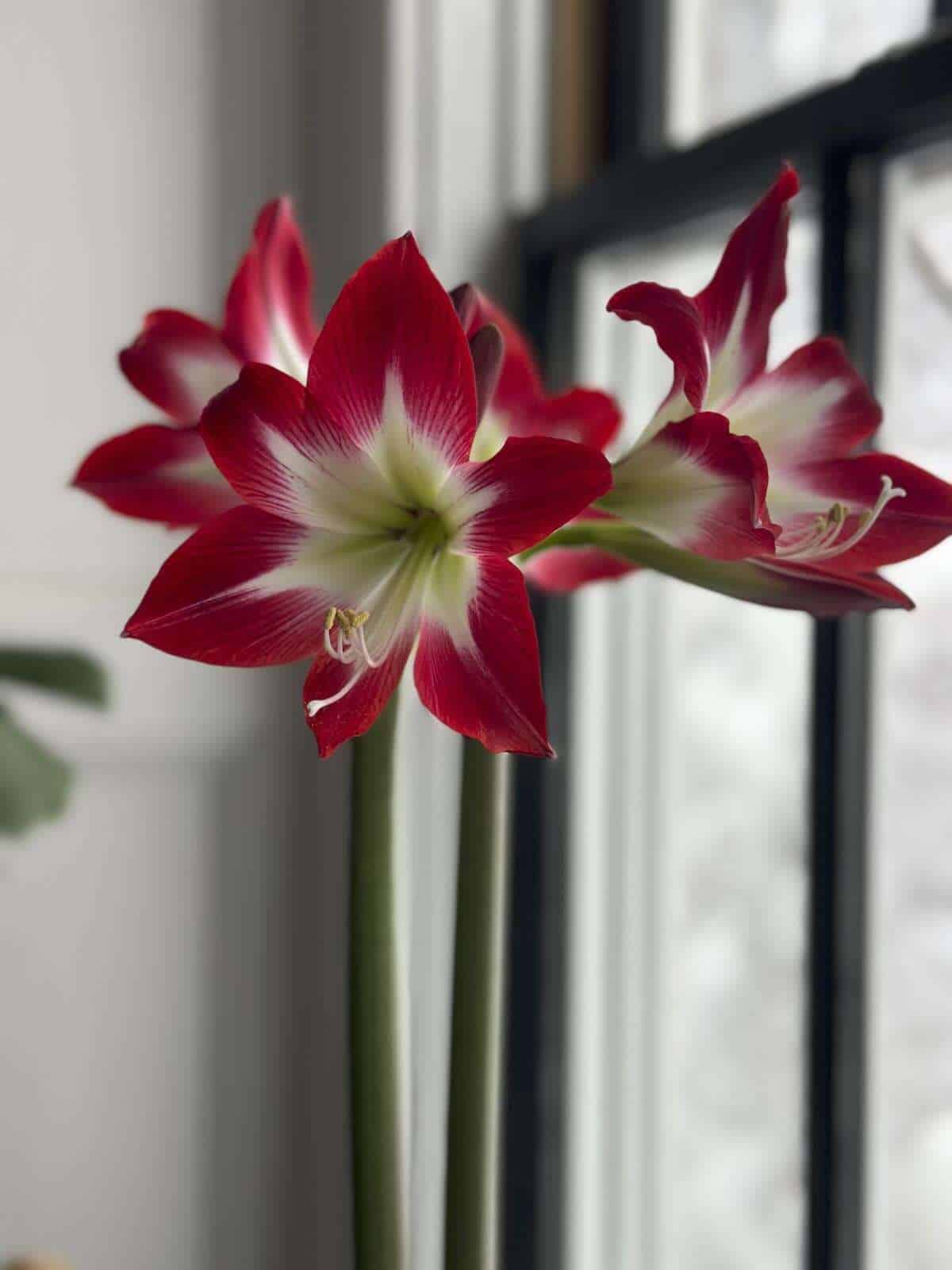 Matt: Well, I mean, so the late 1600s. I mean, they’re from South America, so they really weren’t brought to Europe until the Dutch brought them. But let’s say by 1700 or 1730s, they were in Europe and started to be forced. They realized that this was a plant that bloomed in the winter, and it was easy to grow because you could ship them on a ship.
If you think about it, bulbs are perfectly designed, they’re perfectly packaged, to be on a merchant ship in the 1700s. They come from the Southern Hemisphere, they’re grown opposite seasons. So they can sell these when they went to Europe while they were dormant. And then what would be better than having something flowering in 17th, 18th, 19th century in the winter in Europe? Especially in Germany and England, and that’s where people were really just starting to grow florist flowers, Primula, or anything that would flower in very late winter, early spring.
But paperwhites were closer to them because they’re from the Mediterranean area. So really they date back, too, quite far. So these aren’t even something that Lincoln would have had. It was way before that.
Margaret: And so one of the things that’s interesting with the amaryllis is they’re not all exactly the same. You were just talking about where they originally hail from and so forth. But where we order them from today, our bulb catalogs, they’re coming from two different places, I believe, and they behave differently because of that. So an amaryllis is not an amaryllis is not an amaryllis, right? [Laughter.]
Matt: Even in the name amaryllis is confusing. It’s very similar to Geranium and Pelargonium. So the true Amaryllis is Amaryllis belladonna. We’re not talking about that plant. The plant we’re referring most of us refer to as amaryllis is Hippeastrum. That would be the genus. You rarely would see them sold by that. I think everyone can picture an amaryllis—the big giant bulb, big red flower. That’s what we’re talking about here.
And yeah, they go back quite far, but they also are Southern Hemisphere, Brazil, Paraguay, South American plant. There are a number of species; there’s more than one. And the modern ones we see today are often crosses or sort of complex crosses of a number of species. I mean, no one needs to know that, but you might be wondering why you’re seeing spidery-flowered ones now or miniature ones, and there’s just a lot of breeding going on.
But the Southern Hemisphere ones were always the ones that would, if they were shipped from the Southern Hemisphere, they would bloom at Christmas more likely. And you’ll see that today in catalogs. A good bulb catalog would say, this is a Southern Hemisphere-grown bulb. And you might be wondering, I go to a big box store and I see an amaryllis with the flower bud emerging right now. Yeah, that’s probably going to bloom for Christmas.
But you also might buy this big expensive bulb, and you’re wondering, why isn’t the bud coming out? I potted it. It’s been three months and there’s no bud. That’s common. And those generally are ones that are grown in the Netherlands. Most of the bulbs are grown in the Netherlands. But there are some Netherlands bulbs that are treated, so they will bloom at Christmas.
Margaret: Oh my goodness.
Matt: The catalogs aren’t really clear about that. So I would say always look for a bulb that says Christmas-blooming if you want that.
Margaret: If that’s what you want, if that’s what you’re looking for, a holiday thing. Right. So when you say Southern Hemisphere as opposed to the Netherlands, Northern Hemisphere ones, is it like South Africa? Where are we talking about that they’re coming from?
Matt: Yeah, mostly South Africa, some in South America, but I think most are South Africa now, but they could be grown anywhere in the Southern Hemisphere. Yeah. It’s basically how they’re stored.
And this does go back to how do we get a bulb to bloom ourselves? They have to have that rest period. So the ones in the Southern Hemisphere, obviously they’ve been kept dormant longer, and they’re more likely to start blooming. I think the ones in the Netherlands, if they’re Christmas-blooming, if you do ever see any that say a Dutch bulb, but it’s still Christmas-blooming, it will probably bloom early January, not at Christmas exactly.
But it’s not unusual to buy an expensive bulb. The more expensive bulbs are usually better, I will say that. I mean, people complain that, “I paid $35 for a bulb.” But I don’t know if you’ve noticed it, but those big bulbs that look like softballs often have three buds that will come out over three or four months. So you’re really getting-
Margaret: It’s unbelievable. You’re really getting three bulbs. It’s almost like you’re getting three bulbs in one.
Matt: You get what you pay for with an amaryllis.
Margaret: Do you try to rebloom yours or do you discard them? Tell the truth. [Laughter.] Because one of the things is that, and we’re just talking about depending on where they’ve been prepared, so to speak, where they’re coming from nursery-wise, being shipped from—which hemisphere and the conditions there—dictates when it’s going to bloom.
And then the next year, if you decide to keep it—or at least this has been my experience—it’s not the same conditions. I’m not going to be offering the same conditions that it was used to in those previous years. So it’s got to get used to me and decide under my protocol and my conditions when it’s going to bloom and it’s going to take a year or two or whatever. So I’m going to think I’m failing. But it’s not that; it’s that it was programmed, so to speak, to a different world altogether than where I am, if it came from South Africa or it came from the Netherlands. Right?
Matt: Right, exactly. A lot of bulb collectors or serious bulb collectors talk about flipping that Southern-Northern Hemisphere timing with their South African bulbs; so it could be any South African bulb, and they will adjust to our Northern Hemisphere.
Margaret: In time.
Matt: In time. But you have to be patient. So hats off to anyone who can get an amaryllis to rebloom. You can absolutely. To answer your question, I’m a very lazy gardener, and I guess irresponsible. I mean, when I was growing them in the house, I could never get them to bloom. However, I do know some people that certainly can get them to bloom, and good for them. However, with the greenhouse, once I had the greenhouse, I was still a sloppy gardener and lazy. And because I’m growing so many things, and occasionally an amaryllis after it bloomed in January or February, I don’t know where it went. It went under a bench or it fell off into a potted lemon tree. And the potted tree was brought out in the summer, and I didn’t even know the bulb was there. And I started noticing bulbs popping up in the greenhouse that dropped and started blooming the following year.
And I thought, “Oh, I guess I can rebloom them.”
It comes down to how well you care for it. I mean, so yeah, if you want to get amaryllis to bloom, you absolutely can just think of it as a solar panel. As soon as it blooms cut the stem off—and they make great cut flowers too, if you want to cut it before the buds open. But that helps.
You want to keep that bulb really well-energized, so as many leaves as possible in the brightest sun you can all winter. Keep it growing through spring and through summer and fertilize it every two or three weeks with balanced fertilizer; they are heavy feeders. You want to get a big bulb again, and you don’t want to starve it. These amaryllis, anything in the amaryllis family, forms the embryonic flower buds like one, two, sometimes three years in advance, deep inside that bulb.
Margaret: Wow.
Matt: So if for some reason that bulb sent up three flower buds, it might not the next year, or maybe it has two more in there ready to come out that started forming. So similar to Agapanthus do the same thing, or Nerine, but most likely you will get at least one flower bud that next year, and maybe if you kept it on that cycle again. But around August, you want to stop watering it and then give it a rest that’s dry, and it should be like a six- to 10-week rest. So you probably won’t be a Christmas-blooming bulb again. It’ll be like a February-March blooming bulb. But that would be the way to do it. Just you want to really take good care of it.
Margaret: Again, don’t think you failed if it doesn’t bloom the first, the next year, the first full year with you, so to speak, if it is growing, it puts out leaves and everything; it may just take more time. Or give up and buy a new bulb [laughter].
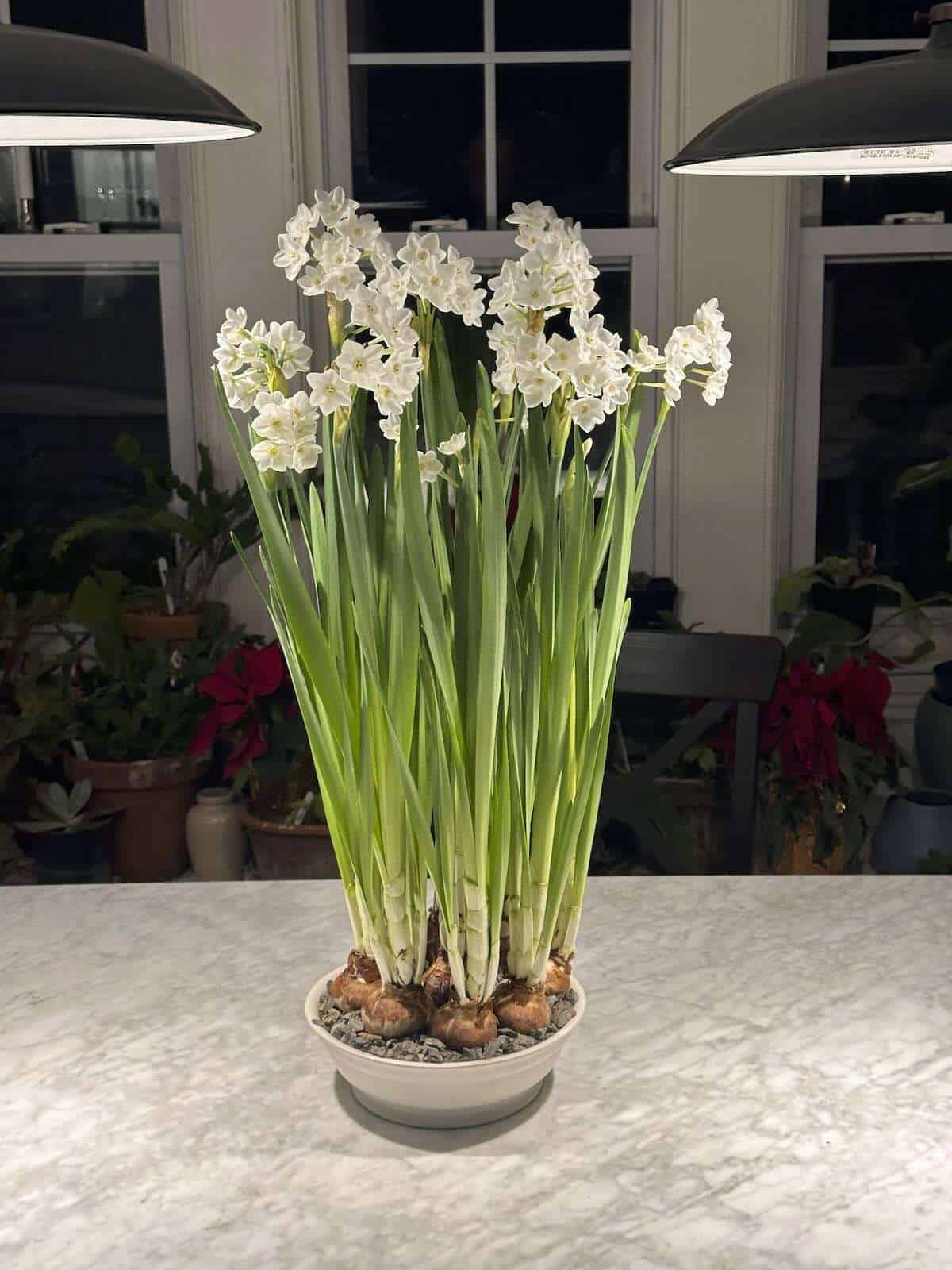 Matt: Well, it’s the way bulbs work. I mean, this leads to paperwhites [above] because I always get asked, “Can I read bloom a paperwhite?” And you can, I mean, but I don’t know why you would want to, because those are commercially grown. They’re heavily fertilized; they’re treated just like they’re basically grown at the finest hotel in the world to bloom again. But I have some in the greenhouse again that fall off the bench onto the floor and they bloom.
And you know what? If you’re listening in Arkansas or Louisiana, they’ve naturalized outdoors, or Southern California, so they are a Narcissus; these are a daffodil, basically. So we know the way we’re growing them, putting them in rocks or in a vase with water and alcohol, whatever is not the best conditions to treat your bulb if you want it to rebloom again. If you do want it to bloom again, you need to plant it like a real Narcissus, like 2 inches deep in the ground, in potting soil, and fertilize it after it’s bloomed. And it is a lot of work.
Margaret: Yeah, that crazy alcohol thing, I mean, that was a rage for a while. I don’t know if it still is or not. I don’t see about it as much as I used to years ago. But just tell us, what was that idea, the idea that you could do them in alcohol or whatever?
Matt: Yeah, I mean, when I first heard that, I thought, oh, that’s just another myth or hack that it seemed crazy, but it actually does work. And there was real research behind it. There was a study at Cornell, I believe students at Cornell first did this. You could Google it and find out, but it was, I think it’s 10 percent alcohol?
Margaret: Like vodka?
Matt: Vodka, or Everclear—yeah, like Everclear or vodka. I think it’s one part, like 1 out of 7 or whatever. [The Cornell report is here; the percent alcohol is 4 to 6 percent and the dilution to achieve that depends on the proof of the alcohol you use.]
Obviously that’s not the exact recipe. But it does work. But the trick with it, and I’ve seen this on Instagram a lot right now, is people are planting their bulbs and they’re watering them with this alcohol-water mixture. And that’s not the way to do it. You should plant your bulbs either in soil or in rocks, so whatever way you’re going to grow them, and then water them with regular water until they’ve emerged about 4 inches and then start the alcohol water. And that does keep them dwarf at the right height for your dinner table or in a windowsill, because paperwhites can grow 24 inches tall and flop over.
Margaret: So the idea is that they get a little drunk and they don’t grow as much [laughter]. O.K.
Matt: It stunts your growth, so that’s why you don’t drink alcohol, I guess.
Margaret: O.K. So do you have particular ones that you’ve sought out and that you grow? Do you grow them in soil? You were talking about potting them up in pots of soil. Do you grow them that way, or do you grow them in gravel? What do you do?

Matt: I do it a number of different ways. It depends. So I’m really growing them for decoration in the house during the holidays. And every year I do something different. Sometimes I might do a pyramid in a bunch of antique vases, and then I might use soil potting soil. I’m not trying to rebloom them at all, so it doesn’t really matter. It’s more of an aesthetic thing.
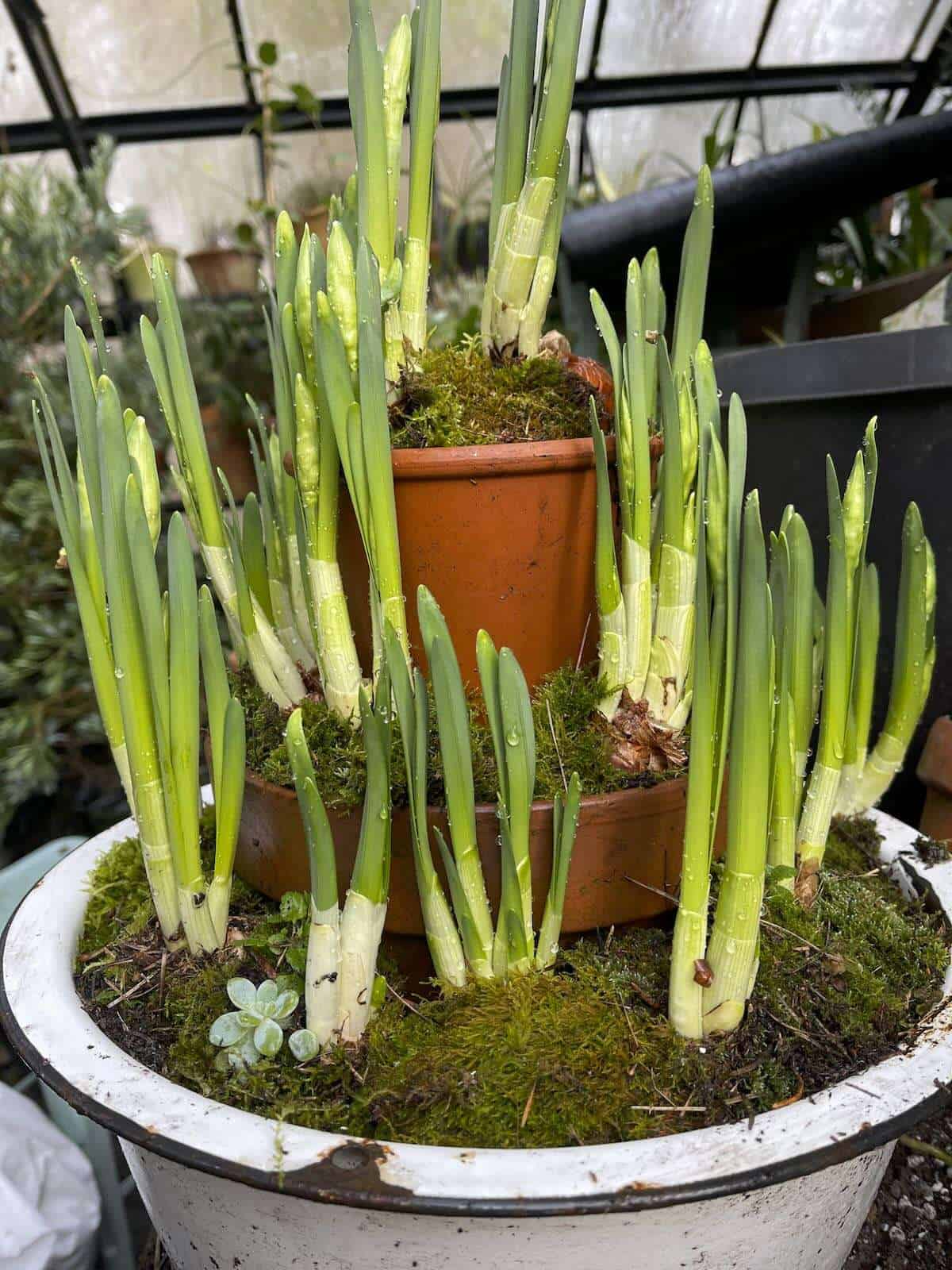
But I think my favorite way now is sort of a gravel and soil mixture in a container that doesn’t have drainage holes in it. So the more traditional bulb pan way [above]. But then I put green moss on top so it looks nice. So it’s more about the aesthetics. But I like the fragrance. I don’t know about you [laughter].
Margaret: Well, I was going to say, so to me that’s the deciding factor with those because amaryllis, they’re beautiful and there’s now, as you’ve pointed out with the breeding, there’s sort of a color or a flower form for every taste, and even a height since they’re experimenting now more with miniatures and so forth. But with the paperwhites, you either love it or you hate it, the fragrance. It’s strong. For me, it’s strong. I’m one of those people who with certain really strong flowers. What’s the white lily that’s so strong? An outdoor plant?
Matt: Oh yeah, like a ‘Casablanca’ type.
Margaret: Exactly. ‘Casablanca.’ And then there’s some sort of vine type thing-
Matt: Yeah, there’s some flowers that shouldn’t be the house, I agree.
Margaret: Yeah, there’s some that are super, super-strong and they kind of get, to me, it’s like a little too much and I don’t really want it in the house as much.
Matt: Especially in winter.
Margaret: Are all the paperwhites as fragrant? All the paperwhites are very fragrant? [Below, Matt stacks moss-covered pots and pans of bulbs to make impressive displays.]
 Matt: Well, I mean breeders have selected now, I mean there are probably a dozen cultivars of paperwhites and maybe eight or so that you can find. This year for some reason the catalogs only offered a few, so I’m not sure. Most of them are grown in the Middle East.
But the strongest old-fashioned type would be the cultivar called ‘Ziva.’ So if you like the scent of paperwhites, if you like the cat pee smell, that’s the one to go to [laughter].
But new varieties like ‘Nir,’ that’s a little less potent though I think some people still would think it’s very strong. But there are some that are very sweet-smelling. So if there is a certain type of fragrance you like—if you like it to smell like powdered sugar or vanilla, ‘Galilee’ is a little better. I don’t know. I think ‘Inbal’ is one. ‘Inbal’ is the one you would most likely find sold commercially, and that’s almost scentless. But if you like super-sweet, the old-fashioned—these were grown in China back in the 1500s—so there’s one called Chinese Sacred Lily. They’re really grown for sort of lunar New Year.
Margaret: I didn’t know that. That’s interesting.
Matt: Yeah, it’s harder to find, but I can’t find it in a lot of Dutch bulb catalogs, but I found it at my local garden center. So some good garden centers might carry five, six different types of paperwhites, but the ones that have a yellow center, so like Chinese Sacred Lily or sometimes ‘Grand Soleil d’Or,’ it has a yellow trumpet in the center. Those are generally sweeter-smelling. They’re sort of closer to ‘Erlicheer’ or the Narcissus you grow outdoors that have multiple small flowers, so they smell really delicious. But they’re not as floriferous; they won’t produce as many flowers, though, and they’re taller stems, so they have their faults, too.
Margaret: How long is it going to take? You said you like them for indoor decoration and so forth. When are you potting these up? Have you already done so? Do you do them in stages?
Matt: Yeah, I did mine yesterday for Christmas, but I also have to sort of time it. It depends how warm your house is. So I have them indoors now in the house. I planted big urns with a dozen bulbs in each. And then I do some individual ones. And these are just for my Christmas table. But if they start to grow too long, I bring them out to the greenhouse because it’s cool in there. It’s 40 degrees, they’re getting full sun. I don’t need to do the alcohol treatment because under those cool conditions they gross stumpier and shorter.
Margaret: I was just going to say, you’ve just shared what part of your holiday decor is. Is there anything else that there’s still time to do that we could do right now? That there’s still time to do?
Matt: Well, I usually do my plant windows with a mixture of those, but also the new Cyclamen that are coming out. There are a lot of interesting varieties that don’t even look like Cyclamen. So look for those. The miniature ones with upright flowers. There’s been a lot of breeding in Germany and in the Netherlands for the past two or three years. So you’re going to see Cyclamen that don’t even look like Cyclamen. They look like primrose—I mean they’re in the primrose family.
I’m mixing all those together. I think even just the buds of Amaryllis growing inside moss with paperwhites all together. You see that done a lot now. They don’t have to be in bloom to look that touch of spring; we like that touch of spring.
Margaret: Nature, right. Well, thank you; thank you. These are good ideas, and I am fascinated about the amaryllis because I had no idea they were coming from different places or anything. So I hope I’ll talk to you again soon and ho, ho, ho, as I said at the beginning,
Matt: Same back to you, Margaret.
(Photos from Matt Matus except as noted.)
more with matt mattus
prefer the podcast version of the show?
 MY WEEKLY public-radio show, rated a “top-5 garden podcast” by “The Guardian” newspaper in the UK, began its 16th year in March 2025. It’s produced at Robin Hood Radio, the smallest NPR station in the nation. Listen locally in the Hudson Valley (NY)-Berkshires (MA)-Litchfield Hills (CT) Mondays at 8:30 AM Eastern, rerun at 8:30 Saturdays. Or play the Dec. 8, 2025 show using the player near the top of this transcript. You can subscribe to all future editions on iTunes/Apple Podcasts or Spotify (and browse my archive of podcasts here).
Comments are closed.