
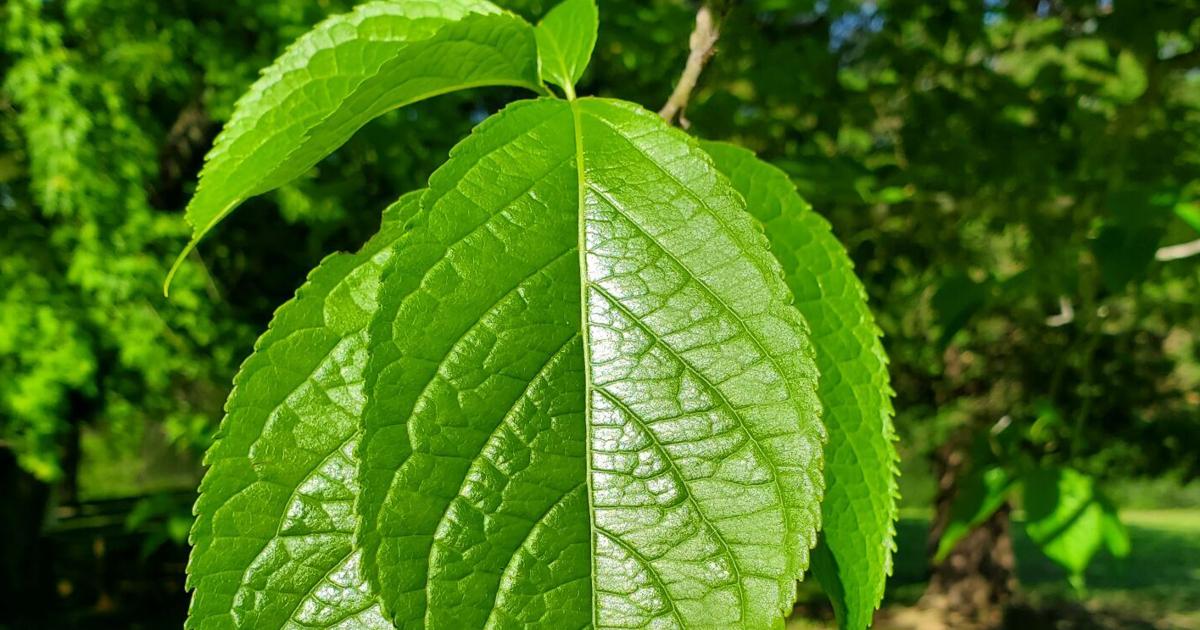
Plants are amazing energy producers, creating the foundation for our natural ecosystems by capturing the sun’s energy and transforming it into biomass that can be shared with all.
From humans to wildlife, this process is essential to everyone and everything that exists on Earth.
In today’s world, filled with an ever-expanding network of solar arrays that capture the sun’s energy for our own use, it’s easy to overlook the everyday leaves we see around us.
However, these plant parts are perhaps one of the most important aspects of life’s evolutionary history on Earth.
The origin of photosynthesis, the chemical process by which plants translate the sun’s rays into energy, is the original solar-energy storage method on our planet and remains the top energy-producing process to date, dwarfing the amount of solar energy human engineering collects on an annual basis.
Photosynthesis is the chemical process by which plants use sunlight, along with carbon dioxide and water, to create energy in the form of sugars, which are highly energetic molecules that can be tapped later for use by the plant.
These sugars are primarily stored as starch in root structures but can be found tucked away in lots of other parts of the plant.
Sugars can be found throughout the conductive tissue of the plant, referred to as the xylem and phloem, which is located just inside the bark of woody plants. In addition, sugars are also tucked away throughout the plant in thin-walled living cells called parenchyma cells, which are part of nearly every plant tissue.
It’s absolutely amazing to me that plants can collect light and transform it into usable energy, but an equally amazing process is their ability to store this energy for later use.
This time of year, as the plant world transitions to winter dormancy, I am often contemplating this energy-storage process, as well as its reuse in spring.
Whether we realize it or not, gardeners regularly interact with this process, since many of the plant-management practices we follow are built around the preservation, storage or later use of energy.
The timing for pruning woody plants is one way gardening practices preserve solar energy plants store throughout the growing season.
By pruning trees and shrubs during the dormant winter season, the impacts of our pruning on the plant’s energy stores are minimized.
Conversely, pruning at the wrong time of year, such as during leaf out or flowering, may unnecessarily take away some of the plant’s energy with every pruning cut.
While the timing for pruning may help preserve energy, woody plant propagation from dormant cuttings is a clever way we have learned to use stored energy for the production of new plants.
In this method, twigs are removed from the plant during the dormant season that have at least one node (or growing point) near the tip of the twig and one node near the base.
The cuttings are then “planted” into pots (or the ground) in the same orientation they were on the plant.
Upon exposure to soil, moisture and appropriate temperatures, the node at the bottom of the cutting will gradually develop roots, and the upper node, or nodes, will begin to develop leaves.
Believe it or not, the twigs on many plants have enough stored energy to produce a whole new root system and leaf canopy that will develop into an entirely new tree or shrub.
Many common landscape shrubs can easily be propagated from cuttings or other methods.
If you are interested in using this year’s stored solar energy to produce new plants next year, join me for a woody plant propagation workshop at Allerton Park and Retreat Center on Wednesday.
Participants will learn all about the plant processes at play in various methods of woody plant propagation, and everyone will leave with dormant cuttings to propagate at home this winter.
For more information and registration, please visit go.illinois.edu/propagationworkshop.
Ryan Pankau is horticulture extension educator with University of Illinois Extension serving Champaign, Ford, Iroquois and Vermilion counties.
Comments are closed.