


Baileydea/Shutterstock
Vine plants can be a great way to make your garden look beautiful while covering your fence, softening the noise coming from the loud neighbors next door, and providing natural shade. Depending on what you decide to grow, there are certain fruits and vegetables that will thrive in your shade garden if given the proper chance. But finding the right vine plant is more important than you think. Make the wrong choice, and you might end up with far more work than you ever planned in the first place, or even face legal issues.
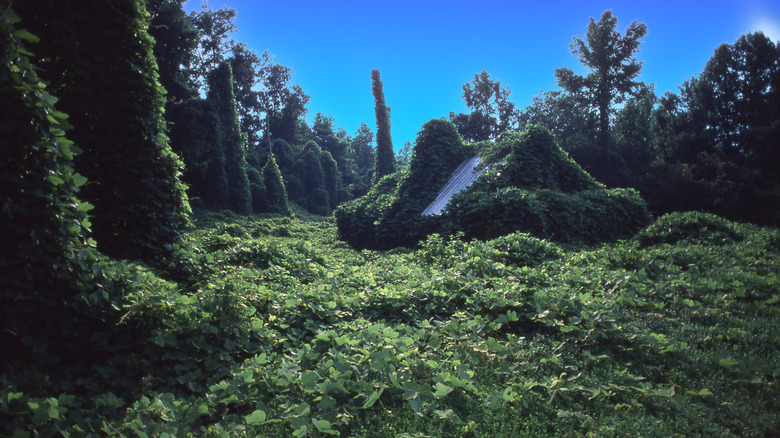
Kudzu (Pueraria montana) is an edible vine from China and Japan that has several uses, including food and tea preparations. It reached the U.S. in the late 19th century and was initially brought in for home adornment, cattle grazing, and erosion control, but it quickly became invasive. To learn more about kudzu growth, we spoke with Kevin Folta, PhD, a professor of horticultural sciences at the University of Florida.
“Kudzu is known as the ‘vine that ate the South’ because it knows no limits,” said Folta. The plant earned its name for a reason, as it can grow at an astonishing rate of up to one foot per day. It currently spreads over about 7.4 million acres in the southern U.S. and is banned or classified as a noxious weed in 13 states, including Georgia, Alabama, Florida, and Mississippi. Folta noted, “While federal law no longer designates kudzu as noxious, various state laws forbid its sale and planting.”
Is kudzu a serious threat to your home garden?
Clay Duhon/Getty Images
Kudzu is no longer on the Federal Noxious Weed List, but it still spreads at an average rate of 123,000 acres per year. Not only can it thrive in almost any soil type, but it also climbs over entire telephone poles, trees, and gardens. “The main problem is the vigor of the vines,” Kevin Folta explained. “Noxious vines like kudzu are incredibly vigorous and are highly invasive. They can also host diseases like soybean rust.”
He pointed out that this creeping perennial vine isn’t usually a massive threat to home gardens because it can be controlled. That is, unless you’re leaving your garden unattended on vacation. “It is a disaster in natural ecosystems, where it outcompetes native plants for sunlight, water and nutrients,” Folta continued. “Growing kudzu indoors is like keeping a pet cobra. While it seems like a great idea, there’s no good reason to have it,” he said. Even though experts have attempted controlled burns, herbicides, and even vine-feeding insects across the years, kudzu remains a persistent challenge.
Folta recommended checking with local university extension specialists in case of a potential kudzu invasion. “Single plants or small sets of plants may be managed by hand weeding, mechanical removal, or even grazing,” he added. For larger infestations, on the other hand, ensuring complete destruction usually requires chemical control, as manual methods alone are often not enough. “Weed specialists recommend 2% glyphosate solutions for home use, but there are multiple products that may be employed by licensed applicators,” said Folta.
Plants that can make or break your garden

South_agency/Getty Images
When asked what advice he has for gardeners drawn to kudzu’s appearance or edibility, as well as what safer alternatives won’t harm local ecosystems, Kevin Folta emphasized that there are plenty of better vine options to pick instead. “Here in the South, we appreciate jasmine and honeysuckle,” he elaborated. The honeysuckle, another perennial plant that can grow as a woody vine or shrub, also produces edible flowers you absolutely must know about.
“Clematis and wisteria also produce vigorous vines,” said Folta. “All of these have the added bonus of showy flowers and often nice aromas.” Some other great substitutes for kudzu are trumpet creeper (Campsis radicans), native bittersweet (Celastrus scandens), Dutchman’s pipe (Aristolochia), or even kiwi (Actinidia deliciosa). On which edible invasive species gardeners should mostly avoid, Folta explained that it largely depends on where you live — plants that are invasive in one region can be completely harmless elsewhere.
“Brambles (blackberry and raspberry) can become invasive and almost impossible to remove,” he shared. “Horseradish spreads wildly in temperate climates, and even mint can become a problem.” Additionally, walking onions (also called Egyptian walking onions) tend to wander far beyond their planting spot. Meanwhile, Bradford pears and jujubes can become highly invasive as tree crops. For all the invasive plants in the wild, there are equally beautiful native plants that will thrive in your garden — just make sure to do your research before bringing any newcomers home.
Comments are closed.