
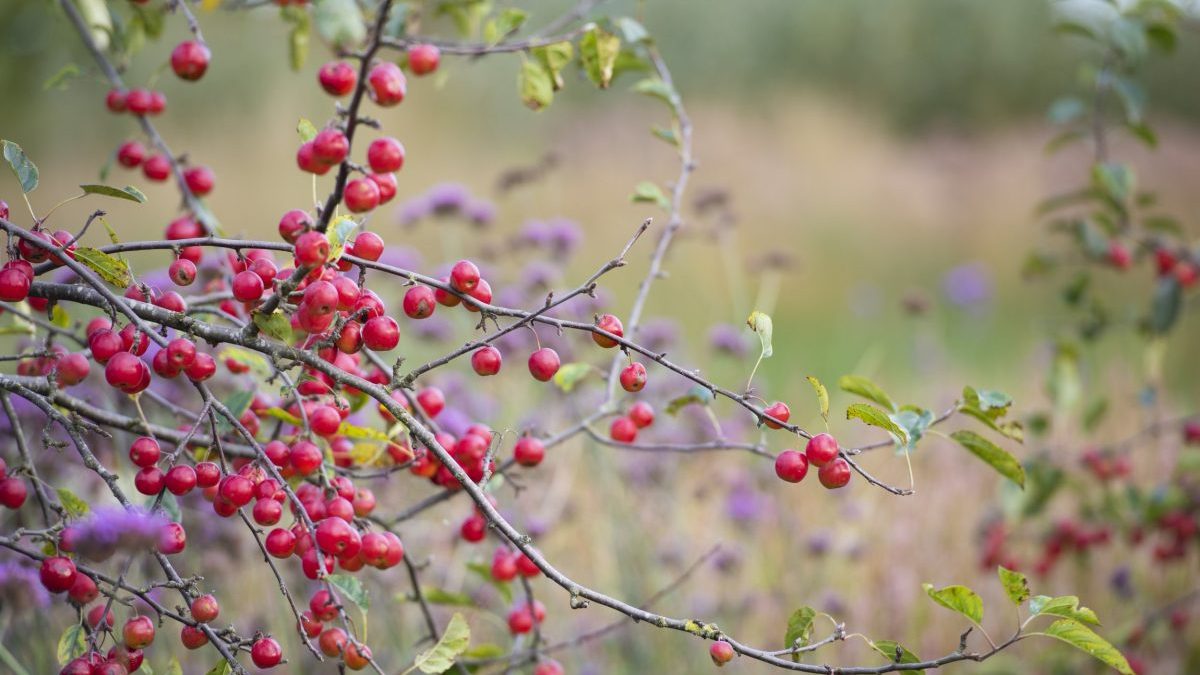
When it comes to deciduous garden trees, flowers are arguably less important than other aspects, such as final size, growth rate and interest at other times of year. Fine flowers, berries, autumn colour, attractive bark and good for wildlife! Such a tree does not exist, unfortunately; gardening is a series of careful compromises to find the tree that best fits your needs.
Being rather thorny, hawthorns are often overlooked, but Crataegus × lavalleei “Carrierei” attains 8m after 20 years with sparse thorns, white flowers and long-hanging red berries that are large (as hawthorns go, anyway). Autumn colour arrives late in rich red.
New FeatureIn ShortQuick Stories. Same trusted journalism.
C. × media “Punicea Flore Pleno” has red-black autumn fruits after showy double-pink flowers, finishing off with yellow and red autumn colour.
Hawthorn fruits will be taken by birds but hang quite well compared to the common hawthorn (C. monogyna), which, although not showy, is a very wildlife-friendly small native tree, but best suited to wilder parts of gardens.
Hawthorn bark is smooth in young trees but develops characterful, flaky, twisted, gnarled brown in older trees. Crab apples are more widely planted than hawthorns and are available in many more forms, with plenty of outstanding choices.
Malus × atrosanguinea “Gorgeous” attains 4-8m, has white pollinator-friendly flowers from red buds, plentiful long-hanging fruits in red, yellow and orange that make good jelly, and yellow or bronze autumn colour.
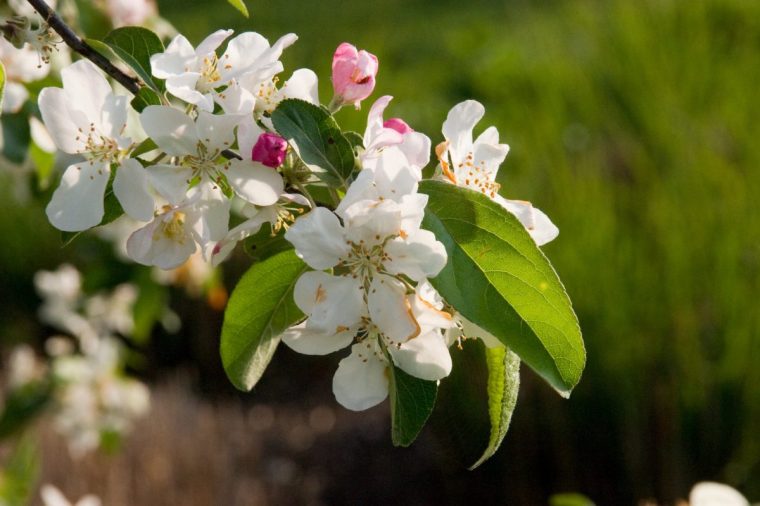 Blossom of Malus ‘Gorgeous’ on Clover Hill at RHS Garden Hyde Hall (Photo: Claire Campbell)
Narrow, spire-like trees are often overlooked but are well-suited to small gardens. Malus “Van Eseltine” can reach 8m, flowering with pink double flowers and red-yellow fruits.
Crab apple fruits are appreciated by birds, while the flowers attract insects with abundant pollen that ensures pollination of any nearby fruiting apples.
Of the flowering cherries, Prunus “Pandora”(right) is fairly upright and compact, with pink pollinator-friendly spring flowers and good red autumn colour. The leaves open in spring with purplish tints.
P. “Spire” is narrow, can reach 10m, with light pink flowers. Its leaves are open bronze, are green all summer and turn orange and red in autumn.
Dogwoods can be shrubs or trees. Tree-like ones are very effective if trained not to be too spreading. Cornus × elwinortonii “Venus” (8m) is one of the best, producing boggling numbers of creamy early-summer flowers (actually bracts) up to 15cm across in early summer, often followed by strawberry-like red autumn fruits with red, yellow, purple and orange autumn colour.
Cornus kousa var. chinensis “China Girl” can be shrubby, so buy ones trained to be tree-like. It bears plentiful white summer bracts, fruits freely and has red or orange autumn hues. It is less wildlife-friendly than “Venus”.
Koelreuteria paniculata can become a medium-sized tree at 10m, but it is slow-growing, so it won’t outgrow its welcome quickly. It has imposing clusters of little yellow flowers in late summer, followed by interesting papery purple-pinkish, bladder-like fruits. Its delicate foliage turns yellow in autumn. Hot summers are needed for the best results, but in southern gardens and with hotter summers expected to become more common, it has great potential.
On paper, Amelanchier is perfect – barely bigger than a shrub, abundant starry-white early-spring flowers, edible fruits and autumn colour – but the flowers and autumn leaves tend to be fleeting, and the fruits are not always numerous. But given shelter, so the wind is less likely to sweep away flowers and autumn leaves, and plentiful sun, for the best colour, Amelanchier lamarckii (8-10m) is a valuable, trouble-free delight.
Comments are closed.