
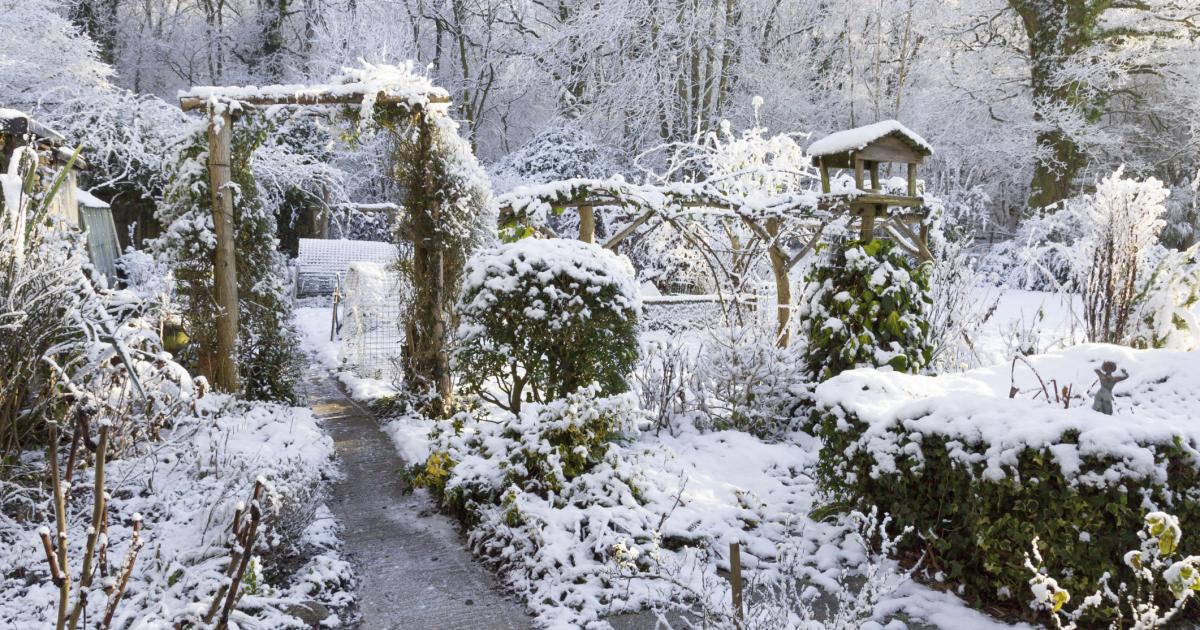
The snow’s ‘blanketing effect is especially important for shrubs and plants in the open ground. Snow contains tiny air pockets and like any biodegradable mulch traps the soil’s rising heat, thereby helping to protect plant roots.
I’ve found my neeps have a fuller sweet taste after a cold spell. It has been posited that a significantly lower temperature triggers a reduction in starch and greater sugar content in leaf and/or root. Nonetheless some research does indicate this assumption may not be entirely correct.
A recent study by Mark Turner et al in North America reported on a trial conducted in North Carolina and Tennessee. The scientists examined the leaves and roots on brassicas including kale, radishes and turnips and found frosting had little overall effect on plant profile. With kale there was a tiny sugar increase, but slightly larger starch level; turnips showed virtually no change in sugars, but more starch; and there was virtually no change in radish sugars, but much more starch. This study gives little support for the assertion that flavour is improved following a frost.
Whatever the sweetness of a neep, some other roots need lifting before any snow, or indeed hard frost. Although celeriac tolerates a little frost, it simply rots in very cold snowy weather, so mine are installed in a greenhouse bed, well away from pest or weather damage.
With varying degrees of success, we do our best to protect our plants, edible and ornamental but the more we study plant morphology, the more we appreciate how little we do know about them and start to recognise the self-protective methods plantsy have developed over the millennia. Fortunately by using increasingly complex techniques scientists are beginning understand these processes.
Two years ago, scientists at Kiel University wanted to see how plant leaves interacted with snow and frost. Unprotected leaf cells swell and freeze and then burst during defrosting. How did plants try to prevent this?
The researchers used a cryo-scanning electron microscope to study the nanoscale ice crystals. This was cooled -140C and the leaf samples were dipped in liquid nitrogen at -196 C. The high-resolution images allowed the researchers to see and measure how tiny structures on a leaf were able to protect a leaf surface from frost damage. Leaves with trichomes or minute hairs on their surface are usually hydrophilic, and attract tiny ice crystals to the tips, thereby protecting the leaf surface below.
The surface of wax-coated leaves prevents water droplets from accumulating on the surface, they simply roll off. This liquid repulsion was even more effective with the double-waxed antarctic native, Deschampsia antarctica.
As a further self defence, daffodils contain a chemical anti freeze that prevents the contents of their cells freezing and it is probable that other winter green species, like Cherry Laurel Prunus laurocerasus with its flat surfaced leaves have a similar mechanism.
Plant of the week (Image: unknown)
Plant of the week
Winter flowering Viburnums, Viburnum x bodnantense and Viburnum farreri flower from late autumn to early spring. Their white flowers open from pink buds, giving the inflorescence a pinkish tone, and are sweetly scented; though your nose to be close unless the sun is shining.
Resistant to most snowy and frosty spells, these Viburnums produce a fresh flush of flowers if really low temperatures scorch those blooms that are already open.
Comments are closed.