
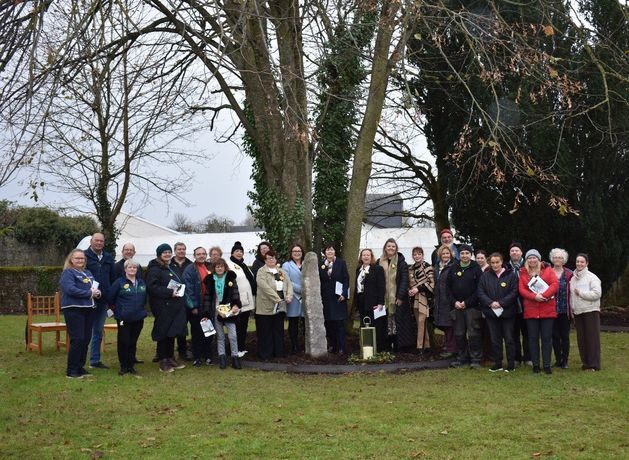
The cemetery dates back to when St. Dympna’s Hospital opened in 1832 and appears to have been particularly in use between 1888 (when a dysentery epidemic affected the hospital) and 1918 (when a severe pneumonia outbreak occurred there).
A stone plaque is all that marked the cemetery, as it didn’t contain headstones. Searches of records haven’t accurately established how many are buried in it but it is thought to be between 40 and 50.
The launch of the memorial garden project follows on from the success of the woodland garden project which was opened in June this year and visited by Health Minister Jennifer Carroll MacNeill in July. This space was transformed from a disused corner of the Supported Training Services site on the grounds of St. Dympna’s Hospital.
Geraldine Maher, service co-ordinator of Supported Training Services, said that upon completion of the woodlands garden project, there was a consensus that the cemetery, as a space, should be revamped to further honour the memory of those buried there.
Following some landscaping, with minimal invasion, flower beds were planted and timber and steel kerbing put in place.
An Ogham Stone was placed at its centre, inscribed to reflect words chosen by programme participants. Those words included Áit (place), Mothú (feeling/emotions), Pobal (the people of the place), Samhín Só (comfort and ease) and Fadó (the past/long ago) to honour all those who rest there.
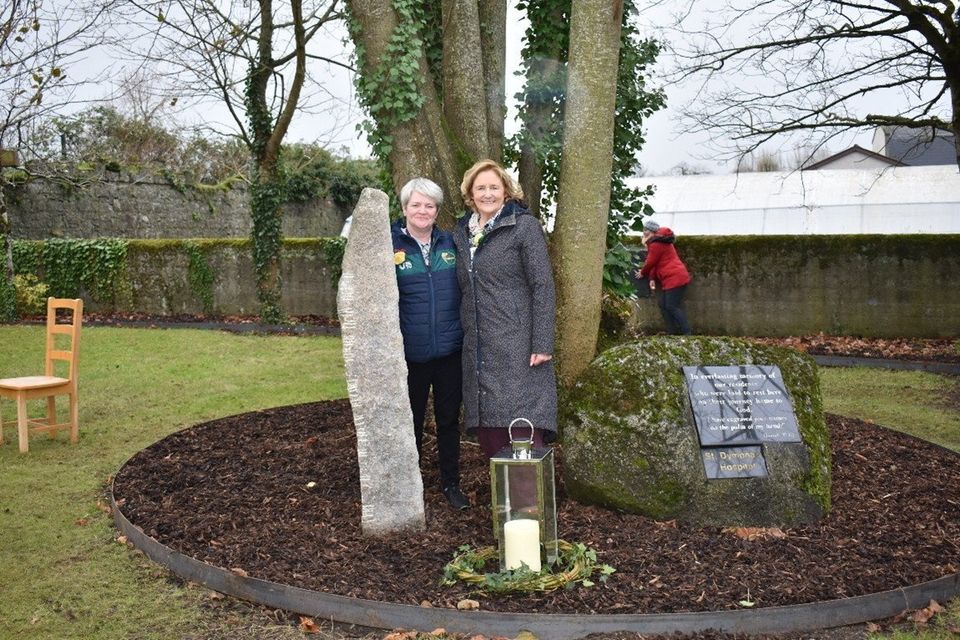
Mary Kelly, clinical nurse manager 3 at Carlow Mental Health Services, HSE Dublin and South East and Liz Browne, a horticulturist with the HSE Dublin and South East, at the opening of the memorial garden in St. Dympna’s Hospital in Carlow
Participants in the project created ‘The Stone of the Gathered Hands was for the living’. Into that slate, each participant carved the outline of their hand.
Four stained glass installations were also created, in addition to the history of the cemetery and St. Dympna’s Hospital being displayed on a history board.
Speaking at the opening of the St. Dympna’s memorial garden, Geraldine Maher said the garden is a “fitting remembrance” for all who were buried there over a hundred years ago.
“The Woodlands Garden inspired the restoration of the adjacent cemetery, with our ‘can do’ attitude, skill transfer, student buy-in, motivated staff and collaborative approach all helping to bring this project to fruition.
“We have, in our valued partnership with the Kilkenny Carlow Education and Training Board, created something beautiful in this space and the memorial garden is a fitting remembrance of those whose final resting place it is.”
Both of the woodland and memorial gardens projects were the culmination of programmes led by HSE tutors and involving service users of the Carlow Mental Health Services attending ‘Skillbase’ Supported Training Services. These projects were co-funded by Kilkenny and Carlow Education and Training Board (KCETB), through Solas ‘Reach’ programme funding and the HSE Dublin and South East.
Comments are closed.