
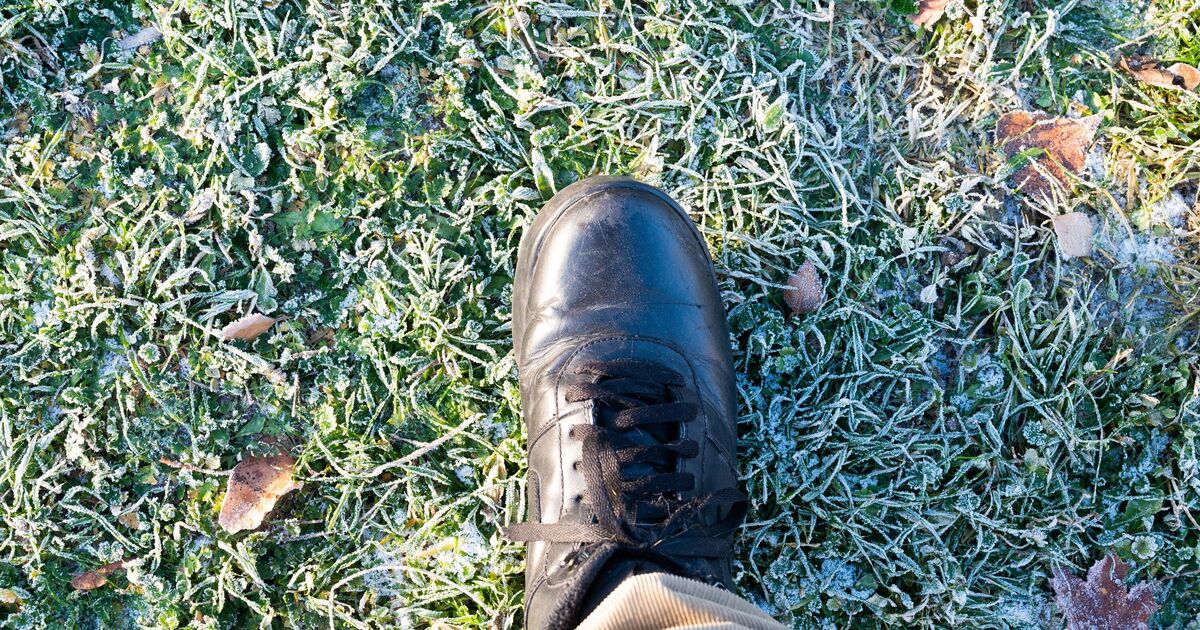
You should never step on your lawn when the frost sets in this winter, as it could lead to a hidden issue that actually harms your grass. Indeed, by doing so, you risk turning the grass tissue into “mush”, which can increase your chances of this particular issue, but there could be a simple solution if you need to access your garden via the lawn.
In the most recent issue of BBC Gardeners’ World Magazine, the publication’s team penned a piece featuring fifty gardening tasks to complete this month, everything from adding rocks to alpine plants to checking for damaged stems. Yet, in a section titled ‘Avoid stepping on frosted lawns’, they warned doing so could “lead to disease”. It read: “Organise a route across your garden that will avoid you walking on the grass after a frost. When someone has walked over frosty grass, the damaged grass tissue turns to mush when it thaws and is more likely to lead to disease.”
It continued: “A series of stepping stones dropped below mowing level is ideal to prevent this happening, particularly on a route that you need to use regularly. A simple path like this will keep your shoes or boots dry, too.”
It’s not just BBC Gardeners’ World that cautions us against stepping on frosty grass, however. The Royal Horticultural Society (RHS) also instructs us to avoid doing this on its website.
The RHS wrote that it can damage the blades, noting that they indeed “go brittle” in the cold weather. It also pointed out that you can leave brown footprints in your lawn that can “take ages to disappear”.
In related news, gardening expert and TikToker Ish has shared some crucial gardening tasks we should be tackling this month, one of which focuses on lawn care.
In his comments, Ish addressed the possibility of flooded or waterlogged lawns, a problem that can be approached with aeration using your trusty garden fork.
Ish said: “It’s not officially too cold to worry about mowing your lawn, it will stay dormant and in shape until next spring. But if you’re starting to notice wet patches then don’t be afraid to use a garden fork to add a little bit of drainage.
“By poking a few holes in, and then just chuck in a little bit of lawn sand in there, you’ll help that drainage, so it doesn’t become all boggy and gross over the winter months.”
Aeration is reportedly achieved by perforating the soil to produce holes, which, in turn, enable the grass roots to access nutrients, water and air, something that can boost their health and address compaction.
Gardeners were advised to aerate their lawns using either a spike aerator, a core, or a traditional garden fork to ensure the soil is moist, with B&Q noting that it’s best to tackle the job one or two days after it rains.
It’s a task that can also help your lawn resist disease and drought, reduce thatch and contribute to deeper root growth.
Comments are closed.