
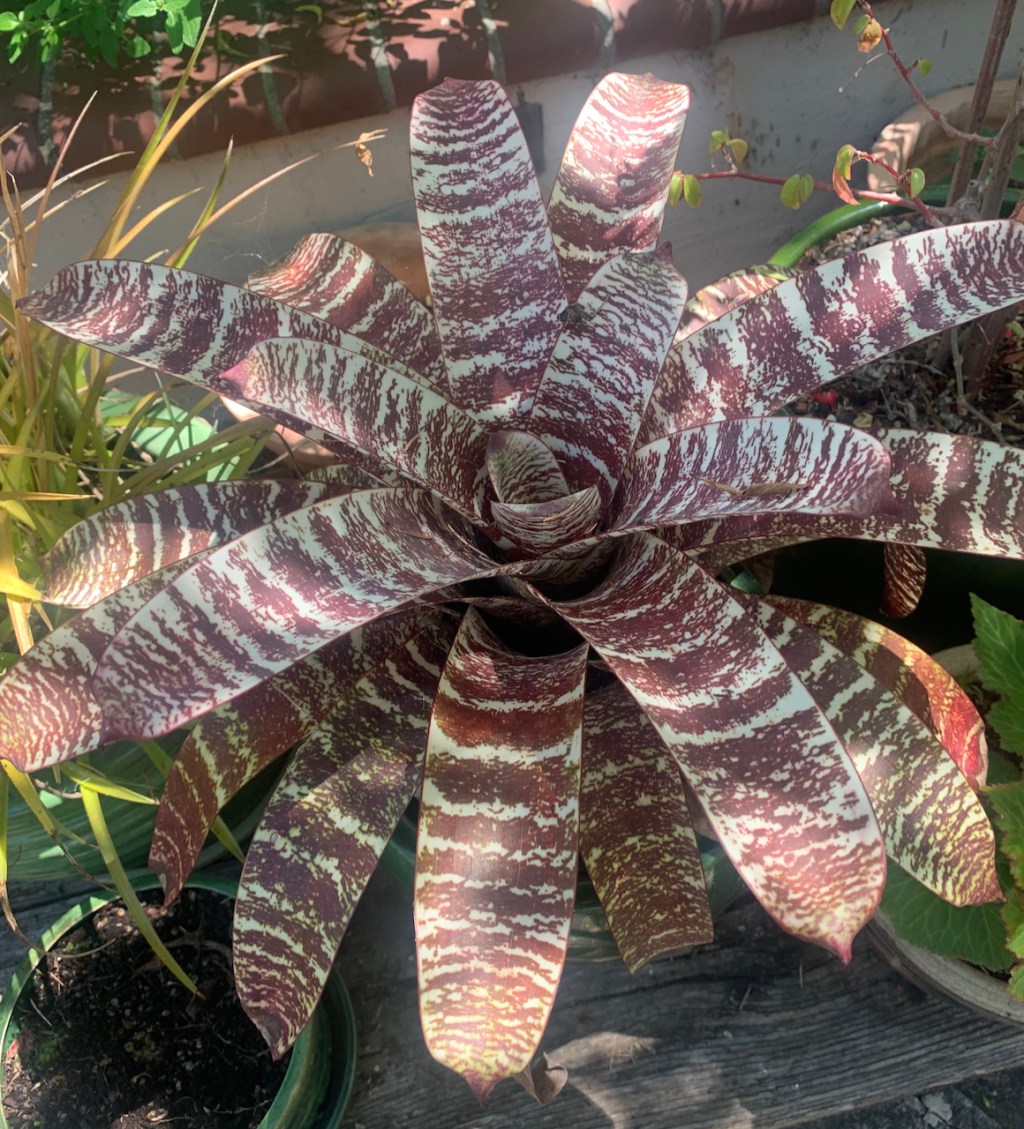
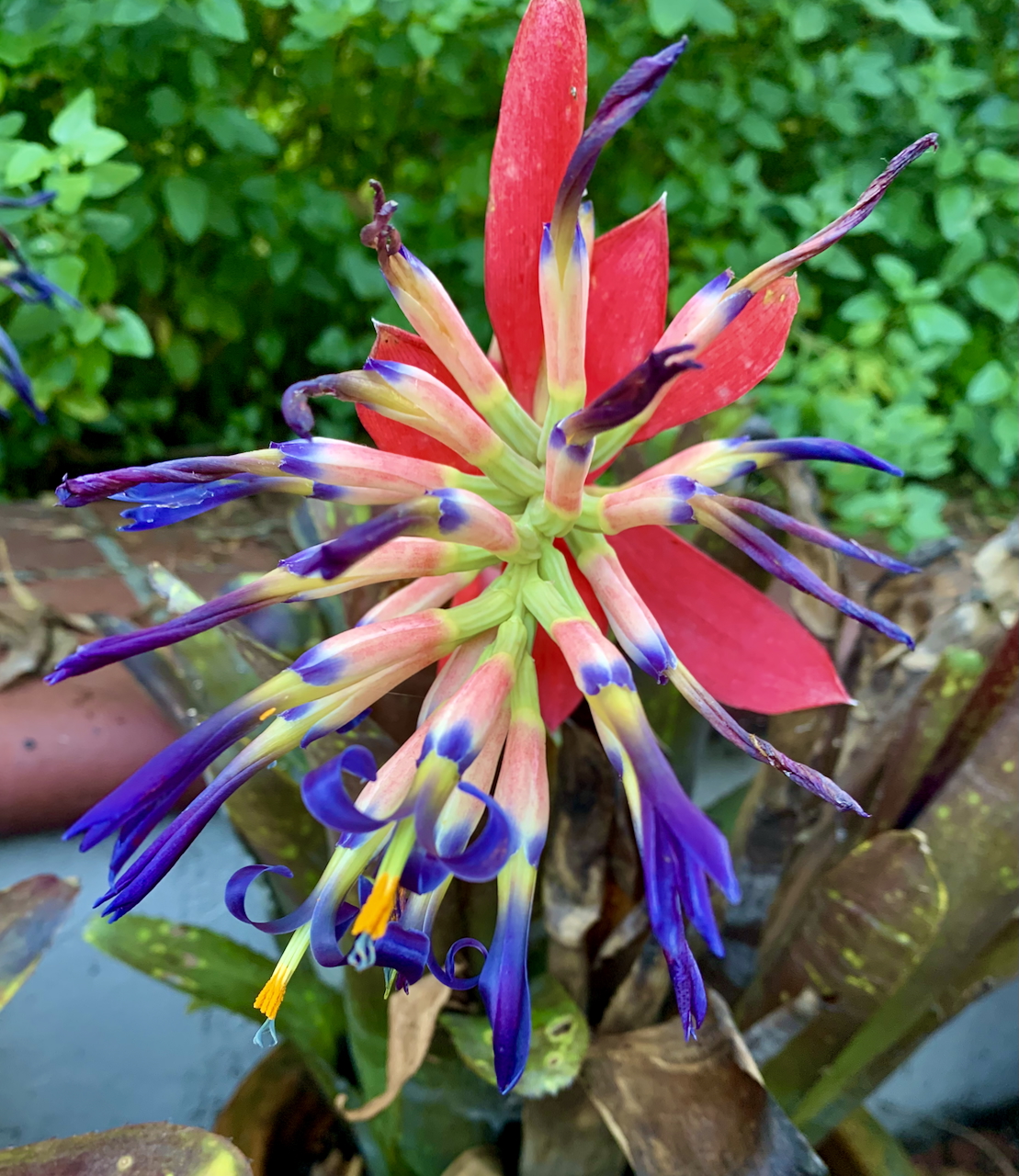
Queen’s tears (Billbergia vittata). (Courtesy Tom Karwin)

Red chestnut bromeliad (Vriesea fosteriana var. seideliana ‘Red Chestnut’). (Courtesy Tom Karwin)

Chilean puya (Puya chilensis). (Courtesy Tom Karwin)
Show Caption
1 of 3
Queen’s tears (Billbergia vittata). (Courtesy Tom Karwin)
Expand
The bromeliads comprise one of the most eclectic plant families in the Americas, including epiphytes in rainforests, terrestrial species in high elevations and arid-land survivors. Taxonomists have organized this family’s many genera in eight subfamilies.
Rather than attempting an overview of this large and diverse plant family, this column focuses on three subfamilies that gardeners can grow successfully in Central California’s coastal gardens.
Today’s image gallery
To illustrate the diversity of the bromeliad plant family, this column’s image gallery features a plant from each of the three featured subfamilies. We attach a brief caption to each image to identify it and describe the plants more fully in the following sections.
Unique subfamily (Bromelioideae)
This subfamily is highly diverse, with 40 genera and 861 species. Most plants are epiphytic, growing on other plants for support. Most species have leathery leaves, often serrated or spiny, forming a central rosette to collect water. Gardeners might find insects in the rosette’s habitat. The blossoms usually comprise an inflorescence emerging from a central spike surrounded by brightly colored leaves (bracts). The flowers often last for weeks, even months, attracting pollinators. Most plants in this subfamily are native to Central and South America, with a few species from the southern United States.
Banded bromeliad (Billbergia vittata). This epiphytic plant’s leaves have a distinctive banded pattern and develop a tubular form to retain water. This plant usually grows on tree branches or rocks, but can be grown in the ground or in a container with well-drained soil. A good substrate option is orchid bark. The roots tend not to absorb water, so irrigate the plant only when it is dry. The inflorescences are bright pink and pendulous, with several small blue flowers developing on tall stems. Someone named the genus for Swedish botanist J.G. Billberg, and provided the specific epithet based on the Latin word for ribbon, “vitta,” referring to the striped leaves.
Air plant subfamily (Tillandsioideae)
This subfamily includes 650 species of epiphytic plants that grow on other plants for support and collect water and nutrients from rain, dew and dust. Plant lovers and interior decorators appreciate their attractive forms and ease of care with water sprays or without soil. Plants in this subfamily have a range of leaf shapes, colors and flower formations, often creating stunning visual displays.
The leaves are usually long and slender, spirally arranged in a rosette shape. Many species’ leaves have tiny hair-like structures (trichomes) that absorb moisture. As the plant prepares to bloom, its green leaves become red or pink in a stunning spectacle. Once a plant in this subfamily flowers, it produces offsets (pups) that gardeners can plant separately. This subfamily of plants ranges from the southern United States through Central America and into Brazil and other South American countries. Spanish moss (Tillandsia usneoides) is a well-known species in the natural environments in the southeastern United States.
Red chestnut bromeliad (Vriesea fosteriana var. seideliana ‘Red Chestnut’). This cultivar, named for bromeliad enthusiast Mulford Foster, has a light red overall blush, with glossy-green, white-striped leaves that turn a rust-red hue as they age. Given time-release fertilizer, the plant can grow to 20 inches high and 24 inches wide. When given strong filtered light and a shady, cool setting, it maintains its best color and form. Vrieseas are slow-growing epiphytes and well-suited to moist, humid terrarium tanks. The red-and-green patterned leaves of this cultivar are a bonus. Flowers that grow on a shaft are white and green with red spots, and last only one night. The plant is monocarpic, flowering only once in its life. The genus is endemic to Brazil.
Enigmatic subfamily (Puyoideae)
This subfamily is known for rich diversity and adaptation to diverse environments in tropical and subtropical regions. The subfamily includes one genus (Puya) and 226 species, typically with rosettes of spiky leaves that both collect and store water and deter herbivores. These terrestrial plants grow slowly, taking several years to reach maturity. The plants develop large, stunning flower spikes that rise above the foliage and produce colorful inflorescences with tubular flowers that attract pollinators. These plants are monocarpic, reproducing by dispersing seeds or by producing offshoots (pups) from the plant’s base. The largest species, Puya raimondii, can exceed 30 feet high and make thousands of flowers in a single inflorescence. The genus ranges naturally across the Andes mountains, from Venezuela to Argentina, growing from rocky outcrops to open grasslands.
Sheep-eating plant, Chilean puya (Puya chilensis). This terrestrial bromeliad, native to Chile, grows on dry hillsides and forms rosettes of narrow leaves with outward-pointing hooked spines. The plant grows slowly up to 10 feet high, and, after about 20 years, develops a 6-foot-high spike of large green or yellow flowers. If growers fertilize the plant, it could produce a flower spike sooner. The plant spreads by offsets, eventually covering large areas. Some people believed that the plant’s spines could entangle sheep and birds that would die and decompose, providing nutrients for the plants. Those people gave the Chilean puya the nickname “sheep-eating plant.”
Advance your gardening knowledge
To explore more details about bromeliad subfamilies, browse botanicalrealm.com and search for the name of a subfamily of interest.
Our recent column included images of three other bromeliads:
• Blossom of pineapple mountain (Ochagavia litoralis) — bromelioideae subfamily.
• Silver vase (Aechmea fasciata) — aechmea subfamily.
• Scarlet star (Guzmania lingulata) — tillandsioideae subfamily.
View these images from the Sentinel’s archive (see below).
This week in the garden
After recent rains, gardens have sprouted young weeds. The gardeners’ seasonal priority is to remove weeds before they set seed and to install organic or inorganic mulch to discourage future weed growth.
Enjoy a weed-free garden!
Tom Karwin is a past president of Friends of the UC Santa Cruz Arboretum and the Monterey Bay Iris Society, a past president and Lifetime Member of the Monterey Bay Area Cactus & Succulent Society, a Lifetime UC Master Gardener (certified 1999-2009), past board member of the Santa Cruz Hostel Society and a current member of the Pacific Horticultural Society and other garden-related societies. To review the archive of recent On Gardening columns, visit santacruzsentinel.com and search “Karwin.” Visit ongardening.com to review columns from 2012-2020 (and eventually) from the following years. Please send comments or questions to gardening@karwin.com via email.
Comments are closed.