
Garden Road Subdivision, Dolma Road Home and More – from the Land Use Boards
Wednesday, 03 December 2025 12:17
Last Updated: Wednesday, 03 December 2025 21:52
Published: Wednesday, 03 December 2025 12:17
Joanne Wallenstein
Hits: 252
 Builders continue their campaign to replace Scarsdale’s housing stock. The newly amended building code, which requires Planning Board approval for site disturbances and building in the property buffer and wetlands, seems to be causing more hearings–but applications are approved with revisions.
Here are just a few of the proposed projects before the Planning Board and the Committee for Historic Preservation to be considered this month and in the new year.
80, 88 and 90 Garden Road
Most significant, a highly controversial proposal for a subdivision at 80, 88 and 90 Garden Road is back on the agenda. Developers have applied to subdivide three existing tax lots into six, to demolish two existing homes on the site and construct five new homes. Neighbors have vociferously sought to block the project for years due to flooding along Cushman Road, which abuts the site. The Village has proposed several large stormwater abatement projects for the area, but while they seek grant funds for the work, nothing is in process as of yet. The last subdivision proposal, considered in September 2025, called for the removal of over 200 trees and the use of tons of landfill to raise the low -lying terrain by four feet.
At the time, the Planning Board voted to circulate a notice of intent to declare the Planning Board as lead agency for a SEQRA review of the plan. The next meeting will be held on Tuesday January 13, 2026 at 7 pm at Village Hall.
17 Dolma Road
Another interesting case involves 17 Dolma Road. The Committee for Historic Preservation denied an application to demolish the original home on the property. However, the applicant appealed that decision to the Board of Trustees who decided not to defend the CHP and the house was razed. The applicant then proposed a modern glass house to replace the Collett-built Tudor and presented plans for the home to the Board of Architectural Review on November 17, 2025. They were told to re-design the house as the BAR did not feel it was in keeping with neighborhood character. The Cultural Resource Survey, done by Architectural Historian Andrew Dolkart in 2012, proposed that Dolma Road be named a study area for historic preservation and the proposed home would stand out from those on the street.
Dolkart’s report says, “Dolma Road, running from Murray Hill Road to Birchall Road, is a short street lined with exclusive houses on large lots, most erected between 1926 and 1929 (one dates from 1935), primarily for wealthy businessmen and their families (Figure 7-10-1). Dolma Road was largely a project of Walter J. Collet, the Scarsdale builder who was responsible for the construction of many substantial houses in the village. Collet claimed that he chose the name Dolma in reference to a mountain range in Bengal, India; just w hy he made this choice remains a mystery. Along Dolma Road, Collet appears to have been not only the builder, but also the developer. Collet worked closely with the architect Eugene J. Lang, who designed nine of the fifteen houses in the study area. Collet remained the builder of the houses designed by other architects. The Dolma Road. houses are large buildings in the American, English, French, and Spanish styles so popular throughout Scarsdale in the 1920s. Among the wealthy owners w ere life insurance dealer George Hofmann (No. 2); publishers (and, apparently, brothers-in-law) Frank Braucher (No. 4) and Frederick Dolan (No. 6); tobacco merchant George Cooper (No. 8); W. Wallace Lyon (No. 11), W all Street broker and insurance man; Alden C. Noble (No. 15), chairman of the board of the Merchants Fire Assurance Corporation; Dr. L. T. Webster (No. 17), a noted epidemiologist at the Rockefeller Institute; and J. Arthur Bogardus (No. 21), chairman of the board of the Atlantic Mutual Insurance Company.
The study area contains several very large Colonial Revival houses, including four of red brick – the Robert W. Keelip House at N o. 5 (Eugene J. Lang, 1929; Figure 7-10-2), resembling a James River plantation, and the New England-inspired George Cooper House at N o. 8 (Eugene J. Lang, 1926; images of the house were published in The Architect, April 1928, pp. 109-13), Edward Y. Baker House (Rich & Muthesius, c. 1928) at 26 Murray Hill Road, a part of the Dolma development, and J. Arthur Bogardus House (Ren ick, A spin wall & Guard, 1935) at N o. 21 (Figure 7-10-3). Tw o stone examples of the style are Lang’s 1927 design for Alden C . Noble at 15 Dolma Road (Figure 7-10-4), modeled on Pennsylvania estates, and his Buck County, Pennsylvania farmhouse of 1928 at 18 Dolma Road for Herman van Fleet (Figure 7-10-5). Lang designed a curious clapboard house in 1928 at 30 Murray Hill Road, with a projecting gabled pavilion supported on the side by monumental, attenuated, square piers (Figure 7-10-6).”
Despite the area’s historic significance, the attorney from Cuddy and Feder for 17 Dolma Road is appealing the BAR’s decision and modifying the plans to shield the view of the modern glass house from the street.
Specifically, they plan to address the Village’s feedback by shifting the driveway and planting trees.
They say:
-The driveway was shifted to the east to limit the visibility of the home from the street;
-A row of 16-foot tall arborvitae is provided at the front property line to further limit the visibility of the proposed home from the street (see Sheet T-1.3);
-A sight line diagram is provided to demonstrate that the proposed plantings will screen the new home.
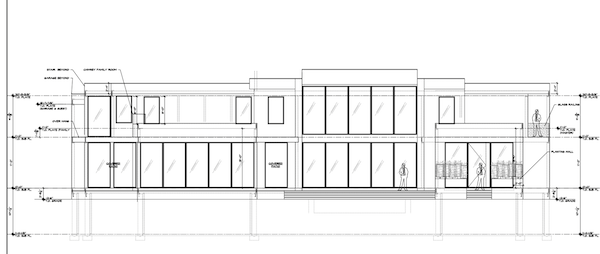 Proposed New Home at 17 Dolma Road.
Addressing the BAR comments about the appropriateness of the design, they say the structure is consistent with modern structures in the Village, in conformance with other contemporary residences approved by the Village and that “the Village is obligated to adhere to past precedent when considering similar design proposals. As such, the Board should approve this Application seeking the same type of home that was approved previously. New York courts hold that, regardless of any change in member composition, a determination of an administrative agency or body that “neither adheres to its own prior precedent nor indicates its reason for reaching a different result on essentially the same facts is arbitrary and capricious” and will be annulled by the courts.”
The Planning Board will consider this application on December 17, 2025 at 7 pm.
See the agenda and applications here:
115 Lee Road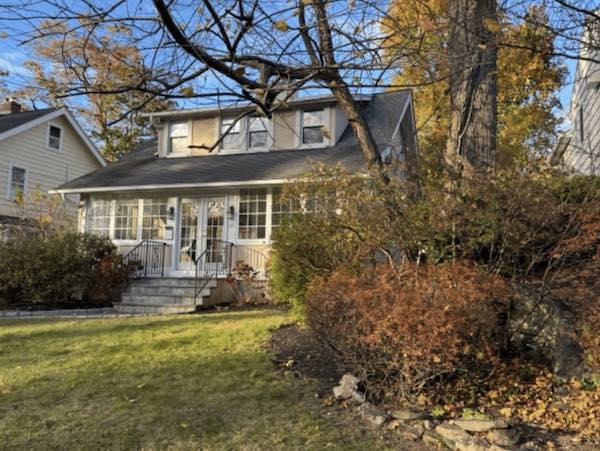 An application has been filed to raze this craftsman/bungalow style home at 115 Lee Road.
An application to raze a craftsman style home and garage at 115 Lee Road, which was built in 1918 has been filed before the Committee for Historic Preservation. The home is nicely set back from the street and appears to be well preserved. Whether or not it can be considered historically significant will be considered by the committee on Tuesday December 16, 2025 at 7 pm.
Comments are closed.