
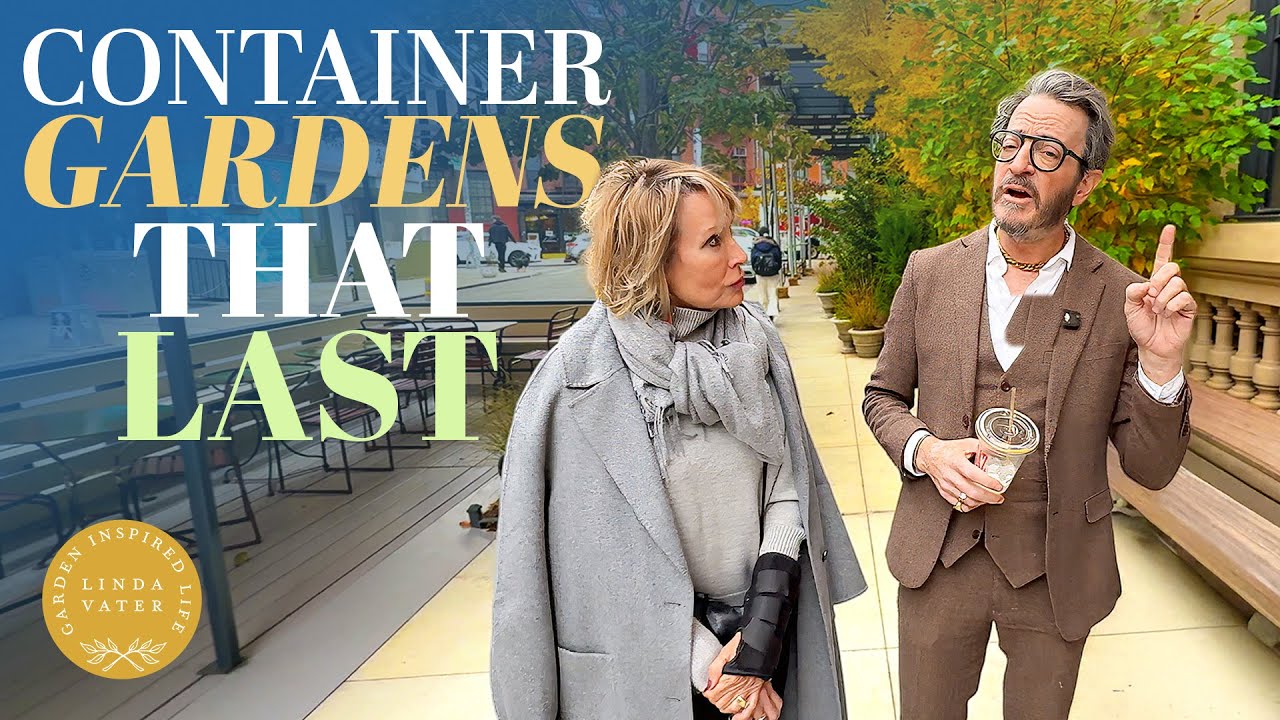
Want container gardens that look incredible and last in every season—not just for a few weeks? In this episode, Linda visits urban garden designer Tommy Little of Urban Green Gardens on the rooftop terrace of the Nine Orchard Hotel in New York City to learn how to plant long-lasting, architectural container gardens that behave like true landscapes, not just pots on the patio.
Tommy shares how he designs boutique container landscapes for hotels, restaurants, and penthouse terraces, and how you can steal the same ideas for your balcony, front porch, courtyard, or small garden at home. From choosing the right size containers and installing drip irrigation to planting Japanese maples, river birch, grasses, heathers, hollies, and evergreens in tough, windy sites, you’ll see how to create containers that are textural, layered, resilient, and beautiful all year long.
🌿 In this episode you’ll learn:
How to plant long-lasting container gardens that look like mini landscapes
Why larger, quality pots are the “foundation” of every great container design
How to design for windy, exposed sites (like rooftops, balconies, and terraces)
Smart tips for drip irrigation and consistent watering in containers
Using texture, height, and contrasting foliage (glossy vs. matte, fine vs. bold)
How to plant trees and shrubs in containers (Japanese maple, river birch & more)
Ways to protect broadleaf evergreens with anti-desiccant in extreme weather
Why “if you’ve never killed a plant, you’re not gardening yet” 🌱
Tommy and Linda also talk about the storytelling side of garden design—how a garden should be an extension of the home (or hotel), reflect the people who live there, and invite you into a relationship of care, empathy, and daily connection with nature.
🪴 Key ideas for your own container gardens:
Think in terms of container landscapes, not single pots
Match your planting style to the architecture and personality of your home
Choose plants that can handle your climate, exposure, and wind
Use grasses, evergreens, and structural plants for four-season interest
Invest once in beautiful, durable containers—they’re like furniture for the garden
👉 Visit Tommy: UrbanGreenGardens.com
👉 For more garden inspiration, design tips, and container ideas, subscribe and explore the playlists on this channel.
#containergardening #urbangardening #rooftopgarden #containerlandscape #gardendesign #lindavater #urbangreengardens #nineorchard #smallspacegardening #balconygarden #patioideas #evergreengarden #dripirrigation #fourseasongarden #japanesemaple #grasses #gardeninspiration #gardentour #howtoplantcontainers
SIGNATURE STYLE SATURDAY PLAYLIST 🌿
THE GARDEN LIFE: Season 1 PLAYLIST 🌿
WEDNESDAY WALKABOUT PLAYLIST 🌿
GARDEN TOUR PLAYLIST 🌿
GARDEN HOME INTERIOR PLAYLIST 🌿
Premiumbeat YouTube ID
SSP9YNQ8ARLEUCAX
MPT7H7R16WXKW1RY
PZVVHDRMLKRZWSK7
B1DHHRI0NZVMXFGN
RXRI0UIS5V7UPYWX
CLUVGVFATIQWTBNJ
Join this channel to get access to perks
@lindavater
SHOP MY AMAZON FAVORITES HERE: https://amzn.to/3NLPpqs
🌳 WAYS TO FIND LINDA 🌳
BOOKS
A Year Of Garden Inspired Living: https://a.co/d/4AAxr4k
The Elegant and Edible Garden Book: https://amzn.to/3kz6eIf
Order Your Garden Journal: https://amzn.to/3JMeMHk
MY RECOMMENDED/AFFILIATE PRODUCTS:
Shop Linda’s Amazon Favorites: https://amzn.to/3NLPpqs
For the Garden: https://amzn.to/3PPDrgH
Linda’s Favorite Pest Controls & Fertilizers: https://amzn.to/4hOE9aj
🍯 Some videos sponsored by our friends at Manukora Honey. Try some of our favorite manuka honey full of antioxidants, pre-biotics, and superpowers. Head to https://manukora.com/linda to get $25 off your Starter Kit.
SOUTHERN LIVING PLANT COLLECTION: https://southernlivingplants.com
Join this channel to get access to perks: https://bit.ly/3ipscuo
✅ HOW TO JOIN MY YOUTUBE Channel on your phone or iPad: https://bit.ly/2W3oijz
🔛Instagram: / potagerblog
🔛Facebook: / lindavatergardens
🔛Pinterest: / lindapotager
My USDA Gardening Zone: 7a
Linda Merch: https://lindavatershop.com
Zazzle Seed Packets: https://www.zazzle.com/linda_vater_seed_packet_envelope-256860347131992223
[Music] Well, I am here with Tommy Little of Where am I? Where am I? Tell me your name. Urban Green Gardens and we’re at Nine Orchard Hotel. Okay. Nine Orchard. Thank you. Thank you for Thank you for giving me um a geographical benchmark. No problem. Um, but and we met maybe five minutes ago and I feel like I already know you. Yeah. And that’s because we’ve been sharing war stories. War stories about growing up in a big family, both of us. You’re one of 10, right? I’m one of 10. He said that he was one of seven. And I said, “I’ll take your seven and raise you three.” And then that just opened up a whole can of worms. It certainly did. But in addition to that, we also have our love of gardening and green spaces. And um I want to talk a little bit just about what you do and what I what I love about you is that you blend, as I said earlier, kind of the practical and the poetic and it’s more than just getting your hands in the dirt and it’s more than just botany. So talk a little bit about what your company does, how long you’ve done it, your background, and how it continues to inspire your creativity today. I mean, I’d love to uh first of all, I love the way you framed that because uh that gives me the opportunity to explain right away to make the distinction that the type of gardening that I do, being an urban gardener, dictates that all of my plants and all my plantings and all my gardens for the most part end up in pots and containers and vessels of all sorts. That’s just what the urban gardener does. And so that dictates a kind of character. It kind of decides what the garden is going to be from the outset before any plants are chosen, before any ideas are invested in, before any sort of story is kind of thought about that tells what the garden is. I like to have a story to describe a garden. And so Urban Green Gardens, which I started in the year 2000 before smartphones, if you can imagine, it’s a very different world then, uh, is a boutique garden design company that found its way into the very niche place of frontage gardens for restaurants and hotels and penthouse terraces. That’s sort of the uh restaurants, hotels, penthouse, terraces sort of makes up the client base of Urban Green Gardens. Containerized gardening is a uh slightly artificial sort of gardening. It’s the kind of gardening that requires the most human intervention of all. And so it’s sort of the most stylized gardening. It’s the kind of gardening. It’s gardening that’s a little more uh kind of hyper real than you know it’s a little more of what it is than just a garden that nature sort of dictates and develops and participates in. It’s a little more guide yeah and guided by humans. And so uh the kind of work that we do is uh about sort of what the sort of style of a garden is, you know, and not just sort of the functionality of it or the uh combinations of plants and things that we want that garden to be and the story that it tells. And and the story at least I I would think in this kind of boutique gardening which is a concept I’m really embracing is that the dwelling the structure the nature of the dwelling whether it’s commercial whether it’s residential whether it’s um urban whether it’s in the country really informs the story that you’re telling with these container gardens but they’re really they’re also container landscapes I think that follow some of the same uh design rules that that gardens also try to follow. Talk a little bit about that because you know I I just love the textural composition and the different varying and the glossy leaves versus the matty matted leaf um uh texture. So talk about all of that a little bit. I mean it’s you touched on this super cool thing which is the garden should be an extension of the home and it should sort of communicate the the design philosophy of the homeowner. Yes. And so I’m working with these highly thematic environments which are restaurants and hotels. Every restaurant, every hotel is a little universe. It’s a product of a bunch of designers, right? And then I come in as another designer, as another playmate making this beautiful world, right? So each garden tells the story of the restaurant. The garden here at Nine Orchard, Nine Orchard is a was a bank building that went up the height of the Victorian era. It is beautiful and rich in embellishment. It’s beautifully made as a building and it’s a kind of a proud uh piece of architecture that sat quietly in the New York landscape forever and ever and ever. It was just sort of it had disappeared in a way and so they brought it back. It’s all being bought out by Chanel this week. Chanel is here all week, the entire hotel. Yeah. Who the heck does that? That’s amazing. Thank you, Chanel, because I had to come and touch things up for them. So, that was nice. And, uh, that feels very flattering that I get to be a part of that experience, too, you know. But, uh, so the garden here tells the story of that proud Victorian kind of, uh, thing that this building is and was. And the Victorians were very dressed up, very buttoned up, very about travel and showing your shine on your shoes and plant collecting. I mean, and tropical plants and conservatories and their green houses and spare no expense getting that very specific orchid or that very specific variety of tulip. Yeah. And it all just it’s just woven through, as you said, kind of the storyline of the fabulous gardens that that you create. So you said you also work on some residential gardens. So I I’m curious obviously a hotel will inform what you do and whatever style the residences will inform what you do. How much do you work with the owners and the personalities of the residences to inform in terms of like color and texture and shade and light? I mean that’s a really really important thing to tune into, right? because you’re creating something that’s an extension of someone’s home and that’s the garden. And so it should be about sort of your vision and your curiosity is about gardening in general, but it should really be something that captures the spirit of the family or the group of individuals or the individual that live and are going to be using that garden, live in that home and are going to be using that garden. So it’s a very collaborative process that remains collaborative. And when I’m done building the garden for a family or whomever it is that has been so kind to hire me to do that, one of the first things I say to them is, “Congratulations. You have a puppy now.” I Oh, okay. I am so going to quote you on that because I think sometimes there’s this um misconception that you create you help create a place of beauty for someone and it’s just an extension of their interior decor. You put a plant here and you put a candlestick on the mantle and No, no, no, no, no, no. You actually have to interface. You actually have to have a relationship with that growing living space. That’s right. And most of the people that you work with, are they wanting that or are they just wanting beauty in their surroundings? I think a lot of people aren’t wanting that. And I think that’s why I kind of wander into their lives and are brought into their lives because they and in my opinion every human need that we all need something that brings out our wanting to care for something and to nurture and love something. And a garden demands that and you don’t have to get out there and work in the garden, but you have to keep an eye on it and you have to call Tommy if there’s something that needs something. And we have a kind of co-parenting relationship now that’s forever, right? We co-parent, we nurture, we love, and we raise this puppy together into something old and beautiful and a member of the family. This is a a you know entering or participating in the care of or even witnessing or even looking at a collection of growing things which is a garden isn’t just a visual experience. It’s an energetic exchange and it’s also a reminder to us that it’s what we come from. Humans are animals in nature. It was only later that we put ceilings up and put clothes on ourselves and kind of disconnected ourselves from the world and the greenness around us. Having a garden relocates one back in nature and it grounds us and it enriches our souls. And like I said, it gives us a reason to become outside of ourselves to tap into our ability to have empathy for something. And when you have empathy for your little piece of green, you can’t help but uh sort of witness that empathy grow to all the green around you, the whole earth. It’s an extraordinary experience and every person that I’ve ever built a garden for has kind of said that their life changed. Transformative. It really is. It really is having a garden and gardening in a garden. Even was reading about gardening. All of it directs us back to nature and that’s a good place to be directed back to. So when was the transition between bank and hotel? This was about 10. This took about 10 years. Part of it because of co Okay. Part of it. So this is a relatively new makeover. Yeah. It is. Yeah, it is. And I don’t know what it was all the that other time. Okay. when it like from its inception to now. But uh I I just know that part of the story and that it sat sort of derelictked and unloved for a long time as well. Thanks you guys. Have a good event. Okay, so let’s just walk the perimeter. Yeah, for sure. and talk about some of the plants that you wouldn’t think as container garden plantings, but nevertheless, you can put anything in a container as long as you give it the proper care and attention. That’s right. And as long as you plant it correctly in the container as well. But um nine orchard is an ex, as you can see, and you can feel right now is a super windy site. Yeah, it’s very exposed. Yeah. So we learned over time that what we had to do here was plant a garden that would do well in sort of the equivalent landscape of like the Hamptons right at the water, right? Oceanside, lots of exposure, lots of uh wind, lots of just sort of uh unfriendliness. It’s not a friendly place to grow things. And so the result of that is that we sort of boiled the pallet of plants down to deciduous trees, uh some evergreens, lots of grasses, and then heathers and kunas. And what is really happening in this composition is something that’s going to sort of stay all winter but not look like a a holiday display, you know? It’s really something that like we’ve allowed certain plants to remain uh and even though they’re going to brown, that’s the stylist in me. I can’t not affect I can’t not adjust. No, I get it. And what also I love is that unlike some other plantings that if they were evergreen in their totality, this mimics nature more. This mimics nature. This mimics nature. So, you know, you’ve got your birch trees and your your maple trees and things which which it’s it’s more experiential because we can be here and we can see those beautiful colored leaves blowing in the wind. we can really feel the, you know, see the grasses sway and yet in the winter it’s not completely barren because you’ve got your, you know, colonade holl and your Arizona cyprus and you’ve got all of that kind of thing here and it just makes it um well, it just makes it feel like a true landscape. Yeah, thank you. That’s the intention. Look at this Japanese maple, Linda. This is incredible. this color. This is uh I’m learning about uh Japanese maples and they’re one of the toughest trees actually. They look so delicate. They look so pedigree, right? They look like that dog that you’re like, I’m not going to get that dog. It’s going to be a lot of work. It’s too pretty. Exactly. And yet they have been here since the in since I initially installed all this, which is now going on four years ago. Lots of things have kind of come and gone and changed and that is gardening too. And I would tell all your viewers to I would I would like to tell everybody that because if you feel like you you’re a failure because you planted something and it died, you’re not a failure. You’re a gardener. Yeah. You’re a gardener. Yeah. If you haven’t killed anything, you’re not trying hard enough. Exactly. Orient me. What direction is this facing? This is uh So this is east. Okay. That’s south. Okay, Brooklyn is down that way. That’s north, which is Midtown and all of that. So, the winds prevail from the south here, which is where the water is. That separates Brooklyn and Manhattan. So, it’s a little bit more humid than it would be maybe otherwise because this here, and we grow Japanese maples where I live. We we grow them, but after a hot summer, they are so desiccated. They they are so brown tipped. Um it’s it’s really tragic. You know, they just get so crispy. Now, now you have to know that if that’s where you garden, that’s going to happen. But these here are so are so intact and and this is river. Yeah. A river birch in a container. In a container. And do you do all of the the maintenance, the trimming, the pruning? We do. I know there’s lots of drip irrigation. It’s also Yeah, it’s all irrigated. And that’s the thing about uh irrigation and again I’ll share this as a sort of insight an industry insight with your viewers. It’s not extravagant and silly to put irrigate or non-ear friendly to put irrigation in. You actually conserve water when you do irrigation over hand watering. Hand watering is not just a waste of water. It’s a waste of time. So much other stuff to do. And also plants require a very very consistent right watering. So that’s what drip irrigation is. It’s calibrated. It’s orchestrated. And you know what we try to do in all of these plantings is really as much contrast of not just color. In this one grouping we have the bluest of green. Then we have this beautiful brown coming from this heavy metal grass. This cryptoaria is this deep deep rich hunter green and then this you know screaming yellow and the color echoes of the branching and the tree bark and the all of that and the grasses is is just is very unifying. It’s very it’s very harmonious. The other thing that I would point out is your containers aren’t, you know, small little six-inch pots of a geranium sitting on a on a window sill. They’re massive. So, they can hold the volume of nutrients that they need, and they can hold the volume of of water that they need, just like a just like a real garden would. You know, there’s an old gardener saying, never put a $10 plant in a $2 hole. I have been saying. Have you been saying that? I had said that yes quite quite often and I was actually working um and I mentioned that in a video for a a name brand of plants and they said oh we don’t want you to say that because that sounds like our plants aren’t aren’t worth you know the house no that’s don’t you get the metaphor don’t you get the metaphor but it escaped them so so I took I took it out but the other thing is that makes this look so impactful is it cir circumscribes the entire building. So, yes, it does. So, the same type of Now, what’s this variety? Is this a This is Yes, this is a fistiata, I believe. Oh, gosh. I hope anybody’s welcome to correct me if I get it wrong. But this is I fell in love with this this year. Every year I have one plant that is my like, you know, your summer boyfriend. This was my summer boyfriend right here. This Fargazia. And I and you might want to try this in your really tough Oklahoma garden because I cannot kill this. I planted it on rooftops. I planted it out in the Hamptons right on the water. I planted it out in Connecticut in pots where the things die, you know, in containers out there because the winters are so harsh. This is a gorgeous. And it’s not what you think of when you think of bamboo. No. And it’s got such almost a Japanese quality to it. The wonderful textural compass. It It does a little bit. Do you grow uh just something as common as Nandina domestica here which yeah gets burned up in our winters but it’s a stunning plant and people think oh well that’s the end of it but you got to let it just just leave it alone let it look ugly completely brutalize it you can cut it all the way back and it will it will come back again and this is beautiful and I’m also noticing how the plants um have subtly changed as we change the exposure so I mean rodendrrons Yeah. Wow. Yeah. Let’s see how this does. But what you can do with all your broadleaf or what we call in the plant world aricacious plants uh going into winter on windy sites is you can spray them with anti-desance. Yeah. A a wilt proof or something like that. It’s the equivalent of putting moisturizer on your skin. It protects them from winds and it keeps the leaves from burning and drying out. Yeah. We do that even sometimes in the summer if you get it in before the heat. I didn’t even know you could do that. Now you have to you have to apply it before the heat hits because otherwise it’ll just it’ll just burn. But it’s, you know, it’s something else there. So um you are probably familiar with Klaus Dolby. Yes. So huge fan of I follow him on Instagram. Clouse, you’re awesome. And Pete Udolf. Oh yes. Those are my two both wonderful. You know what I’m saying? Those are the two people I kneel to. They’re wonderful. Well, Claus, I wrote the forward to his book on cottage gardens. No, that is so cool. He is a just a lovely lovely man. And he can he can do composition of bulbs and plants and and express them and and I’m so covetous because it everything always looks perfect. I mean, you know, no leaf ever seems blemished. Nope. Um, and he he he’s got a few hands helping him. I’m sure he does have Yes, he he does have a few hands, but he is um he is truly a talent. So, do you do lots of bulbs in winter, summer, spring? And then we give them away when we take when we deinstall. So, here it is again like the idea of like gardening is a social experience, right? So everything and I also like move things in and out of the garden that sort of aren’t happy or have gotten too big or sort of uh don’t get along with other things and then those plants go other places. Nothing’s ever discarded. So gardening is a broadening experience, you know, and it’s a way of making friends. And I think it’s also it’s it’s as I said earlier, it’s a relationship and and if if I plant something and it is not going to commit to me, then I’m not going to commit to it. There you go. And so you’re out of there. You can go you can go live someplace else. This is how gardeners are. And it’s like the parent that you like you cringe when the parent swats a kid on the rear end, but it’s like that’s a parent right there. Yeah. Sometimes you just to to be loving, you have to brutalize, you know, you just you have to to sacrifice for the better good, the better and the better beauty of the landscape. Well, I I have just thoroughly in I have just thoroughly enjoyed this. You speak my language and Well, we’re fellow green thumbs. We’re fellow earthworms. Yes. Yes. Well, your talent is absolutely evident and I love it on so many levels. And what I really love for all of you out there in YouTube land is the number of things that you can take away from and please visit what’s your website? Uh urban green gardens urban urban green.com and you’ll kind of fall into it like I did and it is just it’s absolutely just beautiful and more importantly it will give you so many ideas and I want to end on this note. One thing I noticed, those aren’t faux wis or anything. Those are most of them are real concrete, are they not? Yes, they are real concrete. So, they’re formidable. Yeah. And um and you should do that’s what I was trying to say with the $2 plan and the $10 what? $10 plant, the $2 hole. That’s That’s not the $2 hole. That’s the You know what I’m saying? Invest the your viewers. Invest in your pots. Make that the one time. Make that your MCI, your capital investment in the garden. Do it once. Build your house, but make your foundation beautiful. The pots are the foundation that the garden stands on. Well, and they’re like a piece of furniture. They really are. They’re like a piece of furniture and they they need to be beautiful even when they are empty of plant material. That’s so true because they’re like a p a work of architecture and you know, so visit your estate sales, visit your whatever. There there you go. Thank you so much. So, welcome. Thank you. And you are welcome to my little cottage on the hill in Oklahoma City. Well, thank you. I’ll definitely take you up on that. That would be great. All right. [Music]
37 Comments
I just planted evergreens in pots around my building and applied “wilt stop” to them early October. I’m in zone 6b. Also on my new sky pencil hollys that I planted in the garden. Good info!!
Also loved this on so many levels. What fun. More please
What was the plant he called his summer boyfriend? Is it a nandina?
Very nice video, but you forgot to ask the blend he used in the pots I love to know. I garden in N.Y.
Oh, I’ve seen this guy on another show somewhere! Maybe it was Home worthy. He is amazing. And really for those of us with container gardens whether it be on a porch or deck, we can certainly learn from him even if we’re not in our Urban area. I wish you would do an entire video on container gardening. From size of pot to what type of soil, etc. Mostly hand watering for me. No drip system due to lack of a spigot in the area. One big key is over wintering certain plants in containers can be tricky Depending on your zone etc. Also, I have a collection of glazed pots that are rather expensive. The problem is they don’t really all go together. Not sure what to do about that.
Would love some further discussion of their drip irrigation systems and how they maintain their schedule while preventing staining of the concrete or decking
I absolutely loved this interview. Tommy's work and gardening insights are so inspiring. Thank you, Linda, for bringing us along on your trip to NYC!
That was very interesting, thanks so much. I’ve also admired your container plantings, so this was really one container gardener talking to another….great talk.
Great video! Tommy Little was a delight and I am now a new fan. I love his garden talk and viewpoint.
Every time I walk through the city, I always wonder wow these restaurant owners are doing a good job with the plants. I never realize that they were commissioned by an actual artist. I just thought the restaurant staff was putting the plants out there the West Village Chelsea everywhere in the city And I’m very impressed. I have pictures of myself posing in front of these massive container masterpieces of plants
ENJ🪴YED
Fantastic video! Does anyone know what the pots with the bamboo like leaves are in front of the hotel? The one he called his summer boyfriend?? Not sure how to spell what he said it was😮 is it fargese rufa??
Hands down one of my favorites videos of yours ever. Tommy Little himself is such a delight, let alone his beautiful work. Any time you want to feature interesting gardeners creating magic outside of the norm in the future, please do so! I’ll be front row center. ❤
Thank you so much, Linda for the opportunity to meet Tommy. Such an interesting Urban Gardener. Much to learn from him, and lots of takeaways! I just love his concept "we co-parent, we nurture, we raise this puppy together" much like the loving invitation you extended to all of us at the beginning of The Cottage on the Hill to join in on the new garden journey. Huge fan of frontage gardens, and to even say that Tommy's gardens are fascinating is truly an understatement. Many thanks, Linda and Stewart for this presentation. So inspiring
Thank you Linda loved this video. Your interview with Tommy was amazing, so much inspiration from you both
Container gardening’s first great question…How do we extend the life of our container gardens? Thank you Linda.
Tommy is so wonderfully charming and so new york!
🎉❤😊
“Never put a 10 dollar plant in a 2 dollar hole”. Ok, that is a good quote.
Yes! Spend money on your pots!
I loved this video! He was just delightful and I so enjoyed being part of your conversation. I will follow his work, now.
Linda or anyone with knowledge…how does he keep his concrete pots from cracking in cold winters? I don’t think he empties them all in winter?
Loved this video! Loved this so much!
Have you ever heard of Debrah Silver of Detroit Garden Works? Wonderful stuff!
Wow what beautiful plants! I wonder if anybody ever tries to steal the smaller pots I’d be concerned. Thanks for the fun tour.
This is the best. Loved every bit of it.
Containers used in this way are spectacular. Thank you for the images of his other installations. What an artist!
Oh I wish you planned a book signing and meet & greet while in NYC! I really appreciate you, your knowledge and all what you share with us followers, Linda!
I love this video you made. And I love you did introduce us to Tommy ♥️
That was great! And you gave me a New York City fix for the day!
How do those pots survive freezing NY winters❓❓❓
What a delightful man. It truly is a joy to listen to someone who can share their expertise and experience of quality gardening. Thank you!!
THAT was fun! What a great trip to NYC.
That was so wonderful! What an artist! His voice was so lovely. He sounded just like Mr. Rogers to me. He makes me really want to go to NY to meet him. Thank you for this great video!
Fantastic video!
Linda this discussion with Tommy Little was just beautiful I learned so much! I also liked the philosophy behind container gardening that Tommy discussed and it really spoke to me. Oh please have him on again!!! He's a total gem! Great interview Linda!
Hello, his words gave me chills & I was so focused on them. I have a container garden on my balcony. Living in Oh. I put my coat on & go out & care for them to make sure they’re ok. Nature were here we came along.. absolutely love him. Thank you❤
Linda! What a beautiful video! The way this gentleman speaks about plants and being a gardener is JUST so eloquent and classy! Thank you so much for sharing this experience of yours!