
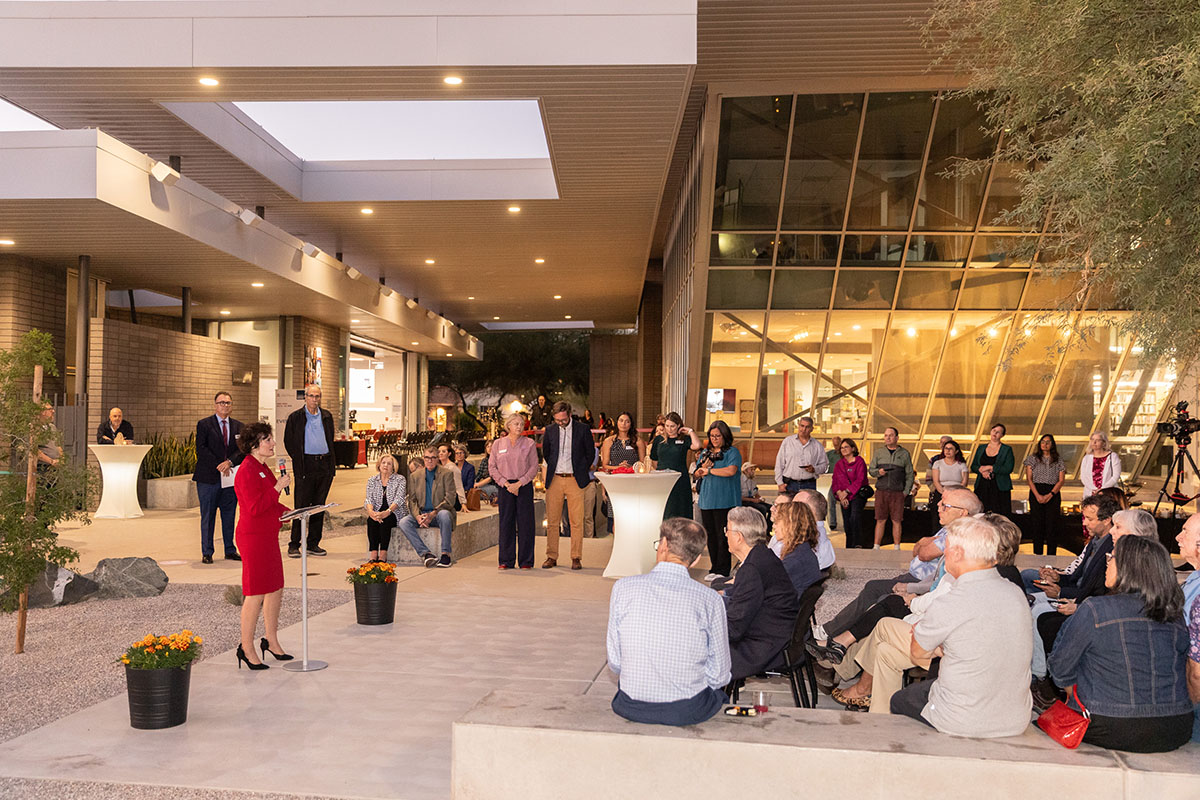
A recently completed landscape renovation has transformed the area surrounding the University of Arizona Poetry Center, replacing what was once a service alley with a shaded garden designed for gatherings, learning and public events.
The area, known as the College of Humanities McCauslin-Smith Gardens, has expanded the center’s footprint and created a flexible outdoor space for both campus and community use.
The gardens, located on the south side of the Poetry Center, offer a new gathering place for visitors.
For Chris Stebe, the university’s landscape architect, watching the garden come to life has been rewarding.
“Seeing something go from a concept to a tangible space where people can make memories is incredibly fulfilling,” he said.
Stebe is the university’s only landscape architect and is responsible for planning and managing the look and function of outdoor spaces across campus.
“Everything from the paint of the building outward is my domain,” he said, adding that outdoor spaces play a role in how students and visitors experience the university. “There’s so much on this campus that’s more than the physical stuff like trees, palms and grass. People have memories tied to these places.”
The Poetry Center project offered the opportunity to apply that approach to a highly visited, well-known site on campus. The renowned Helen S. Schaefer Building serves as the home for both the Poetry Center and the Humanities Seminars Program, which celebrated its 40th anniversary last year, as well as the signature public venue for the College of Humanities.
A long time coming
Since the Poetry Center building opened in 2007, leadership had been interested in improving the public entry experience, said Tyler Meier, executive director of the Poetry Center. The building houses one of the largest collections of poetry in the country and serves both campus and regional audiences through readings, workshops and K-12 programming. However, the outdoor entryway remained unfinished.
“We’d dreamt of a better entryway into the center,” said Meier. “With the support of a community of donors, we were encouraged to explore what that entryway might look like.”
Meier brought the project to Stebe at University Facility Services, who reengaged Line and Space – the Poetry Center’s original architects – to ensure continuity with the building’s architectural style.
The project also required coordination among numerous units across campus, dealing with electric, painting, communications infrastructure, fire safety and accessibility, as well as coordinating with the city of Tucson, which owns the flanking streets around the center.
An outdoor extension of the Poetry Center’s mission
The McCauslin-Smith Gardens were completed earlier this fall and function as an outdoor extension of the Poetry Center, offering shaded seating and flexible open space to support everything from informal study to large-scale gatherings.
“We’ve had some great events in the space already to help inaugurate it and gather community members who support the center – an essential part of our budget model,” Meier said. “We’re looking forward to exploring new and exciting ways to create experiences in the space and welcome campus and community neighbors.”
Designed to accommodate a wide range of needs, the area can transition seamlessly between everyday foot traffic and public events. “The new space can handle anything,” said Stebe. “Two people studying, a small lecture or a 200-person event. That kind of flexibility is fantastic.”
A space built for experiences
“The gardens will activate a whole new range of possibilities for us, from field trips from local schools to receptions and events – and it will support exciting new informal uses too,” Meier said. “We strive to host a space and create experiences where everyone feels like they belong, and the garden area is an exciting new tool we can use in that work.”
Attendees of the College of Humanities McCauslin-Smith Gardens opening ceremony enjoy the newly renovated space.
Chris Richards/University Communications
Although the project was largely defined by planning, coordination and technical execution, it also reflects the personal histories embedded in campus spaces. Stebe often emphasizes the long-term emotional connection people build with outdoor environments on campus.
“Hopefully we’ve created a new space where people build memories,” he said.
For Stebe, that is rooted in personal experience. Before he worked on campus as a professional, he spent years here as a student. He carries a memory from that time of parking his car beneath a mesquite tree each day before class – an ordinary routine that today means something more: that same tree has become a part of the McCauslin-Smith Gardens, and will continue to shade students, faculty, staff and community members visiting the Poetry Center for years to come.
For more information about their collections, community workshops and visiting hours, visit the Poetry Center’s website.
Comments are closed.