
The flight of the winter moths appeared right on schedule, as did the Thanksgiving cactus flowers. Lawns are still green, and random planters in favored locations continue to look presentable and decorative. Island-wide, our landscapes have assumed an austere wintry look, one I like, although not yet entirely without color.
What could be termed a “calendar collision” of gardening activities with holiday activities and preparations becomes more inconvenient every year.
2026 gardens: The new year
The Johnny’s Selected Seeds catalog hit the mailbox two weeks ago, reminding me that the coming year’s garden and planning for it is just around the corner. Please read the message from Johnny’s employee owners inside the front cover when your catalog arrives: “To Our Growers: 3,235 varieties; 30 miles of bed feet; 175+ new products.” It is a background snapshot of the many moving pieces in growing, trialing, and providing the seeds we gardeners desire, but may take for granted.
No crop or seed is a fixed given, but each is the result of skill and labor. Each packet of seeds a gardener opens, plants, and tends represents that gardener’s commitment. Sometimes a sowing fails to work out, to big disappointment. Place that feeling next to the efforts of those who farm and grow our seeds, and you will have greater appreciation and thanks for seeds availability.
Live and let live
Leaves have fallen, revealing much that was obscured. Hornet and bird nests, and their locations, with unsuspected proximity to human activity, are fascinating. “Live and let live” is the best approach to garden allies. A set of four identical, orange-size bird nests, maybe vireos’, became visible after leaf fall, in a line of four crape myrtles. The hornets’ nest (pictured), shaped like a giant lemon, was hiding in plain sight near human activity. No unpleasantness occurred. “Don’t bother me, I won’t bother you.”
Prune now
Every year, the window when trees and shrubs are in winter dormancy is shorter and shorter. There is not much time to accomplish necessary pruning with respect to trees known to be bleeders of sap.
The list of bleeders includes dogwood, birch, grapevines, styrax, and mulberry, among others. Warm conditions in February can cause sap to rise. It is best to prune well before then, so your vine or tree is not bleeding.
I see a lot of bad pruning: stubs, cuts that ignore plants’ basic structure, torn bark, cuts that have little possibility of callusing over. I have done some bad pruning myself, too, over the years –– some of which gives me remorse, still. However, every mistake is a lesson and a way to learn.
Use well-sharpened tools that are correct for the job: lopper or pruning saws, not secateurs, for cuts more than half an inch in diameter. Place the cutting blade, not the bypass part, closest to wood. Look for the branch collar, and cut just outside it. The branch collar is where the callus bark — which heals the cut — originates.
Remove wood that looks diseased, dead, or dying, or that is visibly damaged, such as loose bark. Look for crossing or rubbing branches, and remove one or both. Clean up stubs from previous pruning; again, look for the branch collar, and cut just beyond but close to it.
Silvery plants
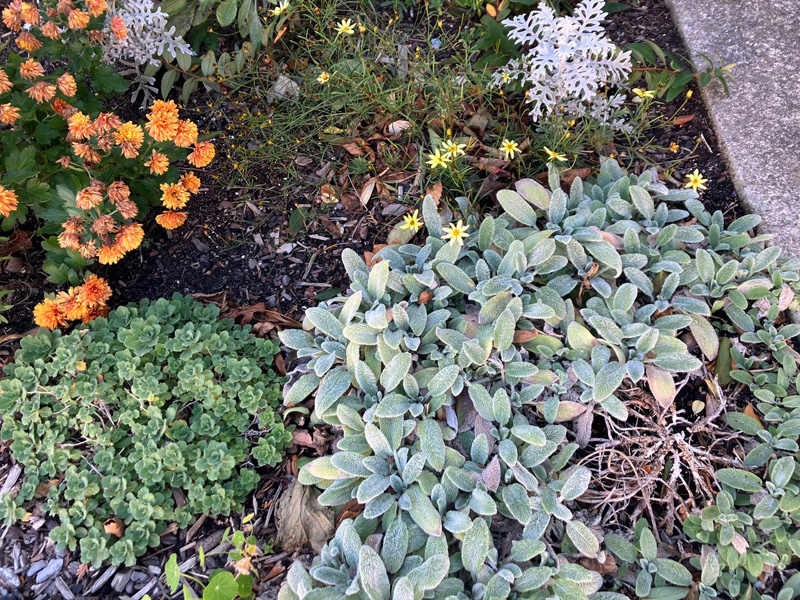
Silvery plants’ effects are a standout now. It is often the case that flowering annuals succumb to frost, while perennials and biennials with interesting foliage remain attractive for a longer time. Those with silvery or gray-green leaves seem to be in sync with this almost-winter season.
Check out lamb’s-ear, Stachys byzantina (S. lanata seems to be the same species). Cultivar ‘Helene Von Stein’ is more on the jade-green side than the type. Along with santolina, common rue, Ruta graveolens, is a winter-hardy subshrub with fine-textured gray-blue leaves that hold well through winter. Plants can be pruned into hedges and balls. All cultivars of lavender make punctuation points when beds hold little else. Personal favorites are ‘Phenomenal’ and ‘Munstead’ strains.
Statuesque Cynara cardunculus, commonly called cardoon, mimics the classical acanthus-leaf motif. Its gray-green leaves form exclamation points in gardens from summer through December. Cardoon is also edible, if you know how to prep it, so may feature in decorative potagers as well as ornamental gardens.
Silver sage, Salvia argentea, is a stunning half-hardy biennial (in other words, it may persist or self-sow where happy: sun, good drainage/dry soil). Plants can reach 2½ feet across in good locations, and are showstoppers. To encourage perennializing, cut off flowering stalks.
Camellias
I brought camellias indoors two weeks ago. Some have budded, and may be in flower around the solstice. Potted camellias can become quite large by houseplant standards. (I think I understand the origins of bonsai!) I am still learning about containment pruning of camellias, after they flower and before they go outside for summer.
The types of pests that camellias are subject to are similar to potted citrus pests: scales, but species-specific ones, and white fly and mealybugs. Camellia scale and citrus scale respond to insecticidal soap and hort oil, as well as swabs dipped in alcohol and run along the foliage and stems. It is only temporary, however; inevitably, they return.
MVAS
From the Agricultural Society’s newsletter: Now called the Home Grown Club, the free and open-to-all meeting is planned for Dec. 10 from 5 to 6 pm at the Agricultural Hall. “Sign up on our website!”
The Martha’s Vineyard Agricultural Society is reactivating something Roxanne Kapitan, Max King, and I started earlier in the twenty-teens, the Homegrown Garden Group. As with sewing circles and knitting groups, it is good to chew the fat and share experience and knowledge. Learning by doing and learning by sharing are invaluable in pursuits such as home gardening. Remember to sign up.
Comments are closed.