
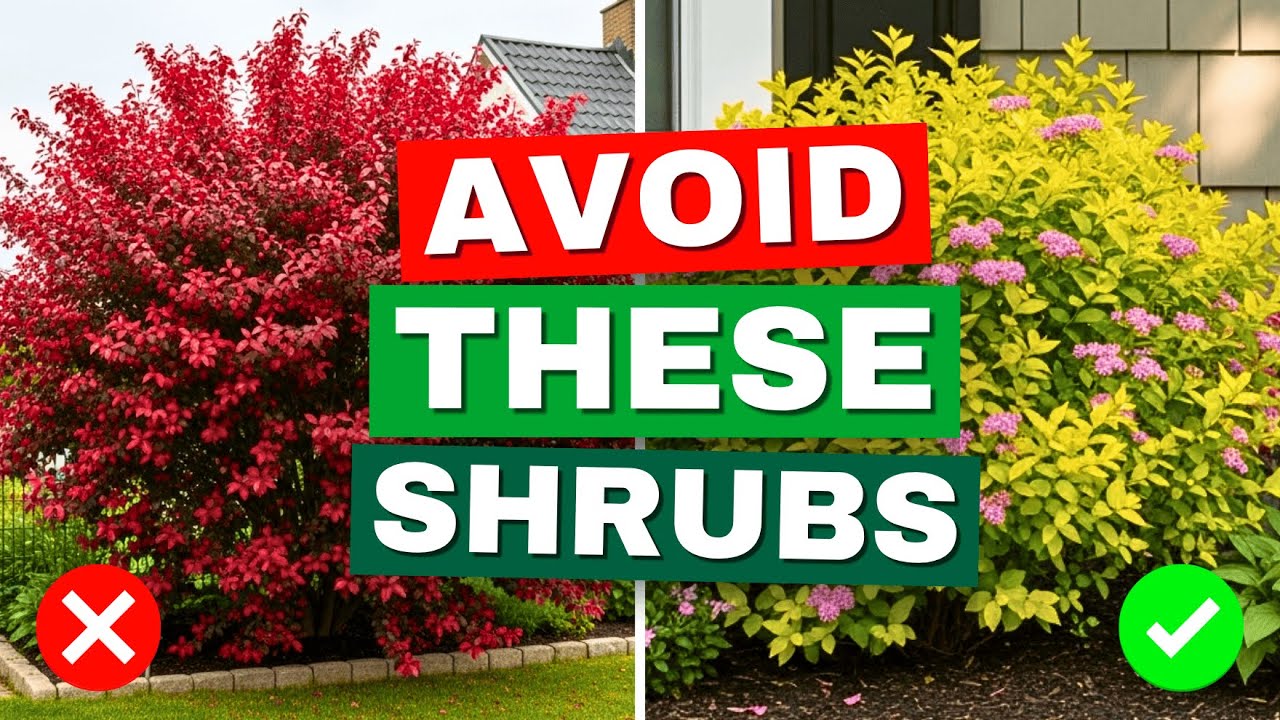
Thinking of adding some shrubs to your small garden? Before you plant, watch this video to learn about the 5 small garden shrubs you should avoid! Some shrubs may seem like a good choice, but they can outgrow their space, become invasive, or require more maintenance than you’re ready for. We’ll also share what to plant instead, with beautiful alternatives that are perfect for small gardens and low-maintenance landscapes!
😱 5 Small Garden Shrubs You Should AVOID—What to Plant Instead!
The 5 most problematic shrubs for small gardens, and why they should be avoided.
How these shrubs can take over your garden, overcrowd your space, and require more attention than you’d like.
Better alternatives to plant instead, for a beautiful, manageable garden that thrives in small spaces.
Tips on choosing the right shrubs for your garden’s size and style, with easy care and year-round beauty.
How to create a low-maintenance garden without sacrificing aesthetics.
Ready to create the perfect small garden that’s both beautiful and easy to maintain? Watch now to find out which shrubs to avoid and what to plant instead!
━━━━━━━━━━━━━━━━━
Join this channel to get access to perks:
https://www.youtube.com/channel/UCZDXM1926FRjQGNWNGSpBQQ/join
━━━━━━━━━━━━━━━━━
#SmallGardenShrubs #AvoidInvasiveShrubs #PlantDoHomeAndGarden #GardenTips #ShrubAlternatives #LowMaintenanceGardening #GardenDesign #InvasivePlants #BetterPlantChoices #SmallSpaceGardening #GardenInspiration #HealthyGarden
━━━━━━━━━━━━━━━━━
Don’t forget to subscribe for more gardening tips, plant recommendations, and landscaping ideas to help you build a garden that’s both stunning and sustainable! 🔔
━━━━━━━━━━━━━━━━━
Hope you guys are entertained, thank you Gardeners!
━━━━━━━━━━━━━━━━━
All images and videos are the rights of these authors. I just collect and combine them into a video that is useful for the audience. Thanks to image and video creators.
━━━━━━━━━━━━━━━━━
❌❌Don’t Re-Upload My Content ❌❌
━━━━━━━━━━━━━━━━━
Contact me if you have any needs: creator@plantdo.xyz
━━━━━━━━━━━━━━━━━
shrubs to avoid for small gardens, worst shrubs for small spaces, invasive shrubs for gardens, small garden design tips, problematic shrubs for gardens, how to choose the right shrubs, best shrubs for small spaces, low-maintenance shrubs, better alternatives for small gardens, shrubs for small garden spaces, invasive plants in small gardens, low-maintenance plants for small yards, gardening tips for small spaces, easy-care shrubs, compact shrubs for gardens, plants to avoid in small gardens, garden design with manageable shrubs, how to design a low-maintenance garden, gardening for beginners
Ever feel like that one shrub you planted just took over your small garden? You’re not the only one. Some plants seem like a great idea at first until they grow fast, spread wide, and suddenly your space feels overrun. In this video, we’re calling out the worst offenders for compact gardens. Shrubs that just don’t know when to stop. But we’re not here to just complain. For every plant to avoid, we’ve got a better, smarter alternative that fits beautifully in small spaces. Let’s get into it and help your garden breathe again. Skip the forcyia. Try sporia gold flame instead. Let’s kick things off with a shrub that’s bold but often too much for small gardens. For Cythia, those bright yellow blooms in early spring are hard to miss. But once the flowers fade, what you’re left with is a fast growing, sprawling shrub that can easily take over your limited space without regular hard pruning. It becomes woody and unckempt, and the foliage doesn’t offer much visual interest throughout the rest of the season. It’s one of those plants that seems great in theory, but in a small yard, it quickly becomes a maintenance headache. Now, if you still want seasonal color and cheerful blooms without the chaos, Sporia Japonica Gold Flame is a brilliant alternative. This compact shrub starts the season with vibrant bronze red foliage, shifts to a bright chartreuse green in summer, and finishes the year with fiery orange fall color. On top of that, soft pink flowers bloom from late spring to midsummer, creating contrast and interest that lasts well beyond forcyia’s brief show. And the best part, it keeps a tidy, mounded shape without constant pruning. Gold Flame thrives in full sun, tolerates heat with ease, and isn’t picky about soil as long as it drains well. It requires very little attention to look dead all season long. A quick trim after flowering helps maintain its form, but even that isn’t strictly necessary. It’s a lowmaintenance shrub that earns its keep in any garden, especially a small one. Planted along the front of borders, near pathways, or even in containers to create long lasting impact. Its changing foliage colors give your garden a dynamic look from season to season, and the flowers are loved by bees and butterflies. It’s a small space champion that brings both structure and softness. Definitely a step up from the unruly for Cythia. [Music] Skip Burning Bush. Try barbarous crimson instead. Next up is a shrub that might look dramatic in fall, but comes with a long list of issues. Eonymous elatis or burning bush. While it’s famous for its blazing red foliage in autumn, this plant has a tendency to get much larger than people expect, it can shoot up to 10 feet tall and wide if left unchecked. And even with pruning, it often outgrows its base. On top of that, in many regions, it’s considered invasive due to how easily its seeds spread and take root in wild areas. Instead of wrestling with burning bush, consider burbarous thundery crimson pygmy. This dwarf barbar offers the same rich red foliage, but in a much more compact, controlled form. It stays small, around 2 to 3 ft tall and wide, making it perfect for tight spots where every inch counts. The deep burgundy leaves add a bold splash of color and its natural shape is dense and rounded giving structure without effort. It thrives in full sun and well- drained soil. And once established, it’s drought tolerant and incredibly resilient. It doesn’t need regular pruning and isn’t prone to disease or pest problems. Just give it some space to show off its form and it’ll reward you with year round visual appeal. even in winter when its stems add texture to the garden. Use it to anchor a small bed, edge a walkway, or pair with ornamental grasses for a modern, clean look. Its tidy growth and bold color make it a standout choice where burning bush might have once been. And unlike its larger cousin, this one behaves [Music] Skip the common lilac. Try dwarf Korean lilac paliban instead. The traditional lilac is beloved for its nostalgic fragrance and stunning spring flowers, but it’s not always the right fit for smaller spaces. These shrubs can reach 12 feet tall and wide, and their large woody root systems compete aggressively with nearby plants. They’re also prone to powdery mildew and need excellent air circulation, something small gurens often lack. Without careful placement and maintenance, they can become more of a burden than a joy. Now, if you love that classic lilac scent, but want it in a neater, more manageable form, Seringa Mired/Paliban or dwarf Korean lilac is your dream come true. This compact variety grows to just 4 to 5t tall with a naturally rounded shape and dense branching. It explodes in spring with masses of lavender pink flower clusters that are just as fragrant as the larger types. And it’s not just a one-hit wonder. Paliban often relums lightly in summer, giving you more than one chance to enjoy its charm. This shrub thrives in full sun and appreciates well- drained soil. It’s resistant to most common lilac diseases and handles urban conditions well, making it ideal for tight spaces and busy gardeners. A little deadheading can encourage relooming, but even without it, the plant stays tidy and attractive. Plant it near patios, walkways, or entrances where you can enjoy the scent up close. Its size makes it perfect for borders or even large containers. And its reliability puts it far above the highmaintenance standard lilac. With Paliban, you get all the romance of lilac without the headache. Skip privet. Try boxwood saficosa instead. Let’s talk about a hedge staple that’s often more trouble than it’s worth. Privet. While it’s fast growing and commonly used for privacy screens, that vigor comes at a cost. In small gardens, it can grow unruly shockingly fast, needing constant trimming just to keep it from swallowing up your space. And if you skip a season of pruning, you’ll be left with a leggy, overgrown mess that dominates everything around it. That’s why Buxus seervy sufferosa or dwarf English boxwood is a far better choice for compact spaces. It has a naturally tidy rounded shape that’s perfect for low hedging or structured accents. Its fine textured evergreen foliage holds its form year round, adding from malady and rhythm to even the smallest beds. And unlike privet, it won’t grow out of control or require constant intervention to look good. This box with variety thrives in full sun to partial shade, is incredibly adaptable to different soil types, and responds well to light shaping. It’s slow growing but steady, which means you get lasting structure without the stress as long as it’s not in overly wet soil. It’s easy to maintain and stays healthy with minimal care. Use it to line paths, define garden beds, or as a formal backdrop for flowering perennials. Its understated elegance works in nearly any design style, from cottage to contemporary. In a small garden, it gives you exactly what you need. Order, greenery, and a break from the chaos of fast growing shrubs like privet. Skip the standard butterfly bush. Try Budga Lo and Behold series instead. You’ve probably seen Budga Devidi or butterfly bush praised for being a magnet for pollinators. And while that’s true, the standard varieties can grow huge. We’re talking 6 to 10 ft tall and just as wide with a wild growth habit that becomes woody and leggy fast. In a small garden, this quickly turns from wildlife haven to overwhelming jungle. Enter the Low and Behold series, a compact line of butterfly bushes bred specifically for small spaces. These cultivars stay around 2 to 3 ft tall, offering the same long spiked blooms that attract butterflies, bees, and hummingbirds, but without the massive size. Varieties like blue chip and purple haze bloom continuously from summer to frost and have a tidy mounding shape that fits perfectly in limited spaces. They love full sun, need well- drained soil, and are highly drought tolerant once established. Even better, they don’t require deadheading to keep blooming, which means less work for more color and pollinator traffic. Add them to borders, containers, or patio beds where space is type, but impact matters. You still get all the pollinator joy, the vivid flower spikes, and the summerlong color, just without the pruning battle or spacehoging. It’s a modern shrub for modern gardens. [Music] And there you have it. Smarter shrub swaps that save space, reduce maintenance, and still give your garden the beauty it deserves. When every inch counts, choosing the right plant makes all the difference. For more tips like these, make sure you’re subscribed to Plantdo Home and Garden. See you in the next video.
32 Comments
All good, but don't get suffriticosa boxwood. It is not disease resistant…Get another small variety instead.
i love those spirea – sadly, so do our wild rabbits and they eat the lot down to the roots unless i have permanent chicken wire around the plant, which of course, detracts from the plant's beauty
It just comes down to research and personal choice and the effort you're committed to make with some of these. There are different dwarf varieties of Forsythia that can be used in small spaces. Golden Clusters only grows to 1.2m by 1.2m so you don't have to forsake this plant if you really want one in your garden. Butterfly bushes whilst growing big can be limbed up and pruned to 1-1.5m making a lovely minature tree. For evergreens that flower in spring, Raphiolepis are good and are also frost hardy. Hebes are also a lovely evergreen choice that flower for small gardens.
I just pulled out my Spirea, the flowers turned brown almost as soon as they bloomed and it needed pruning twice a year. Then it looked bare until the leaves grew back in.
First time viewer…. Fantastic video and narration! I love how you give all the info at the end of each plant. Easy to screenshot for future reference! I just became your newest subscriber! 🪴🥰
Fast multiplying and spreading invasive plants are one thing. Others are fine.
Spirea is pronounced Spy-ree-ah and there is no ‘j’ in Buddleia.
My spirea is dead in the middle.
Those smelly yellow weeds are the worst.
Thank you so much for this wonderful video! I love flowering bushes but never quite sure what to buy for the best result. I will definitely be trying some of these that you suggest. ❤
We can no longer get barberry shrubs here in Indiana. That’s a real shame because I love the colors, (especially the yellow, which I have in my entry garden along with a weeping burgundy Japanese maple.) Stunning!
Extremely helpful video. Thanks.
🌿 So many of these moments truly bring back memories… Which one felt the most nostalgic to YOU? Or is there a tradition you’d love to see return?
Share your thoughts below — we’d love to know what touched your heart the most!
Poor Forsynthia! In many regions this is the very first spot of color that appears in the garden after a long gray winter.
We do welcome that shock of yellow as it tends to jar us all awake to begin enjoying the next sign of spring, and the next… Please do consider the value of nature’s priceless aesthetics in gardens of all sorts, for which an appreciation will hopefully be passed on to our next generations of gardeners.
This was so helpful! 🌿 I almost bought one of these shrubs last week 😅
Gold flame self seeds and ends up all over your yard. Hard no.
lol….i have made most of these mistakes!
very usefull INFO
Are any of these deer resistant?
Barberry is invasive. I find Spirea also are invasive in my zone 5 garden.
Good video but most of these plants are not for the Deep South which is where I live. I will try the Dwarf Butterfly bush though. Thanks for posting this.
Most of these recommendations are terrible as they merely replace one destructively invasive species with another possibly even more invasive one–specifically the barberry, spirea, and butterfly bush are well known for the damage they do to local ecosystems.
There is a dwarf forsythia. I have 2 in my small yard 😊
I NEED bushes DEER WILL NOT EAT🥲
Butterfly bush is invasive! Don't plant!
I don’t quite understand the whole why would you replace ? But I love everyone else’s comments helps me understand the comments.. I actually would like to replace with edible or useable plants, herbs dwarfs something I can consumer water isn’t always free or cheap water is expensive
Great job, keep it up.
Forgive me,yet I personally disagree with many of your suggestions.
It is spelled "Spirea" and pronounced "spy-ree-a".
When your property line is next to pastures for cattle, barberry is the only shrub that will keep them from grazing on your property.
Buxus Sempervirens is prone to blight; I've just removed mine because of it!
Spirea took over our garden and we had to remove. Great looking shrub, but grows larger each year.