
http://www.edibleacres.org
https://www.youtube.com/user/edibleacres/join – Join as an Edible Acres member for access to members live Question and Answer sessions and to support our work!
https://www.paypal.me/edibleacres – A simple and direct way to ‘tip’ to help support the time and energy we put into making our videos. Thanks so much!
Edible Acres is a full service permaculture nursery located in the Finger Lakes area of NY state. We grow all layers of perennial food forest systems and provide super hardy, edible, useful, medicinal, easy to propagate, perennial plants for sale locally or for shipping around the country…
http://www.edibleacres.org/purchase – Your order supports the research and learning we share here on youtube.
We also offer consultation and support in our region or remotely. http://www.edibleacres.org/services
Happy growing!
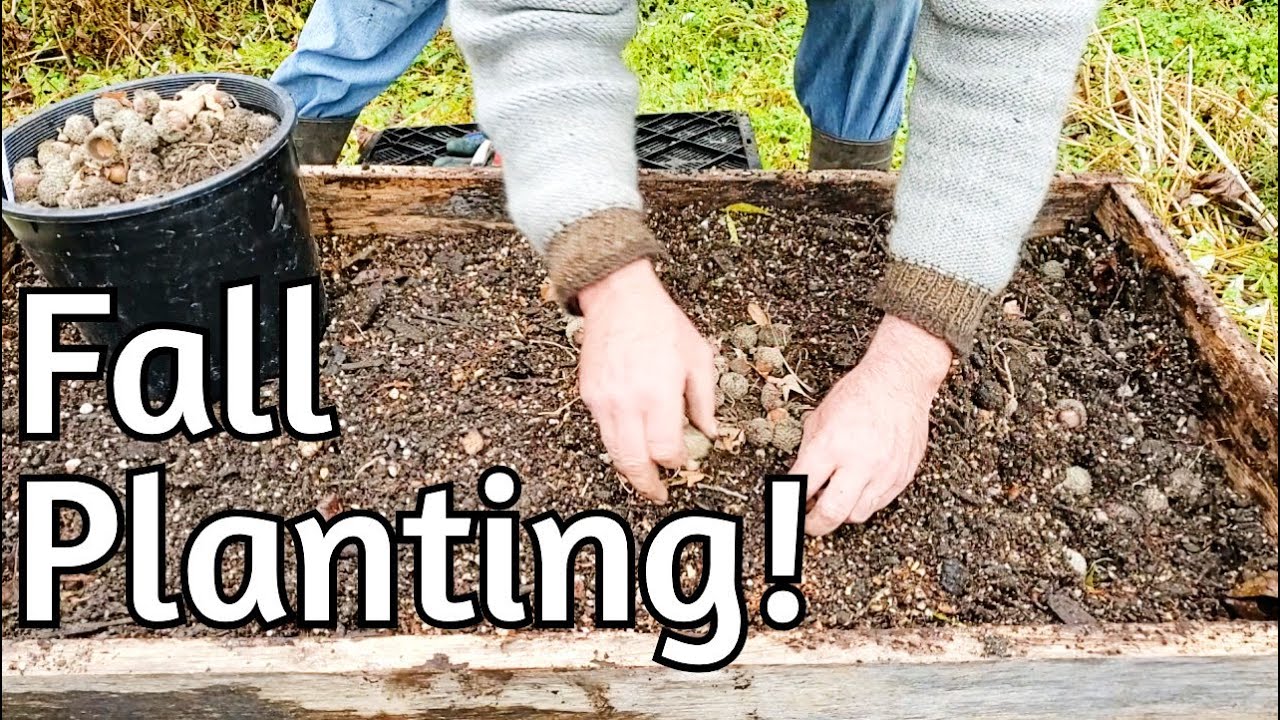
I recently spent some time planting a variety of some beautiful oaks, some acorns. Uh this is an air prune boxes with fall planting. And I thought I’d take some time to record it and share the process of assembling boxes, renovating, organizing the seeds so they plant in the proper orientation and way and mulching them in a way that can coast them through a New England winter. So, I’ve got a wheelbarrow here full of supplies to go out to our air prune boxes and four different varieties of acorns to plant. They’ve been looking at me the whole time we’ve been plant or doing our shipping this fall, waiting to go somewhere. So, I thought it was time to just give them a chance, get them in the earth. So, I came out with a wheelbarrow with some little wooden boards, which I’ll talk about, and get organized in a way to plant. These are air prune boxes from this last growing season. They did a great job of growing probably about a thousand trees in this one area. We’re going to reuse them, but just transpose them. We’re going to move them just a little bit over, which will make sense as I go. So, the first process here is to harvest the soil, the growing media back out. I don’t want to waste this or have to start from scratch. So, I’ll use buckets and containers and simply carefully scrape through with the shovel. This is a chance to also pick through if there’s any perennial weeds and roots. I can also move it to an air prune box off to the side. And then I’m going to dump out the last little bit over the area that it was. These boxes have been here I think for 2 years. And so once the air prune box is out of the way and the risers are taken out, this will be one of the best prepped garden spaces I could ask for. So I can either plant um a little garden here or better yet maybe plant a tree guild. Maybe an an oak gets planted here with a gummy to the south and a whole bunch of sorrel as the ryome barrier. A lot of different options, but that air prune box uh sitting there for a few years really made for a gorgeous bed space and it’s ready to do that same prep work another area. It’s a couple square feet of beautiful places to plant and a weedy spot that’s ready to receive the air prune box. So, I’m just going to go through and move those same little risers. So, those are two foot long nuggets of a rot resistant wood. In our case, black locust. I like three of them. You can use four. And I’ll just want to keep adjusting and moving them around to make sure that the air prune box feels relatively level and relatively supported all throughout. I don’t want it to have to bear the load of all the weight of soil in just one position. So, I’ll just poke push and poke until it feels like okay, this seems about levelish and doesn’t rock very much. And here I’m in a silly way demonstrating that I can stand in it. So, that should be able to hold some soil. I don’t normally test it that way except for show. And there it is, ready to receive the soil. Again, I’ll start by putting some uh random grasses from around the pond and some old waste hay at the very bottom. Just a thin layer to act as a way to keep the soil media from falling through the mesh at the bottom. Just a little bit goes a long way. And then I can speed it up and start dumping those buckets of soil from the same air prune box, but just moved a few feet over. So this will erase all the weeds that are in this area and give us about 200 seedling oaks in the process. You can see the riser there gives me a little bit more uh planting height or depth of root height. I don’t always need to use those, but it’s nice to give that for the fancier seeds. And here I am planting ashworth burr oak. So, this is a type of seed, a type of tree that the seeds normally germinate in the fall. So, most seeds don’t do this and storing them over winter in crates uh buried under leaves is safer. But for anything that sprout sprouts in the fall, so your burr oak, your white oak, those sorts of seeds, kind of have to plant them uh now and then mulch them and protect them for the winter so that they can survive. These are good news is that in our zone 5b, we don’t tend to get cold enough to really really hurt them even when they’re in airprint boxes. But I’ll show how we mulch and protect them a little bit further just to kind of insulate and ensure their survival. I’m just going through giving myself a relatively organized grid. Couple of, you know, an inch or two between each seed on average. This isn’t actually sped up. It’s how fast I plant. I’m just kind of whacking them in. Um, these haven’t sprouted yet, so they’re pretty darn easy. And this gives me a rough idea on how to be able to count how many went in there. It ended up being about 120 seeds for this box. 130. And I’ll just uh rather than pushing them super deep, I’ll just lay them in like you see. And then cover them with soil from another box. Makes it a lot easier. About an inch or two of soil depth for a seed like that seems to work just fine. I’ll make a tag and slide that in so that we have a reference. I put it in the northern end of the box as a convention. And then we’ll put the riser or the um the cage on top, but I leave it open for now so I can mulch in there. I’m going to do this in another box, too. But this one had some issues. This was a box that had Ashworth burr oak last year and they grew really nicely, but we noticed a lot of them had very long roots. They had gone through the bottom and into the earth below. So you have to pull them out damages the roots. That’s not what you want. But that tree will be fine. It’s just not something we want to put out into the world for other folks. We’ll plant this ourselves. So this is the reason why periodically moving air prune boxes. If I want them to be semi-permanent, they need to be semi one or two years and then migrated a little bit over with a new set of risers so that this decoupling stuff can happen cuz this only gets more and more intense and then the air pruning goes away entirely and you just have punitive metal mesh in the roots which is the exact opposite of what you’re looking for. So, moving that one aside, we’ve got a really nice bed again left in its wake. And this time, we’re going to try to use um a little bit better of a riser system to get them decoupled. Our friend Todd in Michigan sent us these chinkapin dwarf oak, which seems really interesting to plant out and work with. They really sprouted. Uh he sent them along and they were in very, very goodstead. And this is a good reminder of why you fall plant acorns. You can see the roots are starting to come out. And so I need to be thoughtful that I’m orienting them where the roots come out from the side and start aiming down. And that is a common convention with most trees. The first point of growth is the root. And so I don’t want to push that straight down. I let it go out and then it goes down. If that makes any sense. Um here we got that all planted in. And then that was a lot of effort and a lot of detail. And we can also, very silly, uh, just dump some seeds in there, too. Both ways work just fine. You can be as fancy or as loose as you want. We found some wine cap mushrooms growing in a wood chip pile nearby this summer. And so, I’m going to harvest some of those wine caps to use as our mulch. So, each of these boxes get uh one bucket of wine cap laden mushroom wood chips, and then we’re going to mulch some hay on top of that to insulate. That should add a really nice layer of decomposition and support. Can be a pretty wild scene moving these boxes around, but it’s very functional. And you can see as long as you speed up the video, it goes pretty quickly, too. So, this is just another one that’s going to get some more acorns. This will get uh English oak. And same basic process. Move it to a new spot, get the risers on there, get the the bed itself laid in, start building up from there, and really refine and perfect that soil mix as we go. By the end of the season, we’ve got absolute beautiful seed starting mix. It’s beautiful. This is two different varieties of English oak. And this one is just ginormous. Found out at a local farm. So, a couple hundred trees will grow in there this season. That’ll get covered in soil, mulch, and insulated. I’m going to pick apart one of these round bills and use that for insulation. Leaf bags work fine, too, or sawdust, wood chips if you got it. But the hay is really nice. I can dump it in the inside of the container first and that will mulch the soil surface and protect that in a good way. That’s why I leave the final cap off while I’m doing this process. That’s it for now. This a couple hours of work, maybe an hour solid. No big deal. Overall, the infrastructure is here. Just rearranging the airroom boxes, sidest stepping them one degree over. So, there’s three airpoon boxes now filled with a bunch of white oak and burr oak, English oak class uh seeds that do need to be able to germinate and start developing their root system in the fall. I wouldn’t be doing this with paw paws and pimmens in a colder climate, but this is lovely for those fall sprouting oaks. Maybe we do a little experiment with some chestnut and hazelnut this winter and set them up as well and see how they perform next year. But that’s the basic idea of air prune box planting in the fall along with insulation. Certainly will follow up probably another two wheelbarrow each of hay. So at a nice angle it goes right up to the top after this settles a bit. That would make me feel pretty comfortable that the box is nestled in for the winter well enough. Let me know your thoughts. Thanks for watching.
15 Comments
👍 nice & usable project. Thanks for sharing. 😊
Would i be OK doing this right now with paw paw and persimmon seeds in zone 6B/7A?
Dwarf chinkapin,I'm so excited!
I hope they become one of your staple offerings!
I love your sense of humor!!😂
Great video, Sean!
I have a grass catcher on my zero turn mower… do you think mulching with fresh clippings would work for acorns and nuts? Not sure if that’s too much nitrogen or if a more trashy hay is desirable for mulching!
Do you have a sense of how many oak trees are growing around the country because of your air pruned boxes?
Lovely work and good narration, thanks
I think I'll start recording my planting so I can speed it up too 😂
I planted Burr oak acorns yesterday too! Today we will be planting Valley oak acorns! I also have Red, Scarlet, and pin oak acorns to plant directly! I will also be making air prune boxes based on your design for next year! ❤
So many great tips here on air-prune beds! It must be fall! You are wearing a fine hand-knit sweater of a natural wool. That's quite extraordinary in this day and age of acrylic fast factory fashion. As some may know, I'm a needle crafter. I love making quilts, crochet and knit items and appreciate seeing home-made apparel, household utility and problem-solving items, and decoration. When cooler temps prevail, I can be found early morn at the sewing machine working through the year's mending. One of your sweaters has been mended with great style and care! Would it be possible for you and your family & friends to do a small segment on what you do to increase the longevity of your clothing, how you all do laundry, mending, or other home thrift tips 'n tricks or whatever you care to share around those ideas?
Thank you.
Nicely shown and described process, very useful thanks! Makes me curious what the low temperature tolerance limits are for some of these acorns. Naturally, squirrels aren't planting much more than 2 inches or so and the ground freezes to a greater depth than that. The hay here is acting to loosely couple and capture the heat source from the ground, correct? So the acorns wouldn't get as cold as without hay in theory but still probably below freezing either way. In that perfect world, we have time and resources to set up the experiment but of course hedge the bets because it's potential income. Accidents are just passive experiments 🙂
Would you be able to share more information on your soil mix? Maybe this is covered in a different video? Is it pretty much the same mix for everything? Thanks for being a great permaculture resource.
I like sawtooth acorns. They are bigger and easier to process I to flour. Ever grow that variety?
Does the tap root recover when planted in the ground?