
Dennis McNamara
| Special to MyCentralJersey.com


White House Christmas tree arrives on horse-drawn carriage
First Lady Melania Trump received the White House Christmas tree on a horse drawn-carriage.
For some faiths Dec. 24 marks the religious Feast Day of Adam and Eve. This being a gardening piece, rather than a religious one, I won’t delve too deep into the subject other than to briefly explore the connection of our present-day tradition of having a Christmas Tree with the medieval origins.
The story of Adam and Eve in the Garden of Eden and their disobedience of picking the forbidden fruit (original sin) is said to have brought sin and death into the world, creating the need for a savior. The placement of their feast day immediately before Christmas highlights the Christian narrative of salvation on Christmas Day. Celebrating the feast day included an evergreen “Paradise Tree,” a symbol of everlasting life and love of God.
The tree was decorated with apples (forbidden fruit) and later lighted candles were added to the Christmas tree. The candles are widely attributed to the 16th-century Protestant reformer, Martin Luther. Legend holds that he was inspired by the beauty of stars twinkling through evergreen branches on a winter night, which reminded him of the stars over Bethlehem. The practice of bringing an evergreen into the home for the holiday was then spread by German immigrants to the United States and gained widespread popularity.
Fast forward to the 1880s in Menlo Park where Thomas Edison and his associates were developing the first electric lights. Edison had his team string lights outside his laboratory to be viewed by passing trains as a promotion for his new invention. Edward Johnson, an associate of Edison, is credited with creating the first string of Christmas Tree lights. He created the electric Christmas lights in 1882 for his home as a safer alternative to burning candles on trees. Initially, the strings of lights were prohibitively expensive. The wiring of electric lights had cost about $300, about $2000 in today’s dollars. By 1903 General Electric began offering affordable pre-assembled, pre-lit kits to make the lights more accessible to the public.
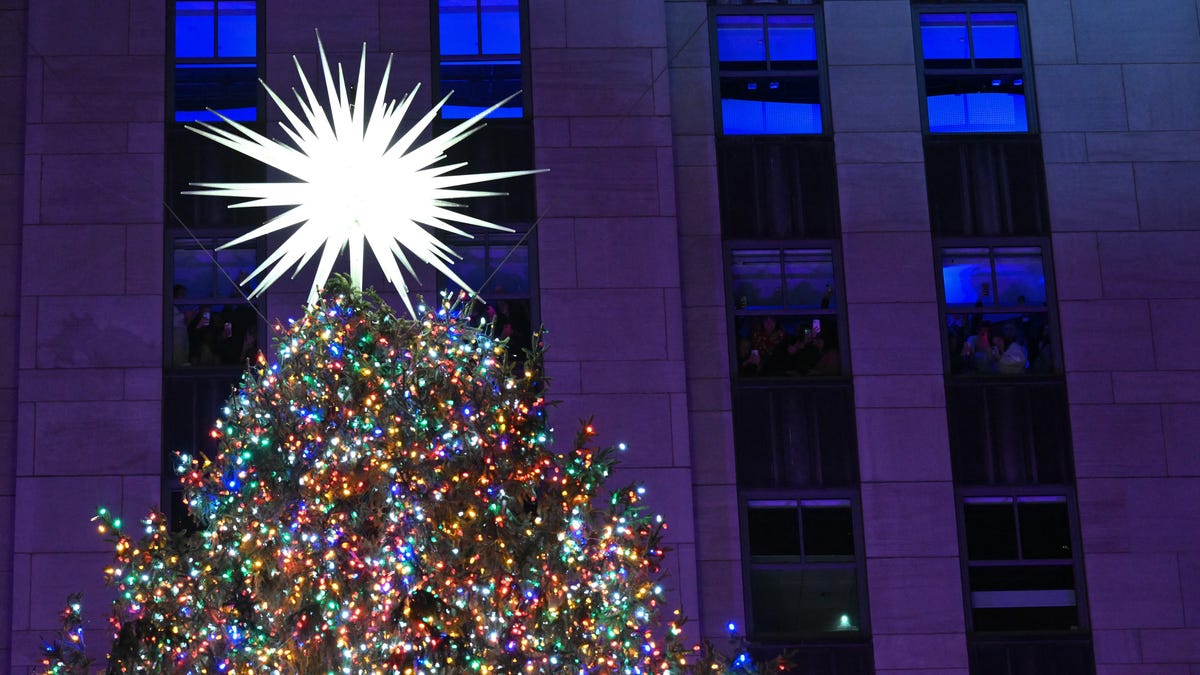
On Christmas Eve in 1923, President Calvin Coolidge began the country’s celebration of Christmas by lighting the National Christmas Tree with 3,000 electric lights. Every year, people gather to see the large tree aglow and beautifully decorated with ornaments.
While the Feast of Adam and Eve is not an official universal celebration, the traditions associated with their feast day (like the Christmas tree) live on.
At the Rutgers Fruit and Ornamental Research Center in Cream Ridge, we study many plants, their traits and characteristics, along with their potential problems. Our task is then to prescribe solutions to those problems. While the bulk of the work at Cream Ridge revolves around native tree and shrub species, Rutgers is also working at finding disease resistant conifers for the Christmas Tree growers.
These growers have conifers from around the world – mainly firs, spruces, and pines. One of the most popular Christmas Trees for the growers is the Douglas fir (Pseudotsuga menziesii), Pseudotsuga means “false hemlock.” The Douglas fir, a conifer in the pine family, Pinaceae, is a native to western North America. It possesses very desirable traits for the Christmas tree trade – it is a fast-growing tree with soft needles and has a nice pine fragrance.
Unfortunately, the Douglas fir has shown to be susceptible to Phytophthora root rot, a plant disease caused by a type of water mold, leading to root decay and wilting. Providing the growers with a viable solution to the Phytophthora problem along with presenting a reasonable alternative species is the work at hand. We will make the results of this study available at a later date.
Following is a quick review of some alternative Christmas tree species:
The Korean fir is not a commonly grown Christmas tree in the U.S. but may be increasing in popularity. It has had good success in well-drained soil. The needle undersides have a striking white coloration. It appears to be relatively pest free compared to some other conifers. It has a moderate growth rate, though not as fast as Douglas fir or Norway Spruce.
The Frasier fir often commands a higher price compared to other trees. They are superior in terms of needle retention and with proper indoor care can be kept for up to five weeks. The problem with growing the Frasier is that they are most susceptible to root rot.
Balsam firs are generally thought to have the most pleasant fragrance. But the problem with growing Balsams is that they are prone to have aphid pest infestations.
Canaan firs have a more subdued fragrance than the Balsam and typically have fewer insect and disease pests. They will tolerate wetter soils than Frasier and Balsam firs and could help to adapt to climate change issues. An added plus to this species is that they may be ready to market possibly two years sooner than a Frasier fir. Few people can visually differentiate a Balsam fir versus a Canaan fir.
Along with the mentioned species, our Cream Ridge Christmas Tree study also includes pines, spruces, cedars, and hemlocks, the details I will share in a later article.
Have a Merry Christmas and enjoy the Feast Day of Adam and Eve.
Dennis McNamara is an agriculture program associate at the Rutgers Cooperative Extension of Monmouth County.
Comments are closed.