
Blossom of pineapple mountain (Ochagavia litoralis). (Courtesy Tom Karwin)
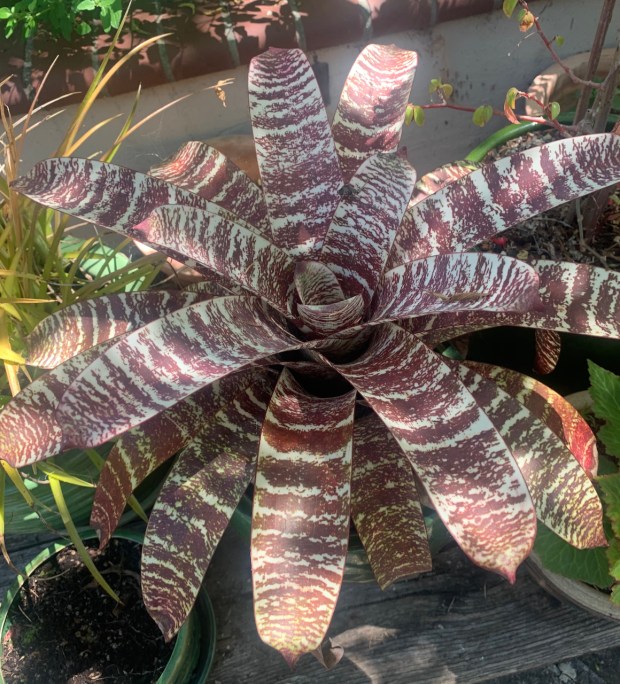
Red chestnut bromeliad (Vriesea fosteriana var. seideliana ‘Red Chestnut’). (Courtesy Tom Karwin)
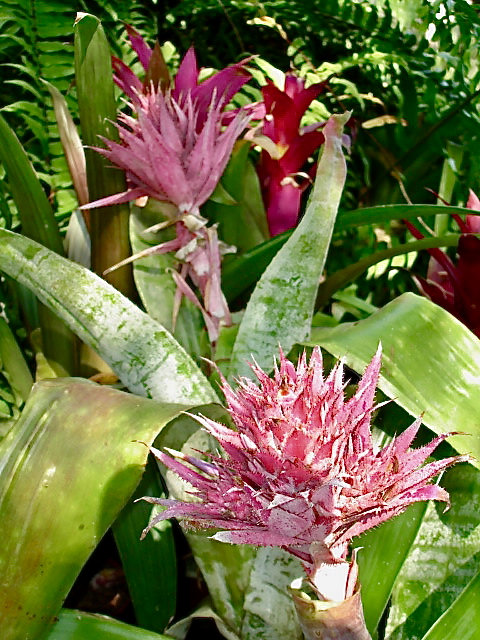
Silver vase (Aechmea fasciata). (Courtesy Tom Karwin)
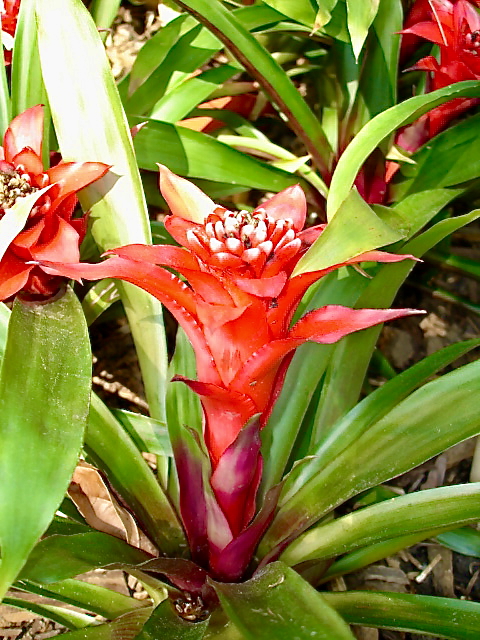
Scarlet star (Guzmania lingulata). (Courtesy Tom Karwin)

Flaming sword (Vriesea splendens). (Courtesy Tom Karwin)
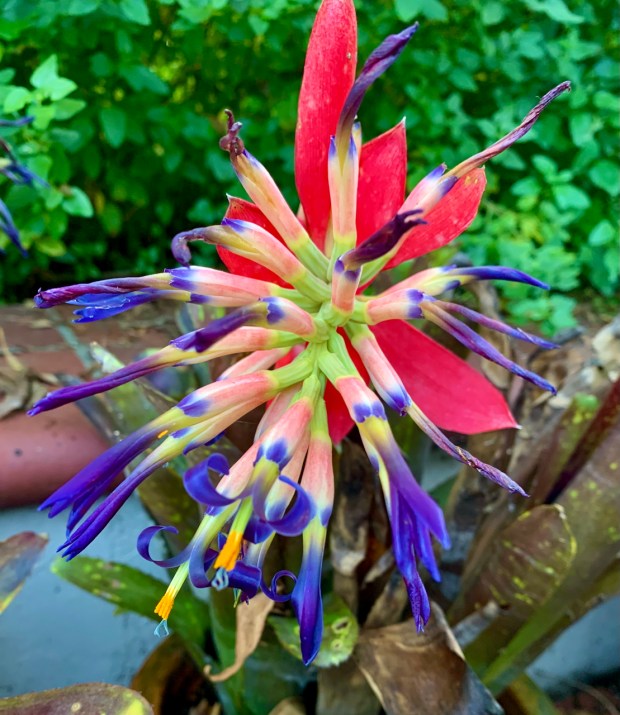
Banded bromeliad (Billbergia vittata). (Courtesy Tom Karwin)
Show Caption
1 of 6
Blossom of pineapple mountain (Ochagavia litoralis). (Courtesy Tom Karwin)
Expand
My garden includes — or has included — a range of plants from Mediterranean climates, other interesting regions and other categories. This diversity reflects my appeal for attractive blossoms or foliage, need to satisfy environmental conditions and inclination to include uncommon varieties.
Gardening explores and enjoys the diversity of garden-worthy plants.
I recently searched my collection of digital photos, looking for “bromeliads.” The application, Apple photos, yielded a gallery of images with “bromeliad” in their titles and included many images with other titles (or none … my error) that, to the app, looked like bromeliads.
I worked to add titles to the untitled images from my garden, using my cell phone’s plant identification utility, PlantNet, which is free and almost always helpful.
In this project, I identified several images of bromeliads, several still in my garden, and others no longer there, for various reasons.
Today’s image gallery
This column’s gallery features bromeliads with blossoms unlike roses, daisies and other popular garden flowers.
Overview of bromeliads
This plant family, called the Bromeliaceae, includes 80 genera in eight subfamilies and 3,700 known species, native mainly to the tropical Americas. Most of these genera are native to northeastern South America (the Guiana Shield) and parts of Colombia and Brazil. The family is organized into eight subfamilies and includes both epiphytes and terrestrial species.
Subfamilies of the bromeliads
The Bromelioideae subfamily includes the plants most gardeners think of as bromeliads, although that term applies to the parent family.
The Bromelioideae includes 40 genera, most of which are epiphytes, some of which can adapt to terrestrial conditions.
My garden includes members of the following subfamilies: aechmea (255 species); billbergia (64 species); cryptanthus (63 species); neoregelia (112 species); and ochagavia (4 species).
My garden also includes a tufted airplant (Guzmania ‘Jazz’), from the tillandsioideae subfamily of the bromeliads.
Aechmea
Silver vase (Aechmea fasciata). This Brazilian native has elliptic-oval leaves in a basal rosette, growing to 35 inches tall and 24 inches wide.
Billbergia
Banded bromeliad (Billbergia vittata). Another Brazilian native, this plant grows 36 inches tall and 18 inches wide, with leaves in a rosette form. The leaves have a glaucous green shade with horizontal white stripes below and a glossier, brighter green on the upper side. The inflorescences include individual tubular bright red flowers with purple tips. Bright red bracts line the lower half of short flower stems, called rachis. The genus is named for Swedish botanist J.G. Billberg, and the specific name is a Latin word referring to the plant’s striped leaves.
Queen’s tears (Billbergia nutans). This plant is native to Argentina, Brazil and Uruguay. It has grown in two large containers in my garden for a few years and developed scores of offsets (“pups”). We recently divided the offsets and planted them 1 foot apart under a large tree. These plants have established roots and are growing new leaves. The plant might reach maturity in two or three years or could produce new blossoms in the spring. When they do flower, the display should be impressive.
Cryptanthus
Earth star (Cryptanthus bivittatus ‘Ruby Starlite’). This terrestrial bromeliad is low-spreading and slow-growing, reaching 6 inches in height. It has a star-like shape of 6-inch-long, slender leaves with pointed tips. The leaves have long stripes in two or more colors, ranging from pink to red, white to cream and light to dark green. When mature, the plant produces a cluster of tiny three-petaled white flowers in the center of the rosette.
Ochagavia
Pineapple mountain (Ochagavia litoralis). This soil-dwelling terrestrial bromeliad is native to central Chile, which has a Mediterranean climate like that of coastal California. The plant forms a rosette of 12-inch-long spine-margined leaves. In the Monterey Bay area climate, during early fall, this plant produces a spherical inflorescence about 3 inches long and wide, on a 5-inch-long stalk that emerges from the rosette’s center. It contains up to 35 tubular flowers, each a few centimeters long, with three pink petals. Bracts surround the flowers, and bright orange stamens and style protrude from each flower. The blossom has a head rosette form, with a composite (head/capitulum) structure.
After growing in my garden for several years, this plant developed a tight cluster of rosettes for offsets and bloomed for the first time this year. Seven of the rosettes produced one blossom each. The blooms have now faded, and we will schedule a project to divide and replant the rosettes. When the plants bloom again, the display will be impressive.
Enjoy your garden!
Tom Karwin is a past president of Friends of the UC Santa Cruz Arboretum and the Monterey Bay Iris Society, a past president and Lifetime Member of the Monterey Bay Area Cactus & Succulent Society, a Lifetime UC Master Gardener (certified 1999-2009), past board member of the Santa Cruz Hostel Society and a current member of the Pacific Horticultural Society and other garden-related societies. To review the archive of recent On Gardening columns, visit santacruzsentinel.com and search “Karwin.” Visit ongardening.com to review columns from 2012-2020 (and eventually) from the following years. Please send comments or questions to gardening@karwin.com via email.
Comments are closed.