
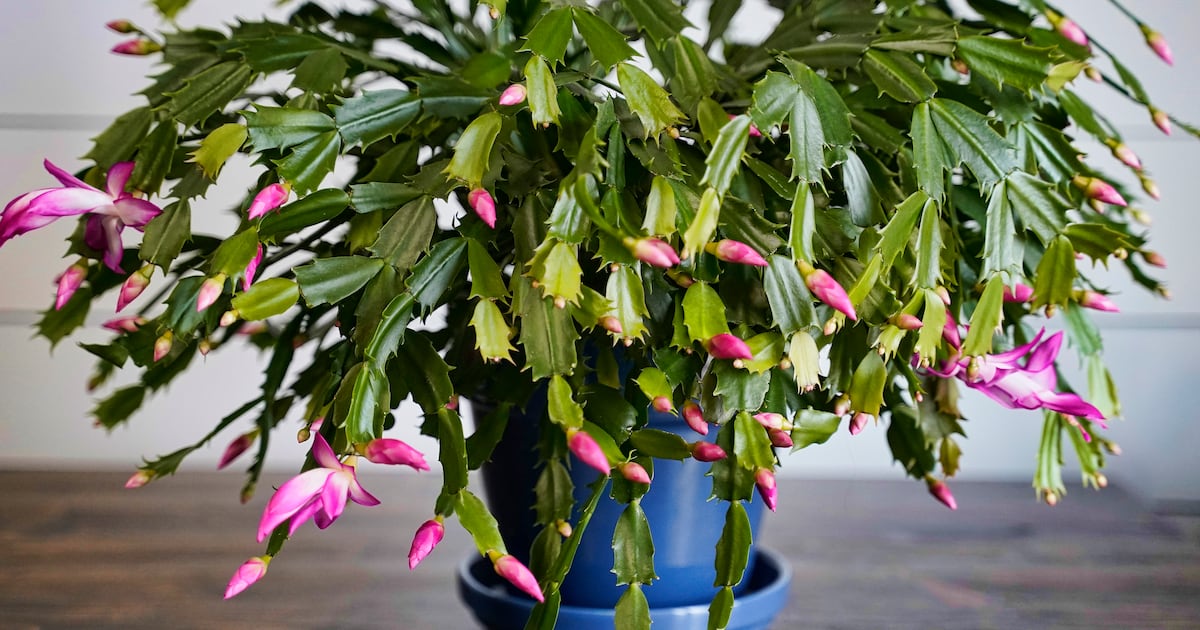
 Thanksgiving or holiday cactus (iStock / Getty Images)
I have not hit the emails in a while, but I have had some interesting ones worth sharing.
Let’s start with a subject I have covered before: how to tell the difference between Thanksgiving, Christmas and Easter cacti. It is easy. Thanksgiving cacti have claw-shaped segments; Christmas cacti edges are smooth and scalloped; and Easter cacti are rounded with bristled segments.
Obviously, if yours is blooming now, it is a Thanksgiving version. Christmas cacti should be setting buds. Note that I am not including the scientific names as I have finally come to realize it is the flowers people care about when it comes to holiday cacti. And I could write lots about their care, but really, they bloom in reaction to the day length. This is one set of plants that should not be kept under those lights I know you all have to keep your indoor plants healthy.
These holiday plants are not really cacti, but rather epiphyllums. Technically, these grow on other plants, which they do in the wild. We grow ours in soil. There are many other epiphyllums, with one group called orchid cacti. Google it. These have huge flowers in all manner of colors, including some that are positively fluorescent. All do exceedingly well in Alaska and particularly in homes that do not have supplemental lights. They are great collection plants. All you need is one segment to start a plant. You can find lots of sources on the web.
Next, I write about the soil food web all the time and it is the basis for all my books. Some readers want to know if this is purely an outdoor thing, or is there a soil food web in our indoor plants? The answer is most definitely. It has the potential to be just like the outdoor version, complete with worms and micro-arthropods, but most likely it is some sort of reduced version as the complete diversity that should exist outdoors rarely can be found in indoor soils.
Next is thrip season. Or are they gnats? Thrips are solid, one piece, rice-like critters. They damage the leaves of plants. Fungus gnats look like tiny wasps. These tiny pests appear this time of year and lay eggs on damp soil where they infect roots. They fly around and can be very annoying. You can make paper or cardboard circles to keep them from finding the soil. Or you can use the liquid made by putting a mosquito dunk in water. And if you have gnats, you are probably watering too much. Houseplants generally do best by soaking them and then letting the soil dry on the surface and down an inch or so.
What about fertilizer? I don’t use it. As noted last week, compost is what I use. If you feel you must use a fertilizer, get an organic one with low numbers. Just know using fertilizer throws the soil food web out of balance and usually results in some sort of problem appearing out of nowhere. Folks, it is just as easy to buy compost and use it. Unlike fertilizers, there is no mixing and you cannot use too much, so your plants won’t burn.
Jeff’s Alaska Garden Calendar
Alaska Botanical Garden: Check out the winter lights on display. Fantastic. Mushroom workshop anyone? How about entering an ice carving demonstrating? Oh, join too.
Lights: Get ‘em up. Stop wasting time.
Poinsettias: They are here. They need drainage and hate sitting in water. They also abhor drafts.
Comments are closed.