
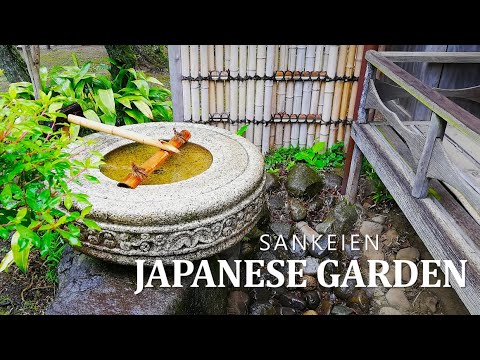
Sankei-en:
58 Honmoku Sannoya, Naka-ku, Yokohama-shi, Kanagawa Prefecture, JAPAN
Filmed on 2024/05
#japenesegarden
#gardentour
#gardens
Sankeien Garden is a vast Japanese garden located
in Yokohama City, Kanagawa Prefecture. Covering an area of approximately 175,000㎡,
it was opened to the public in 1906 by businessman Sankei Hara and
was designated a national scenic spot in 2006. There are 17 historic buildings relocated from Kyoto,
Kamakura, and other locations within the garden, 10 of which are designated
as Important Cultural Properties of Japan, and 3 of which are designated
as Tangible Cultural Properties of Yokohama City. It consists of two areas, the “outer garden”
centered around the large pond and the “inner garden,” which was
the private garden of Sankei Hara. The stone lantern on the right is not unique in shape, but rather have lost the fire pockets that was originally there. Sankeien Garden was bombed
by the US military on June 10, 1945, and many of the stone lanterns are damaged. The stone lantern visible in the background
has all its parts intact, but since it is newer than the lantern in the foreground, during the post-air raid reconstruction period. This is a viewing platform called “Teisha“. As mentioned earlier, many historical buildings
and artworks have been relocated to Sankeien Garden, but “Teisha“ is not a relocated structure. It is believed to have been built by Sankei
at the end of the Taisho era. Looking for “Rinshunkaku” from inside “Teisha“. Can’t see well? Don’t worry.
We will check it from up close and then from a distance. We arrived in front of Rinshunkaku. ”Teisha” we saw earlier can be seen in the back left. “Rinshun-kaku” is said to have been a villa
built by the Kishu Tokugawa family in 1649 along the Kinokawa River in what is now Wakayama Prefecture. It was later moved to Osaka City, where it was acquired by Sankei in 1906
and relocated in 1917. During the relocation, the shape of the roof
and the layout of the three buildings were changed, but the interior remains in its original state. The “Hyotanmon water basin” located next to
the Tenraku-no-ma room in Rinshun-kaku. It is said to have been used by Toyotomi Hideyoshi,
a military commander of the Warring States period. Also known as the Sankei-en Chozubachi,
it is a representative work of art in this garden. However, no matter how many times I visit this garden,
I have never seen a visitor pay attention to this water basin. The washing basin is decorated with gourd patterns
and bears an inscription dated Tenshō 17(1589). The gourd is a symbol of good luck, prosperity, and fertility, and Toyotomi Hideyoshi loved to use gourds
as lucky charms to bring him good fortune. The whole picture of Rinshun-kaku Rinshun-kaku is usually not open to the public,
but it is occasionally open for a limited time. When I visited the interior, photography was prohibited, but it was interesting to listen
to the guide’s explanations while touring the facility. Hara Sankei, who owned this garden, was a businessman who made his fortune
in silk production and raw silk trading. He married the granddaughter
of raw silk merchant Hara Zensaburo, took over the business, and greatly expanded it. When the Great Kanto Earthquake struck in 1923, he is said to have devoted himself
to the reconstruction of the Yokohama area, investing his own money. Climbing the slope toward Gekka-den Gekka-den and its surroundings Gekka-den is a building that was
relocated from Kyoto Fushimi Castle in 1603 by the military commander Tokugawa Ieyasu,
and was used as a waiting room for feudal lords. The tea room visible in the background is called Kinmoukutsu. It was built in 1918 based on a design by Sankei. The name Kinmoukutsu comes from the fact that the floor pillars are made from reclaimed wood
from the handrails of the Sanmon Gate and Kinmou Hall at Daitoku-ji Temple in Kyoto. The land itself was purchased around 1890 by Haru Zenjiro. Later, Sankei landscaped the site as a garden,
collected buildings and artworks, and opened it to the public. On the left is a building called Chōshū-kaku. The back of this building is not usually open to the public,
but on this visit, it was opened, so let’s take a look. From here on, the scenery will be natural, so if you only want to see the artificial garden scenery,
please skip to 8:24. Sankei’s financial resources were devoted to
collecting artworks, regional reconstruction in times of emergency, supporting painters and sculptors, and nurturing young artists. Within this garden, there was also a residence for Sankei, where many artists gathered. He invested considerable financial resources
in this garden as well and sent the gardeners
he hired to Nara and Kyoto for inspection. The gardeners dug a river and used the soil to create a hill. Not only buildings and artworks,
but also plants were transplanted from famous places. Including the view from the back of Chōshūkaku, there are many areas of Sankei Garden that
are only open to the public for a limited time, so you can see new views every time you visit. I had visited this spacious garden many times
and was familiar with its diverse scenery, but this was my first time noticing the sound of water in this garden. The whole picture of Chōshūkaku When you head toward outer garden from Chōshūkaku,
you will see the tea house Shunsōro. You can see cats here and there in Sankeien Garden. Sankei aimed to preserve Japan’s historical buildings
and cultural properties, support artists, and at the same time, make them widely accessible
to the general public, with the goal of encouraging Japanese people to take an interest in their own history and culture and deepen their understanding of it. There are many examples of wealthy mansions
being converted into high-class restaurants, but this garden has several teahouses
where visitors can enjoy casual meals while admiring the garden, demonstrating how Sankei’s vision continues to this day. If you like this video, please subscribe
and give it a thumbs up👍. Thank you for watching!
Comments are closed.