
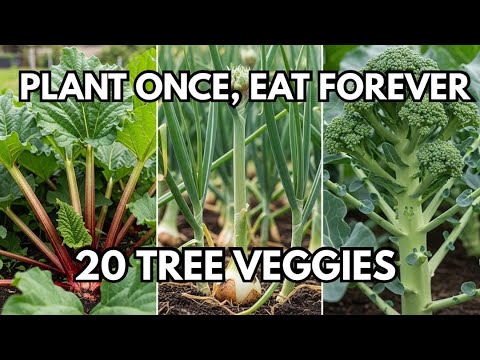
#perennialvegetables #gardening #growyourownfood
Tired of replanting your vegetable garden every single year? Discover 20 incredible perennial vegetables that grow like fruit trees—plant them once and harvest for years, even decades! From asparagus that produces for 20+ years to Egyptian walking onions that literally plant themselves, these budget-friendly perennials will transform your garden into a permanent food source.
In this video, you’ll learn about perennial vegetables that most gardeners don’t even know exist. We’re covering everything from common favorites like rhubarb and artichokes to hidden gems like Daubenton’s kale and tree collards. These plants will save you hundreds of dollars over their lifetime while giving you fresh, organic vegetables year after year.
Perfect for budget-conscious gardeners, homesteaders, and anyone who wants a low-maintenance food garden that practically runs itself!
🌱 WHAT YOU’LL LEARN:
20 perennial vegetables that produce for years
How to save money by planting once instead of annually
Which perennials work best for your climate
Tips for establishing and maintaining perennial vegetable gardens
Low-maintenance gardening strategies
🔔 SUBSCRIBE to Earthly Gardening for weekly budget-friendly gardening tips, tricks, and secrets that help you grow more while spending less!
👍 LIKE this video if you’re ready to stop wasting money on annual vegetables!
💬 COMMENT below and tell us which perennial vegetable you’re most excited to try!
📌 SAVE this video to your gardening playlist so you can reference it when planning your perennial garden!
Join our community of smart gardeners who believe you don’t need to break the bank to grow incredible food. Growing smart, not hard—that’s the Earthly Gardening way!
#gardeningtips #vegetablegardening #organicgardening #homesteading #permaculture #sustainableliving #budgetgardening #perennialplants #growyourown #backyardgarden #gardeningforbeginners #foodforest #ediblegarden #urbangardening #containergardeningideas
What if I told you that some vegetables don’t
actually die after one season? While your neighbors are replanting their gardens every
single spring, spending hundreds of dollars on new seeds and seedlings, there’s a secret group
of vegetables that keep producing year after year. Just like apple trees, these aren’t your typical
annuals. They’re perennial powerhouses that laugh in the face of winter and come back stronger every
season. And by the end of this video, you’ll know exactly which 20 vegetables will turn your garden
into a permanent food factory. But here’s the catch. Most gardeners have no idea these even
exist. Hey there, garden friend. Welcome back to Earthly Gardening, where we grow smart, not
hard. If you’re new here, I’m so glad you found us because today’s video is going to completely
change how you think about vegetable gardening. And to my returning viewers, you absolute
legends. Thank you for coming back. You’re part of a community that believes gardening shouldn’t
drain your wallet or your energy. Now, before we dig into these incredible perennial vegetables, do
me a quick favor. If you’re serious about saving money and creating a garden that practically runs
itself, smash that subscribe button and ring the notification bell. Why? Because we drop new budget
friendly gardening secrets every single week. And trust me, you don’t want to miss what’s
coming next. Plus, it’s completely free and it helps this channel reach more people who need
these tips. All right, let’s get growing. So, let’s talk about what’s really happening here.
Most of us were taught that vegetables are annuals. You plant them in spring, they grow all
summer, you harvest, and then they die. Next year, start all over again. It’s like being stuck in
an endless loop of spending money at the garden center, preparing beds, and doing the same work
over and over. But what if that entire system was just unnecessary? Here’s what nobody tells
you. There’s an entire category of vegetables that behave exactly like fruit trees. You plant
them once and they keep producing food year after year after year. Some of them for 5 years, some
for 10, and a few they’ll outlive your mortgage. These are perennial vegetables and they’re about
to become your garden’s best investment. Now, I’m not talking about some exotic, hard to find plants
that require special soil from the mountains of Tibet. I’m talking about vegetables you’ve
probably eaten before. Vegetables that are sitting in grocery stores right now, but nobody told you
that you could plant them once and forget about the annual replanting circus. So, let’s jump into
these 20 incredible perennial vegetables that grow like fruit trees. Vegetable one, asparagus. First
up, we have asparagus. And this is the heavyweight champion of perennial vegetables. Plant asparagus
crowns once and they’ll produce for 20 to 25 years. Yes, you heard that right. Two decades of
fresh asparagus from one planting session. Now, here’s the thing. Asparagus makes you wait. The
first year, you don’t harvest anything. The second year, you barely touch it. But by year three,
you’re harvesting delicious spears every spring for the next two decades. It’s like putting money
in a savings account that pays you in vegetables. Asparagus loves full sun and well- drained
soil. Plant it once, be patient, and then enjoy literally hundreds of pounds of asparagus over its
lifetime. Vegetable too, rhubarb. Next is rhubarb. The perennial that people mistake for a fruit, but
is actually a vegetable. Rhubarb is ridiculously tough. It survives freezing winters, comes back
every spring with those beautiful red stalks, and produces for 15 to 20 years minimum. You plant one
rhubarb crown and you’re set for decades of pies, jams, and compost. The best part, rhubarb actually
needs cold winters to thrive. So, if you live in a cooler climate where other perennials struggle,
rhubarb is your best friend. Just remember, the leaves are toxic, but those stocks are
pure gold. Vegetable three artichokes. Now, let’s talk about artichokes. These beautiful
plants look like something from a fantasy garden, but they’re perennial in warmer climates. In zones
7 and above, artichokes come back year after year, producing those gorgeous flower buds that we
harvest and eat. Each plant can produce dozens of artichokes per season, and they keep going for
5 to seven years. Even if you’re in a colder zone, you can grow them as perennials with some winter
protection. Artichokes are impressive, delicious, and they’ll make your garden look absolutely
stunning. Vegetable for sorrel. Sorrel is one of those vegetables that most people
have never heard of, but once you grow it, you’ll wonder why it’s not in every garden. This
leafy green has a tangy lemony flavor that’s perfect for salads and soups. Sorrel is virtually
indestructible. It grows in partial shade, tolerates poor soil, and comes back every single
year for about 6 years or more. You plant it once, and you have fresh salad greens from early spring
through fall, year after year. It’s like having a salad bar that never closes. Vegetable five,
Egyptian walking onions. Here’s where things get weird and wonderful. Egyptian walking onions
are perennial onions that literally walk across your garden. They grow little bulbs at the top
of their stalks. Those bulbs get heavy, the stock bends over and the bulbs plant themselves in a
new spot. It’s like your onions are migrating across your garden bed. You can harvest both
the underground bulbs and the topset bulbs and they keep multiplying forever. Plant them
once and you’ll never buy onions again. Plus, they’re a conversation starter because they’re
just bizarre and amazing. Vegetable six globe artichokes. Similar to regular artichokes,
but worth mentioning separately because of their reliability. Globe artichokes are true
perennials that establish deep root systems. They’re drought tolerant once established, which
means less watering and less work for you. In Mediterranean climates, these plants become
massive productive fixtures in the garden. One plant can yield up to 30 artichokes in a
season, and they’ll keep producing for a decade if you treat them right. Hey, quick pause here. If
you’re finding this valuable and realizing you’ve been wasting money on annual vegetables when you
could be growing these perennials, do me a favor, hit that like button so more people can discover
these money-saving secrets. And drop a comment telling me which perennial vegetable you’re most
excited to try. I read every single comment and I love hearing from you. All right, let’s keep going
because we’ve got 14 more perennial vegetables to cover. Vegetable seven, water crest. Water crest
is a perennial that thrives in wet conditions. If you have a bogggy area in your yard that nothing
else will grow in, water crest will absolutely thrive there. It’s a packed with nutrients, has
that peppery bite that makes salads interesting, and it grows like crazy once established.
The best part, you can keep harvesting it, and it keeps growing back. It’s perennial in
mild climates and will selfseed in colder areas. Meaning it basically acts perennial even when
it technically isn’t. Vegetable 8 sea kale. Sea kale is one of those vegetables that sounds fancy
but is actually super easy to grow. It’s a true perennial that produces tender shoots in spring
that tastes similar to asparagus. Sea kale is also extremely ornamental with its blue green leaves
and white flowers. So it pulls double duty as both food and garden decoration. It’s drought tolerant,
pest resistant, and will produce for you for about 8 to 10 years. Plant it in a sunny spot with
good drainage, and you’re done. Vegetable nine, lovage. Lovage is like celery’s overachieving
cousin. It tastes like celery, but grows as a massive perennial herb that comes back bigger
every year. You can use the leaves, stems, and seeds for cooking. One plant is usually enough
for an entire family because it grows so large. Loveage is hearty, requires almost no maintenance
and lives for decades. Seriously, there are love plants out there older than most people reading
this. Plant it once and your great grandchildren might still be harvesting from it. Vegetable
10. Good King Henry. This is an old-fashioned perennial vegetable that’s making a comeback.
Good King Henry produces edible leaves similar to spinach, edible shoots similar to asparagus,
and edible flower buds. It’s like three vegetables in one plant and it’s completely perennial. It
tolerates shade better than most vegetables. So, if you have a partially shaded area, this is your
plant. It’s been grown in Europe for centuries and deserves way more attention than it gets.
Vegetable 11, Turkish rocket. Turkish rocket, also called Turkish arugula, is a perennial version
of regular arugula. If you love that peppery arugula flavor, but hate replanting it every few
weeks, Turkish Rocket is your answer. It’s a true perennial that produces leaves almost year round
in mild climates. In colder areas, it dies back in winter, but returns in spring. The leaves
are slightly more bitter than annual arugula, but they’re perfect for salads, and the plant is
essentially unkillable. Vegetable 12. Caucasian spinach. Caucasian spinach is a climbing perennial
that produces spinach-like leaves on vigorous vines. You can grow it on a trellis and it’ll
produce fresh greens from spring through fall. It’s heat tolerant, which means it keeps producing
even when regular spinach would bolt and become bitter. The plant dies back in winter but returns
from its roots every spring. It’s productive, space efficient, and completely hassle-free once
established. Vegetable 13, Dobington’s kale. Most kale is biianial, but Dobington’s kale is truly
perennial. This variety doesn’t produce seeds, so all its energy goes into producing leaves.
You can harvest from it almost year round, and it keeps going for years. The leaves are tender,
delicious, and packed with nutrients. Plus, you can propagate it from cutings, so one plant
can turn into an entire kale forest if you want. It’s virtually pestfree and handles cold weather
like a champion. Vegetable 14. Nine-Star perennial broccoli. Yes, perennial broccoli exists and
Ninstar is the variety to grow. This plant produces multiple small broccoli heads instead
of one large head and it keeps producing for about 5 years. The heads are white or cream
colored, tasting like a cross between broccoli and cauliflower. It’s slower to establish than
annual broccoli, but once it gets going, you’re harvesting broccoli every year without replanting.
That’s a gamecher for broccoli lovers. Vegetable 15 chives. Chives are so common that people forget
their perennial. Plant chives once and they’ll divide and multiply in your garden forever. You
get fresh onion flavored greens almost year round, plus beautiful purple flowers that are also
edible. Chives are perfect for containers, garden borders, or as companion plants. They require zero
maintenance and will literally outlive you if you let them. Vegetable 16. Garlic chives. Similar to
regular chives, but with a garlic flavor instead of onion. Garlic chives produce flat leaves and
white flowers, and they’re just as perennial and lowmaintenance as regular chives. The difference,
they’re heat tolerant and actually prefer warmer weather. You can harvest the leaves, the flowers,
and even the flower buds. They’re productive, flavorful, and they’ll naturalize in your garden,
meaning they’ll spread and fill in empty spaces on their own. Vegetable 17. Horseradish. Horseradish
is the perennial that won’t quit. In fact, the bigger problem is stopping it from taking over
your garden. Plant one horseradish root and you’ll have horseradish forever. The roots are what you
harvest for that spicy condiment that clears your sinuses. Horseradish is incredibly vigorous,
tolerates poor soil, and requires absolutely no care. Just be strategic about where you plant
it because once it’s established, it’s there for life. Vegetable 18, Jerusalem artichokes. Also
called sun chokes. These are perennial tubers that taste nutty and slightly sweet. They grow
tall like sunflowers because they’re related and they produce edible tubers underground.
Jerusalem artichokes are ridiculously productive. Plant a few tubers and they’ll multiply like
crazy. They’re also beautiful with bright yellow flowers in late summer. The only warning, they can
be invasive, so plant them where you don’t mind them spreading or contain them in a designated
bed. Vegetable 19, wild leaks. If you’re into foraging culture, you know ramps are worth their
weight in gold. These perennial wild leaks have a devoted following because of their unique flavor.
Ramps prefer shade and moist soil, making them perfect for woodland gardens. They grow slowly
from seed, but establish into permanent colonies that produce every spring. Once you have ramps,
you’re part of an exclusive club of gardeners who grow one of the most sought after wild vegetables.
Vegetable 20 tree collards. Finally, we have tree collards. And these are absolutely mind-blowing.
Tree collards are perennial brassacas that grow into small trees, producing edible leaves year
round in mild climates. They can live for 10 to 20 years, growing up to 12 ft tall. You keep
harvesting leaves, and they keep producing more. They don’t produce seeds, so you propagate them
from cutings, which means every tree collard is essentially a clone of an ancient plant that’s
been kept alive through cutings for potentially hundreds of years. It’s like growing a piece
of living history that also feeds you forever. So, there you have it. 20 vegetables that
completely change the game. Instead of spending money every single year on seeds and
seedlings, you invest once and harvest for years, sometimes decades. This is how you build a truly
sustainable, budget-friendly garden that works for you instead of you working for it. Now, here’s
my challenge to you. Pick three of these perennial vegetables and commit to planting them this
season. Just three. Watch what happens over the next few years as those plants establish and
start producing food without you having to replant them. That’s how you transform your garden from
an annual expense into a permanent food source. If this video opened your eyes to a whole new way
of gardening, please share it with a friend who’s always complaining about gardening costs. Hit that
subscribe button if you haven’t already because we’re building a community of smart gardeners who
refuse to waste money on things they don’t need to. and drop a comment below telling me which
perennial vegetable you’re most excited about. I genuinely want to know. Until next time,
keep growing smart, keep growing affordable, and remember, the best gardens are the ones that
take care of themselves. I’ll see you in the next
28 Comments
لا اله إلا الله محمد رسول الله
Rhubarb! When I was a little kid my father passed we lived with 7 of my mother's family in Scotland in a 3 bedroom no central heating government house. My Gran grew everything over the years especially during the war. If we were hungry she gave us a treat. Washed rhubarb stalks In bag with sugar in the bottom. Dip and chew. Yum. I can't find the stuff in the US.
Watching from New Zealand. I'm a newbie gardner, so I'm looking for food that does not cost alot and will produce for a few years. I currently have rhubarb(which I harvest often..yummy), silverbeet, spinach. spring onions. Not sure how many I will be able to grow, that will be a good gardening experience. Happy growing everyone:)
Thank you for the information. Can they be grown in an Indian climate preferably containers like Artichokes.
Water cress, by little pond/ lovage… for soup/Jerusalem artichokes, 2nd year, even though deer ate flowers 😮😅
Your challenge is on.
Amaranth…I have that on my list also
20 Vegetables that need not be replanted:-
1. Asparagus
2. Rhubbarb
3.Artichokes
4. Sorrel
5.Eygptian Walking Onion
6. Globe Artichokes
7. Watercress
8. C. Kale
9.Lovage
10. Good king henry
11.Turkey Rocket, Arugula
12. Caucasian spinach
13. Dobinson kale
14. Nine star perinial brocolli
15. Chives
16. Garlic chives
17. Horse raddish
18. Jerusalem artichokes
19. Wild leaks
20. Tree Collards
Please inform the names of vegetables that can grow in Kerala India where the soil is alkalic, soil with more stones and sand. Also the land has only two seasons. Winter and summer only. Average temperature is 30-35 degree celicious.
Helpfull
I'm a loveing of All of them! I'm a Oklahoma City ok.
great list
The nice thing about Egyptian onions is the deer don't eat them so i plant them outside the fence
Most well known
Broccoli, asparagus, artichokes
You forgot Amaranth
You know, Rosr of Sharon leaves are supposed to make a good potherb, and the flowers, too. I cannot find any recipes, or testimonials. Does anybody have experience? You will certainly want a seedless/sterile variety so it doesn't spread all over, but it seems like it could be a real winner: buds like okra, and immature seed pods are also edible.
Been gardening over fifty years and never heard of some of these, will try three and more! I am in the mountains area of So California. I will try the sun chokes.
This Awesome. Thank you
2:40 to skip the yapping
Could you say which if any of these 20 perenial vegetables can be grown in tropical climate
I am hearing this from Sarawak Malaysia… South East Asia.
Are the suggested plants plantable in the hot humid climate like ours
if you leave most vegetables to seed in situ to seed, youll get some again next year.
Asparagus
AI
Lots of these i have never seen.
Hate AI
🦘🇦🇺🦘
👍👍👍