
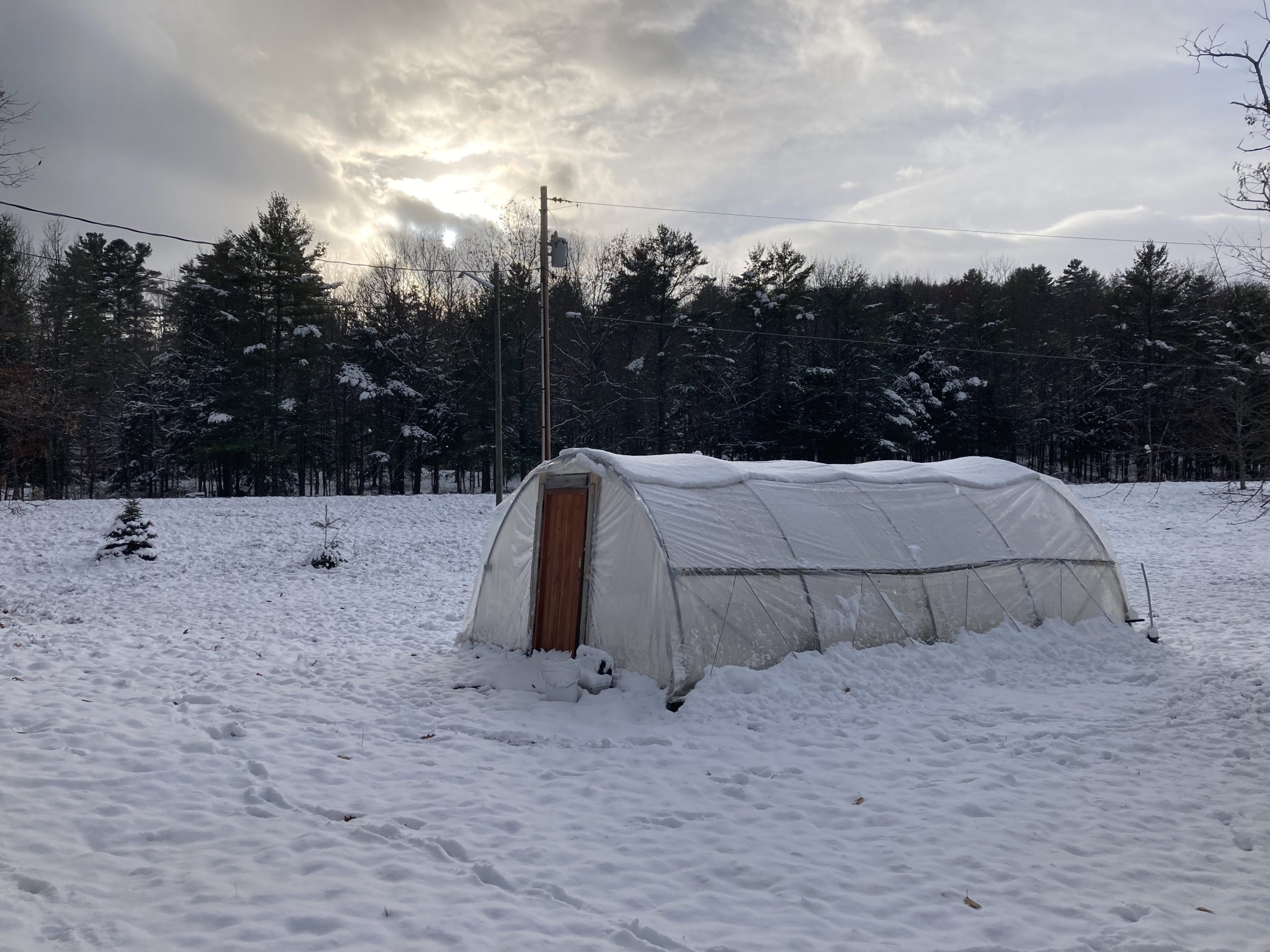
It’s winter. The tomato cages are back in the garden shed. The hoses are coiled and put away (did you drain them first?) Growing food is pretty much off your mind because that’s the way it goes this time of year.
Right?
Well, sure—we might reflect on the past season and plan for the next. We might get out graph paper and charts, surf YouTube gardening videos, read some books (I have a few to recommend). But aside from some herbs on the windowsill, or early starts in the nursery in February, winter is just not the time for growing food. Everyone knows that.
Certainly, many professional growers extend their seasons. Essex Farm and Juniper Hill, if not growing year-round, are pretty close to it. They have high tunnels, and they add heat. At least, my friend Adam from Tangleroot Farm certainly did before shuttering his business; big blowers warmed the air of his gutter-connected quadruple greenhouse in the colder months.
But that’s not the only way to do it.
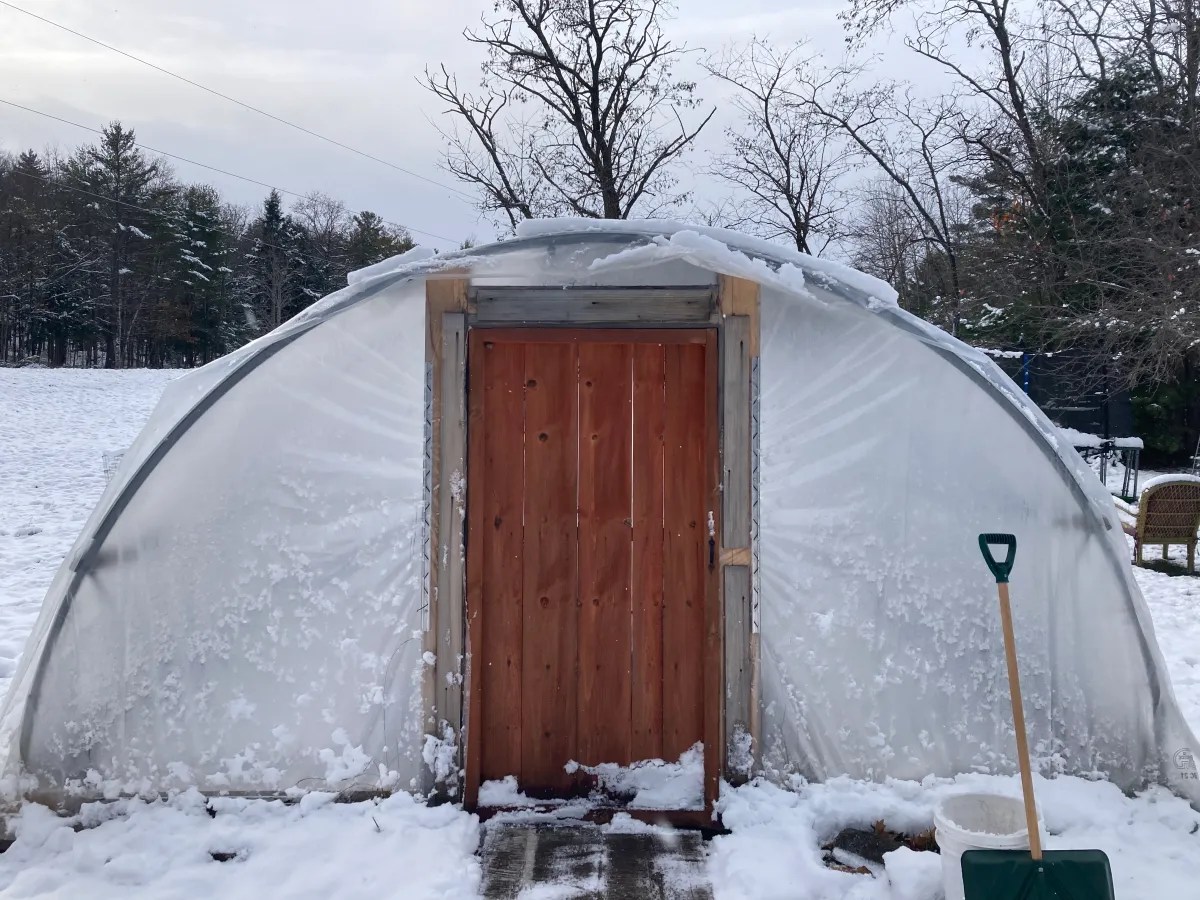 Hoop house in November. Photo by T.J. Brearton
Row covers
Elliot Coleman lives in Maine. He’s been a gardener for more than fifty years. When I learned that his farm was on the 45th parallel in USDA hardiness Zone 5 just like Elizabethtown, New York, I took an interest in his growing methods. Particularly, winter growing.
Coleman grows vegetables in unheated hoop houses right on through Christmas, New Year’s, Valentine’s Day and all the rest.
The trick is two things.
First, is row covering. You may have seen row covers on vegetable farms. The ones made from lighter fabric allow sunlight and rain to pass through while keeping out (or at least discouraging) insects. The heavier ones trap heat to help protect against frost. You don’t usually see row covers in hoop houses – at least, I hadn’t – until I discovered Elliot Coleman.
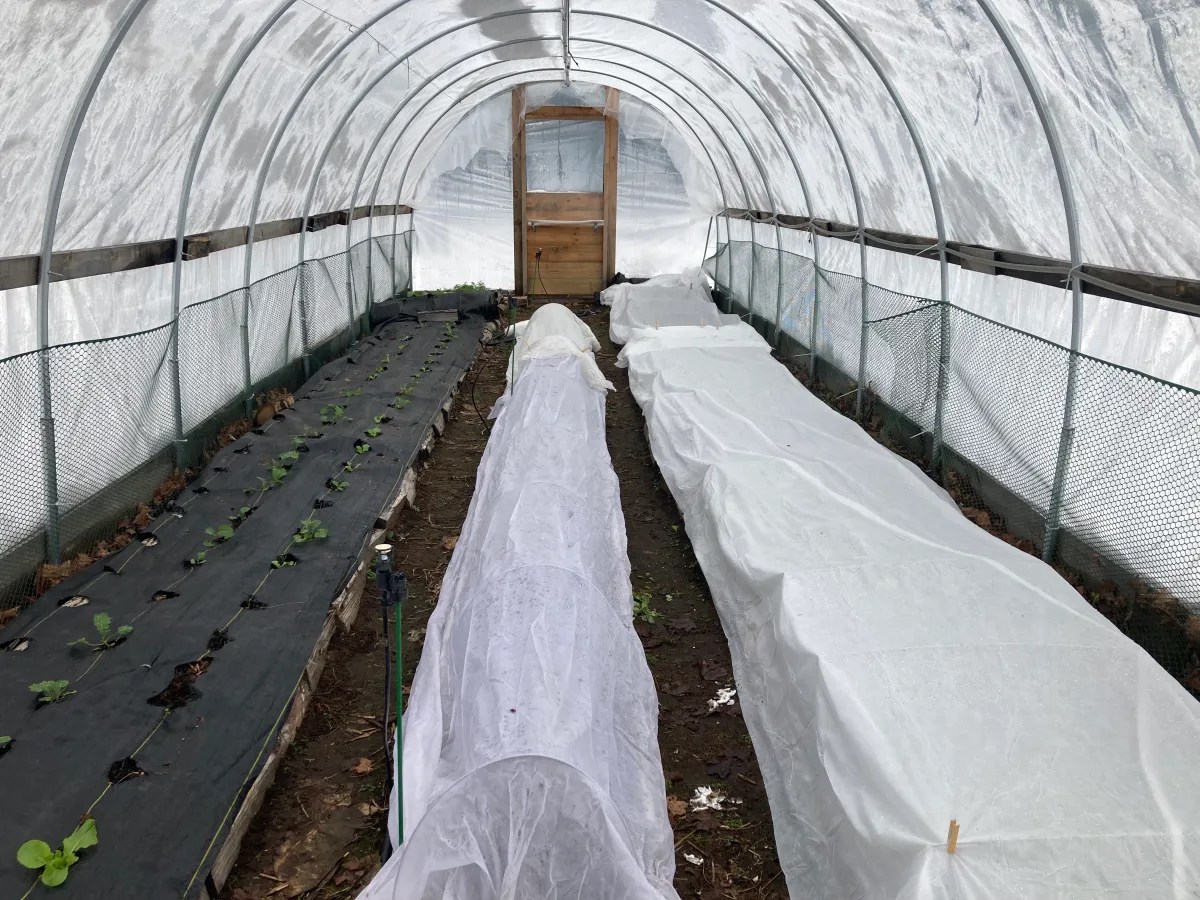 Covered rows in winter hoop house. Photo by T.J. Brearton
“Coleman’s methods are really for when you’re in your third or fourth year of farming,” Adam told me this past summer. He meant you can get ahead of yourself in the vegetable business, and run into trouble.
But what if you’re not running a commercial operation? What if you’re not promising people anyone vegetables in January? What if you simply want to see if you can do it? I did, and I was pleasantly surprised.
Winter growing
I said the trick was two things. Here’s the other: vegetable selection.
While it may seem obvious, not all veggies are the same. Even as they’re genetically altered and hybridized and everything else, each has its preferred climate.
For winter growing, it’s all about leafy greens and root vegetables. Let’s start with the leafy greens. Spinach and kale do well and should be able to survive even the darkest depths of winter. Some greens you may have never heard of—Tatsoi and Claytonia (sometimes called Miner’s Salad)—will likely do even better. Salad greens, too, can survive much longer than you’d expect, with some varieties apt be the best. I’ve had good luck so far with Buttercrunch, Tango, Flashy Butter Oak, and Rouge D’Hiver. For mustard greens, particularly the species of Brassica rapa, Arugula, Mizuna, Red Streaks Mizuna, and Baby Bok Choy all developed excellently as the snow fell outside the hoop houses.
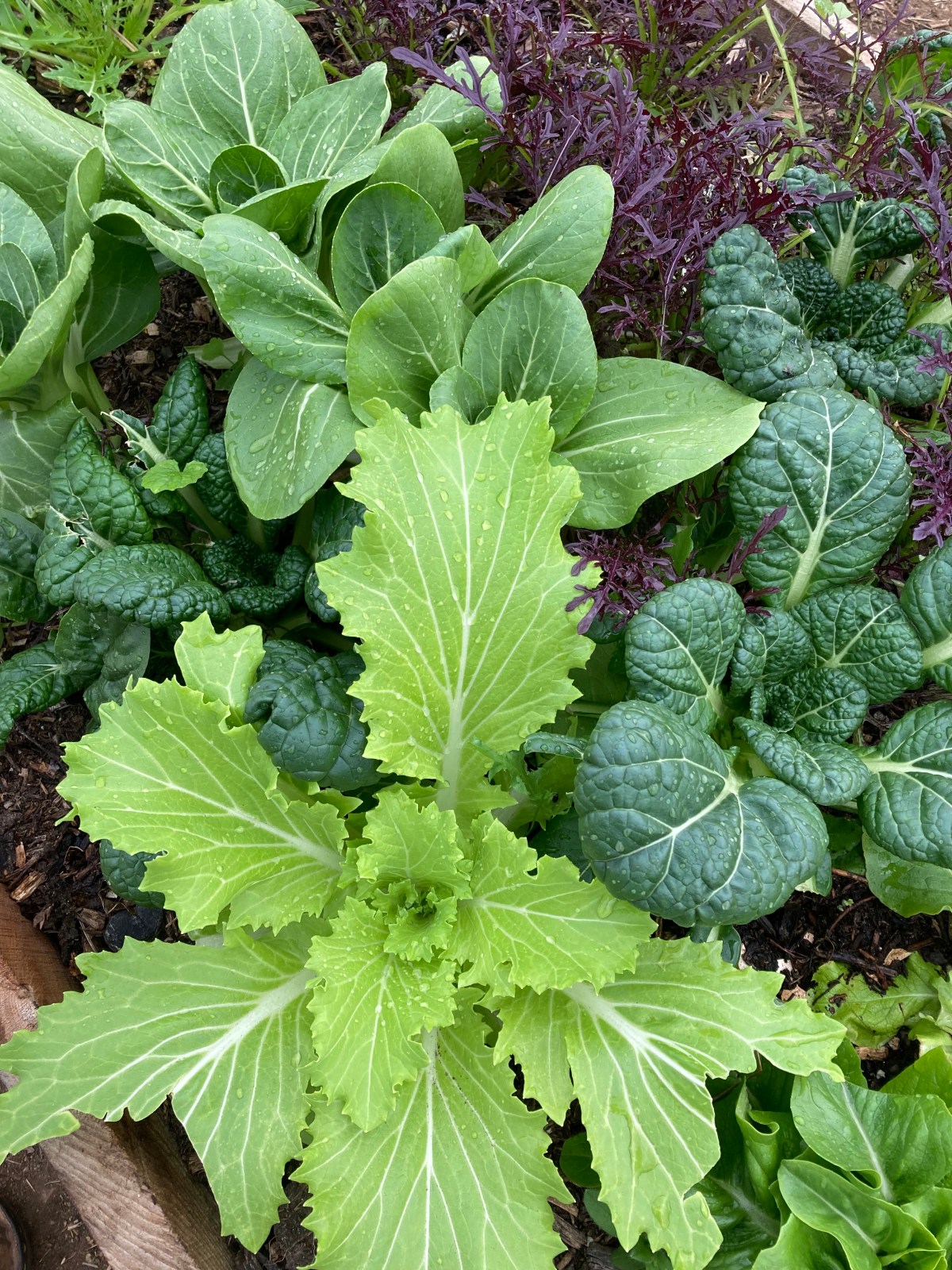 Kale and other greens. Photo by T.J. Brearton
Root vegetables will work too. It makes sense, too: the worst thing you can do to shorten a vegetables life is to pull it out of the ground! As long as those roots are alive, the plant is alive. It may be hardly growing, it may even go dormant, but it’s still alive. (That’s why you can prune a plant right down to the stem at soil level, and the next year, see new sprouts shoot up.)
Essentially, what you’re doing when you keep carrots and beets and leeks in the ground is storing them. The hoop house acts like a living refrigerator.
Which brings us to the next important thing to understand: the plants need to be established before the cold weather hits.
 Carrots and radishes in November. Photo by T.J. Brearton
Timing
The first year I tried this, I was sowing seeds on Election Day. Not quite optimal. By November, as we all know, daylight is in short supply and the temperature is dropping. The seeds – those that germinated – didn’t have a chance to develop, and the nursery seedlings couldn’t endure the transplant shock.
When I started again in February, though, seeds I thought had never germinated, like spinach, were now poking up. The carrots and beets had indeed grown. I transplanted fresh leafy greens and watched as they took off. By mid-March, I had fresh salad greens on my family dinner table.
Lights, water, wickets
Sunlight matters, of course, so ideally, no trees or buildings should block the low winter sun. To an extent, the hoop house maintains moisture, and the row covers do an even better job, but as the days lengthen again and the sun strengthens, you’ll need to peel those row covers back or it can get too warm. And as spring nears, an occasional watering is good.
The million-dollar question is: how do the covers stay above the vegetables? I’ve found nothing satisfactory on the market. For use outside, row covers are suspended by hoops, but the height of the hoops reduces the advantage of the ground warmth for winter growing, or they might create too narrow of a tunnel. (If a row cover touches the vegetables, the cold from frost can transit through the fabric. You want air all around.)
Last year, I took some square tomato cages I was no longer using, about three feet tall each, and cut these up with tin snips into makeshift wickets. I’ve found this shape allows a nice, even distribution of the cover across the row while holding the cloth about six to nine inches off the ground. Most of the greens—spinach, arugula, claytonia, mache—all fit quite well under the covers. If they don’t, they’re typically not the best plant for winter growing, anyway. Low to the ground means warmer and safer.
Alright—happy growing, and good luck!
Comments are closed.