
If you want to support our work fighting for a freer future, please join us: https://bigbrotherwatch.org.uk/join/now/
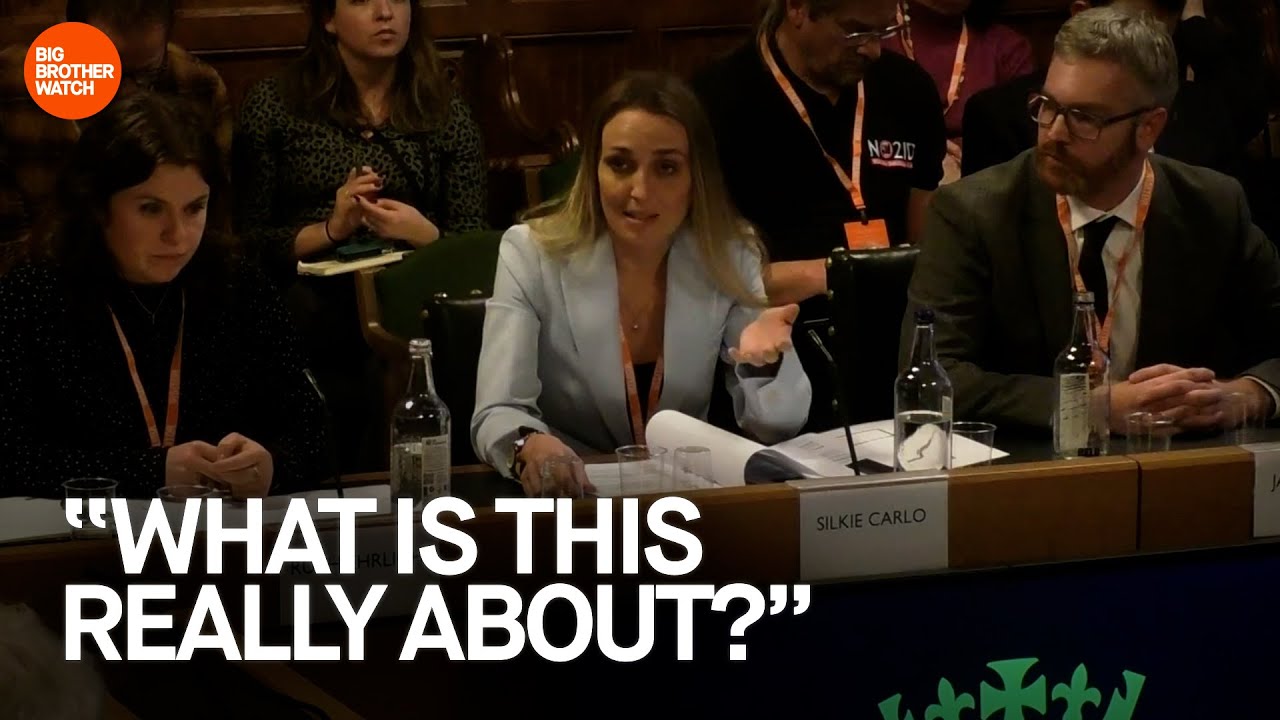
Big Brother Watch director Silkie Carlo gives evidence to the Home Affairs Committee on digital ID.
This cannot be understated: Introducing a mandatory digital ID in Britain would fundamentally change the nature of our relationship with the state by eroding our freedoms and turning us into a papers, please society.
Silkie made those dangers unmistakably clear to the committee today.
If you agree with what Silkie told the committee today, I’d like to invite you to stand with us in opposing mandatory digital ID.
As the prospect of a digital ID system draws closer, we urgently need more people standing with us to push back. Becoming a Big Brother Watch supporter is the single most effective way to strengthen this campaign.
If you want to support our work fighting for a freer future, please join us: https://bigbrotherwatch.org.uk/join/now/
And make sure you subscribe to our mailing list for breaking news and action alerts! https://bigbrotherwatch.org.uk/subscribe/
Follow us on Instagram | https://www.instagram.com/bigbrotherwatchhq/
Follow us on TikTok | https://www.tiktok.com/@bigbrotherwatchhq
Follow us on Twitter | https://twitter.com/BigBrotherWatch
Follow us on Facebook | https://www.facebook.com/bigbrotherwatch/
Follow us on Telegram | BigBrotherWatchHQ
Credits:
Music: Ticking Tension by Soundridemusic
Link to Video: https://www.youtube.com/watch?v=xN6y84DCAxk
I don’t think anyone in this room
genuinely believes that the mandatory
digital I.D. is about
illegal working. Which begs
the question, what is it
really about? The Prime Minister has killed
support for the digital
I.D.. We can see that
in the polls. We also see it in the fact that the, petition,
the E-petition on this issue
is the fourth biggest petition
in British history. We’ve never had, nationals need to have a permit
in this country to go about our
everyday lives. And so the mandatory
nature of what is being
proposed would introduce
that. Thank you very much, Silkie Carlo, I’m the director of Big Brother
Watch, we’re a Privacy
and Civil liberties, non-profit non-party campaign group
in the UK. I have engaged
with the government over the past
ten years on digital identity
matters in various forms, including
being on the Privacy and consumer
advisory group, and engaging
with, the recent data bills on digital, identity
verification. What risk
do you think? Like the mandatory element
of digital I.D. presents
to somebodys privacy and other rights? I think that the,
the mandatory nature of the proposed
digital I.D. scheme is really the heart
of the problem. A digital digital
identity is something
that we all use every day in various
different ways. But a government
issued mandatory digital ID has
the potential to, create a incredibly intrusive system of surveillance
data collection, and it opens up
possibilities for the
government to, issue and revoke permissions
in certain ways. I think
where disagree slightly
about the E-visa the E-visa scheme is something we should certainly
talk about, because it has been blighted with
very serious issues, which has obstructed
people from accessing essential services. But a visa
is essentially a permit. We’ve never had, nationals need to have a permit
in this country to go about our
everyday lives. And so the mandatory nature of what has being proposed would introduce
that, that something we would be
a country that is on licence, that needs
a government permit to do something
that otherwise we would have
the freedom to do. And I think in terms
of giving people and in fact, why your inboxes are
so full, perhaps, it is that that
mandatory nature, of the
ID coupled with a restriction
on liberty, which is what
the government has suggested, for something
you would otherwise lawfully
be able to do, unless you have
this, digital ID card, you won’t be
able to work and already other government
departments are talking about
renting benefits, education, etc.. So I think that we would be having a completely
different conversation
if the government were talking
about a system it was thought
was so attractive that if it made it
available, lots of people would want to use it
instead. It’s a
mandatory system that is paired with, restrictions on
people’s liberties. And we have got
questions on the e-visas later. So if we can just
focus on the specifics around the mandatory
nature. Do you have
any examples of individual rights and other countries
that you feel have been affected
by this? Talking
of the Aadhaar scheme in India, something that’s often overlooked
is that that scheme has even been linked
to citizen deaths, through for example,
accessibility problem
sets a massive biometric
identity system of over
a billion people. And that has, access
issue because it’s required
for access to welfare access
issues, have been documented
to have resulted in people
actually dying. So incredibly
serious consequences. Also, that system
holds health, data. And, has, individuals
have been refused healthcare, because of their HIV Aids status,
for instance, which is held
on this digital identifier. But I do think
we see examples of abuses closer to home
as well. We’ve spoken
about the cyber security risk. So if
an individual’s, enrolled in
mandatory systems, you lose that
control over how you manage
your data. You’re relying on other companies
or the state. And, and Estonia
often held up as being
the gold standard example has suffered multiple cybersecurity
incidents where people’s
photos have been
leaked, etc.. And on a more
individual basis. For example,
a police officer in Estonia was fined
for checking his fiance’s
criminal record. So you get access
problems as well where people get
unauthorised access to joint databases. Finally, how do you how do you see it
going forward, a kind of a creep
in digital ID that people’s privacy
and human rights are at risk? Is that something
that worries you? We are incredibly
worried about function creep
with the system. And, right from the off,
really, I think the warning signs
have been there. This was introduced
by the government as something ostensibly to tackle
illegal working. I don’t think anyone in this room genuinely believes that the mandatory
digital ID is about
illegal working, which begs
the question, what is it
really about, and what will
the other uses be? Already,
you know, in the Friday afternoon that this was
announced by the Prime
minister, just two hours
later, the government’s webpage
about digital ID was talking about, tax benefits,
education, childcare, many, many other uses
for a digital ID. So, function creep is inherent in the,
in the system. And I think people rightly be concerned
about that. Even in the, I will have to
correct myself. Actually,
I said that we never have
had a mandatory ID that was a wartime
ID cards. Of course,
but they, even they which were initially issued
for rationing, ended up sprawling to 39 government agencies before
they were scrapped by the Churchill
government. So it’s inherent
to any system. And the other side of what is so concerning
about that these other use cases is, again,
if the, if this is starting
with, the pairing over restriction
on liberty, what would the other
restrictions be in many people’s minds
in this country? The, the, the the most recent
experience of a digital pass
was the Covid pass. And in that case, there
were restrictions, placed on people depending on
where you could go and what you
could do based on your vaccination status,
for example. So there we saw a digital
identity system that had very
sensitive data that then controlled where you could go. And what you could do was also seen
by many to be, an attempt to
influence decisions. Again. In that case,
some people can work in health
and social care. For example,
if you had the, didn’t have the right vaccination
status, and, and, so I think function creep
is both inevitable and an overriding concern
with the system. Chi Onwurah. Thank you very much. The concerns
that you’ve raised are ones which I know a lot
sort of echoed by, my constituents. And, I do
wonder what kind of, what kind
of, safeguards, might help, reassure
you and citizens about a digital ID scheme,
which you just have it’s advantages
to it. And so, for example,
I mean, can can you think
of examples which would help? And so, for example, we talked about
perhaps, the option to delete
all your data that’s held
by, government, at one time or and I think this is
the Estonian model that,
you know, each time your data is accessed, you have some kind of, you’re told when your data
is accessed, which isn’t
the case now. I mean,
I don’t know who in government’s
looking at my data. But do you think those would help
reassure you and help
reassure the public, about
the digital ID? I think that, it’s likely
that the way that this announcement
has been managed makes it
irrecoverable for this government
and potentially for the next
5 to 10 years. I’m afraid to say, I think
the Prime Minister has killed support
for the digital ID. We can see that
in the polls. We also see it in the fact that the, petition
the petition on this issue
is the fourth biggest petition
in British history. Second
biggest petition, on a non
Brexit issue. Your constituents are up
in arms about it and I think it is
because of that, the way that it’s
been introduced, the fact that no one
really believes it’s about, immigration,
that it might be about
something else. And how poorly explains
the system has been in that sense. It also makes it very difficult to recommend
safeguards because there isn’t actually a policy
here. There’s been
an announcement, and I’ve engaged with the government
on digital I.D. issues. As I say,
for a decade, I’ve spent
many times in, in, you know,
government offices with civil servants talking about
how a system could be created. We have seen
none of that reflected at all in what has happened
over recent weeks with this
announcement. There’s been
no detail. There is no substance.
If we’re talking about, in theory, what kinds of
safeguards could any kind of theoretical digital
ID system have? We could have
very long conversation about. It is certainly the starting point
would be that it shouldn’t
be mandatory, that it
should be optional, and that
people can then take up a government
issued digital I.D. if they feel that it
benefits them, that it should be
something that they can exercise
total control over, that they get
to choose who sees their information,
where, when, and for what
purposes. And, critically,
as Ruth was saying as well, that we don’t see
a merging of government
databases. Which is a really
big risk with digital
ID systems. It’s that, you know,
your, your, the taxman can see your GP records,
etc.. Well, I have to say that is also an impetus
with these systems because the argument
will be, well, why can’t, DWP see
your health status? Why can’t
we integrate that? So in many different circumstances, there will be
a strong impetus for that data
to be shared. But that was
something that would have
to be very strongly legislated around to ensure that
it couldn’t happen. Thank you. So I just, so I have a background
in health service as a surgeon. So I’m interested in
how the digital ID might link to
the health record. You were talking
about this just now, and it seems to me
that, if we could, allow people ownership of their
own health record, which was held
digitally, that would give
people agency over their own
health care, and it would be a incentive for people
to voluntarily take a digital ID, which would then be
usable across different health
agencies. Everybody has an NHS number which is given to
them when they’re born. That might be a way into a system
such as this. It seems to me that, encouraging people to engage in
a digital ID system could be done
by means of giving people
agency over to their own healthcare records, such that you were able to get
between healthcare providers, hospitals and general
practitioners with your own
health record. And if you knew what was in
your health record a little bit more about
your health, you’ll probably look after it
a bit better. And, so
I would like to see the question of how
the health record is incorporated
into a digital ID spoken about
a little bit more. Do you think there’s
any mileage in thinking about it
like that? The legal position is that people
have the right to access
their health data. It could be presented in a much easier way for sure. But I’d be very
sceptical about that being used
in a kind of carrot and stick situation
where, you know, if you, have easier access
to your health data, then you enrol
in a digital ID, which is actually
something different to just accessing
your health data. You should just be able to access
and control your health data irregardless
of a digital ID. Thank you. Chair. I just want to focus specifically on linking the digital ID to the right
to work. I think
you’ve been really clear on your kind of fundamental
concerns and, and I suppose, and ideas of a principle to which you disagree
with. Is there
any really specific, concerns
that you have around linking it to, to the right
to work? What has been
proposed is a is a multi-billion
pound system. And I think
it would be right to start with why
rather than why not. And I don’t think it washes that a British
passport is not British
enough or good enough
documentation to have the right
to work as people
currently use it. Instead,
you would need this new mandatory
digital ID. We’ve seen
with e-visas that that has
already locked people out of work
because of the, accessibility
and technical problems
that there have been with that scheme. So learning
from that, aside
from the principal dishes and
the rights issues and the lack of a
basis for why
this is necessary for right to work, we be very concerned about the practical implications
of that. You know, and, and bearing in mind
that this is, it’s everyone
from the government, we’re talking about
teenagers as well. So it could be
somebody doing their first paper around up to a pensioner
working in their garden
centre. It’s a massive, massive scope for who would
then be forced into this mandatory
digital ID scheme. Do you think there’s any policy area in
which digital I.D. would be justifiable in terms of support and to help
to enforce the law? Yeah, I’m not really
sure that there’s I mean, I’ve never heard an argument
that, you know, we could enforce this area of the law
so much better if only what we had mandatory digital
ID is. It’s just not
something that I have come
across, unless you go to a very extreme end of the surveillance
spectrum. And that’s
one of the things that I’m really
worried about here in so much
as what we do know about the digital
ID system proposed is that, it will be basically
a massive, facial
recognition system because it would be
linked to facial biometrics. That’s one of the only
substantive things we’ve been told
about this government proposal. So that means that you would have
around 50 million
British adults, in with their sensitive personal biometric data
in a system and quite unusually
as well, lots of foreign
nationals as well, millions of foreign
nationals. It’s not actually a British
only system, because it relates
to everyone who’s working here. And given that this
has been introduced at a time
when the government is also backing a significant
expansion of facial recognition surveillance
in this country, and that we have
also found without discussing
with Parliament, the government
is now using the passport
database, for facial recognition
searches. I’d be very worried
about how, as you say,
from a law enforcement
perspective, this new gargantuan biometric system
could also be used for that extension
of surveillance. Could you just outline how you think the government should account for
digital exclusion when developing its plans
for digital ID, whether that
be mandatory or or indeed
not mandatory? The facial
recognition aspect, could introduce some
exclusion factors, because of
the issues that there have
been, with mis identifications and facial
recognition, particularly around
race and gender, and also certain
disabilities. But also, you know, inclusion
in a, in a system doesn’t always need to mean
that people, forced
into a digital or technological
system, for example, I think there would
have to be an offline
alternative for the many,
many people who don’t have good connectivity,
who don’t have good digital skills, but also to acknowledge
there are many people that don’t want to be forced
into a system that that don’t want to have
smartphones, and how conversation
around smartphones
is changing as well. But the idea is that everyone would have a smartphone
with a very, very essential piece
of data on it. And I think that
that might not stand the test of time
as well. I just exposed the dangers
of digital I.D. to Parliament. Now, the fight against digital ID needs you
head to no2digitalid.co.uk to take action.
21 Comments
💪It's time to fight back against digital ID : NO2DIGITALID.CO.UK
What makes me laugh about all these schemes is that it is sold as tackling crime. So ban guns – how many criminals buy guns in a shop? Ban drugs – again, when is the last time someone bought cocaine in ASDA? Create a mandatory digital ID – how many criminals will have a bonafide digital ID? Criminals don’t care about these systems and are very clever at bypassing them – in most cases stealing someone else’s ID, thereby criminalising the innocent. Criminals are so clever (they should get regular jobs where they could do what they do legally with tax loopholes).
Nothing like this works, as those who abide by the law are the actual targets, then it breeds contempt, and the criminals just carry on regardless. What is the point?
The influence is from the EU, which is looking for a data grab to sell and make $$. I believe it is a violation of human rights and civil rights.
They only way to safeguard from overreach ,miss use or creep or loss of data. Is don't have a single digital ID!
I wonder how many politicians will benefit cash-wiselike the Blairs will, from the Digital ID.
Starmer thought everyone would fall in line the moment he mentioned immigrants, well they didn't, they saw through his underestimation of the UK public. People both for and against illegal immigration do not want digital ID
Digital ID is about control and power. Technological base for control, censorship and state punishment of decent.
How is this different from a NINO?
Excuse me “democratic government” why don’t you just start listening to the people?#thinkingface
This a step towards complete control over the populace…
that lady asked about safe guards – there are no safeguards. If you collect digital data, it can and will be stolen, multiple times. Plus, being notified when someone access your data isnt going to help the main fear – that the id function creep will extend to curb rights and liberties – for example not being able to access certain things unless you id has certain permissions – whos access your data and when is a lesser problem once this kind of system evolves in the way it obviously will.
As a New Zealander if my government were to try to bring something like that in I would definitely vote no!. If it was forced on us without a vote I would refuse it even if it meant I had no access to healthcare, food or work. I would rather die that live under a tyrannical government and surveillance state. Its bad enough now and i know that we are already living in a surveillance state but Digital ID's particularly forced is a bridge to far.
MANDATORY requires CONSENT by the people. Where is the referendum on this.
This idea is not proposed by our government, it has been pushed on us by NGOs like the UN, BLAIR INSTITUTION, NATO, WHO, WEF. Starmer is the puppet selected to push it.
Its not going to happen. We say NO. If you want Digital ID give it to those who are coming over on dinghies. The British born already have National Insurance numbers, whereas, they have nothing.
you can talk all you want in these committees – they created them
Papers please…!!! Here we go "Fascism mark II" ~ for our own good
reminder "Governments require the consent of the governed", but in British law consent is assumed unless explicitly withdrawn
Once they received all the information for the digital ID your information will be backdated as far as they can check everything you've purchased every penny that's gone into your bank account business or domestic every holiday every car you've purchased your ball go on and on and they will come for you
The wedge goes in and then it will widen!! Whatever they say now it will only get used to exert more control in the future! The BEST safeguard is that it is scrapped! 😡 NO, NO, NO!
100 % not what it seems – control the masses
Blah blah blah blah
Peaceful non compliance
Not to mention the amount of money at least someone in world's going to get the Tony Blair and his son for instance more criminal you know