
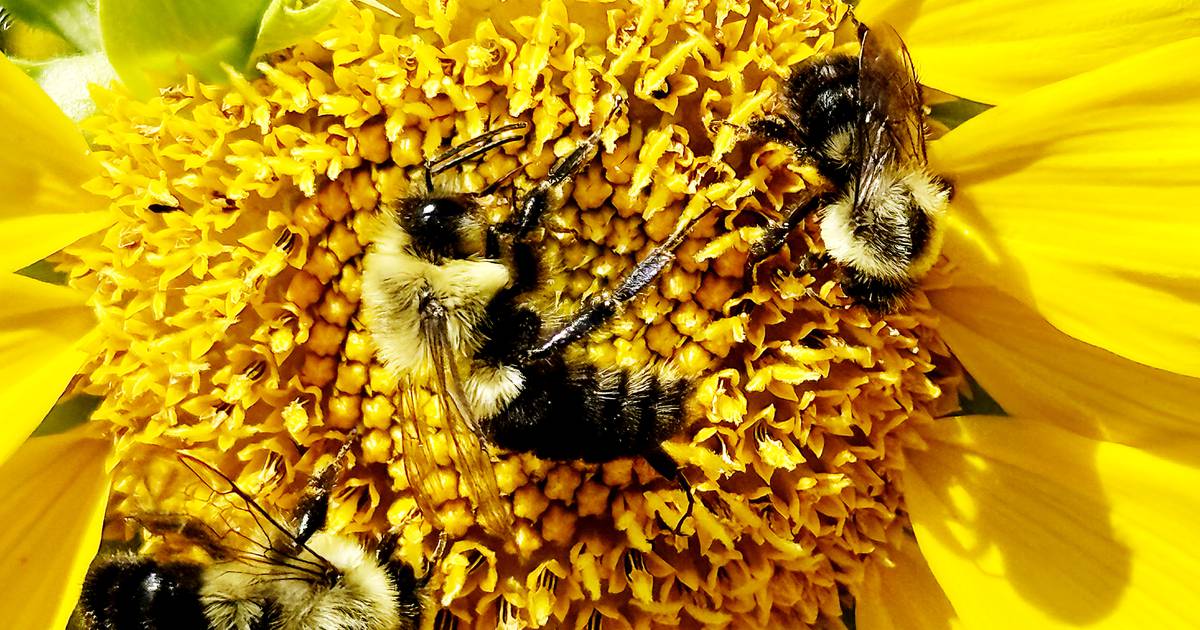
We’ve heard that pollinators are important and that we should plant flowers to help them. Let’s take a closer look at what we can do to promote pollinators in our yards that can be done without spending a lot of time or money.
Background
Pollination is needed to produce seeds; about 80% to 90% of plants need an animal to pollinate them with the rest pollinated by wind or self-pollinated. In North America, about 99% of pollinators are insects. Others are birds and bats.
The most important pollinators are bees, especially solitary bees, but ants, butterflies, wasps, flies and beetles also pollinate. Through pollinating, these insects support our food crops and sustain habitat diversity by pollinating native plants that provide food, nesting and shelter for wildlife.
Pollinators themselves are an important source of food in the food web, for example, almost all songbirds feed insects to their young, with chickadees needing 6,000 caterpillars to raise a nest of baby birds.
Food
Most insect pollinators go through a life cycle of four distinct stages: egg, larva (caterpillar), pupa (chrysalis), and adult. The larva and adult stages are usually the ones that eat, and they each need different kinds of food.
Many butterfly caterpillars need to eat food from one or a few specific plants. Often, these are plants native to our area. The most well-known relationship is the monarch caterpillar which must eat plants in the milkweed family.
Other pollinators may not be as specific, such as the black swallowtail caterpillar which needs plants in the carrot family, including the native golden alexanders, wafer ash, and prickly ash, but also the non-native Queen Anne’s lace, carrots, parsley, dill, and fennel.
Adult pollinators often feed on pollen and nectar; in the process of eating, they pollinate the flowers. Planting flowers that either have a fragrance or are a bright color are a magnet for many pollinators.
Planting native plants will do more to support the habitat, but non-natives can also supply nectar and pollen. Plant so that there are flowers that bloom throughout the growing season, from spring to fall.
Shelter/nesting sites
Leaving some leaf litter, dead plants, and tree stumps over the winter will provide nesting sites for pollinators. Many butterflies such as the Black Swallowtail, Fritillaries and Orange Sulfurs overwinter as chrysalises in leaf litter. Native bees (not honeybees) overwinter as larvae and/or pupae.
Depending on the species, they may nest in hollow plant stems or tree stumps, or in a small patch of uncovered soil. If you clean up your yard too well in the fall, you risk killing off these pollinators.
“Leaving the leaves” is more effective at encouraging beneficial pollinators in our gardens than using an artificial nest such as artificial bee hotels.
Reduce/eliminate pesticides
To improve your overall garden habitat for pollinators, consider using non-chemical methods to control pests, such as covering your plants or removing pest insects by hand.
If you must apply pesticide, read the label for precautions about application times to reduce unintended targets.
With just a few simple steps you can promote more pollinators in your yard. More information on making a pollinator-friendly garden can be found at https://illinoispollinators.org/pollinator-habitat-design/
Sue Styer is a certified Master Gardener and Naturalist volunteer with University of Illinois Extension serving DuPage, Kane, and Kendall counties.
Comments are closed.