
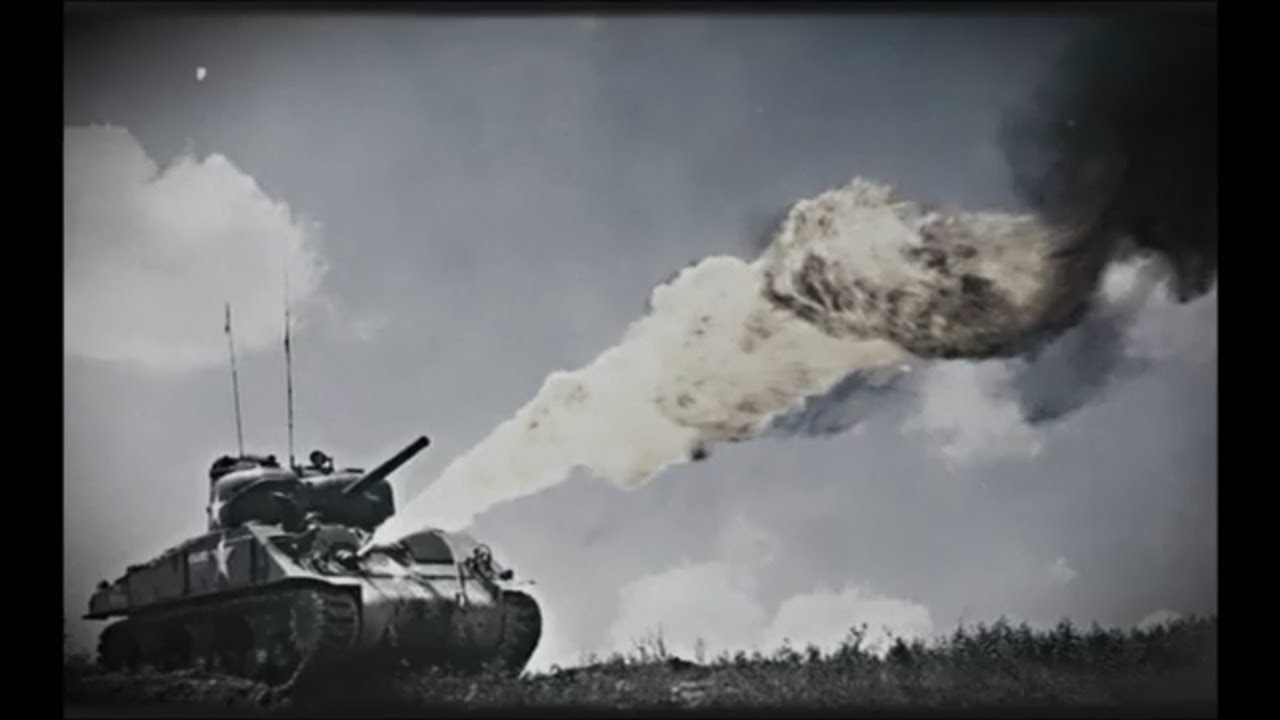
In the jungles of the Pacific, Japanese soldiers had built their fortresses deep — bunkers buried beneath coral, caves sealed by steel, and tunnels thick with smoke and death.
They believed nothing could reach them there.
But then came a new sound — low, mechanical, and terrifying.
The U.S. Army’s modified Sherman tanks, nicknamed “Zippos,” rolled forward… each armed with a flamethrower capable of spewing fire over a hundred feet into enemy positions.
Within seconds, entire bunker complexes turned into blazing infernos.
Japanese soldiers who once shouted “Banzai!” now faced a weapon they could neither outrun nor outfight.
This is the true story of how American ingenuity — through the creation of flamethrower tanks — turned the tide in the Pacific islands of Saipan, Iwo Jima, and Okinawa.
A story forged in heat, courage, and the relentless will to end the bloodiest war in history.
___________________________________________________________________________
SOURCES & REFERENCES!
Books & Academic Works:
Flamethrower: The Story of the 2nd Battalion, 13th Marines in the Pacific War — Bryan Mark Rigg (Potomac Books, 2021)
With the Old Breed: At Peleliu and Okinawa — Eugene B. Sledge (Presidio Press, 1981)
Flame Dragons of the Pacific: The Sherman Flamethrowers in the Pacific War — Sherman D. Pratt (Naval Institute Press, 2004)
Helmet for My Pillow — Robert Leckie (Bantam, 1957)
Archival & Government Reports:
“Flamethrower Employment in the Pacific Theater” — U.S. Army Center of Military History
“Mechanized Fire: The Role of Flamethrower Tanks in WWII” — Armor Magazine (U.S. Army, 1989)
“The Human Element in Pacific Warfare” — Journal of Military History, Vol. 63 (2001)
“Iwo Jima and the Evolution of Assault Tactics” — Marine Corps Gazette (1946)
Technical & Intelligence Sources:
U.S. Army Ordnance Department Technical Manual TM 9-374: Mechanized Flamethrowers (M4A3R3 “Zippo”) — National Archives (NARA.gov)
Marine Corps After Action Reports, 1944–1945 — Combined Arms Research Library (CARL)
Combat Photography Unit Archives — U.S. Navy Historical Center
Pacific Theater Operations Report Series — U.S. Army Signal Corps (1943–45)
___________________________________________________________________________
Disclaimer:
This documentary is based entirely on verified historical accounts and archival research. Produced for educational purposes under U.S. historical fair-use standards. All scenes and stories are based on documented events from World War II. The video does not promote any political ideology, hatred, or violence. It aims to highlight humanity, irony, and the lessons of history.
___________________________________________________________________________
Subscribe for more cinematic WW2 documentaries: @WW2ChroniclesVault
Turn on notifications to never miss a new release.
#WW2Documentary #WW2History #PacificWar #USMarines #FlamethrowerTank #ShermanTank #WWII #ww2 #IwoJima #Okinawa #Saipan #USArmy #HistoryDocumentary #MilitaryHistory
the jungles of Saipan June 1944 thick smoke coils above shattered palm trees the air trembles with the deep guttural roar of engines from the dense haze something moves slow unstoppable a massive steel beast its hull scorched black grinding over fallen trees and wreckage Japanese soldiers crouch inside their underground bunkers gripping rifles slick with sweat the sound grows louder a hatch creaks open on the tank side and then a stream of fire bursts forth a wave of flame surges through the trenches igniting everything in its path the air itself seems to burn screams echo through the tunnels as oxygen vanishes in seconds for the first time the Japanese defenders realized this isn’t just another tank it’s a weapon built for one purpose to turn the battlefield itself into a furnace and soon every island across the Pacific would know its name the flamethrower tank by mid 1943 the Pacific War had entered a brutal new phase The United States had stopped retreating island by island they were now pushing back against Japan’s once unstoppable empire but every step forward came at a staggering cost on islands like Tarawa and Guadalcanal US Marines Learned the true meaning of Japanese resistance the defenders did not surrender they did not retreat they fought from tunnels bunkers and caves turning each square mile of jungle into a fortress the Americans had superior firepower but that advantage often meant little against men buried beneath layers of coral and concrete conventional artillery and bombing softened the surface yet the Japanese survived underground waiting to ambush in many battles flame and smoke became more decisive than bullets by 1944 American commanders realized they were facing a unique problem one that called for a terrifying solution the standard infantry flamethrower the M22 was devastating in close combat but dangerously limited its range was barely 20 to 30 meters the operator had to stand exposed a living target carrying a tank full of fuel on his back many never made it close enough to fire engineers and officers began asking a grim question what if we could mount that same weapon on a tank the idea wasn’t entirely new the British had used early versions in Europe known as crocodiles but the Pacific presented different challenges the terrain was tight humid and treacherous tanks overheated fuel ignited too easily still the US Marine Corps persisted the first experiments began on Hawaii and the Marshall Islands engineers took the sturdy M4 Sherman the workhorse of American armor and began modifying it out went the main cannon in its place a flamethrower capable of projecting burning napalm over 100 yards the turret was refitted with pressurized tanks and ignition systems what emerged was a new monster the M4A3R3 nicknamed Satan by those who witnessed its power each blast could send a jet of fire arching across the battlefield rolling into pill boxes and trench networks it didn’t just kill it cleared entire defensive sectors in seconds even heavily reinforced positions once immune to bombardment collapsed under the inferno Japanese doctrine relied heavily on psychological endurance soldiers were trained to fight to the death to embrace pain and to reject fear but when they faced flame even that discipline faltered witnesses reported defenders abandoning their posts running into open fire or committing suicide rather than burn alive still the road to deploying these machines wasn’t smooth tank crews were hesitant to drive vehicles filled with volatile fuel one direct shell hit could turn the entire tank into a fireball and logistics teams had to find ways to safely transport and refill these tanks in tropical combat zones no small feat under constant enemy fire but the need outweighed the risk by early 1944 as the US prepared for the invasion of Saipan the concept was approved for combat Marine engineers and Navy CBS rushed to convert standard Shermans into flamethrower variants on site some were crude improvised with whatever equipment was available others were more refined prototypes capable of multiple sustained bursts and when they landed on Saipan the world would witness for the first time the terrifying marriage of armor and flame it was a moment that changed the nature of Pacific warfare forever the Japanese soldiers hiding in bunkers would soon discover that concrete and courage were no longer enough Saipan June 15th, 1944 the sun had barely risen when the first wave of you US Marines hit the beaches the invasion marked the start of one of the most decisive campaigns of the Pacific War the assault on the Marianas Islands behind those beaches lay a fortress Japanese engineers had spent months carving the island into a maze of bunkers tunnels and hidden firing ports they had planned every inch for a last stand General Yoshitsugu Saito commanded nearly 30,000 defenders all sworn to fight to the death the first days were a slaughter machine gun fire cut down Marines before they reached the sand dunes mortar shells landed in waves US tanks tried to move forward but bogged down in the soft sand and coral each pillbox destroyed seemed to be replaced by two more then the Marines brought out their new weapon the M4A3R3 flamethrower Shermans freshly converted by Navy CBS rolled ashore they were crude but lethal each tank carried over 400 gallons of thickened gasoline the nozzle hidden within the mantlet of the tank’s gun could unleash a jet of liquid fire over 120 yards long at first Japanese soldiers didn’t know what they were facing they fired rifles and grenades at the tanks expecting to disable them as usual but then came the roar a sound like a dragon breathing a single blast swept across a trench line igniting the earth itself palm trees erupted in flame the air shimmered with heat witnesses described scenes that bordered on hellish bunkers that had resisted artillery for days were erased in seconds the flames crawled through firing ports and ventilation shafts sucking the oxygen out and leaving nothing but silence Marines who had fought through endless ambushes suddenly watched the enemy positions vanish in waves of smoke one officer later recalled when those tanks fired it was like watching the gates of hell open even the toughest Japanese troops couldn’t hold against that the effect went beyond destruction it was psychological collapse Japanese defenders began fleeing their underground shelters abandoning fortifications they had vowed never to surrender many preferred to charge into gunfire rather than be consumed by fire for the first time American forces saw Japanese resistance break under terror alone on Tinian just weeks later the tactic was perfected the terrain there was flatter allowing the flamethrower Shermans to move more freely engineers even modified their systems for longer bursts and faster refueling combined with infantry coordination the tanks operated in pairs one standard Sherman covering with its 75 millimeter gun while the other advanced with fire the results were devastating cave networks that had taken months to dig collapsed under the heat entire garrisons were flushed out or buried alive in one engagement near Uchi Point a single Satan tank cleared a 300 yard defensive belt in less than 10 minutes by the time the Marianas campaign ended the impact was undeniable you s forces had not only captured Saipan Tinian and Guam they had also exposed a flaw in Japan’s defense strategy bunkers and tunnels once symbols of invincibility had become death traps the flame weapon didn’t just defeat them it rewrote the rules of island warfare words spread quickly through both armies among American troops the flamethrower tanks earned nicknames Satan Zippo Ronson after cigarette lighters that lit every time among Japanese survivors they were whispered about like demons many believed they were invulnerable or cursed driven by fire itself behind the front lines US command took notice reports from Saipan and Tinian proved that flame tanks reduced casualties and accelerated assaults dramatically by early Daray 1945 plans were underway to expand their use in upcoming invasions including Iwo Jima and Okinawa but the Japanese weren’t finished they adapted digging deeper tunnels building double sealed bunkers and preparing traps specifically for flame tanks some soldiers stockpiled explosive charges hoping to sacrifice themselves beneath a tank’s tracks others created decoy caves to lure the flames’fury away from real command posts yet even with these defenses the balance of terror had shifted the Americans now had a weapon that combined armor mobility and psychological domination the Pacific jungles had turned into laboratories of fear and the next islands would witness that fear reach its breaking point as the last fires burned out on Tinian commanders looked toward their next objective a volcanic fortress just 750 miles from Tokyo that name would soon echo across history Iwo Jima February 19th, 1945 the sea boiled with the engines of over 800 landing craft on the horizon the black silhouette of Mount Suribachi loomed like a volcano from another world the island was only 8 square miles but it was the most heavily fortified patch of earth in the Pacific beneath its volcanic ash lay a hidden city 11 miles of tunnels 15 concrete bunkers artillery casemates and machine gun nests linked underground by miles of passageways the Japanese commander General Tadamichi Kuribayashi had studied every prior US landing Tarawa Saipan Tinian and he knew what the Americans would bring he had one goal make them pay for every yard in blood on the beaches chaos erupted the moment the first Marines landed machine gun fire ripped through the surf mortar shells exploded in black sand the air was thick with sulfur smoke and the screams of the wounded within hours tanks bogged down communication lines broke the terrain swallowed men whole Kuribayashi had ordered his troops not to fight on the beach but to hold fire until the Marines were fully exposed inland the result was devastating when the American armor advanced it was ambushed from multiple angles at once from the ground from tunnels from hidden gun ports that opened and vanished like ghosts but the US had come prepared with something new alongside standard Shermans rolled a small number of M4A3R3 flamethrower tanks veterans from Saipan now refined for maximum efficiency their nickname Zippo tanks their mission was simple but terrifying burn the island clean by the second day as the Marines pushed toward Suribachi the flamethrower tanks began their work one after another they crept toward volcanic slopes that bristled with gunfire they didn’t need to see the enemy they just needed to know where the shots came from a jet of fire answered every muzzle flash flame burst into caves tunnels and pill boxes devouring oxygen and men alike inside the underground chambers temperature soared above 800 degrees Celsius metal warped concrete cracked ammunition cooked off in a chain of thunderous detonations in one grim account Marines described watching an entire cliff face erupt in a wall of orange and then collapse sealing the defenders inside you could hear them one Marine said later but only for a few seconds then the sound stopped the tanks advanced with eerie precision a 75 millimeter Sherman would suppress the target while the Zippo moved in then one short blast two seconds and the entire structure vanished in flame Kuri Bayashi’s troops fought with fanatical courage they tried everything crawling under tanks with mines ambushing from hidden shafts or firing at close range from cave exits but every counter attack ended the same way the tanks armor shrugged off small arms fire and their response was unstoppable one by one the Japanese defenses around Suribachi were erased on February 23rd the volcano fell silent smoke drifted from its caves like the breath of a dying monster and atop the summit Marines raised the American flag an image captured by Joe Rosenthal’s camera that would become one of the most iconic photographs of the century but for the flamethrower crews the battle was far from over north of Suribachi lay a maze of defenses even denser the main Japanese stronghold Kuribayashi’s Central Command bunker sat hidden beneath 70 feet of rock connected to hundreds of tunnels every advance turned into a siege the Zippo tanks became the key they worked systematically sector by sector burning out resistance that artillery couldn’t reach the Marines even coordinated air observers to Mark new targets for them anything that moved or breathed inside a bunker zone by March the island was a blackened ruin flame had carved new landscapes trenches turned to glass steel melted into slag and yet pockets of resistance refused to die entire Japanese platoons chose suicide over surrender igniting grenades rather than face capture even Kuri Bayashi himself continued directing operations until the final week his position surrounded by fire when his command bunker was finally overrun he had already ordered a last banzai charge one of the largest of the war it was annihilated in minutes the battle for Iwo Jima cost the United States nearly 26,000 casualties but it also broke Japan’s will to hold ground the psychological and tactical dominance of flame tanks had reached its peak what began as an experimental weapon on Saipan had now become a symbol of inevitable destruction American engineers immediately began modifying more tanks for the next invasion Okinawa but what no one realized yet was that Okinawa would
not only be the bloodiest campaign of the Pacific it would also test how far human endurance could stretch in the face of fire the lessons of Iwo Jima burned themselves into the memory of every soldier who survived as one Marine officer wrote in his diary the flame thrower is the most terrible thing I have ever seen but without it we’d still be fighting on that island today the war was entering its final phase and the flame would soon reach Japan’s doorstep Okinawa April 1 1945 the largest amphibious invasion of the Pacific War had begun more than 13 ships carrying 180,000 US troops approached the shores of Okinawa an island just 340 miles from Japan’s home islands the Japanese called it the typhoon of steel and they were right under the command of General Mitsuru Ushijima over 100,000 Japanese soldiers in Malaysia had turned Okinawa into a fortress of coral and death every ridge cave and Hillside was wired for destruction and hidden within it all were the ghosts of Iwo Jima the Americans had Learned their lesson brute force wouldn’t be enough they brought with them dozens of M4A3R3 flamethrower Shermans improved after Iwo Jima with longer range and more efficient fuel systems each could project fire over 150 yards a weapon of terror and precision when the landings began initial resistance was light it felt too easy Marines advanced inland confused by the absence of fire but by the second week the trap closed from the southern hills the Japanese opened a hellstorm artillery mortars and machine guns from concealed ridges the US advance was shredded and when infantry tried to flank they met an unseen network of tunnels and caves that seemed endless that’s when the flamethrower tanks were unleashed their arrival turned the battlefield into a scene from another world the Marines called them the Dragon wagons each Sherman moved with deliberate dreadful calm turret turning the nozzle extending forward like the snout of a serpent when the flame erupted even the ground seemed to recoil sheets of fire rolled through cave openings and trenches roaring with the sound of jet engines inside oxygen vanished whole bunkers imploded as heat and pressure built up faster than walls could contain Japanese defenders had been told to expect tanks but nothing could prepare them for this flamethrower tanks didn’t need a clear target they didn’t need direct hits just a spark at the right angle could turn a cave into an oven one Marine report from April 10th described it simply the effect on the enemy was total paralysis those not killed outright refused to move they could no longer think only hide and nowhere was safe Okinawa was not just a battlefield it became a psychological experiment in endurance American troops too were shaken by what they saw some could not watch the results of their own fire others admitted that after seeing friends buried alive in Japanese explosions their sympathy vanished the line between survival and morality blurred for weeks combat followed the same brutal rhythm daylight brought air strikes and shelling then tanks advanced with infantry close behind the flame throwers LED scouring every hole that dared resist by nightfall the landscape glowed red smoking cratered unrecognizable at Shuri Castle the heart of the Japanese command Kuribayashi’s tactics were reborn under Ushijima he refused to die easily instead of banzai charges he made the Americans fight inch by inch burning through his men and their own sanity every strong point required flame every advance came at the cost of dozens of lives and still the tanks rolled on by May 1945 the last major Japanese positions were collapsing the combined use of flamethrower tanks and demolitions cleared 90% of the southern Ridge complex Marines described the caves as crematoriums of stone American engineers documented the results a two second burst could incinerate a bunker’s interior temperature to 1,200 die degree correns within moments the M4A3R3 carried 400 gallons of fuel enough for over 80 separate bursts each capable of wiping out a platoon in seconds the psychological toll on the defenders was catastrophic captured diaries revealed their despair there is no way to fight fire even the air turns against us our soldiers fear nothing but the flame many Japanese soldiers took their own lives rather than face the tanks others tried desperate measures charging with satchel bombs crawling through burning trenches and but few reached their targets alive by June 22nd after 82 days of combat Okinawa was declared secure but the word secure felt hollow the island was a graveyard 25 Americans were dead over 100,000 Japanese soldiers were annihilated civilians more than 100,000 caught between the infernos perished too the use of flamethrower tanks had proved devastatingly effective but it also forced a question that no one in command could ignore if this was what it took to capture one island what would happen if America invaded Japan itself the answer came two months later not in fire from tanks but from the sky the lessons of Iwo Jima and Okinawa became the silent justification behind the most controversial decision of the 20th century the use of atomic bombs because by then American planners knew if every Japanese soldier was willing to fight to the death and if fire was the only weapon that could break them then Japan would burn before it surrendered the age of the flamethrower had reached its limit it had won battles but it had also shown the world that some victories come at a cost too deep for comfort and in that realization the flame of the Pacific War began to fade replaced by a light far brighter and far deadlier the battle for Okinawa was over but its echoes would haunt the Pacific for generations when the last caves were cleared and the guns finally fell silent in late June 1945 the island was no longer a place it was a scar a burning wound on the map of the Pacific War every ridge was blackened every bunker reeked of fuel and death in some places the coral itself had melted into glass American engineers surveying the aftermath wrote that entire sections of terrain had been thermally sterilized the statistics were staggering over 180,000 Japanese troops and Okinawan conscripts had fought on the island fewer than 10,000 survived the rest annihilated by artillery bombing and flame American forces too had paid a terrible price twelve hundred and thousand killed 36 thousand wounded and thousands more psychologically scarred it was the bloodiest battle of the Pacific campaign even more than Iwo Jima or Guadalcanal but within the carnage lay a grim revelation the US flamethrower tanks LED by the modified 4A3R3 Sherman’s air had achieved tactical perfection they could flush out any defensive position neutralize enemy strong points faster than conventional artillery and clear ground that previously cost entire companies at Okinawa flamethrowers had cleared over 7,000 caves and tunnels something infantry alone could never have accomplished yet the moral cost was profound reports from the US Marine Corps Chemical Warfare Service noted that crews operating flamethrower tanks suffered higher rates of combat fatigue than standard armor units some couldn’t sleep after missions others admitted to recurring nightmares hearing screams echoing through their headsets long after the engines were off major general Roy S Geiger commanding the 3rd Amphibious Corps later remarked the flamethrower tank was a necessity not a choice no other weapon could break Okinawa’s stone his words summarize the terrible logic of total war when the enemy refused to surrender fire became the final language in Tokyo Japanese military leaders studying the battle reports were shaken they knew what it meant if the Americans invaded the home islands Japan would face this multiplied 1,000 times over at the Imperial Staff Office a secret memorandum circulated in early July 1945 noting no defense can be made against flame weapons morale cannot withstand their effect for the Americans Okinawa was both victory and warning every lesson Learned they’re pointed toward an unthinkable conclusion Operation Downfall the planned invasion of Japan could cost millions of lives the destruction wrought by fire made planners realize something chilling if a handful of flamethrower tanks could devastate an island what would happen when entire cities were subjected to that same principle from the air in the weeks after Okinawa US bombers under Curtis Lemay began their fire bombing campaign on Tokyo Osaka Nagoya and Kobe operations designed to replicate what the tanks had done at ground level but on a massive scale tens of thousands perished each night in seas of flame fire had become America’s most terrifying weapon not out of cruelty but efficiency it broke defenses where bullets could not it shattered willpower where artillery failed and it taught both sides that technology had surpassed humanity’s ability to restrain it on the shattered island survivors both American and Japanese began to bury the dead in the ruins of Naha and Shuri marines found burned helmets twisted rifles melted canteens the air still stank of fuel weeks after the fighting stopped the island’s civilians those who had lived through the inferno emerged from caves half blind coughing broken a war correspondent from time magazine wrote Okinawa looked less like a battlefield and more like the end of the world and perhaps in a way it was because in the ashes of Okinawa the blueprint for the final act of World War 2 had already been written the idea that the quickest way to end the war was to unleash a weapon even fire could not rival the US now knew it had the power to end the conflict through total destruction and only two months later it would when the war ended the terrifying image of American flamethrower tanks lingered far beyond the Pacific even among US officers there was a moral reckoning the flamethrower once hailed as a tactical miracle was now seen as too brutal for a post war world reports from Iwo Jima and Okinawa described Japanese soldiers incinerated inside bunkers their last moments turning the caves into ovens general Holland Smith a Marine Corps commander later admitted it was effective yes but it was also horrifying no one who saw its power could ever forget it after 1945 the US began phasing out large scale flamethrower use by the Korean War engineers preferred napalm and demolition charges for clearing enemy positions and by the late 1970s flamethrowers were banned under the protocol on Incendiary Weapons part of the United Nations Convention on Certain Conventional Weapons c c W but the legacy didn’t vanish modern flame systems evolved into thermobaric and fuel air explosives weapons designed for the same purpose to clear fortified positions and shock the enemy psychologically today the PA flame tank is a symbol of both innovation and fear a reminder that even in war power often comes at the cost of humanity
Comments are closed.