
Bluff lettuce, powdery liveforever (Dudleya farinosa). This plant’s pale green leaves
often have bright red tips. During the dry season, it has striking red foliage, as shown. On
a tall stem, it bears a branching flower cluster with many pale to bright yellow flowers. Commonly found on the coastlines of northern California, including in a specialized habitat in Point Lobos and Del Monte Forest in Monterey County. An important hummingbird plant along the coast in its natural range. (Credit – Madeleine
Clare via Wikimedia Commons)
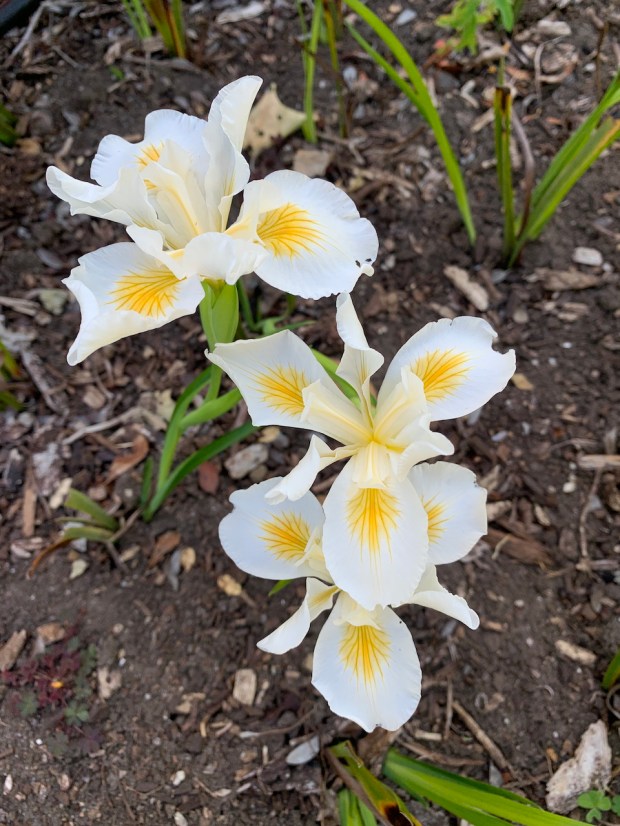
Iris douglasiana ‘Canyon Snow.’ Dara Emery introduced this hybrid in 1974. Blossoms:
white self; yellow signal. Early to midseason bloom. Received the Mitchell Medal in 1978. (Courtesy Tom Karwin)
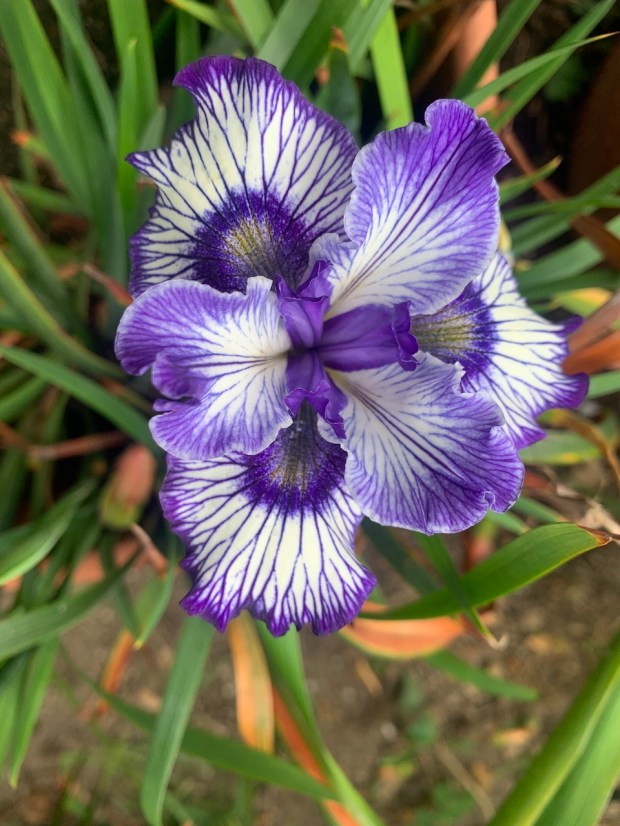
Iris douglasiana ‘Da Vinci Code.’ Joe Ghio introduced this hybrid in 2010. Blossoms:
standards white veined blue on inside; falls white, blue across haft, dark blue veining to
solid blue edge, blue signal. Late midseason bloom. Received the Mitchell Medal in 2019. (Courtesy Tom Karwin)
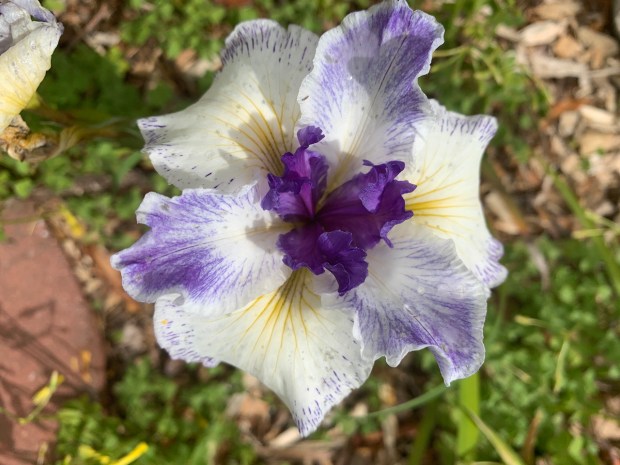
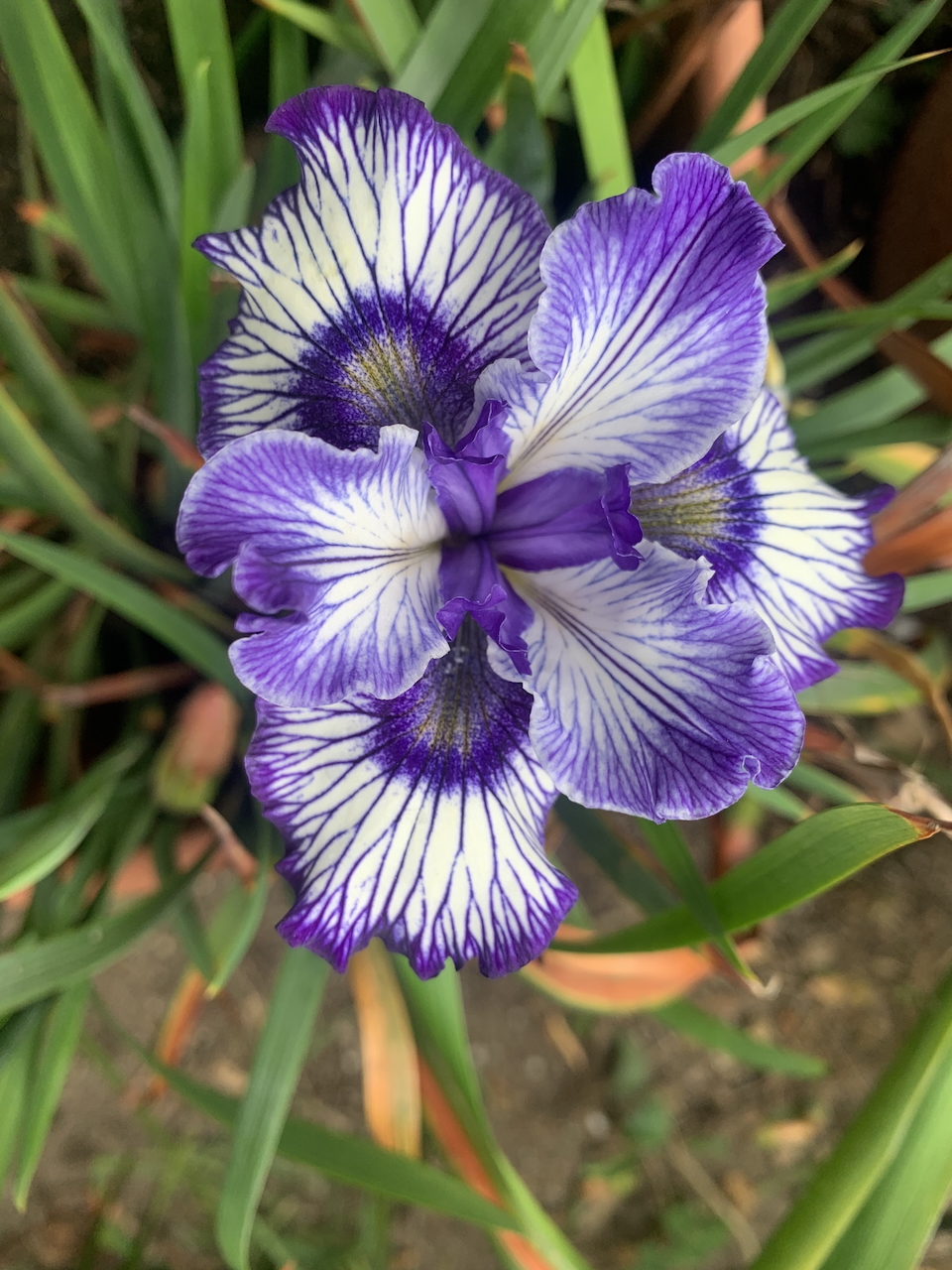
Iris douglasiana ‘Bonus Points.’ Joseph Ghio introduced this hybrid in 2014. Blossoms:
Standards white, marbled blue-violet on top half, white halo around edges; style arms deep blue-violet. Falls white, cream in center to the heart, narrow stitching and dotting around edges. Early to midseason bloom. (Courtesy Tom Karwin)
Show Caption
1 of 4
Bluff lettuce, powdery liveforever (Dudleya farinosa). This plant’s pale green leaves
often have bright red tips. During the dry season, it has striking red foliage, as shown. On
a tall stem, it bears a branching flower cluster with many pale to bright yellow flowers. Commonly found on the coastlines of northern California, including in a specialized habitat in Point Lobos and Del Monte Forest in Monterey County. An important hummingbird plant along the coast in its natural range. (Credit – Madeleine
Clare via Wikimedia Commons)
Expand
Gardeners are currently in the midst of this year’s season for cultivating Pacific Coast irises, commonly referred to as Pacificas or PCIs. These plants occur in several species, all of which are native to the coast of California. They are evergreen plants native to Mediterranean climates, characterized by long, dry summers and cool, wet winters. They grow well in the Monterey Bay area, with cultivars of the iris douglasiana species being the most popular variety.
Overview of Pacificas
The iris genus, one of 69 genera in the Iridaceae plant family, includes 310 species. The American Iris Society’s Iris Wiki organizes these species into 19 groups, one of which is the Pacific Coast Irises.
Hybridizers have developed a growing number of cultivars of Pacific Coast irises in a broad spectrum of colors. The cultivars are grown by nurseries and available through online nurseries.
Today’s image gallery
This column’s gallery features selected Pacific Coast irises, with selected hybrids of the species, iris douglasiana, from my garden. We have edited the captions from the American Iris Society’s Iris Wiki.
This gallery also features an interesting image of a bluff lettuce (Dudleya farinosa) specimen, as a reference to an upcoming event (see “Mark your calendar” below).
Growing Pacificas
Most Pacificas are small and compact, ranging in height from 6 to 24 inches, with some species reaching heights of up to 36 inches. Plants of these sizes fit easily into a residential garden, either in limited clusters or large swaths.
Acquire these plants in the fall from garden centers or online nurseries.
Gardeners can also grow Pacificas by planting seeds in a fine starting mixture and transplanting the seedlings into the garden after they have developed two or three new leaves.
For sources of rooted plants and seeds, see “Advance your gardening knowledge” below.
Pacificas grow in full sun along the coast and prefer slightly shaded areas in warmer inland gardens. Well-draining soil and good air circulation contribute substantially to successful growth. Gardeners can provide these conditions on a sloping or mounded, stony or grit-filled bed. Provide the plants’ native conditions by adding a light mulch, similar to natural leaf fall.
Provide occasional summer watering.
In the Monterey Bay area and California’s other coastal regions, Pacificas usually bloom from January to mid-May. This period is approximately three weeks earlier than that of the tall, bearded irises. In the early fall, when Pacifica foliage can be unsightly, gardeners can trim the foliage down to the appearance of new growth. The plants will respond quickly in the spring with new growth.
Dividing Pacificas
In the late fall, gardeners can transplant and divide their Pacificas.
My garden includes numerous iris douglasiana ‘Canyon Snow’ plants in a sun-filled area devoted to California and Mexican native plants. A Ceanothus shrub has partially shielded some of the Pacificas from the sun, and those plants are healthy and green, while the Pacificas in full sun have smaller, yellowing foliage.
We have been motivated by these observations to divide and transplant the sun-exposed plants to a semi-shade area of the garden.
Gardeners should pursue transplanting Pacificas when the roots are plump, white and at least 1 inch long. In the Monterey Bay area, the late fall is the right time for this project.
When digging Pacificas, replant them promptly. When needed to delay the transplants for a few days, soak the roots in water to keep them moist.
We will share photos of the spring bloom of the swaths of our steadily growing collection of ‘Canyon Snow’ Pacificas.
Mark your calendar
The Carmel Orchid Society will conduct its Fall Orchid Market from 9 a.m. to 4 p.m. at the Community Church of Monterey Peninsula, 4590 Carmel Valley Road, Carmel, Friday and Saturday. This event features an array of orchid varieties for visitors to appreciate and consider adding to their plant collections, as well as attend talks and demonstrations on orchid care. Attendees can select from plants offered by seven vendors and members of the society. Saturday’s lectures include “Dividing and Repotting Cymbidiums” (10 a.m.), “Displaying and Mounting Orchids” (11 a.m.) and “Ikebana: The Traditional Japanese Art of Floral Arrangement” (1 p.m.). Visit carmelorchidsociety.org/Events for details.
The Monterey Bay Area Cactus and Succulent Society will hold its monthly meeting Nov. 16 at the Corralitos Grange Hall, 165 Little Corral Way, Corralitos. Free parking is available, and the building is ADA accessible. The meeting doors open at 11 a.m. for a bring-your-own luncheon, and the meeting starts at 12:30 p.m. The November meeting will feature Stephen McCabe’s talk, “New and Old Adventures in Dudleya.”
Advance your gardening knowledge
To explore online information on Pacific Coast irises, visit the website of the Society for Pacific Coast Native Iris (pacificcoastiris.org). The site’s “Garden Iris” pull-down menu includes a list of nurseries that carry Pacificas. Online nurseries offer plants in a range of sizes depending on the season. In the fall, Pacificas are often available in 1-gallon containers.
The society also operates a seed exchange. We expect the 2025-2026 Seed Exchange to open in December. Visit the society’s website and click on the “Seed Exchange” menu. The society notes, “Seeds will produce a plant that is only similar to the parents from which it came. Only the species will come true from seed.”
The American Iris Society’s Iris Wiki (wiki.irises.org) includes an extensive database of registered cultivars of several groups of irises. Click the link on the left column for “Pacific Coast Native” irises.
For an introduction to popular succulent plants, browse author Debra Lee Baldwin’s online presentation, “What You Need to Know About Dudleyas” (tinyurl.com/4jx3943a).
This week in the garden
Consider adding Pacificas to your garden.
Enjoy your garden!
Tom Karwin is a past president of Friends of the UC Santa Cruz Arboretum and the Monterey Bay Iris Society, a past president and Lifetime Member of the Monterey Bay Area Cactus & Succulent Society, a Lifetime UC Master Gardener (certified 1999-2009), past board member of the Santa Cruz Hostel Society and a current member of the Pacific Horticultural Society and other garden-related societies. To review the archive of recent On Gardening columns, visit santacruzsentinel.com and search “Karwin.” Visit ongardening.com to review columns from 2012-2020 (and eventually) from the following years. Please send comments or questions to gardening@karwin.com via email.
Comments are closed.