
Get D5 Render Pro for free for 8 days and use this link to get a 5% discount!: https://myspace.d5render.com/subscribe/year/?aff=showitbettter
More tutorials on D5 Render:
Courses: https://showitbetter.co/courses/
Resources: https://showitbetter.co/resources/
Website: https://showitbetter.co/
All of my architecture plan videos here: http://bit.ly/2oCH5yI
All of my architecture diagram videos here: http://bit.ly/2nQ7IBP
All of my architecture render videos here: http://bit.ly/2oeY8UY
All of my tips and tricks here: http://bit.ly/2okicV9
My Architecture computer setup:
My current computer setup details:
Logitech MX Master 2s: https://amzn.to/3nW77Kq
LG Monitor 24 inch ( I have two of these): https://amzn.to/3to1WUI
Dual Monitor Desk Mount: https://amzn.to/3ephQdb
AMD Ryzen 7 3800x 8-Core processor 3.89 Ghz: https://amzn.to/3ergRJq
Nvidia GeForce RTX 2070 Super: https://amzn.to/33qkoBK
ADATA HardDrive: https://amzn.to/2PXxNhi
RAM: 32 G
500 g SSD
Cooler Master Keyboard: https://amzn.to/3bcLsZj
📱 Instagram: http://bit.ly/2mOgrjG
Subscribe to our newsletter (discounts, freebies and tutorials)
http://eepurl.com/deiFun
Timestamps:
0:00 introduction
0:50 System Requirements for D5 render
1:36 My current setup for D5 render
2:01 Pricing of D5 Render
2:27 Downloading d5 render
2:57 How to import a project in D5 render
3:12 Main Interface of D5 Render
5:06 How to add a scene in D5 render
5:22 How to edit the camera of D5 render
5:48 How to apply materials in D5 render
7:32 How to use AI to apply materials in D5 render
9:59 How to apply water in D5 render
10:21 How to add glass in D5 render
10:54 How to make more realistic materials in D5 render
11:39 How to add vegetation in D5 render
16:24 How to add furniture in D5 render
18:24 Interior Parallax models in d5 render
19:48 How to add artificial lighting in d5 render
21:48 How to add environment effects in D5 render
26:03 How to add effects in D5 render
27:28 How to use AI Atmosphere Match in D5 render
29:56 How to render an image in D5 Render
31:29 How to create an animation in D5 Render
34:20 Final renders
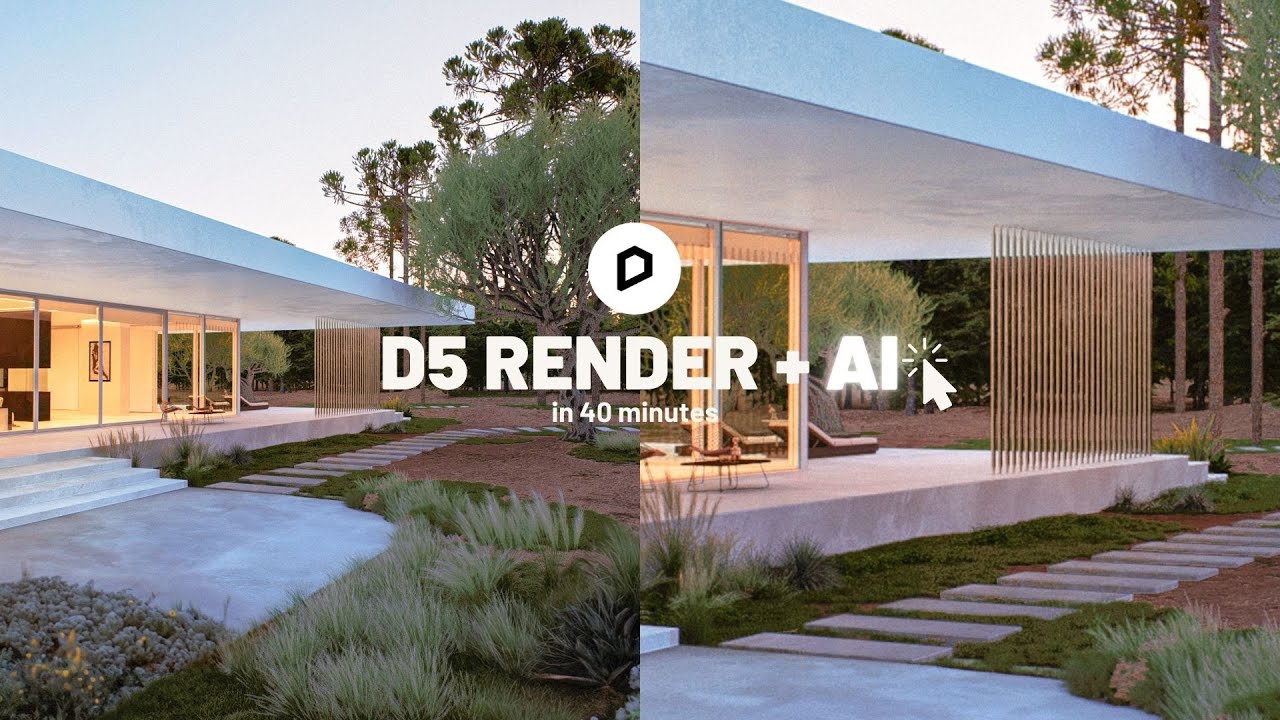
by the end of this video I’m going to show you how I turned this 3D model into this beautiful image and these beautiful animations welcome to another tutorial this is going to be a D5 render tutorial completely for beginners from scratch if you have no idea what D5 render is and want to start learning all about it this is the video for you I’d made a video similar to this one a few years ago but D5 render has been updated since then it has a ton of new features and a ton of new things so I wanted to create an updated version of this video among these new features we have have the ability to accelerate the design and 3D creation process using AI this is truly exciting and I’ll be incorporating these features into this video this is going to be a really long video so there will be timestamps at the bottom of this video and also in the description so you can jump to the part that interest you the most or you can just watch it all along with me and I think that’s enough talking let’s Jump Right In so one of the most important things you need to know before downloading def5 render is the system requirements does your computer handle it or do you need to update it right here we are in the D5 render website and if you go to product and go to system requirements you’re going to be able to see the specific requirements that D5 suggests you have so for example Windows 10 operating system or above in NVIDIA GTX 1060 gigb or above or an AMD Radeon RX 6000 or above if you want to go more in detail into these system requirements you can just click right here on detailed info and here you will see different types of graphics cards or processors that D5 render recommends to run smoothly uh D5 render also D5 render has a free Benchmark tool which you can download or you can also download defy render and just test it out on your computer does it run does it not run it’s all dependent on You So currently I have an Intel processor core I9 12th generation I also have 32 gigs of memory and most importantly for D5 render we need to see what graphics card we have and for me my case is a GeForce RTX 3080 TI laptop GPU now this is very different from desktop computer CPU you can test out and see the different benchmarks but overall these settings have worked pretty well for me let’s talk about the pricing of D5 render the pricing is one of the most interesting things that this software has specifically because it’s free it has a free version which you can create your projects create different renders you can have different assets you have access to a very big library inside of D5 but if you want the pro version it’s only $30 a month which from my perspective is not that expensive if you compare it with other softwares in the same industry now if you want to download D5 render just go to the download tab and click on the get the windows app so as soon as you download D5 render and open the main window this is going to be the first window that you’re going to see first we have a few demo scenes which you can download completely for free and test out D5 render if you work with a specific 3D modeling program you can download the plugin for free and install it on your specific software so for example I use the SketchUp Liv sync plugin but there are also compatibility options for 3D Max for Revit for Rhino aryad Cinema 4D and blender so it has a ton of different options depending on your 3D modeling software now let’s create a new file and let me show you how to import a 3D model you’re going to go to file import and I’m going to select my fbx model and double click on it and as soon as the model loads I’m just going to click on it once and place it inside the interface here I’m just going to type in zero for all the cord inat so it can be centered and this is the model that we’re going to be working with and I want to show you the main interface of D5 render so as you can see we have three main bars and one Central viewport in the left bar we have three options we can create a new scene we can add different layers and we can see our imported models or we can also see the objects that we have inside of the model and use this to filter that or use the search bar to filter it in the top bar we have our assets window where you can find your models your materials your particles and your hdris and you can also find your own local models then we have the D5 Studio option which we will see more in depth later we have some shortcuts to add lights to add specific paths we can add tools add particles add a camera and add a section we’re going to see all of this throughout the video and in the right bar we have two main tabs which are the environment Tab and the effect tab for the environment tab it controls everything from the sky also the hdri that you can place instead of the sky and also a weather tab where you can modify the clouds the fog the wind and precipitation and for the effect tab this is something that you’re going to be using towards the end of your images so you can add specific Styles you can add color grading postprocessing and even add your own specific L and here at the top bar we see some options to create an instant render to create an animation or to watch the render queue to navigate inside of the viewport you can just use the W ASD keys to move forward backwards to the side and you can also use the Q and E tools to move either up or down if you press shift on your keyboard it will go faster if you press space your keyboard it will go much slower you can modify all these settings right here where it says navigation you can either be in fly mode orbit mode or walk mode next we have the camera settings where you can adjust the exposure the field of view the focal length the camera clipping plane the depth of field option and also to see it in two perspective mode or just see it in perspective mode these are some quick toggles where you can see your image from different points of view and finally in the display option you’ll have the option to see your model in different modes in different quality modes that is maybe going to make your computer a little bit faster or a little bit slower you can also filter your model by hiding or showing any of these things now let’s start working with our model the first thing that I’m going to do is I’m going to save a scene just so I can come back to it and reference it and start improving this scene as the main render if I’m going to add a new scene I can just click on this button that says add scene or I can also update this previous scene by just hitting right here on the update scene button what you can also do is edit the camera inside of the scene and start moving around and you can edit the physical camera so for example I can drag it down drag it to the front and here in the camera options I can also control the aspect ratio for example if I want a 4×3 16×9 9x 16 aspect ratio I can control all this through here and also I can control the depth of field camera clipping plane focal length Etc as soon as I finish modifying it I just click on update and that is it now let’s start applying materials to our model the first thing that I’m going to do is I’m going to go to my assets window and click on the material tab let me just make this a little bit bigger so you guys can see the whole window here I have different categories of materials for for example suround camic fabric plastic wood flooring Etc and the search bar inside of D5 render is also really good so as soon as you start typing in certain type of material so for example it’s typ in concrete it’s going to give me different options within different categories of the materials that maybe I’m searching for or if not I can also filter my selection by name by the newest and latest material or the materials that are free or the materials that are not free I can also change the icon size and scroll through the different pages so in this case I’m going to type in white concrete so as soon as you have a series of options selected let’s say that I wanted to select this one I can just click on download wait a few seconds for it to download click on it and just select the surface that I want to apply it to in this case I’m going to select the white concrete and place it on the roof and walls of my house as soon as I apply my material I’m going to have some material options on the right bar of my screen so here I can modify the specific maps for example the normal map specular map roughness map metallic ambient occlusion Etc I can modify the emissive and reflection CICS and most importantly I can modify the size of my maps so for example if I wanted to make it smaller bigger move it rotate it or in this case adjust it to complicated surfaces I can click on options like Tri planner and UV randomizer here you guys can see that my texture will be applied in a very interesting way now if you wanted to save the specific material and use it later in your project or use it for other projects what you can do is go to the top bar right here and click on add to local as soon as you see this you can go to your local library and here you can see that I’ve added the white concrete as maybe one of my favorites or I’ve just downloaded it to make it easier to access later on now one of the biggest features that D5 render has is the ability to use AI as a companion inside of D5 run I think this is the first software at the moment that uses AI inside of their program which is truly amazing and we’re going to be using AI throughout this whole tutorial and I’m going to show you the specific parts now for adding specific materials you can use AI to generate your own custom maps let me show you how now here I want to apply a wood deck texture to this surface right here what I’m going to do is I’m going to go to my asset set window go to materials and select a basic material inside of this category you can select your custom material and I’m going to apply custom materials to my Surface as soon as I have my window option right here I’m going to go to my base color map option click inside this color map and select the texture that I want to use so as you can see we have our default texture but we don’t have a normal map specular map roughness map Etc D5 render automatically tries to simulate what this texture would look like so for example if it didn’t have that simulation it would look very flat kind of like this and what we can do with the help of AI is go to this button right here which is which says AI generated texture maps and as soon as I have this I just click once on it wait for it to load and D5 render will automatically generate its own texture Maps based on the map that I gave it as soon as I have my texture Maps I can modify the roughness I can modify the parameters also I can modify the texture size and then add it to my local library and here I can apply it to all the different surfaces where I’m where I’m going to use the same material now let’s apply a Terrain material onto our model this specific terrain material was downloaded from the quick Piel library now the first thing that I’m going to do is I’m going to press I on my keyboard to select the surface that I want to apply the material to and here we’re going to use a very cool tool by D5 render which is batch importing our PBR textures previously you had to import them one by one and this could take some time but now in D5 render you can just click on batch import PBR textures select all of them at once and click on open and in a matter of seconds you’ll have your own terrain material here we can perfect it just a little bit if we Zoom away we can see a very obvious repetition in all of the material which we don’t really want so what I can do is go over here where it says UV randomizer and turn this option on the material will be well spread out and well texturized and now I’m going to click on the duplicate option and apply it to this surface as well and now we have the terrain material now for this concrete entrance I’m going to show you how you can apply materials in a different way first I’m going to type I and click on my Surface then I’m going to open my material window and start dragging in the different maps that I’m going to use so for example the albo map the normal map the roughness map the ambient occlusion map and that’s it by dragging and dropping my textures I’m saving a ton of time now let’s say you wanted to add add some water into your model there are many options that you can choose from the first option that you can choose from is selecting the surface on your computer clicking on material template selecting the water option and customiz it from there you can also go to your assets tab select the water option and select the one that you like the most or what you can also do is Select for example this type of surface click on flowing water and in less than no time you have a river inside of your model now that I have the majority of my materials applied let me show you how to add glass onto your model the first thing that I’m going to do is I’m going to select the surface which the glass is on I can create my own custom glass by going to material template and selecting transparent or I can also go to assets search for the glass category and you can apply this normal glass I’m also going to apply it on this surface and also on this surface right here as soon as you have it applied we can see some customization options right here on the right part of our screen the most important part is adjusting the refraction and the thickness of your material to modify your glass material you can select the refraction option and also adjust the thickness of your glass now that I have all of my materials applied onto my model let me show you two quick tips to make your materials look much more realistic the first tip is rounding your Corners so select your surface and at the bottom select on the option round corner I like to keep this at a radius of three this is before rounding the corners and this is after I’m going to repeat the same process with all of my materials the next tip is adding decals onto your surfaces so you have to go to assets model and select the decals option here you will find different categories of things that you can place onto different surfaces to make them look much more realistic I’m going to select this wall dirt right here and place it on this wall I’ll adjust the size just a little bit adjust the placement and modify the opacity you don’t want to overdo it here just very subtle opacity is the key now let’s start adding our vegetation inside of our model one of the coolest features that D5 render has is the vegetation Library it has vegetation from all over the world and the best thing is that you can filter it by species or you can also filter it by type of vegetation and to add a tree is very easy you just have to select the tree wait for it to download and then place it on your model and to add vegetation in a faster way we can use three three tools the brush tool the scatter tool and the path tool with the brush tool you can select it right here from this top bar and we’re going to select the trees that we want to paint in after having these trees selected I’m going to adjust the brush parameters like the radius the density the size and of course here I’m going to select line to terrain here you will see a preview of the brush and if I start painting it in very softly you can see that I start to get many trees at the same time but here I want to adjust my parameters just a little bit I want to increase the radius decrease the density click on random size in start painting it in again and just like that you can paint in trees very quickly but let’s use our second tool which is the path tool for the path tool I’m also going to select a group of trees in this case I’m going to select some shrubs and as soon as I have my selection ready I’m going to create a path around this walkway here I can select different noes From the Path adjust the smoothness and I can also increase the number of elements inside of my path change direction randomize the direction randomize the spacing as well and randomize the offset if I want to modify the elements inside of the path I can also eliminate some of them like for example this one and this one and randomize the size as well now if this was a path that you were going to use later in the future in other parts of your model you can save this path as a preset just click on create preset select the path name like for example small scale bushes and click on Save in the next time you wanted to create another path select the small scale bushes create the path and that’s it you don’t have to personalize it all over again and our third tool for adding vegetation is using the scatter tool here you can just go to your top bar select scatter select the model that you would want to SC like for example this one right here adjust the parameters like radius density and size and select the surface which in this case it’s going to be this one right here since it’s such a big surface it’s going to take a little bit to load but as soon as I have it on you can see that all the trees were scattered in a very fast way now in case you mess up you don’t have to erase the trees one by one you can just select on One Tree and here you can see some brush records where you can either repeat the same parameter or click on apply to eraser to erase this whole action now one of the best ways to add more realism and also save some space in your computer is by using backdrop planes so if you go to your asset Library go to your models select on landscapes and also select backdrop plane you can select from different kinds of backdrop planes that you can add to the backdrops of your images in this case we’re going to select the Autumn trees and Autumn trees to option as soon as we have it we’re going to place it on the external edge of our model now one quick tip if you want to rotate your object before you place it you can just press r on your keyboard and the object will rotate before you place it and I’m going to press contrl D to duplicate it and put it on the other side now I’m going to press contrl D to dup at it once more and just rotate it now as soon as I added my backdrop planes it seems as if though I’ve added a ton of trees in the background while I’ve just repeated the same image over and over again okay so let me show you the model with all of the vegetation and all of the materials applied here you can see the backdrop planes that we talked about earlier also some big scale trees towards the outside of my house and once we get closer to the house we can see some small scale vegetation that I’ve painted in with the brush tool to make it seem very random and organic to paint in this grass I’ve just selected the grass cluster added it as a brush tool and started painting it in randomly on my terrain just like this to add that extra level of realism we don’t want to paint the grass all over the place because realistically that’s not how it happens we just want to paint it in certain parts that make it look kind of imperfect and kind of patchy to really sell this image now in case you want to add some Vines onto your model D5 render has a really interesting tool to add Vines adapted to each surface so let me show you how it works first you’re going to go to your aets Tab and search for Vines as soon as you see this you’re going to select this icon I’m going to place it on my wall and I’m going to make sure this Leaf is projected onto this wall or into the surface that you want to apply it to and now I’m going to click on generate and just like that we have a Vine inside of our model here I can adjust the leaf density the angle the length and even the Leaf color now this is where you may start to get a little bit overwhelmed and your model managing skills are going to come in handy for this so that’s where this object tab is really important here you can select this grid and filter your objects by category so for example here I just want to see all of my nature objects I can select all of my nature objects and I can either lock them place them in a group by pressing contrl G and hide them all at once this just makes my modeling process so much easier as soon as I have my group ready I’m going to name it vegetation so now you’ve seen how I’ve Applied Materials to my model and also how I’ve applied vegetation to my model now let’s take a look at how we can add different Furniture assets to make this scene look much more realistic and so much better okay so let’s open our asset window and I’m going to go to Furniture the key to adding good Furniture is adding a general piece of furniture like for example this exterior chair and then adding some details on it to top it off like for example a towel a table some food something to drink of course and of course some company now this is looking really good let’s also add an outdoor dining set press crl D and duplicate it and rotate it just a bit now let’s talk about the interior assets for just a bit I’m going to go to assets and start adding Interior Furniture like my living room my kitchen different little assets here and there so I’m going to add this black leather multi-seat sofa press r on my keyboard to rotate it and let’s also add some chairs of course we have to add our coffee table and I always love to add some Greenery for my Interiors so one of the more interesting things that we can also add to our Interiors is for example some Dynamic particles D5 render has a set of dynamic particles which you can add to to give more realism and movement to your renders so if I wanted to add a fireplace I would just click on fire right here and place it in the fireplace of course I can adjust the size and this gives just much more realism to my image now some really cool Dynamic particles you should definitely add into your next render is for sure some birds and why not some leaves as well and just like this your render is getting prettier and prettier now I’ve imported all of my models from the asset Furniture library and I want to show you what models I have mostly on the interior side of my house just so you can get an idea of what I placed inside so first we have this long dining table then if we go to the living room right here you can see that I changed the sofa up just a little bit and I also added this furniture in the background right here here now for this wide open space here in the back there is a Furniture library that is made out of different types of assets that are found inside of the asset library and towards the back we can see another dining room another bar type dining room and that is basically it and finally there are also some rocks right here just so it gives it a little bit more landscap is kind of Vibes now this is all the furniture that I’ve added inside but just in case you don’t have a lot of time to add piece by piece there is also another tool inside of D5 that you can use to add a Feeling of a warm interior so we’re going to go to our assets window and we are going to go to Interior Parallax next we’re going to select the residential category and I’m going to select the residential interior 11 for example as soon as I select it I’m going to press r on my keyboard to rotate it and just place it right behind the glass facade now as soon as I have my interior Parallax placed I’m going to go to this Goin Skylight and just place this at night just so you can get a better idea of what I’m talking about and I’m going to select again my residential interior Parallax here I can adjust the lighting of the space so here I can just make it much brighter or much dimmer I can also adjust the intensity of the light I can adjust the temperature of the light so if I want a warmer light or a cooler light and if we get a little bit closer to the image like for example right here I can adjust the position of the elements so for example I can make it look even deeper like even closer to the window or or even farther away so I think this would look interesting or I can just erase the elements all together after I have this I can duplicate it and place it on the other side and just like that we have a really interesting interior without all the hassle of placing all the inside elements I recommend you use this of course if you’re not going to create interior renders but if you are going to create interior renders you may want to spend some time adding very specific Furniture elements to just make your image stand out much more okay so now we have the materials we have vegetation and we also have our interior models now let’s talk about artificial lighting and ways to add light inside of your model so we had already talked a little bit about Dynamic particles like for example this fireplace right here which also gives some light in but right now what I’m going to do is I’m going to turn a surface into an emissive material just so I can simulate the idea of a light fixture on the ceiling of my house so I’m just going to go inside of my house like just like this and from the interior model I have a different surface that is supposed to be a strip light that goes around the whole living room so if I press I on my keyboard and select this surface I can see that the map is just a normal map that doesn’t have any materials applied whatsoever but what I can do is just go over here where it says emissive and turn the emissive option on just like this and as soon as I turn it on you guys can see that this acts as a light and it illuminates the whole Space so I’m just going to turn the exposure down just a little bit so for example if I turn it off once again you guys can see how everything just goes dark and starts looking underexposed but if I turn the admissive option on it starts to look much much nicer it starts to look very interesting and here inside of the admissive option of course I can control the intensity of the admissive miss the color of the light for example I think this is a very greenish tone for me so I think I’m going to select a more reddish kind of tone for example something like this I think would look much more interesting that goes along with the fire or I can also select a specific temperature which I think is much easier and much more precise now if you go outside of the model and we see the interior lights you can see that just with this light how much light we can see now in our in our Interiors also another way of adding lights is just going over here to the top where it says add lights and we can add either a point light spotlight strip light or rectangular light and we can also add a stage light so for example I really like to use rectangular lights so I’m just going to place this right here and start modifying the length and the width of this and I’m going to click on show light shape so I can see the whole shape of the light and I’m going to keep on modifying these Dimensions just a little bit here and this would all be done with a rectangular light all right so now that I have all of my interior lights set and also some exterior lights as well which are just you know these Point lights that just make everything look a little bit warmer and contrast a little bit more with the outside I want to go ahead and start adding the environment effects which I think this is maybe the most fun fun part for me which is giving some life and personality to this whole image so I’m going to walk you through the options of of adding some environments either through the goo and Sky effects or also through the hdri effects whichever of these you choose you can create really really good images with so let’s start with the goo and sky so for the GE and Sky you can think of it as its own built-in Skylight system where you can personalize what time of day it is where the north is coming from or you can also maybe go into these interior settings and specify the month the day long ude latitude you know be very specific about your location and the newest option inside of D5 render is using the custom Sun so with the custom Sun I can adjust the sunlight intensity I can also adjust the alt altitude as well as the azoth and here if I increase the disc radius and if I increase the light intensity you guys can see that it’s going to be increased right here as well so I can take this to an extreme or also maybe say that there’s little to no sunlight kind of like this and I’m also going to see the effect as well so for example if I I place my image in a in a high altitude and variate the asmo and what I’m going to do is I’m going to change the altitude just to make it a little bit lower and I’m also going to change the asouth I’m going to increase the sunlight intensity just a little bit I’m going to go to my camera option press f8 and also press on walk mode and just lower the whole height of this now as soon as I have this defined let’s say that this is the sun setting that I want I can start adding much more things like clouds fogs wind and precipitation so let’s go one by one to see how I would use it in this case but if I toggle the cloud option I can control the amount of clouds my image has so for example I can make it a very cloudy image of course I would have to adjust the sunlight intensity just so it makes a little bit more sense I can also adjust the cloud thickness the cloud density the cloud height I can indicate it to cast some shadow on the ground so when it cast Shadows you guys can see that I don’t I I no longer have my sunrays and my shadows and I can go back and change the amount something more like this and maybe change the thickness just a little bit and of course why not the density now as soon as I have my cloud settings ready I’m I’m going to go to my fog option and here I don’t want to add too much fog but if I turn the fog option to an extreme like you seeing right here and I and I start adjusting it you can start seeing how this is going to affect my final image but but again we don’t want to exaggerate this too much because it starts to look fake so I’m just going to add just a little bit of fog and leave the rest as it is and finally for the precipitation effect if I turn it on and I turn it to an extreme like for example let say I want some snow and I increase the strength my image is going to to totally change but in this case let’s say I just want some small little puddles so I’m just going to I’m going to leave the strength at zero puddles I’m just going to leave at 28 I think or maybe a little bit a little bit higher I think just so it looks like it it just finished raining now these are some of the effects we can get with a Geo and Sky option so if we go to the hdri option you guys can see that my image changes completely except for the weather options the weather options are going to remain the same if I go inside of my hdri if I click inside of this window I’m going to be able to select from some default hdris that are included inside of D5 and if I click on any of these hdris my mood is going to start to change so for example I’m going to turn the fog option for now and the precipitation option for now just so you guys can see how the hdri changes the whole image so I can select a cloudy hdri kind of like this and inside of your hdri you can also personalize and customize the lighting settings so for example I can increase the Skylight I can increase the the amount of light coming from the background image I can also rotate my hdri or to indicate where the brightest point of my image is coming from I can adjust the color temperature of my hdri to make it either cooler or warmer and if we take a look at this from another point of view like for example let’s say from right here we can see that the puddles give it give this image a lot of life and makes it look much more interesting so I can adjust the background light here you can also import your own custom hdri which I also like to use and I’m going to select this hdri for now which I think looks really interesting okay so now we have our hdri we have our vegetation we have our lights we have our materials we have our models we have the majority of things already set what we need to do is we’re going we need to add our special effects to our image which means color correction which means exposure uh contrast highlights all of these things so let’s jump into that right now so here in the effects tab AI also starts to play a very important role but before I show you the very special AI tool that D5 render has inside of this newer version Let Me show you how I did it before AI the first thing that I did was adjust this postprocessing window which is just you know adjusting the whole exposure of my image just like this I can also adjust the Highlight local exposure as you guys can see I can modify a little bit of the contrast and maybe I want to make this whole image much much colder or maybe much warmer you know this could also look nice I can change the tint of my image decrease the bloom I don’t like to use the bloom effects a lot I don’t know why you can also add your own custom l so for for example if I turn on this slot you guys can see that it gives me a sort of filter very special filter D5 render has their own specific lots that you guys can try out or you can just quick click on customize lot and load your own different Lots so this looks nice I’m just going to lower the intensity just a little bit now I’m going to go to Color grading for color grading I have different options I can adjust the global color grading or go specifically into the shadows midtones and highlights so these are all the things that I would do if I did not have an AI option but now I want to show you the newest tool from D5 render which is AI atmosphere match now this is going to save us all this time a ton of time a ton of work because the Luts that we appli the postprocessing everything is going to be applied from a reference image using AI so let me show you how to use it first of all we’re going to go over here to the top where it says AI atmosphere match and here I’m going to upload a reference image now I have a ton of different render saved that I’ve created from past tutorial some of you can recognize for example this is from our last D5 render tutorial and since right now I’m creating a Kind of Night image for example I think this one would look pretty pretty interesting again I’m going to snap the current View and I’m going to click on start generating I’m going to wait and click on apply now and as soon as it’s done you guys can see the incredible work that we have here so the sky is very greenish very greenish bluish like the one we have in our reference image we also have a very textur kind of vibe from the wall walls which we have also in a reference image and the whole vegetation the whole surroundings is also very desaturated very green and I just love this entirely so this is something that I want to use so for example right now I’m going to create a new scene that’s going to save it with all of the effects now I’m going to maybe move my camera around just a little bit so I can have a different sense of a different scene that I want so for example start testing out with one more image to see how it can look so for example this image right here which I think maybe I’m going to change the view let’s maybe let’s go something around this tone and snap the current View and click on start generating and wow I mean honestly this is amazing normally I would have spent a few hours just adjusting the different tones of the image but now with my reference images I can export a ton of different renders with the same Vibe with the same kind of filter if you like so now let me show you some of the different scenes that I’ve created using the AI atmosphere match so these are some of my favorite images and I think this tool has so much potential because in a matter of really seconds in a matter of minutes you can import maybe five different reference style images like for example here you guys can see that the the whole mood and whole and everything in general is completely different one from the other so for example these are some of my favorite images that I’ve generated with this now that we have it ready let’s render our image so as as soon as I have my scene ready I’m going to go to the image Tab and start adjusting the final parameters so here you can just adjust once more everything that you had the option to adjust from the camera option so I can adjust the focal length the horizontal view I can also select the camera settings right here and adjust the specific camera settings like for example the depth of field option I can turn it on and set the focus plane right here towards the middle ground kind of like this and turn on the Blurred option I think this is looking interesting thing and for sure I can modify the the aspect ratio kind of like either I if I want a 9 9 by 16 image or 16×9 which maybe is kind of the way to go or maybe a 4×3 image I think this is more of a classic render as soon as I have this I can select the channels that I want if I want to export with Sky mask amb occlusion material ID reflection in this case I’m not going to export with any of them because I’m not going to um modify this anymore I can select this or I can also select the preset size in my case I want to export a 2K image but you can export up to 16k and as soon as I have it ready I’m going to click on render now this is how our final render came out and I loved it because you can see the out of focus option right here you can see the textures you can see the boy in the background just posing for I don’t know someone else and I thought it looked really interesting here are some other images that I rendered which I thought also looked really interesting like for example this one right here this one right here I think the the ambient the whole vibe was just so cool but now let’s go back to a render and let’s say that I want to animate this scene as well what I would do is go to the video option right here and I can create a new clip just by clicking on create clip and this is going to create like a whole entire scene for me and inside of this clip I can include different shots so for example I’m going to add this view it includes the shot but now let’s say I want to add a close-up view maybe with a different kind of camera setting like for example something that is much more like this I can also add add this current view on top top and finally I maybe let’s include a top down view top you know something like kind of like this which maybe also looks super interesting so as you guys can see we have three different shots so for example this first one then then we have the second one and then we have the third one so if we just play it out just like this it’s just going to be a few still shots that are just going to be right there but now if you don’t have any idea of what shots you should include let’s say let’s go for example to a new scene if you have no idea what shots you could you should include D5 render also gives you some templates for some shots which I think are really interesting so for example I have my shot here but you can go to the template and here you guys can see different types of templates and say you don’t know what pan down is you can just hover over it and you can see what the pan down would do or let’s say a 360 pan a dolly twist out Dolly twist in you know a ton of technical names but you don’t even have to know or understand them you just have to hover over them and see maybe okay so I want the slide left I think this looks interesting I’m going to apply it and if I go to this to this scene and play it out it starts to slide left this is super interesting now let’s add another scene horizontal push which is like a zooming in right so I’m just going to click on horizontal push and I’m going to click on play and it starts to zoom in wow this is crazy and now let’s look for another view let’s just maybe start right here something like this I think this looks interesting and now let’s click on slide down I think would look really interesting right so as soon as we click on play this looks nice but maybe it’s a little bit too fast or it’s just like sliding too fast so what I can do is just modify the amount of seconds that it slides down so for example I don’t want it to be in 3 seconds I want it to be in 5 seconds so I just type in five and this looks perfect but I can also modify the direction of which it slides so for example right now it just slides down but I could tell it to slide just to the side just like this which would work as well would work pretty well and I could also change the perspective mode and change the camera clipping plane and wow I think all of this looks amazing just like these three scenes they look really interesting the next thing that I’m going to do is just click on render to render them render them both right so I’m going to select the size you know I can modify the size right here or I can modify this the export resolution right here as well so I’m just going to select a 1080p size 30 frames per second would look nice for me and I’m going to click on render let’s wait and see the results okay so this was probably one of the longest tutorials I’ve ever made I’ve had so much fun exploring D5 render probably I could stay here for hours and hours and explore more possibilities with the new AI tools and also with all the different tools that just make my life much easier when I’m starting to render I’m enjoying D5 render a lot I hope you guys enjoy this video as well but I would love to create more videos on more advanced settings like creating an advanced animation creating realistic grass creating you know selecting the right templates for the AI atmosphere match you know there are so many things there are so many Advanced intermediate and advanced things that we could talk about which I would love to talk about about with you guys so if you guys have any video recommendations please comment them down below and also one of the things that I haven’t talked about D5 render which I think you know this video is pretty long but if you’re here for the video I think you know you would also want to be interested in this is that D5 render has a really interesting community space that is very active so if you go to D5 render there will be an option to go to D5 render community and you can see what people are creating with D5 what problems are they having you know what other companies are using D5 render that are using like creating really amazing results which I think you would love to check out so the community feature or the Comm the whole Community tab is really interesting uh I want to thank also D5 for sponsoring this video for for letting me explore around with this model I think it it was a very lovely model I’m going to create a ton of images renders posts and stories and post them all through my social so if you see this on the social comment on social share it I would it would just really helps the channel out there will be a link to download D5 render in the description I hope you guys enjoy it and I’ll just leave you with the final images and with all the explorations that I did right here so you can just enjoy them much more thank you guys for watching and I will see you in the next video [Music] bye [Music] he
45 Comments
great, thank you
Great tutorial! Could you share the 3d model to practice, please? Thanks
how can I use brush tool to scatter imported object?
I just love watching your videos, I like how you talk so polite and it doesn't exhaust even tho the video was lengthy but it was interesting. A huge investment of time and energy is required for such a comprehensive yet to the point tutorial. Great Work!
Great tutorial! Gonna start using D5
Wow , im so glad I've found your tutorials, you're great explaining and resuming everything so we can learn very fast and easy! Thank you very much!!
my graphic card is NVIDIA GeForce RTX 3050 6GB Laptop GPU
will it blow up? 😀 😀
it is good for beginners but results do not meet vray level
Hey, maybe someone had the same problem as me
When i put my materials on a object, i can not turn on UV randomizer after, its just not showing this option anymore
How do I download D5 Render
Great thank you
I'm now in love with d5 render🤩🤩🤩 can anyone shares the link for downloading please
Thank you sir, it is so wonderful!
Get D5 Render Pro with a discount with this link: https://myspace.d5render.com/subscribe/year/?aff=showitbettter
3d model plz😊
very nice 👍 ❤❤❤
Is it possible to change the size of furniture models while placing them?
Feels so illegal to watch this only for free. Thank you so much!
Thank you so much. In my opinion, you are the best at delivering educational content. You truly work with excellence.
love you you and your work man
Q: Would you recommend Sketch up over Rhino for the 3D modelling?
omg a render who has araucaria tree
Can designers use the free version for commercial purposes?
Thank you so much for this video! The beauty you compose here is just incredible, you're truly a genius. You've helped me immensely in taking my first steps with D5 Render. You're top-notch, thanks!
Hello and thank you for showing this tutorial with us , just a question where i can download the model so i can do in the same time with you? Thank you
why if uIput material in exterior the interior wall has same material
Thank you so much, sir!
I really appreciate your effort and hope to come across more of your tutorials.
It looks like a combination of unreal engine and lumion.
BTW, do i need to give individual colour to similar mesh model when making the model or just need to Keep it in a group?
Like lumion identify the same object though same colour.
Thank you. Can you tell us how you generated a FBX file that has surfaces, objects (like walls, ceilings, windows frames, glass, etc) to be imported in D5? when I export FBX from Revit, It comes up aa one object for the entire model. Thank you again for your help!
thank you so much for this tutorial! 😀
The best rendering tool and the best explanation it deserves
Thank u so much for the simple yet clear tutorial I wouldn't survive architecture without this 😊
Perfecto
Bro this is the best tutorial I have ever seen by the perspective of learning I am not from this field than also I feel this software is easy to use, it is just because of your tutorial
Hi! Has anyone successfully achieved a realistic onyx effect in D5 Render? I'm trying to get that semi-translucent, glowing look like you get with two-sided or subsurface materials in V-Ray. I've tried using transparent materials and subsurface scattering, but it's still not quite right. Would love to know what settings or tricks others are using—especially for backlit onyx panels. Any tips or examples would be really appreciated!
gtx 1650 not support? 🙁
STREPITOSO ! comprerò D5 !
Hi would u be able to share the dataset model skp / rvt sample model ? would love to practice and follow same workflow with this great video! Thanks
Thank you for this! Is there a way to download the scene model for this tutorial?
good job!!
I've imported a SketchUp model, and it looks very blurry. What could be the issue or setting? thanks.
Do u have link to download the tutorial model?
Hi, could you please tell me if I need to purchase the D5 in order to create or to render for my projects? I have already downloaded the app and I don't have the option to upload or create new things.
love the tutorial. but slow down a little broo
Tutorial for full beginner is meant to teach. You are teaching newbies so SLOW DOWN otherwise nobody would want to watch your tutorial that only those who already know the software understand. They will skip and look somewhere else.
Totally brilliant!!!