
If you maintain a landscape, you deal with weeds. At this point in our hot season, which continues into fall, I’m sure you have devoted considerable effort to keep weeds under control.
We employ a variety of options to do that, including physical control (cutting back, pulling, hoeing, digging out) and mulches. Herbicides are also an option and may be necessary for controlling weeds in some situations.
When herbicides are used, gardeners need to be particularly careful. After all, you are introducing substances into your landscape that are designed specifically to kill plants.
It is entirely possible that you could seriously damage or kill desirable plants if you use them improperly. If used properly, however, they are useful tools in our efforts to manage weeds.

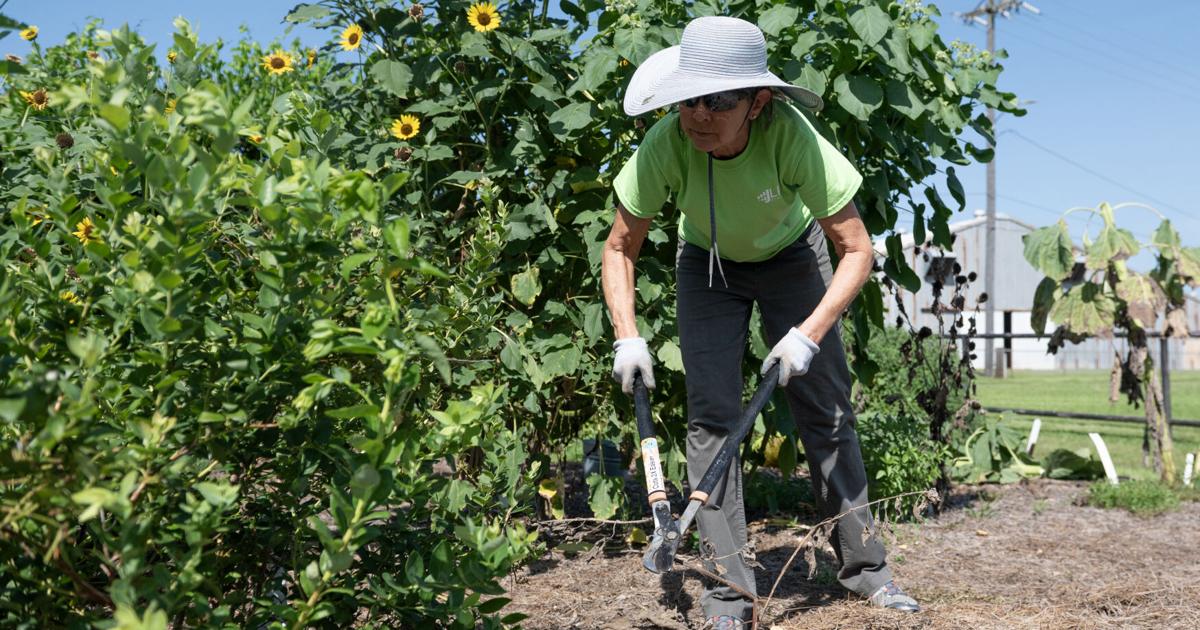
Horticulturist Bek Credeur does daily weeding in a bed with native plants.
STAFF PHOTO BY LESLIE WESTBROOK
Once is not enough
Herbicides, in some cases, may be the most practical and effective method of weed control. In the majority of situations, you will need to apply herbicides more than once for effective control. Make sure you are using the right herbicide, and then keep at it.
Two applications of a lawn weed killer (at properly spaced intervals) will generally provide better weed control than one. When controlling tough, persistent weeds, such as bermudagrass, torpedograss or oxalis, you might need to apply an herbicide numerous times, each time the weed grows back, before you begin to see improvement.
Frequent monitoring and prompt, repeated, persistent effort are critical for weed control, whether you are using herbicides or physical controls. Remember, nothing can grow in your yard unless you let it.
Understanding the language
When discussing herbicides, it’s important to learn some terms.
PREEMERGENCE HERBICIDES: Apply these to weed-free areas to prevent weed problems by killing germinating annual weed seeds. For instance, early October is a good time to apply preemergence herbicides to lawns and beds to prevent cool-season weeds that grow from October to April/May.
POSTEMERGENCE HERBICIDES: Apply these to actively growing weeds to control a current weed problem.
Volunteers cut back weeds in an overgrown area. Remember: It’s easier to pull weeds regularly than to deal with a mess all at one time.
PHOTO BY SHAWN FINK
SELECTIVE HERBICIDES: These will kill the weed but not the ornamentals or turf when applied over all the plants in an area. These are commonly used in lawns, but there are also products useful in grassy weed management in beds.
NONSELECTIVE HERBICIDES: These will kill whatever you apply them to. They are useful for killing everything in an area prior to planting. Or they can be applied specifically to weeds without getting any on nearby desirable plants.
CONTACT HERBICIDES: These only kill the part of the plant to which they are applied. They will not kill below-ground parts when sprayed on the leaves and are most effective on annual weeds. Most organic herbicides are contact types.
SYSTEMIC HERBICIDES: These are applied to the weed’s foliage and are absorbed into the plant’s circulatory system and move throughout the weed. They kill all parts of the weed, even below-ground parts (such as rhizomes or bulbs below ground), and are the best choice for perennial weeds.
What’s the situation?
Before using any herbicide, you must first carefully assess your landscape situation. The first step is determining where the weed is a problem. Is it in the lawn, flowerbeds, shrub beds, ground covers, vegetable garden or vines growing on structures or other plants? Where the weed is has a profound effect on the herbicide and application technique you should use.
Mowing alone isn’t enough. Try applying a preemergence herbicide to keep weeds from coming up in the fall.
STAFF PHOTO BY LESLIE WESTBROOK
Next, identify the weed. Different herbicides will control different weeds. If you use the wrong herbicide, you waste effort and money. Some examples of common weed categories include grasses (bermuda, torpedo), sedges (cocograss, nutsedge, kylinga), broad leaf weeds, annual weeds (warm- and cool-season), perennial weeds and vines.
Choosing an herbicide
When you go to a nursery or look online to purchase an herbicide, you need to know:
The location (in the lawn, ornamental beds, vegetable beds/food crops).What the weed is — bring some with you to the nursery or do online research.What category of herbicide you want to use: preemergence, postemergence, systemic, selective, contact.
If you intend to use a selective herbicide, you also need to know the type of lawn grass you have or the ornamentals growing in the bed with the weeds (in a bed of mixed ornamentals, make a list of the ornamentals growing in the bed to compare to herbicide labels).
With this information, you can choose the appropriate herbicide by looking carefully at the labels or talking to professionals (LSU AgCenter horticulture agents or nursery staff).
Do not ask a professional, “What can I use to control weeds in my lawn?” You must include what kind of grass you have and the type of weeds to get a proper recommendation or to choose the right product by looking at the label or to research what to use online.
It is also critically important that you completely read and understand the label of any herbicide you intend to use (read the entire label before you purchase an herbicide). If you use it improperly, you can do great damage to your landscape plants.
Comments are closed.