
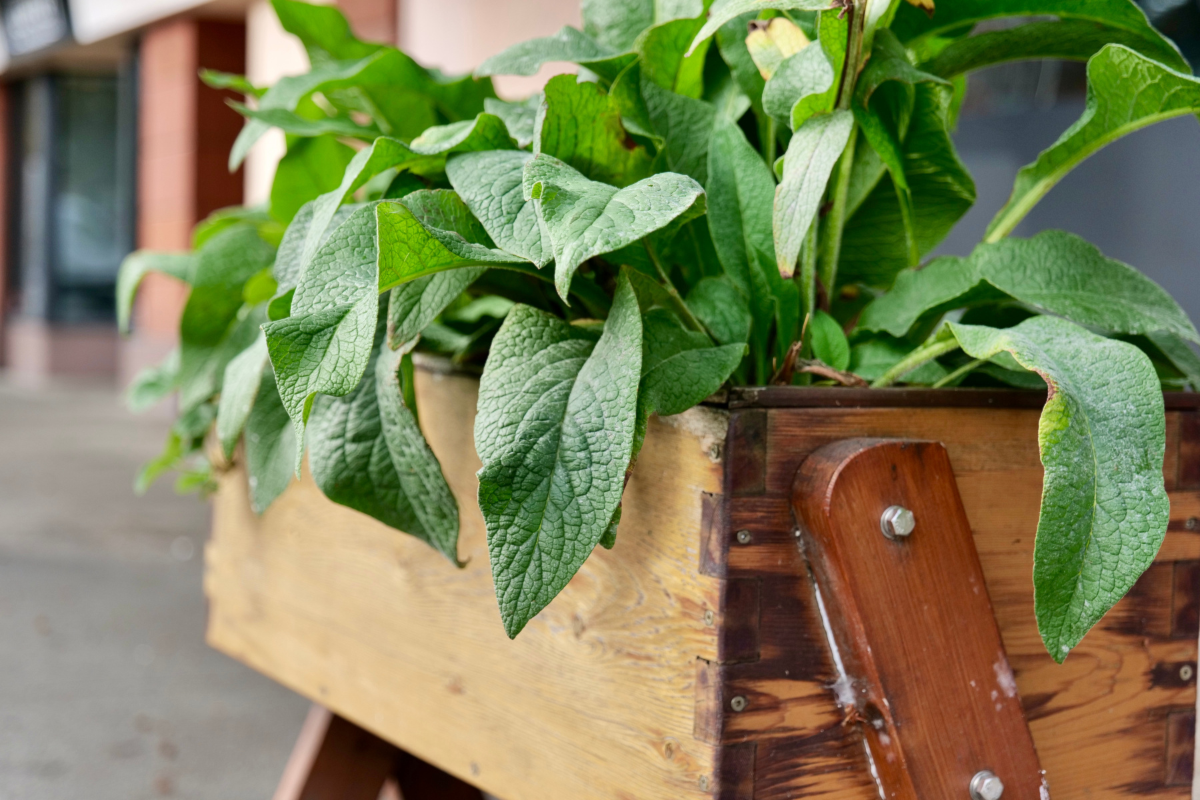
Amid the rush of traffic on Blanshard Street, a stretch of sidewalk has quietly turned into a haven for bees, butterflies, and even hummingbirds.
The Pollinator Corridor, managed by FED (Food Eco District) Urban Agriculture, is a collection of planters filled with native pollinator-friendly plants.
Instead of being just decoration, the garden is a food source and refuge for insects and birds that are critical to the region’s food systems.
By planting a mix of species that bloom at different times, the project ensures pollinators have something to feed on year-round.

One of seven planter boxes along Blanshard Street. (Tony Trozzo/Victoria News)
For Alistair Howes, FED’s special projects and engagement manager, the work is about much more than flowers.
“We’ve seen a lot of mason bees, way more than I thought were here,” said Howes. “They’re small, ground-nesting bees, and they struggle to find places in the city. To see them using the space shows how much impact even a small project like this can have.”
The project has also revealed something important about downtown ecosystems.
“You see aphids take over a plant, and then two weeks later, the ladybugs come in and balance it out,” he said. “It’s just a reminder that big ecosystems exist at the smallest level, even in the middle of the city.”
The organization, which began in 2014 with a focus on sustainable dining, shifted during the pandemic toward food production and urban gardens.
Their My FED Farm program distributed thousands of container gardens to households and community organizations facing food insecurity.
That work has since grown into larger-scale projects, like a farm at 395 Harbour Rd. that produces thousands of pounds of food each year.
Still, Howes said, the Blanshard Street garden feels special.
“Downtown, you don’t see a lot of green,” he said. “So this is about giving pollinators space, but also people a chance to interact with green space in an everyday way.”

Alistair Howes stands by the planter box on Blanshard between Broughton and Courtney. (Tony Trozzo/Victoria News)
The project hasn’t been without challenges. Planters have been knocked over, and native plants don’t always look manicured in late summer. But Howes sees those moments as opportunities for education.
“Native plants serve a purpose, even if they don’t look neat all the time,” he said. “That’s part of what we want people to learn.”
For now, seven planters line the corridor, each carrying its own mix of native species. Howes hopes to expand the project in the years ahead, adding more green space along one of Victoria’s busiest streets.
“Even a small pocket of plants can support so much life,” he said. “That’s the lesson here.”
Comments are closed.