
On a Tuesday morning in the waning days of summer, Jeremiah Thompson moves through raised beds in a garden on Milwaukee’s North Side. He leans in, wraps his fingers around a red cherry tomato — one his favorites — and twists it free. “I’m a bandit for these right here,” he says with a laugh.
Then, a few feet away, he teases up some weeds and levels the dirt back out. “As long as they keep their hands in the soil,” he tells me, “they’ll keep it off the trigger of a gun.”
Thompson is a manager of the CAGE — short for Community Agricultural Growing Experiences — community garden here in Milwaukee’s Triangle North neighborhood. He’s 25 now, but he’s been at this since he was a kid. He started showing up at Andre Lee Ellis’s We Got This garden on 9th and Ring when he was 10 or 11. It was from Ellis that Thompson first learned the saying.
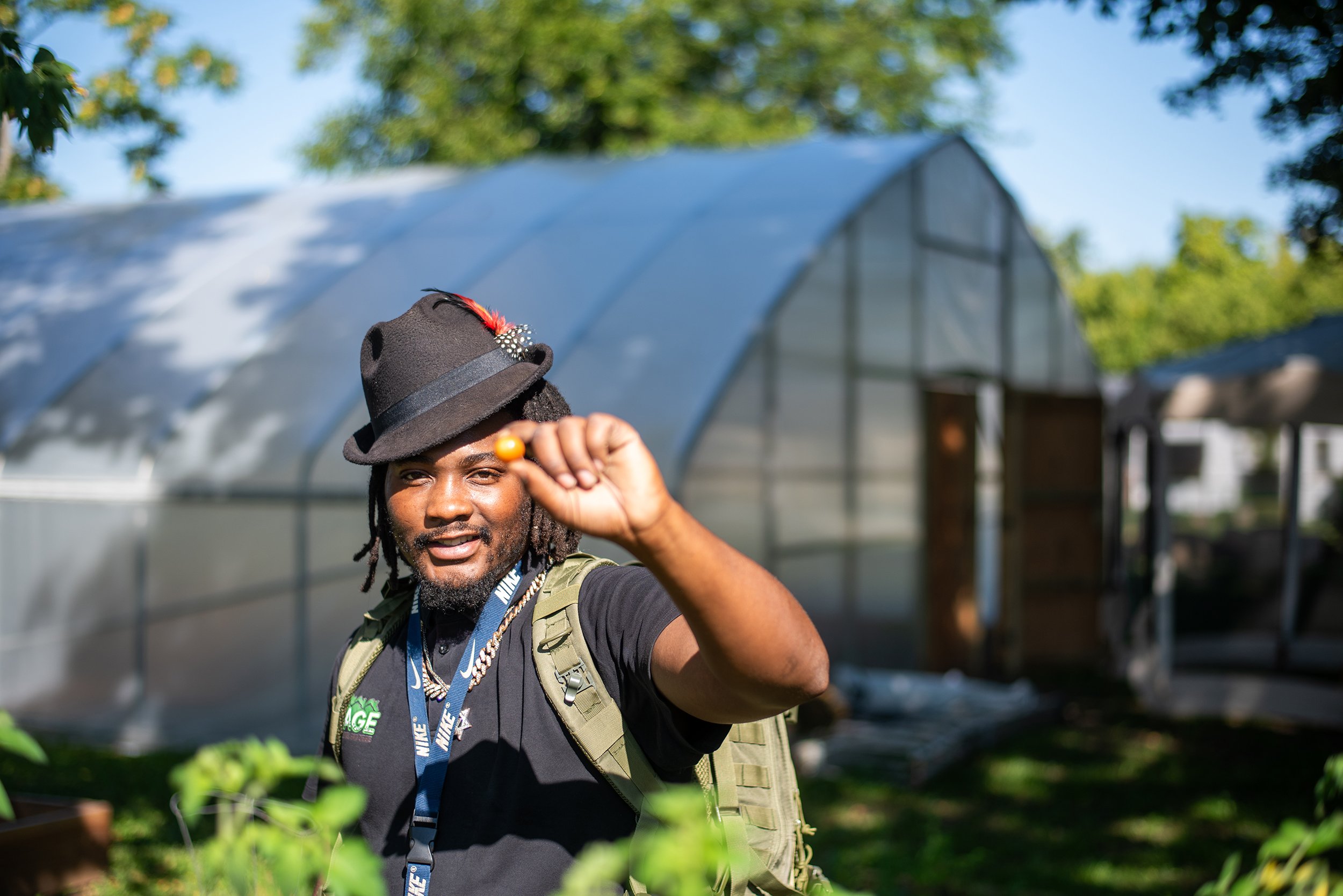 Jeremiah Thompson holds up a cherry tomato at the CAGE community garden in Milwaukee.
Chip Brownlee for The Trace
Back then, Thompson would race nearly two miles from his house to make the 8 a.m. start time at Ellis’s garden. “There was a hundred of us in that garden every Saturday from 8 to 12,” he says. “I knew about the garden when I was 9, but the program was 12 to 17. I was still trying to sneak in there, and he just saw my heart and the garden kind of cuffed me. That’s Pops. That’s the ‘Earth dad.’”
The We Got This garden is still up and running, but has been passed from Ellis to a community board. The CAGE garden, located next to — and under — a decommissioned Milwaukee firehouse that’s now used for firefighter training and fitness, is Ellis’s latest community gardening project.
Six hydroponic machines in the firehouse basement can push out a steady 45 to 50 pounds of leafy greens every month — year-round, Thompson tells me. Outside, a recently constructed hoop house will soon shelter collards and herbs. Raised boxes hold squash, peppers, tomatoes, and more collards.
 Collards growing in one of CAGE’s hydroponic machines.
Chip Brownlee for The Trace
CAGE pays teens to show up and help tend the garden — a stipend of $10 an hour, mostly on Saturdays — but the program does more than plant leafy greens. Before putting the crews to work, Thompson and a small team run them through a curriculum of skills, teaching them not only about gardening but also about life. The CAGE team hosts “Guess Who’s in the Room” talks with business owners, city leaders, and mentors; and closes with a “word of the day,” asking participants, largely young men, to speak plainly about what’s been on their mind lately. “They’ll say, ‘I didn’t know people cared for real. I didn’t know people wanted to hear me,’” Thompson said.
It’s part gardening class, part shop class, part life lessons.
“Just change their way of thinking,” he says. “If they’re thinking negative, we guide them and we help them shift it. It’s basic men life skills. You never know what heart you might catch.”
Thompson said he’s seen how a small shift can stick. “Maybe they kept a hoodie on because they’re shy or don’t feel like they belong,” he tells me. “Next Saturday, they take it off. It’s not what you do — it’s how you do it.”
CAGE team members go beyond the garden, too. They show up for teens in court, and help them get ankle monitors removed, finish probation, and apply for expungement.
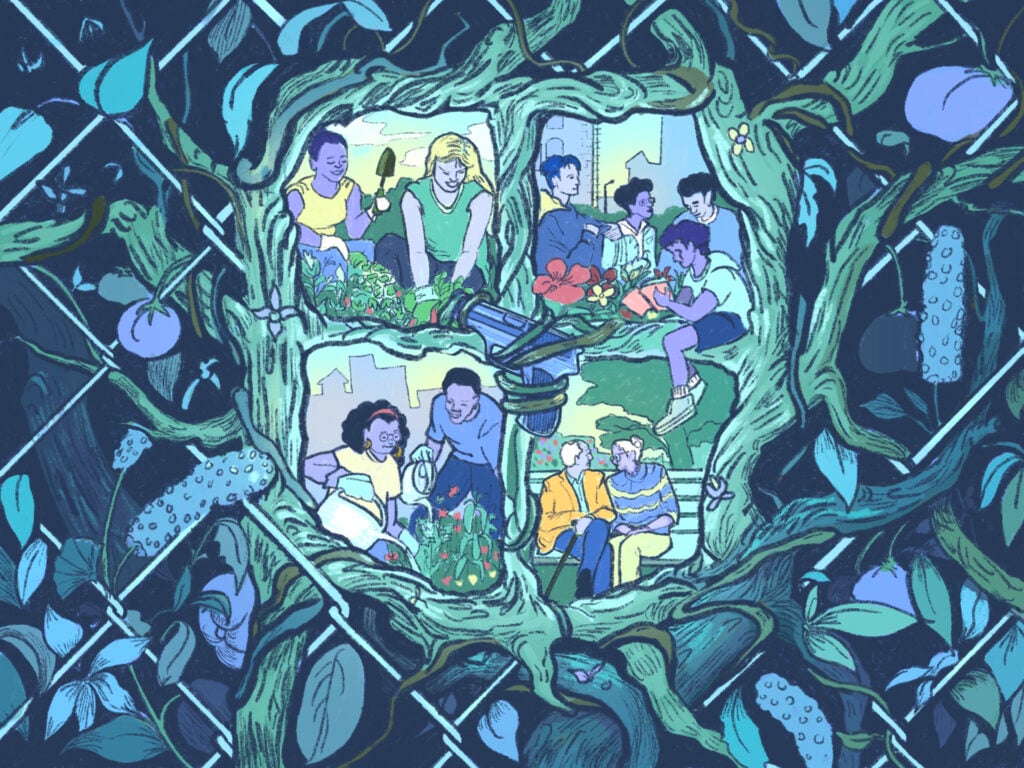
If this sounds like a community violence intervention program disguised as a garden, that’s because in many ways it is. Research has long shown that tree cover, greening vacant lots, removing dilapidated buildings, adding lighting, and other environmental improvements are scalable public health interventions that can help reduce violence.
In Philadelphia, for example, a citywide randomized controlled trial of cleaning and greening 541 clusters of vacant lots led to significant reductions in gun assaults, burglaries, and other crimes, with the largest drops in neighborhoods below the poverty line. Residents living near greened lots reported a 58 percent reduction in fear of going outside and a 76 percent increase in using outdoor space. The study also showed no sign that crime simply moved to another nearby space.
Charles Branas, an epidemiologist and gun violence researcher at Columbia University who conducted the Philadelphia trial and other studies on place-based interventions, said greening and environmental improvements should be considered a community violence intervention.
“It reduces gun violence and other nuisances,” he said. “People come out and feel better. They connect to the space, which is one reason they feel safer — by going out in general, connecting with the space, and connecting with each other. There’s good evidence for that.”
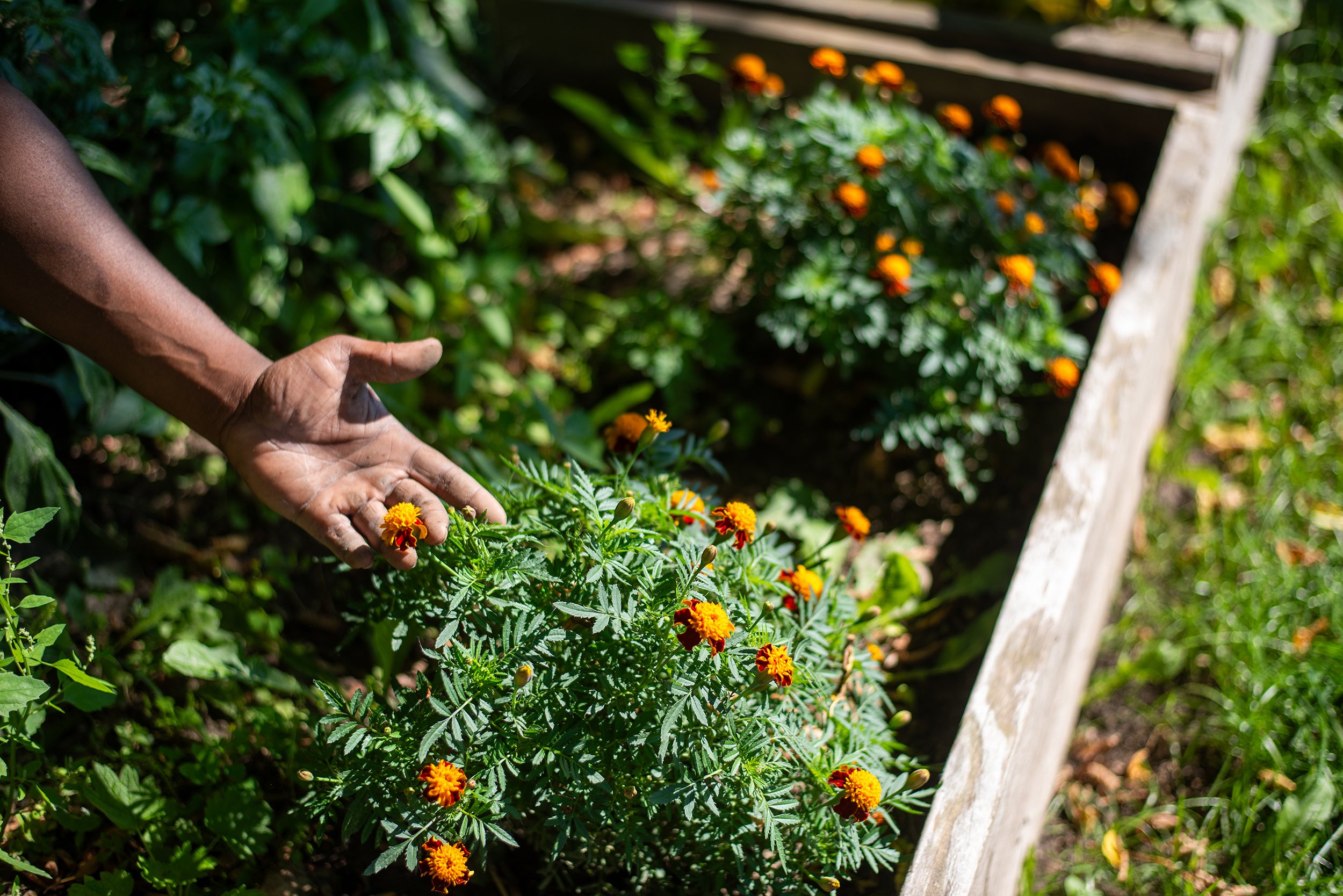
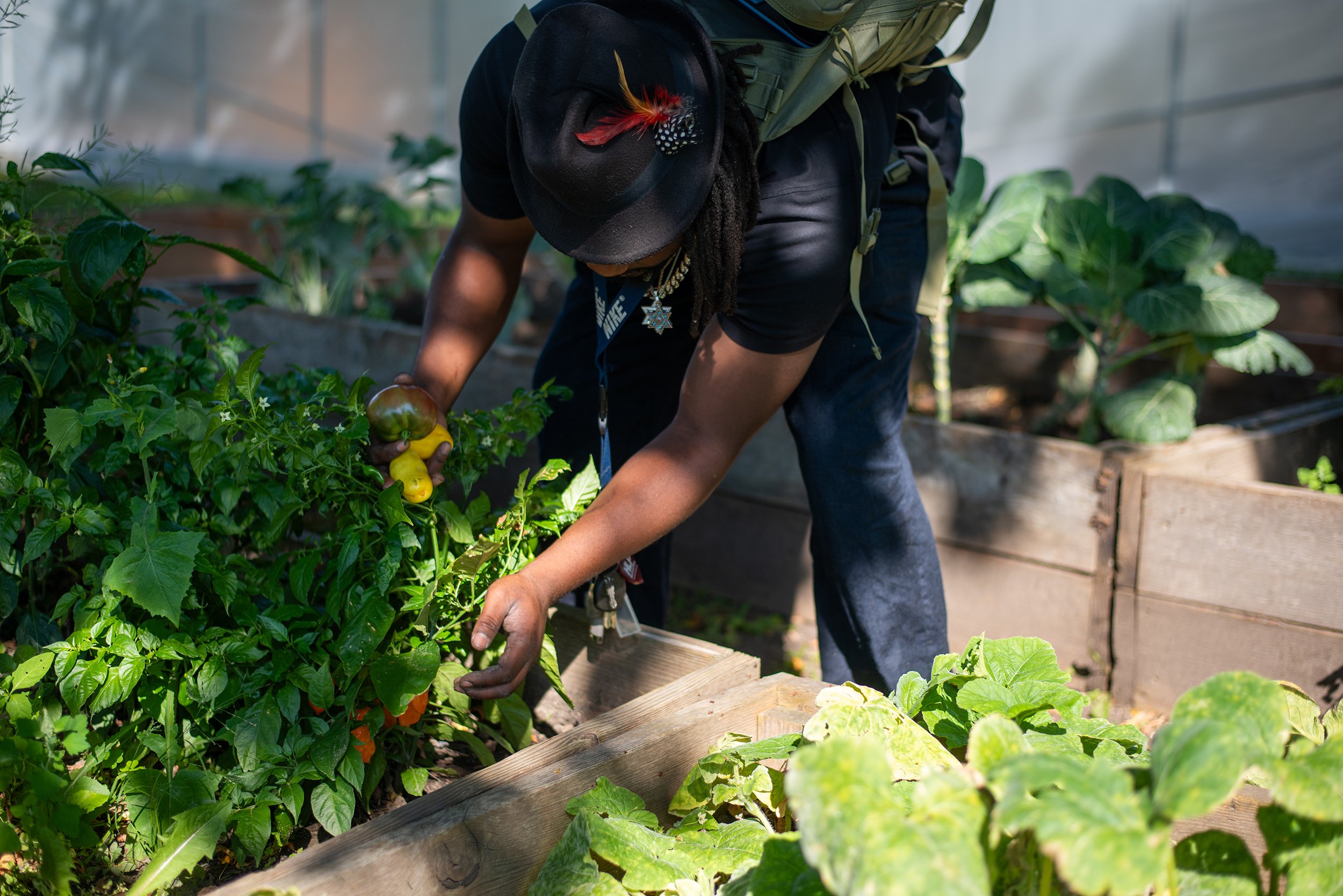
Jeremiah Thompson holds a marigold growing in one of CAGE’s garden beds and tends to a pepper plant.
The interventions were simple and cheap: remove trash, grade the land, hydroseed grass, and plant a few trees.
“It’s so inexpensive to create green space or remediate a building or add lighting,” Branas said. “Once it’s done — often within two to three weeks — the space is completely different. People’s experience of their neighborhood changes quickly, and they do not want it to go back.”
Zoom out to the national level and the pattern holds. A study of nearly 60,000 census block groups in the 300 largest U.S. cities found that neighborhoods with more greenness had lower risk of both violent and property crime, even after accounting for other factors like income, social disadvantage, policing levels, GDP, and climate. A number of efforts have taken the idea from a system-level intervention to individual gardens, explicitly connecting their efforts to gun violence prevention.
None of this is to say every green space lowers crime by default. Poorly designed, neglected parks can become magnets for problems. Branas also distinguished between general greening of a neighborhood and what often happens with some community gardens: “A fence goes up and it becomes a members-only enterprise, which isn’t what broader greening aimed for — it was intended to remain open to the community entirely,” Branas said. “Some community gardens maintain openness, but a number become more exclusive.”
Still, the evidence for environmental improvements is strong. Another large review of 45 studies on the effects of greening, parks, and tree cover pointed to declines in violent crime, including 12 studies that addressed the presence of community gardens. The signal in the research is to design for safety, openness, and belonging, and to budget for maintenance.
In Milwaukee, that’s a significant part of Thompson’s job, and he’s intent on keeping the garden going. But Thompson doesn’t talk in studies or p-values. He talks about what it feels like when a kid waters a seed, sees the first sprout, and then picks a tomato. “That’s what really gets them,” he says. “Like, ‘Dang, I grew all of that with just this little seed.’”
The garden also lets participants help neighbors around them in a city that has long suffered from the scars of redlining, disinvestment, and food deserts. Recently, the Pick ’n Save grocery store on 35th and North closed. “It’s getting tight,” Thompson says. “Our elderly are gonna have to start traveling.”
With the hydroponics buffering the winter and the hoop house extending the growing season, Thompson hopes their garden will at least help offset some of the insecurity. “There are already not a lot of grocery stores,” he says. “That’s why we grow our food for free.”
CAGE’s food goes to community members. The garden hosts pop‑up tables announced on Facebook Live or spread through word of mouth, and donates to local kitchens like Trickle Bee, a pay‑what‑you‑can vegan spot. “Grandma might be doing Sunday dinner, need a bell pepper or a tomato,” Thompson says. “They can just come and get it.”
The garden is growing other ideas, too. In the center of a spiraling path — a labyrinth to be walked for focus — CAGE is building what it calls a Healing House, a small, trauma‑informed space with ambient sound, mirrors, affirmations, books, and possibly even massage chairs, where people can decompress or get matched with someone from the team. On the way in, they’ll be able to pick flowers or build a salad from the beds.
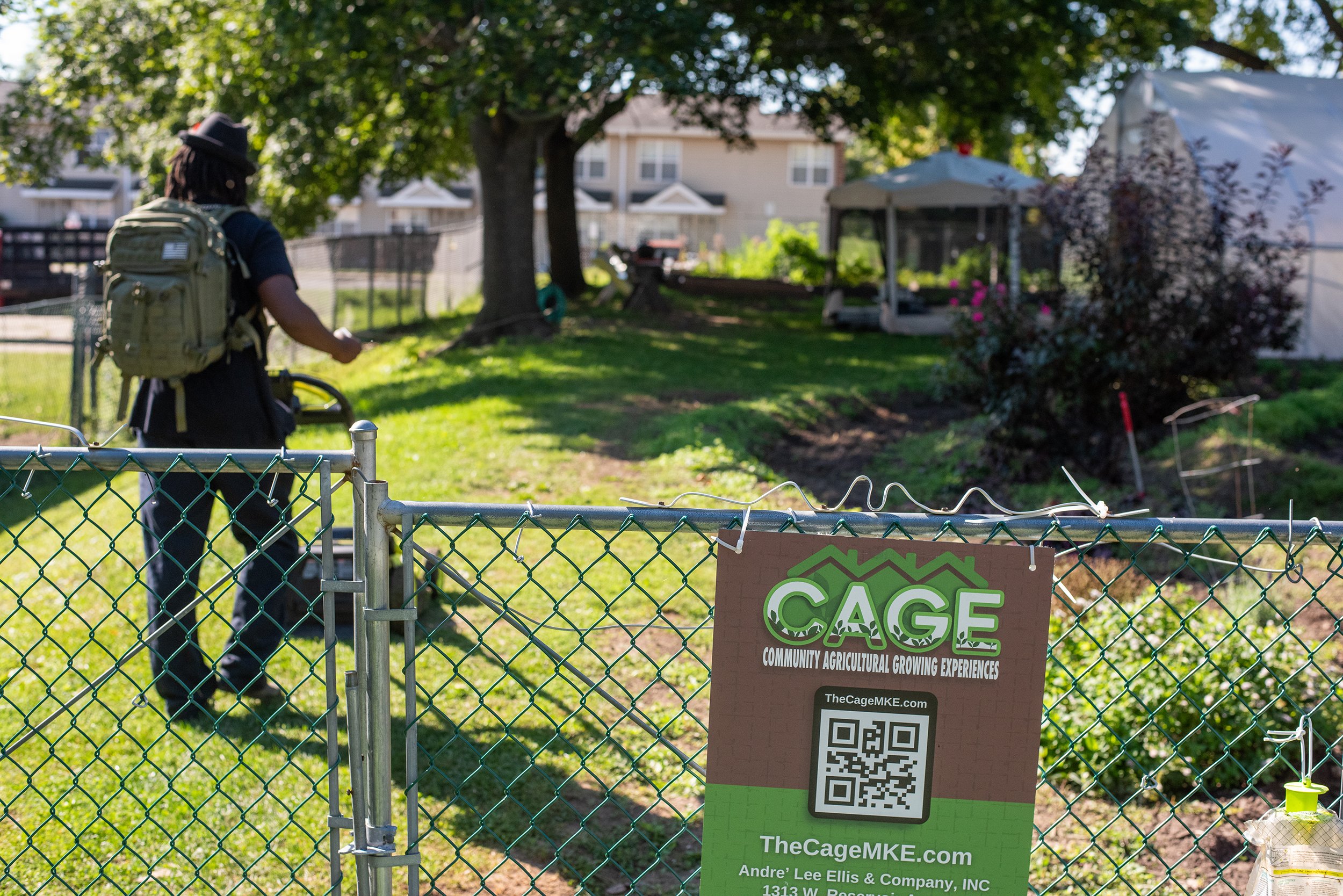 Jeremiah Thompson mows grass in the CAGE community garden in Milwaukee, Wisconsin.
Chip Brownlee for The Trace
After we talked, Thompson fired up the push mower and began cutting grass, continuing the work of keeping up the garden. For him, CAGE is a model he hopes other communities might pursue.
“We just try to grow food, grow lives, and grow community,” he said. “I think that’s the only way that the world will get better — if everyone works hard at the same thing together.”
Comments are closed.