

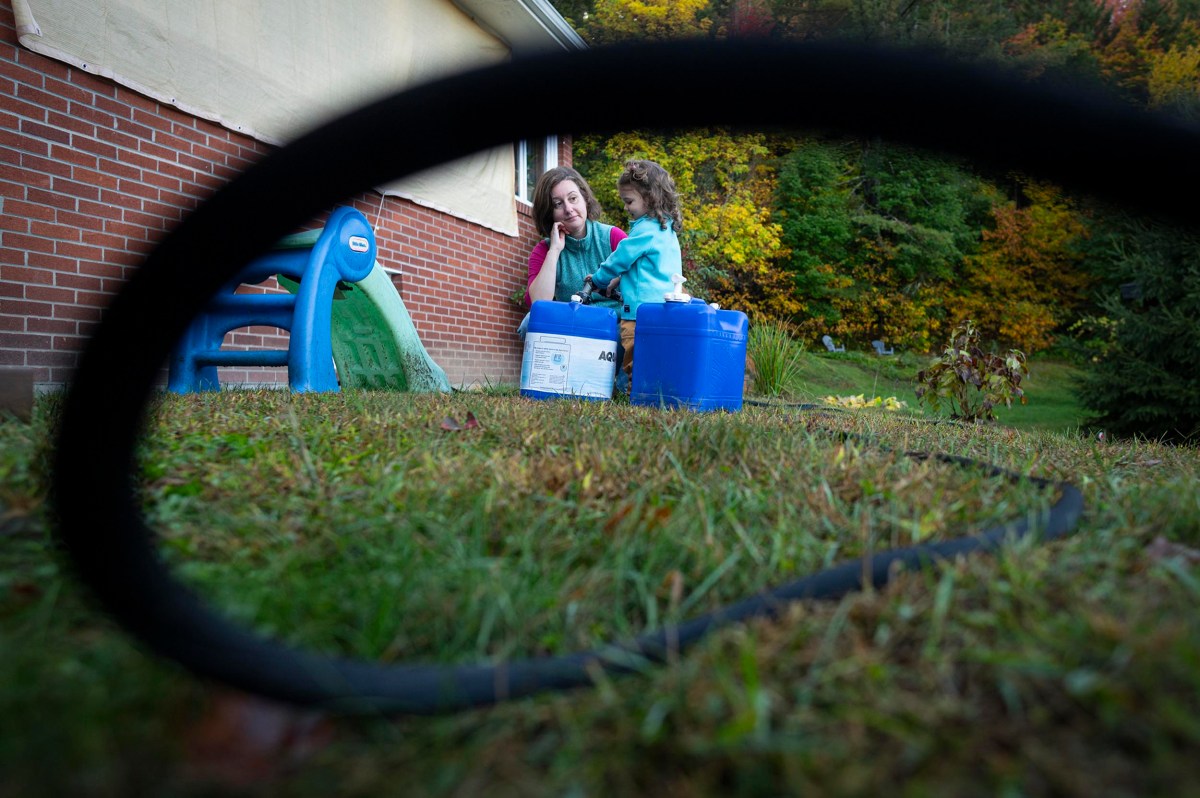
 Kelly Murch and her two-year-old daughter Rose fill 15-gallon containers with water at a friend’s home in Northfield on Friday, Sept. 26. Photo by Glenn Russell/VTDigger
A family of five in Northfield has been without running water for 12 days.
When the spring water they rely on at their home trickled to a stop on Sept. 9 because of the state’s ongoing drought, Kelly Murch said she started to call around for options.
And with three children — ages 2, 7 and 11 — it’s been “a weird time,” she said. Like living in “Little House on the Prairie,” a TV series based on a book about a 19th-century homesteading family.
At first, their neighbor helped them out by lending a large tank and his truck. With permission from the town, they filled up four times at the spigot in the community garden and paid $5 per round.
Murch and her husband ran a garden hose from the filled-up tank through a window to a big old water cistern in their basement, which is working well thanks to gravity, she said, even though it’s “not very elegant.”
Then, on Wednesday, the town turned the water off in the garden, Murch said.
Town Manager Jeff Schulz said he regretted that the community garden spigot had to be shut down. The town needed to cut the access due to fears of tampering or unintended contamination, he said, something state regulators say is a real concern.
“We need to protect the water system and should not allow for limited and unmonitored access to the system without a policy,” Schulz wrote in an email. “Thus far we have provided that resident with about 400 gallons of water and we do very much sympathize with the residents being without water.”
Luckily, Murch and her family were able to turn to a community member and friend for help. On Friday morning, they filled up the tank at a friend’s yard in town.
“I was really concerned initially,” said the friend, Sarah Eath, “because we didn’t know where they were going to get water from. And I was worried they wouldn’t be able to stay in their house.” She is glad now it’s “more of a limited water than no water” situation.
Murch and her family have to be very mindful about their water use, Murch said. They are taking their wash to a laundromat, though it is time-consuming and expensive; saving gray water from dishes for reuse; and taking really short showers. All of it is particularly hard with a 2-year-old who is being potty trained, she added. While they were teaching her to flush before the water shortage, now they are telling her not to.
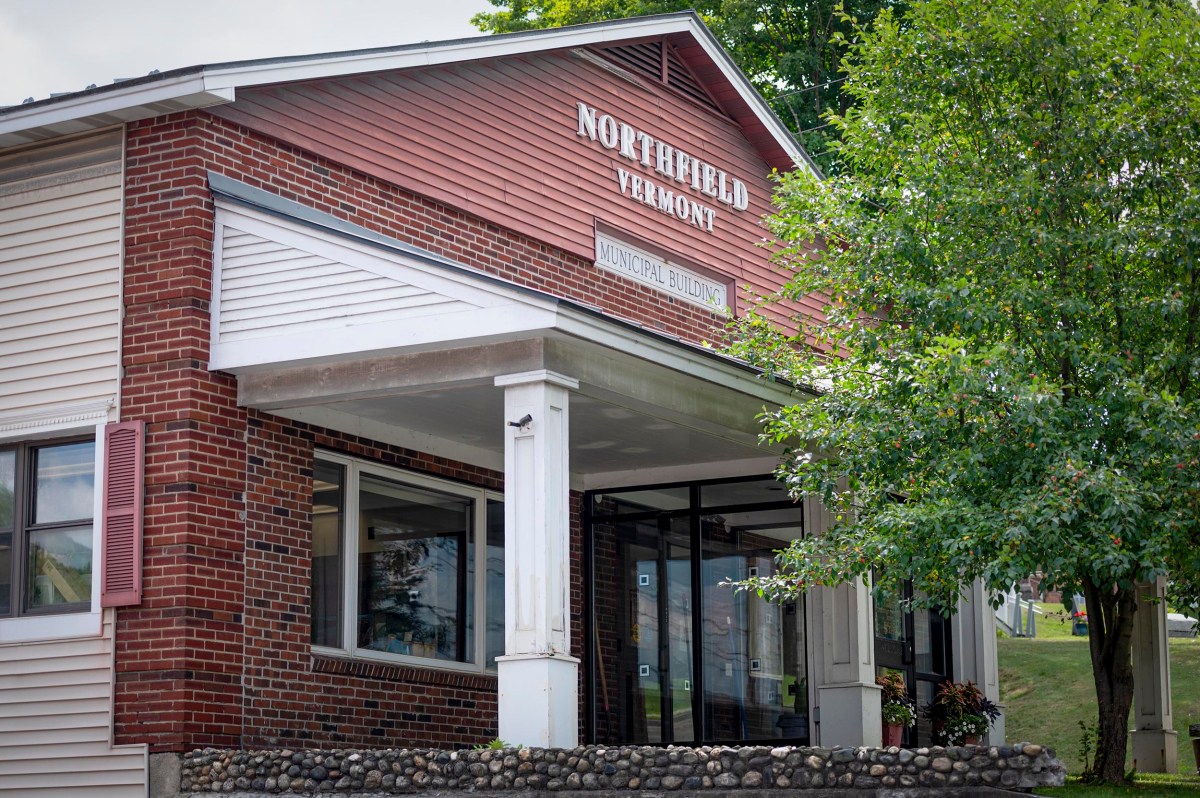 The Northfield municipal building on Friday, Aug. 1. Photo by Glenn Russell/VTDigger
In Northfield for four years, Murch is grateful she has the support of friends and neighbors. But she is worried about others, particularly older residents, who may not be as lucky and are without water during what is being called a historic drought across Vermont and the Northeast. She’s also not happy the town hasn’t been more proactive about informing residents about the drought, water conservation and options for potable water.
Murch, who worked as a disaster response instructor with the Red Cross in Washington state before she moved to Vermont, said she is shocked the town doesn’t have an emergency plan for drought in place and hasn’t better informed residents about the ongoing drought.
“Water is just so essential, you know,” Murch said. “It boggles my mind the fact that there is not an organized effort to go door-to-door and check on residents, or out-of-town people who don’t have water and don’t know what to expect because they haven’t been notified that there’s anything going on.”
According to Northfield’s All-Hazards Mitigation Plan, updated in 2023, the town does have a municipal emergency response plan but flooding — not drought — is the major focus. The 2023 document does suggest the town “should consider what, if any, actions should be considered based off best practices related to drought, mitigation, state guidance, and risk.”
READ MORE

Montpelier and Barre are among communities that have issued water conservation alerts as a result of the drought conditions playing out across the state. As of Thursday, almost 70% of the state, including Washington County, remains in a severe drought, and 24% of the state is in extreme drought, according to the U.S. Drought Monitor.
“So really being smart about reducing water use is a really big thing” for people in the drought affected areas, said Ben Montross, drinking water manager for Vermont. This applies to residents who are not having issues now because they could potentially be affected too, he said.
The state has received 398 reports of drinking water supply shortages or outages, mainly from private homeowners, according to Montross, who said this is the worst drought he has seen statewide in 12 years. Of these, 77% of the reports represent shallow groundwater meaning a spring or a dug well and 20% represent drilled wells.
He urged residents on community water systems to pay attention to notifications and guidance posted online by municipalities. Those who don’t have running water could also let their state representatives know, he said.
The state’s drought database maps at least six water outages in Northfield affecting residents who have private wells, reported between Aug. 25 and Sept. 1. Four of them are fed by spring water, two are wells.
Schulz, the town manager, said he has only heard from one — Murch. He encouraged all residents to call the town if they are facing a water scarcity problem.
On the job for more than 11 years, Schulz said he has never faced a situation where residents in Northfield have run out of water. He posted a brief advisory Monday on the town’s Facebook page asking residents connected to the town water system to be “mindful and conservative” in their water use.
“Northfield is fortunate that its water source consists of three very high yielding ground water wells and the wells continue to produce at normal levels,” the post states.
The town will discuss a policy and procedure to sell municipal water to residents or businesses at the Oct. 6 utility commission meeting, Schulz said, and address measures to ensure the public water system, which is highly regulated by the state, is protected. They will also discuss an emergency plan.
For alternate options, Schulz pointed to “a well-known source of spring water on Route 12A that is accessible to anyone at no cost” and private water haulers, which cost money.
That public source on Route 12A is hard to access with large containers, and it is also flowing low currently, according to Murch.
Fresh well water is also available from an outside spigot at the Capital City Grange, according to Merry Shernock, vice chair of the selectboard.
Meanwhile, residents facing water shortages have been stopping in to buy water jugs, 5 gallon buckets and larger water containers at a longtime hardware store in town.
“I happen to have a spring still going, but I’m hearing about (other) people having issues,” said Ray Fernandez, owner of Fernandez Hardware.
“Some of the basic stuff you can solve your problem with at the hardware store. For the rest, you have to wait for Mother Nature or wait for the drill company,” Fernandez said.
That’s another hard-to-come-by option in Vermont, according to Murch. She said she called about a dozen different contractors that dig wells in Vermont and found they are booked out months, through next year. Many of them are in Massachusetts or New York.
When she was poking around to find the cause of the water stoppage, she came across the state’s drought resources page created by the Agency of Natural Resources. She found there was funding available for residents interested in drilling a well, but there was an application deadline.
“We missed it by six days,” she said. “But we didn’t even know there was a problem until there was a problem.”
State officials said the Healthy Homes program — which predates the drought — closed on Sept. 3. They pointed to the Department of Environmental Conservation’s On-Site Loan program that does not currently have a deadline, and some other options that could help Vermont residents with water supply repairs.
Comments are closed.