
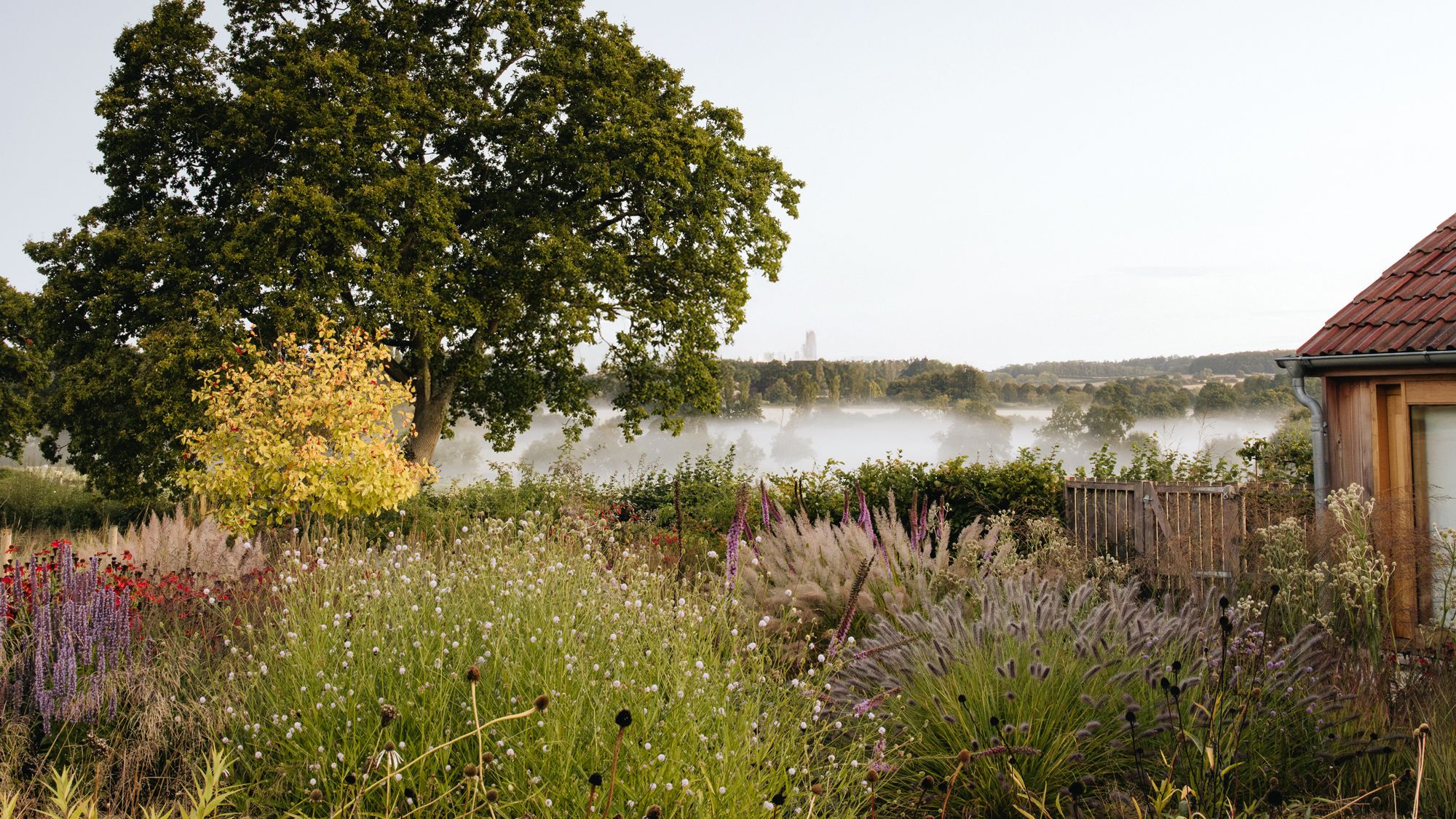
A central stone-pitcher axial path through the length of the garden maximises the view towards a mature oak tree that stands beyond the boundary. On either side of the path, steel-edged beds are planted for year-round interest, starting with swathes of bulbs in spring, but peaking in autumn with highly textural grasses including Pennisetum alopecuroides ‘Red Head’ and Calamagrostis brachytricha. These are contrasted with late-flowering perennials, all selected for their ability to hold their forms through winter: agastache, veronicastrum, helenium and amsonia are joined by spikes of Liatris spicata.
At the far end of the garden is an area used for decades by the farmer as a dumping ground. It was hard to imagine anything flourishing there, so Sheila planted it with the toughest plants, including wild roses Rosa canina, R. rubiginosa, R. rugosa and R. moyesii ‘Geranium’ that feel appropriate to the setting, but also create a protective thicket around the boundary. To make the most of the west-facing views from there, a seating area overlooks low and sculptural forms, including clipped mounds of Lonicera nitida, together with Rosa pimpinellifolia, R. glauca and R. x odorata ‘Mutabilis’, with Molinia caerulea ‘Moorhexe’ contributing more late-season colour and texture.
Sustainability is at the heart of this garden. Other than the paved section under the canopy adjacent to the house, all areas are permeable, with paths made using stone pitchers or gravel sourced within a 40-mile radius. Sculptural stone boulders came from a quarry only a mile from the house. Sheila was eager to reduce the amount of waste removed from the site (‘to assuage the guilt of having to take away so much of the old property during the build’). So concrete was cleared, crushed and partly recycled into gabions that provide a retaining wall round a parking area concealed with hornbeam hedging.
Pennisetum alopecuroides ‘Red Head’.
Eva Nemeth
The making of the garden was as low impact as possible. ‘We spent the summer of 2021 repeatedly weeding perennial nasties by hand,’ says Sheila, who does not use any chemicals. The clay soil buried under concrete for more than 50 years was lightly decompacted and improved with a low-nutrient, locally sourced mixture of topsoil and coarse sand, and annual mulching. The planting is designed largely with biodiversity in mind (fruiting trees, rosehips and seedheads that are left standing over winter all attract abundant wildlife). A patch of wildflower meadow adds another source of food and habitat for myriad creatures.
From its unprepossessing beginnings, this little slice of Wiltshire has returned to full health. ‘The planting is such a magnet for pollinators,’ observes Sheila. ‘When in flower, the trees and native hedgerow we reinstated are humming with bees and so many forms of insect life. It all feels truly alive’.
Sheila Jack Landscapes: sheilajack.com
Comments are closed.