
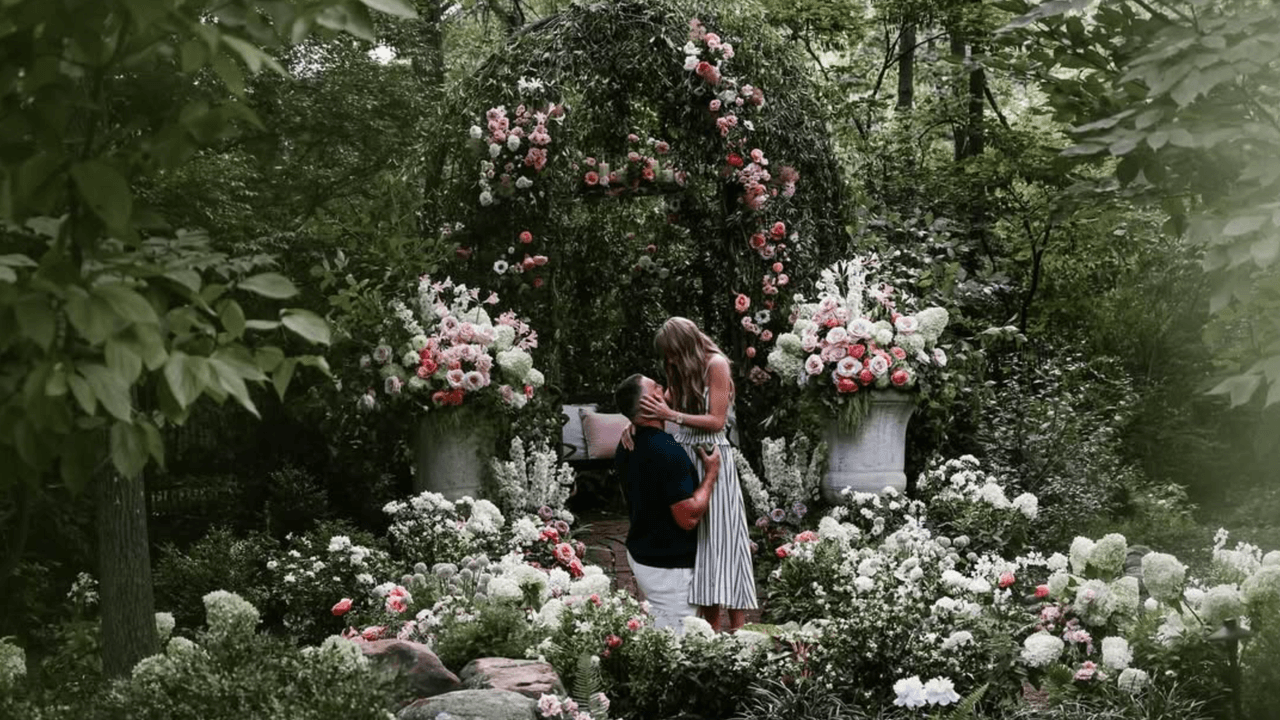
Everyone’s obsessing over the soon-to-be bride’s old mine cushion-cut diamond ring but it’s the English cottage garden in Taylor Swift and Travis Kelce’s engagement photos that has us going back for more. More joy, more romance and certainly more gardening inspo.
Why? Because we love us some Taylor Swift easter eggs and this is the most important one so far: “Chose the rose garden over Madison Square” she sang in ‘The Lucky One’, the thirteenth track on her 2012 album, Red. It’s been 13 years since; 13+13=26. Taylor’s lucky number is 13 and she announced her engagement on the 26th. Oops, we digress. And no, much as we believe in the spiritual power of plants, we’ve not labelled Taylor Swift and Travis Kelce’s engagement garden auspicious or magical. We’re just obsessed with the planting.
It’s layered but not strict; there is colour, but not too much, and what it might not have in formality, it makes up in subtle styling (no, we are not talking about that big floral chandelier). Here is everything we love – and you need to know – about recreating Taylor Swift and Travis Kelce’s engagement garden wherever you call home.
An archival photo from Smithsonian Gardens showcasing the enduring appeal of cottage gardens.
The Best Colours for a Cottagecore Garden
‘Soft’ is your keyword – and the look you want to achieve – if you want to plant an English cottage garden from scratch. Keep big, juicy colours like red, orange and loud yellow aside. Instead, focus on pastel tones – pale pinks, baby blues, lilacs and lavenders – to start with. Add shades of white, butter yellow and plants with silvery foliage. Let these plants mature for a year before adding depth with hints of deep purples and sunshine yellows, and still, only in moderation. Think of these deeper shades as focal points to draw one’s eye to something else or to elongating the sightline (and thus creating the illusion of a bigger garden) by planting them at the very back.
Don’t Overthink Your Planting Scheme
The charm of a cottage garden is that over-grown look that feels as though nature always intended it like that. We all know the simplest looks are the hardest to achieve but these pointers should help you along.
Typically you would plant your bigger plants at the back and taper down the height as you come closer to the edge of the border. Forget this rule and mix up the heights – as long as you use common sense and ensure all plants get natural light. You can use tall, wispy plants – clumped together – mixed into a low border, contrast leaf shapes and even colours. For a proper cottage garden look, plant in chunks and closer than instructions suggest. Bare soil in any garden is not a good look, however, it is prudent to leave some gaps carefully hidden between plants that take up space so that you have room to add more next year. Alternatively, expand your border by a few inches or be brave and forget the border concept altogether: create meandering gravel pathways and let your planting brush past as you walk through.
The Flowers You Need To Recreate Taylor Swift and Travis Kelce’s Engagement Garden
The foundations of any cottage garden are the classics: annabelle hydrangeas, peonies and all manner of roses, from shrub roses to climbers and those gorgeous ramblers. Use delphiniums, lupins, alliums and anemones for height, and add gaura and salvia for movement.
Comments are closed.