

It’s safe to say that green-fingered Graham Barratt from Gloucestershire, UK, knows his onions when it comes to nurturing prodigious produce, having this summer harvested a haul of horticultural titles.
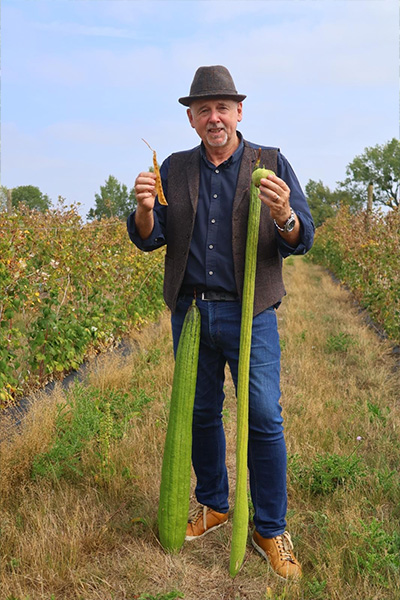
Graham told GWR that he has “been growing veg on and off for most of my life” but the competitive edge crept in just over a decade ago once he started growing his produce on a communal farm with access to a commercial polytunnel.
“Soon, I became interested in trying to compete with my plot neighbours and soon grew some big onions. The interest grew from there and I’ve been hooked ever since.”
His 2025 streak of success kicked off on 2 June with a magnificent mangetout, which measured in at 180 mm (7 in) – bigger than an iPhone 16. At more than double the size of your average snow pea, it has now been recognized as the longest pea pod.
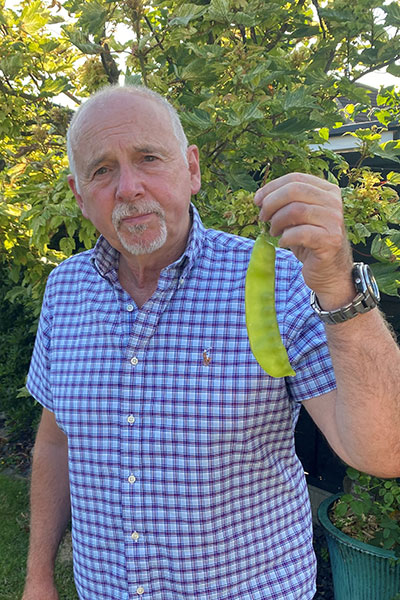
The seed came from a variety known as “JI2144”, a designation given by the John Innes Centre, a long-established plant research facility in Norwich, Norfolk, UK, where they keep a large living collection of different pea species and cultivars.
Archives indicate that this particular strain was sent over in a batch of samples from Spain in the 1970s. The giant pea pods were rediscovered within the John Innes Centre collection when one scientist by chance spotted a 165-mm (6.5-in) example growing in one of their beds in 2009, but Graham’s 180-mm monster has now exceeded even that mark.
The pea pod was assessed directly by GWR horticultural consultant Sebastian Suski, who is the head judge for the CANNA UK National Giant Vegetables Championships (the 2025 edition due to take place 26–28 September at the Malvern Autumn Show), as well as an official for global body the Great Pumpkin Commonwealth.
Suski told GWR: “Graham worked really hard earlier this year to set a new GWR title for the longest pea pod, which turned out to be the first of four incredible new records this summer. I was very pleased to verify this special record personally.
“I’m glad that Graham continues to set himself and achieve new goals – massive well done!”
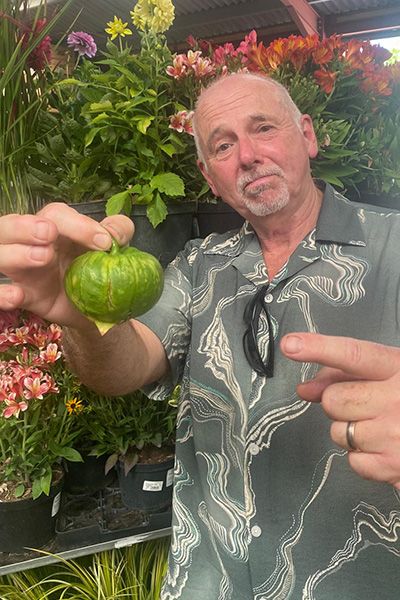
Next up on 11 July was a titanic tomatillo. Picked from a “Plaza Latina Giant” plant, a variety known for its larger fruit, the 140-g (4.94-oz) specimen presented by Graham was nevertheless exceptionally hefty – enough for it to become the heaviest tomatillo yet documented by GWR. Indeed, it is four times bigger than a typical tomatillo – a fruit widely used in Mexican cuisine that also goes by the name of husk tomato.
It’s 35% heavier than the previous holder, a 104-g (3.67-oz) tomatillo grown by Patrick Teichmann (Germany), as assessed on 31 August 2024.
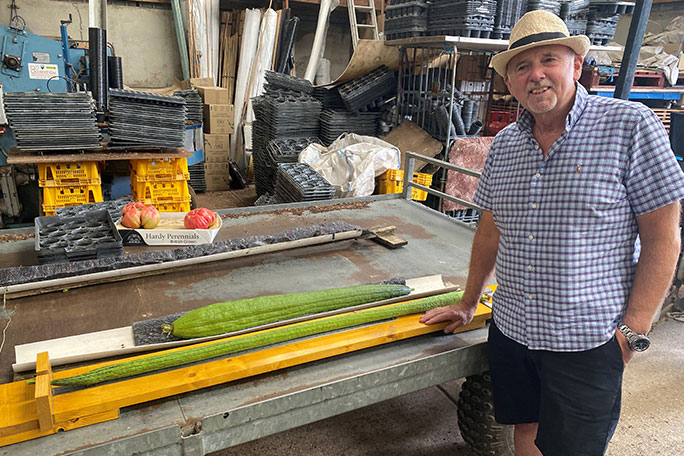
Graham wrapped up his summer of gardening glory with a double-whammy of luffa records, both assessed at the Wargrave Nursery in Berkshire, UK, on 28 July:
Longest luffa: 1.396 m (4 ft 7 in), surpassing the previous record by 10 cm (3 in)
Heaviest luffa: 2.82 kg (6 lb 3.5 oz), surpassing the previous record by 0.2 kg (7 oz)
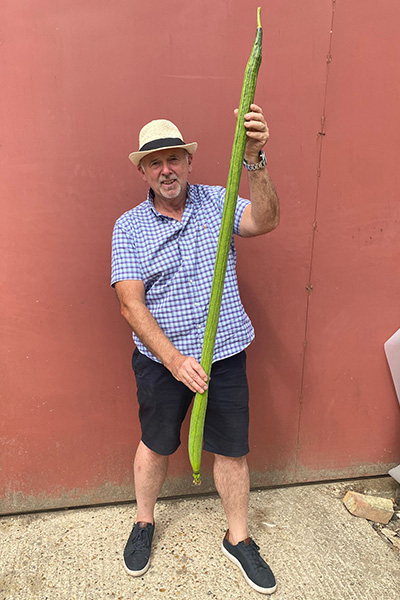
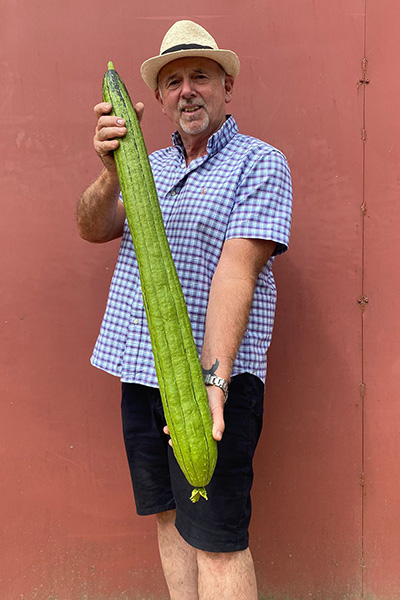
A member of the gourd family (Cucurbitaceae) which also includes pumpkins and squashes, luffas (sometimes spelled loofahs) are versatile fruits that grow on vines native to more tropical climes – particularly popular in southern Asia.
Although edible when the fruits are young, if left to mature they become too fibrous for culinary use, but do become suitable for another purpose: when dried, their absorbent, squidgy bodies make for a popular sponge, even with an exfoliating quality thanks to their slightly rough texture.

Asked if he thinks the weather in the UK has been a contributing factor to his horticultural triumphs in 2025, Graham was in no doubt: “Absolutely. The mild spring and extended warm summer has benefitted my growing, particularly as I have been growing more exotic veg, and this has definitely added to success.
“The downside is that it has matured them too soon for the shows.”
Comments are closed.