
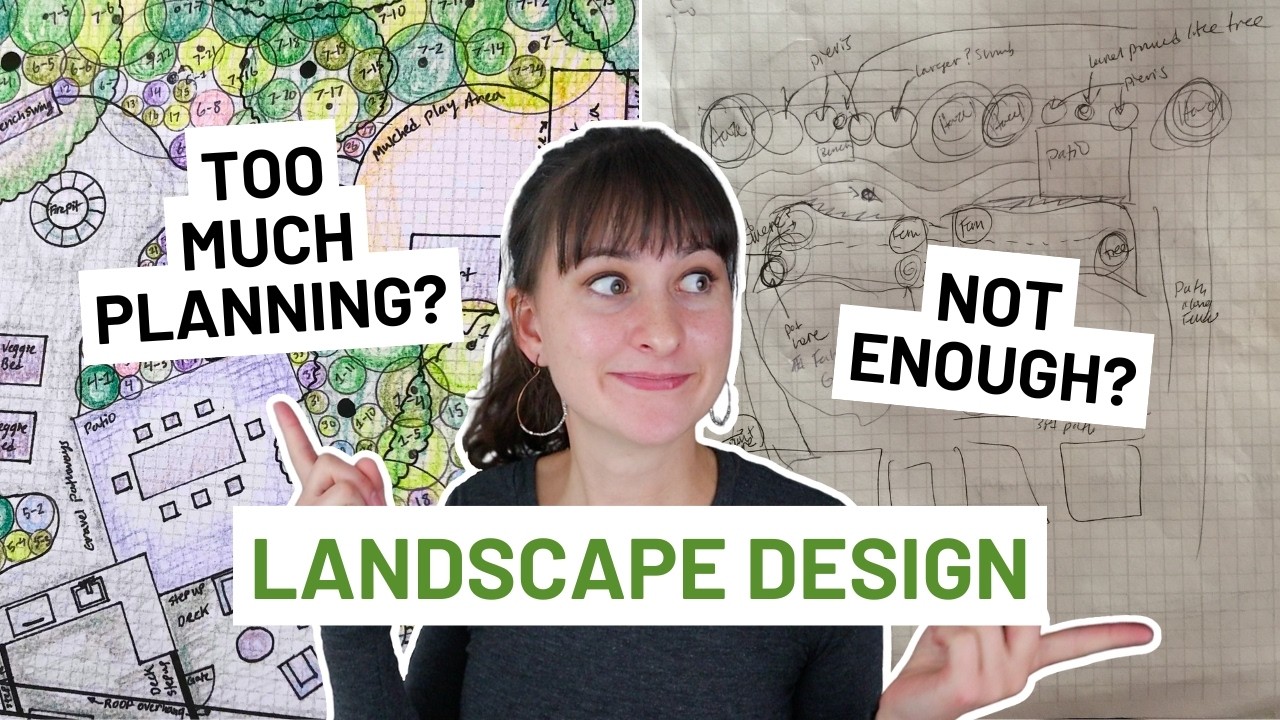
How much should you plan your yard? What is too much planning? Not enough? If you’re a do-it-yourselfer and starting a landscaping project, here are some considerations
Resources:
🪴 READY, SET, LANDSCAPE DESIGN: What you need to know to get started
🪴 RIGHT PLANT, RIGHT PLACE: How to find the right plant for a spot in your yard https://www.gardenprojectacademy.com/free-mini-course-choose-the-perfect-plant/
🪴GREEN THUMB IN AN HOUR: How to create a low-maintenance
garden bed + landscape
🪴 DESIGN-YOUR-OWN LANDSCAPE LAYOUT: How to create your own design (for beginners and do-it-yourselfers)
DIY Landscape Design Online Course: Design-Your-Own Landscape Layout
🌱 ALL VIDEOS- More DIY Landscape Design Resources: https://www.youtube.com/watch?v=nqJUJccnWHM&list=PLT4LLM91GU1vCdjFTxJ_KorHiqKuEo3jr
If you’re new here, hello! Welcome to Garden Project Academy, where I offer online courses and resources to help you have a more successful garden project, and make the world a better place with the opportunity you have to do some landscaping. My name is Eve Hanlin, I’m a certified horticulturist and landscape designer from the Pacific Northwest corner of the USA.
More ways to follow:
Newsletter: https://www.gardenprojectacademy.com/newsletter/
Instagram: https://www.instagram.com/gardenprojectacademy/
Facebook: https://www.facebook.com/gardenprojectacademy
Pinterest: https://www.pinterest.com/gardenprojectacademy/
Remember that everything in my videos is for informational purposes only: It is entirely up to you to decide what is best for you, and your landscape.
©2025 Garden Project Academy LLC
ready to transform your yard but unsure of the amount of planning that you need to do. So, if you’re starting a new landscaping or garden project, you already know the benefits of a plan. Plan prevents mistakes. It clarifies the vision, makes installation so much more efficient. And I know I’m a landscape designer. I know I’m biased. Of course, I am going to tell you that you need a plan. But I am a little bit more aware than the average person of the benefits of a good plan because people hire me to help them redo things that they’ve already done. They often wish that they had a plan right at the start. So, hiring a designer is not a requirement. The good news is you can do it yourself. Even if you’re new to gardening, but either way, whether you hire help you make it yourself, you still need to make a plan. This brings up a bunch of new questions. What goes into a plan? How much planning is the right amount? How do you know if you’re underprepared or when you’re overpreparing and you’re wasting time? That’s what I’m here to help with today. If you want to create a design for your yard or a similar space, I recommend you create what’s called a layout plan. Now, terminology can vary, but this is how I define it. A landscape design layout plan is a big picture overview of the space. It’s drawn to scale, and it plans out what will go where. So, where the garden beds or the main plantings will be, the pathways, the furniture, compost area, if you want a shed, a water feature, you know, how much space do you need to walk around these things to maintain them to care for things? How wide do you want the pathways to be or do they need to be to be practical? What’s covering the soil? Where do you need utilities or irrigation? Where will the trees be that are going to provide the privacy? I could go on. In general, it’s what will go where and why and how these things fit together. More than likely, you will not install this entire plan all at once, but it’s still really important to create a plan now of what will eventually go where and why just right at the start. The idea is that we’re creating the end vision, the future, what’s possible for this space. It’s still important even if you are only going to be able to take a baby step this year. It’s still important to create this end vision right from the start. This does not have to be set in stone by any means. You will likely make changes to your plan. It’s good to make adjustments along the way as you learn more about the space, but it’s very common for folks to do the opposite where they start installing things here and there and they plan to figure it out along the way and that’s when they end up redoing things. A good layout has a tremendous influence on the look and feel of the space, how how comfortable you are spending time in the space or how well it suits the activities, the goals for that space and the amount of maintenance or the amount of work that space will take to maintain. A good layout plan plays to the strengths of the space. No matter how small, flat, boring, sterile your yard may seem, every yard has certain characteristics that should influence the layout. A simple example of this is how the sunlight, the shadows move through the space. And maybe you don’t want your patio to be in the shadow of your house all winter, covered in frost that never melts. Maybe you want to plant a deciduous tree so that it loses its leaves in the winter and you get sun on that patio in the winter, but in the summer you get leaves, right? That are going to provide some shade in that space. So even if these were the only variables, just the how the sun moves through the space and the placement of your house or a tree, the patio, your yard is going to have tons of other attributes that can be strengths or weaknesses. And you want to place things in that space. So, you’re playing to the strengths. Weaknesses can become strengths in certain cases. Compacted soil that’s really level because there used to be a pool in a spot that’s going to be a pain to turn into a garden bed, but it’s a really great place to put something that benefits from being level and flat. You want to put a shed up, a greenhouse, a patio, a seating area. Maybe there’s spots in your lawn that aren’t growing as well as other spots. Maybe that’s the space you turn into a garden bed and you preserve the lawn in the area where the lawn’s already doing the best. When folks think about landscape design, their mind often first goes to the the colors, the textures, the materials, more of the aesthetic side of things as well as the the plants, the practical aspects of plant selection. All of this is important, but actually as a landscape designer, one of the most important steps where we spend the most time, it’s going to be on this layout. It is important to take some time to clarify generally what you want in the space, why why you want that in the space, how it will all fit together in a practical, functional, and beautiful way, all while playing to the strengths of the space. That’s a landscape design layout plan. Now, let’s talk about the details. How much detail do you need? How much is too much detail? A layout plan must be drawn to scale and it does not need to be perfect, but it should be close enough that you can actually draw out your ideas and and test things out how they’ll fit together in the space. I highly recommend using graph paper with grid lines because a common mistake is to draw out ideas on a vague or semi accurate plan where you’re like, “Oh, it’s 20 feet from here to here and then you start drawing in ideas in between.” Without this more specific indication of size, that kills the point because if you aren’t drawing things to scale, you can’t really test out that layout or envision how your ideas will fit together. You’ll think you are, but you’re not. And an example, pathway width has a huge effect on how the space looks, how functional, comfortable the space is. So, the difference between a foot and a half wide pathway, a 2 and 1/2t wide pathway is very significant. You can test things out on paper based on their real sizes, how much space you have left, especially if you’re working in a small space. This creates a record, creates a reference, it creates a place to brainstorm, experiment, test out ideas quickly. Then you have this end vision, this plan that you can hand to somebody to translate what the end vision is later. It can also make it really easy to calculate how much mulch you’ll need for a space, how much you need to order. You just count the grid lines, right? It’s a starting point for planning out installation phases. so much more. So, make a paper version. It takes a good afternoon, you know, with a tape measure outside. It’s a little bit tedious, but it is so worth the time. If you have a large space, like multiple acres or a space with really complex slopes, making a plan on paper can be a little bit more challenging, but there are methods. You can still make a layout plan. Now, if you want to just spruce up your curb appeal a little bit with a few flowers, maybe you want to improve an existing garden bed or two and that’s it. It can still be helpful to get some ideas down on paper, but in these cases, you likely don’t need a full layout plan if these are your only goals. But if you’re changing the shape or the arrangement of garden beds or or much of anything beyond that, creating a layout plan becomes helpful. Now, let’s talk about planting plans. So, once you have a layout plan, you have an idea of what you want to put where, you can use this layout plan to create a planting plan. And even when you don’t need a layout plan, like that example of just sprucing up a garden bed or two, a planting plan can still be a good idea. This is a plan for what you’ll plant where and why. A planting plan can be pretty easily turned into a shopping list, too. And when it comes to plants, again, let’s talk about how much detail, how much planning is the right amount of planning. When it comes to plants, you can design down to every plant, but I often don’t recommend this, especially at first, and this might surprise you, but especially for bigger gardens, I don’t recommend planning down to every single plant. I do recommend planning out the structural plants in detail and then the remaining filler plantings. You have a vision, a recipe, and a general plan. So, the structural plantings make up the main structure of the design. They’re the highest priority plantings. They have the largest influence on the look and feel of the space. How much mass is in the space? They also tend to be the focal points, the privacy plantings. They are also often though definitely not always the plants that take a little bit longer to get established like trees and shrubs. You should plan the structural plantings out in more detail and then the we move on to the filler plantings after that. And although filler plantings also make up an important part of the main look and feel and should be carefully selected, you know, researched so that they will thrive in that space. It doesn’t matter as much if the filler plantings end up in a very specific place. You can just freestyle with these a little bit more. If you have a smaller space, maybe you design in more detail. Maybe you make a plan for almost every plant because you’re trying to make the best use of the space you have to work with. And if you have a large space, maybe there are some areas that you plan out in careful detail and some areas where you plan in less detail. So the front garden beds, for example, you’re planning out in more detail, but a privacy hedro, you are researching the plants that go into this space, but maybe you freestyle a little bit more. Either way, even if you have a really big space though, you should still be considering the layout for the whole space. Placing features in a way that places the strengths of your space or utilizing what you already have in the best ways possible. Prioritizing is important in all aspects of landscape design. You prioritize the features that are most important. You prioritize detail in the areas that are most important and then you freestyle a little bit more when it doesn’t matter as much. You should research plants to make sure they’re a good fit for the space. But sometimes even if you do all the research, there will be plants that respond in surprising ways and there can be even unique characteristics because plants are living things. There can be unique individuals. Maybe you’ll transplant something to another spot. You’ll try something else. You should still do this research and planning, but you should also be prepared for there to be a little bit of a feedback loop. So you make an informed attempt. You see what does well and then you do more of what works, less of what doesn’t. This is normal gardening. it. Even as a professional, there are still going to be variables. There are times when I do all the research, I plant something, I’ll plant five of something and one of those five will not make it for whatever reason and then we have to respond to that. Work from there. Again, plants are living things. There can be individuals with unique characteristics. There’s so many variables. So, just know that no matter how much you plan, gardening is going to be an iterative process. You’re responding to what works. You’re revising based on that. more of what works, less of what doesn’t. You may be feeling really excited, inspired, ready to get out and do things right away, but if you feel like the design process is slowing you down, it is helpful to view this not as a holdup, but as one of the most exciting parts because you are imagining, you’re creating this end vision. And once you do, you will have these clear steps to take to get your project installed. When you do head outside and you start digging, you know where to dig. you will get to create this transformation that you’re envisioning even faster because of the time that you’re investing in the planning process. It is an investment. It’s a valuable investment, a fun one, because just a little bit of time and effort now is going to save you a lot of time and effort later just because it’s easier to erase the pathway and redraw it on paper than it is to move it in real life. So, if you want to get started today, you want some help, I created a free miniourse. It’s called Ready Set Landscape Design. It includes the first steps to take and really simple mistakes that people often make at the start of the process and it’s less than an hour long. It’s free. All you need to do to sign up is, you know, create an account like a username, password so you can keep track of your progress as you move through the course, as you watch the videos. So, there’s a link in the description below to get started. Again, it’s free and some people do get stuck in the design process because it’s fun, but usually if you are feeling stuck or if you’re feeling a little bit overwhelmed, maybe if you’re unsure your design ideas are right, if you’re unsure of the next steps, you can’t seem to get outside and confidently start digging, this means you probably need a little help. So, you’re in the right place. If you’re new here, hello. My name is Eve. I teach landscape design and gardening for do-it-yourselfers. I’m here to help you have a more successful garden project right from the start and to maybe make the world a little bit of a better place with this opportunity you have to do some landscaping. There’s a lot of opportunities for that in gardening. So, if you are stuck, please comment your questions. Check out the description below for resources like I’ve got some upcoming online workshops. I’ve got tons of on demand resources like ready set landscape design that I mentioned. I even offer a course that guides you step by step through the entire process. This is what I do. And the next video is an overview of the steps to the landscape design process. So if you want more info on what goes into creating a landscape design layout plan step by step, then be sure to watch. So, I’ll see you in the next
11 Comments
Free mini course! 🪴READY, SET, LANDSCAPE DESIGN: What you need to know to get your landscape design started
https://www.gardenprojectacademy.com/ready-set-landscape-design/
I was so excited to see you in my feed. Love your videos, especially as a new gardener.
Having a plan, also allows you to play around with different options without anything permanent happening.
When I moved into my home 2 years ago, I took measurements and then sketched out where I wanted beds as close to scale as I could. I then decided the 'theme' of each bed (pollinator, fruits, natives, pond, etc). And that's sort of where I stopped in planning. I have a hard time picturing plants in their maturity and how they work with other plants. I figured from the plan where to put trees, but didn't know which trees I wanted. In the two years since, I have added a LOT and editted some things back out or moved them as needed. And I know that as my 3 to 5 ft trees grow, there's going to be even more editting as I will be able to eventually add shade plants that I currently can not put in.
But as a DIY gardener, I find it helpful keep that initial layout plan near at hand to make sure I don't get lost in what to do next… or put a shrub/tree where I intend to put hardscaping. And yeah, the plan has evolved too as I have lived with the yard, but not much.
Edit: Feeling like a bit of a lunkhead now. Admittedly, I commented while sitting in a dentist office where my data was so slow I couldn't really watch the video. Only to then finally get to watch the video and hear what I said was already covered…
This couldn't have appeared at a better time. I have bought my first house and every man and his dog has a "helpful" suggestion. I am discovering that I need a firm idea of what I want so that I can communicate this without getting railroaded.
Is there a less manual way of laying this out than the amount of drawing required through that plan you drew up? In 2025 with AI options, it seems like a layout plan based on an uploaded plot plan or an aerial photograph seem like much faster ways of playing around with options. I'm just not aware of which options to use with this.
I LOVE this channel! Im so glad I found it ✨️.
Yay! A new @gardenprojectacademy video!
Thank you for this video on this topic! Your lessons are always helpful and inspiring!
Does the course include how to use the grids of the graph paper for this purpose, …does each square represents 1 ft or something else, including what size circles you're using to reference different radius sizes for each plant type?
I love your videos. You have great tips, and I love that you encourage native plants, too, while also giving general design tips.