
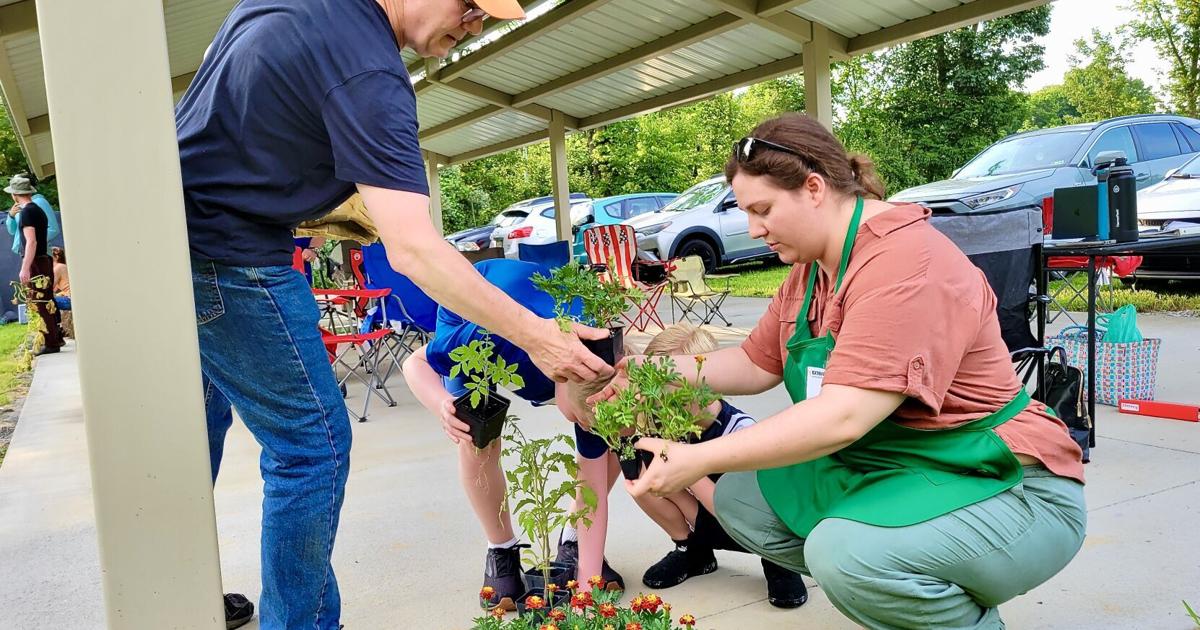
MARTINSBURG – The largest group, to date, of bug and gardening lovers joined together in the Garden of Promise pavilion to attend the workshop, “Good Bugs vs. Bad Bugs: What is Beneficial and What is Not,” on Tuesday night.
According to Garden of Promise Manager Brian Hairston, the workshop was part of a series held at the garden throughout the growing season. Last year, the series featured two or three different events. That number will increase this year, with the inclusion of workshops related to gardening-adjacent topics, like bugs and canning, as well as topics unrelated to gardening.
“In the future, we’re looking to have workshops of all kinds here to strengthen the family – not just about gardening,” Hairston said, mentioning one of the workshops held last year, offered by the Martinsburg Initiative, kicked off this new focus on families.
While many families do not garden, they can certainly use gardening to develop stronger relationships with each other and their community. This has proven to be the case for Maryse Biernat, who moved with her husband from Arizona to Martinsburg two years ago, to take advantage of the Ascend West Virginia program, which offers a $20,000 benefits package to remote workers that move to the state.
The couple enrolled in WVU Extension’s Master Gardener training program at the beginning of the year. Now, halfway through the 40-hour internship required to become certified Master Gardeners, they have found great joy in gardening together and connecting with others through gardening events.
“This is the first place where we’ve been able to have a garden,” Biernat said. “We bought our first house here, with a little bit of land. We wanted to have a garden there. When we found out about the Master Gardener program, we knew we wanted to do it, to learn how to take care of our own garden and become more involved with our local community.”
Biernat, who is a remote, adjunct professor for Rio Salado College in Phoenix, Arizona, loves teaching. So, she wanted to find a way to use some of her Master Gardener service hours in an educational capacity by offering a free workshop on the bugs that are beneficial and detrimental to gardening. Together with Master Gardener Marilyn White, she developed the workshop on “Good Bugs vs. Bad Bugs: What is Beneficial and What is Not.”
Focusing on “good bugs” – minute pirate bugs, praying mantises, ladybugs, lacewings and hornworm parasitoid wasps – and “bad bugs” – flea beetles, squash bugs, aphids, tomato hornworms and squash vine borers – the workshop helps people appreciate the ecosystem and understand why a thoughtful approach to bug elimination is essential to a thriving garden.
“It’s wise not to use insecticides or pesticides in your garden,” White said. “One of the mornings that I was out dealing with the squash bugs, I saw that there were pollinators down in my squash blossoms. If I had used insecticides and pesticides on the squash bugs, I could very well have killed the things that were good – that I wanted.”
She added that she and Biernat would love to give this presentation again.
“We’ve never held this before,” White said. “If a library wants the presentation or a garden club or a school or a community garden, they can just call WVU Extension and we can set it up.”
To contact the WVU Berkeley County Extension, call 304-264-1936 or visit https://extension.wvu.edu/berkeley.
To learn more about upcoming events at the Garden of Promise, visit its Facebook page or website, at https://www.gardenofpromisewv.org.